























ZWO FF65 APO Refractor: A Compact Full-Frame Astrograph
Feb 11, 2026
Soumyadeep Mukherjee
Soumyadeep Mukherjee is an award-winning astrophotographer from India. He has a doctorate degree in Linguistics. His work extends to the sub-genres of nightscape, deep sky, solar, lunar and optical phenomenon photography. He is also a photography educator and has conducted numerous workshops. His works have appeared in over 40 books & magazines including Astronomy, BBC Sky at Night, Sky & Telescope among others, and in various websites including National Geographic, NASA, Forbes. He was the first Indian to win “Astronomy Photographer of the Year” award in a major category.
Share:
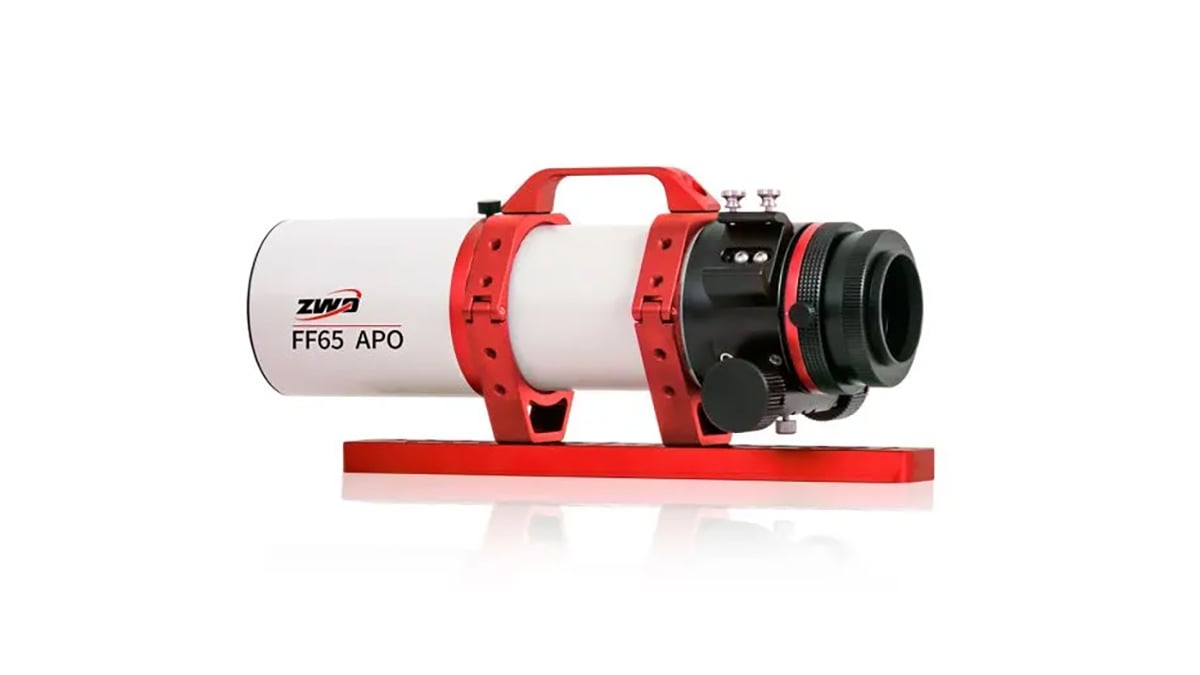
Deep-sky astrophotography looks for tight star profiles, controlled chromatic aberration, and a flat focal plane across increasingly large sensors. As full-frame astronomy cameras become common, optical systems must correct field curvature without mechanical complexity. The ZWO FF65 APO addresses this requirement through an integrated quintuplet apochromatic design with built-in field flattening. ZWO engineered this telescope as a dedicated flat-field astrograph.
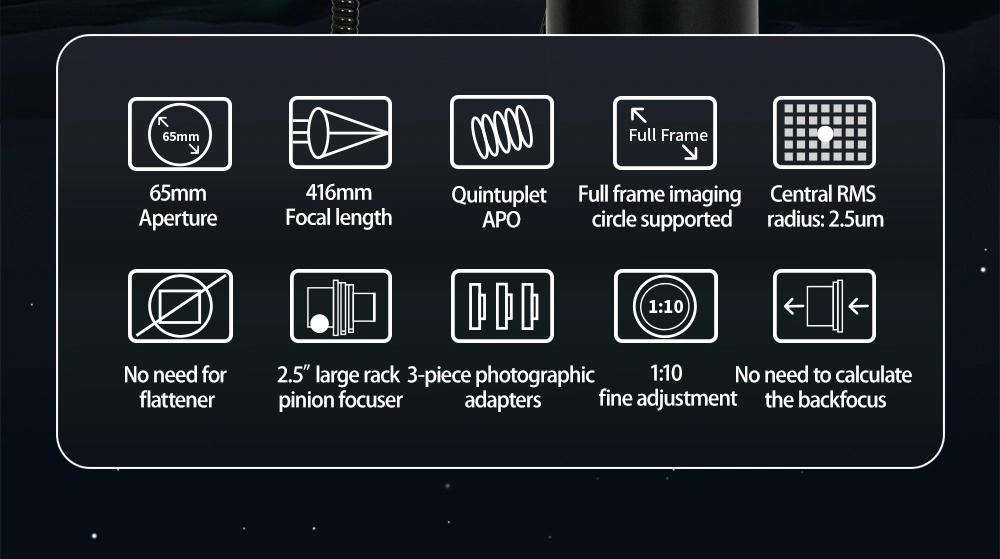
The FF65 APO combines a 65 mm aperture with a 416 mm focal length and an f/6.4 focal ratio. It delivers a 44 mm image circle, which supports full-frame sensors without requiring an external flattener. ZWO integrates the corrective optics into the primary lens group, simplifying system configuration and reducing spacing errors. As a result, the telescope functions as a coherent imaging platform rather than a modular optical assembly.
Integrated quintuplet optical architecture
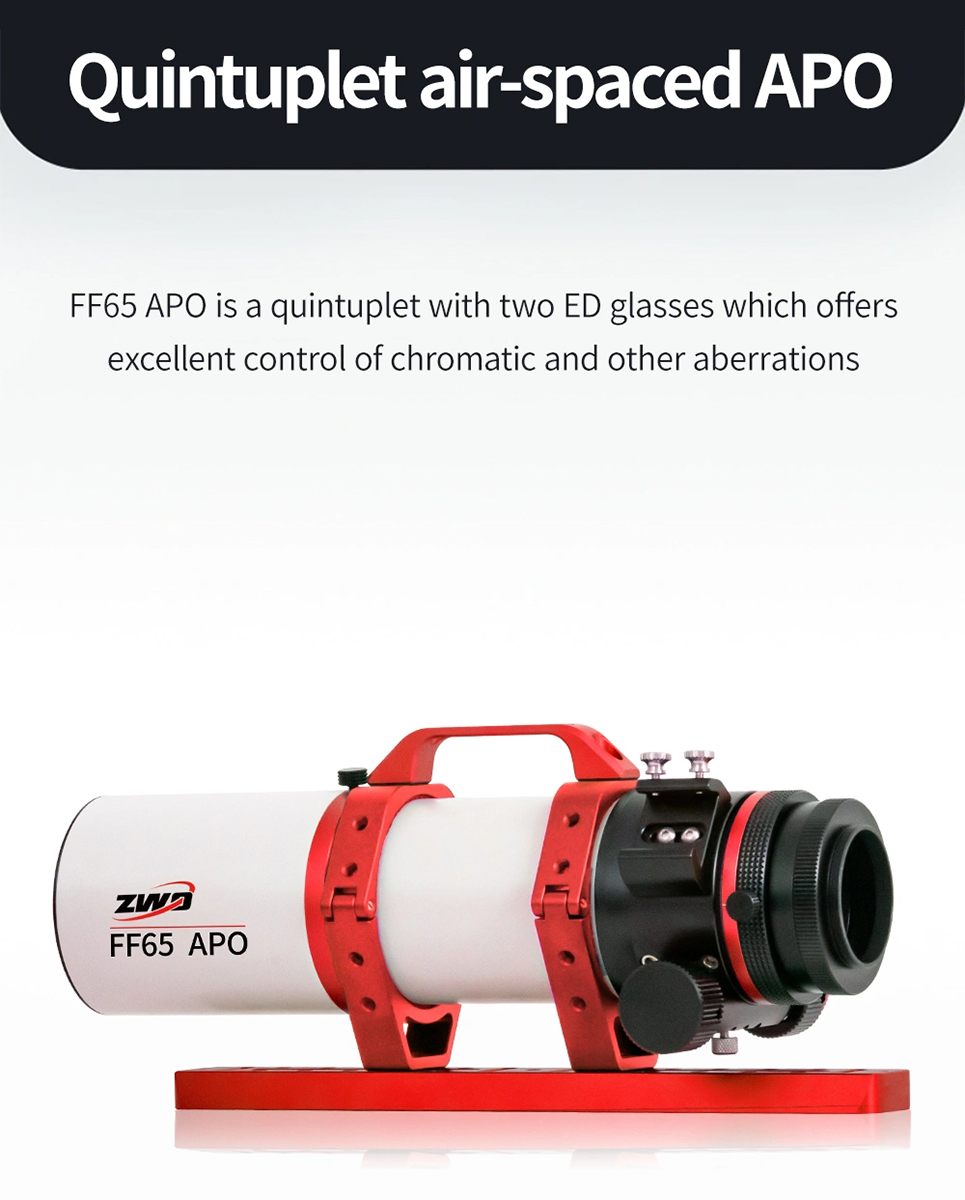
The FF65 APO features a five-element, air-spaced apochromatic lens system. ZWO incorporates two extra-low dispersion elements within this configuration. These ED elements suppress secondary spectrum and reduce chromatic aberration across the visible band. Consequently, the telescope maintains tighter star profiles and more accurate color reproduction during broadband imaging.
Unlike traditional triplet refractors that require a separate field flattener, the FF65 APO integrates a dedicated field-correcting group within the optical path. This internal correction produces a flat image plane across a large diameter. Therefore, users do not need to calculate or fine-tune flattener spacing. The optical design itself defines the correct geometry.
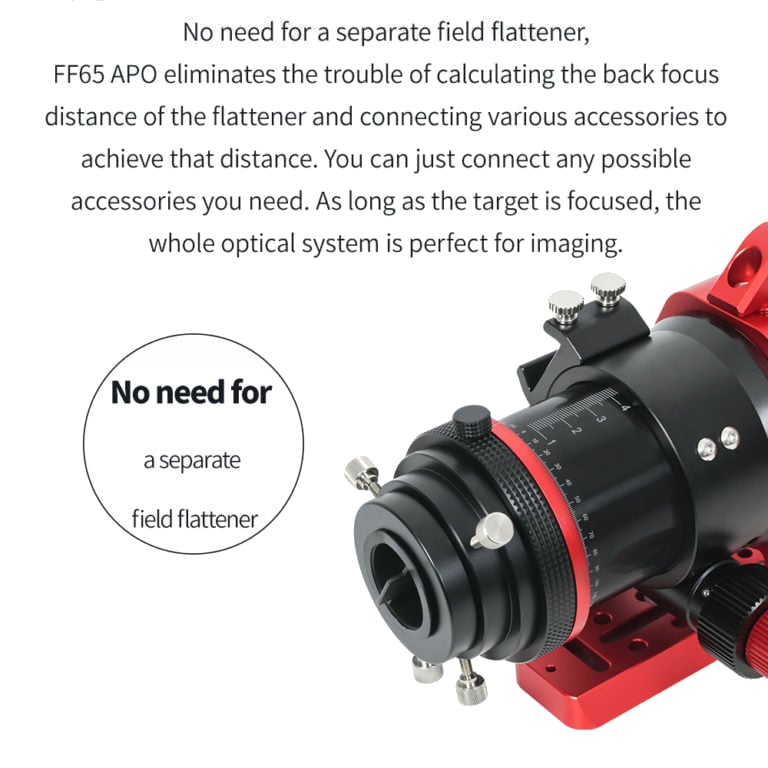
The specified 44 mm image circle reflects this design choice. A 44 mm corrected field comfortably covers full–frame sensors. Edge stars remain controlled, and field curvature stays minimal within the designed backfocus range. In practical imaging terms, this means astrophotographers can attach a full-frame camera and expect consistent performance across the sensor.
ZWO applies full multi-coatings to the optical surfaces. These coatings improve light transmission and suppress internal reflections. Improved transmission increases efficiency during long integrations. Reduced reflections enhance contrast and help preserve faint detail in nebulae and star fields.
Focal length, speed, and imaging scale
The 416 mm focal length defines the imaging character of the FF65 APO. It places the telescope firmly in the wide-field category. This focal length captures extended emission regions, large nebulae, and dense star fields with ease. It frames broad celestial structures without excessive cropping.
At f/6.4, the system balances speed and correction. Faster systems can introduce stronger aberrations if not carefully controlled. Slower systems demand longer exposure times. The FF65 APO occupies a moderate position between these extremes. It gathers sufficient light for deep-sky work while maintaining stable optical correction across the field.
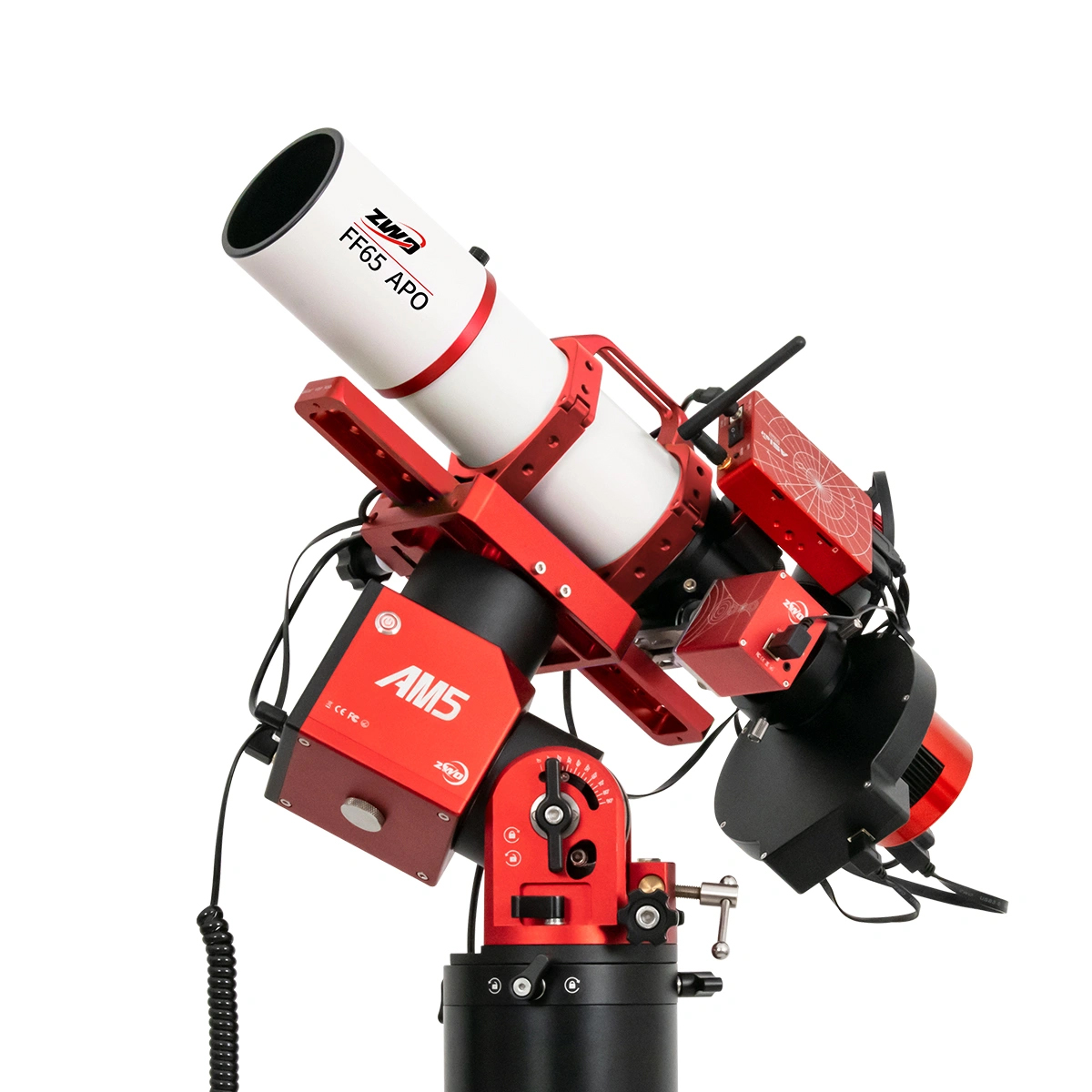
Moreover, the moderate focal length reduces sensitivity to tracking error. Mount imperfections become less pronounced compared to longer focal length instruments. As a result, the telescope pairs well with compact equatorial mounts and harmonic drive systems. Its optical performance does not depend on heavy, high-capacity mounts.
The 65 mm aperture may appear modest on paper. However, wide-field astrophotography often prioritizes framing and flatness over sheer aperture. In this context, the FF65 APO provides adequate light collection while preserving portability. It focuses on capturing expansive celestial regions rather than magnifying small targets.
Mechanical design and focuser system
Optical precision requires mechanical stability, too. ZWO constructs the FF65 APO using CNC-machined aluminum components. The tube assembly maintains alignment under load and resists flexure during long exposures. Structural rigidity affects star shape and focus stability.
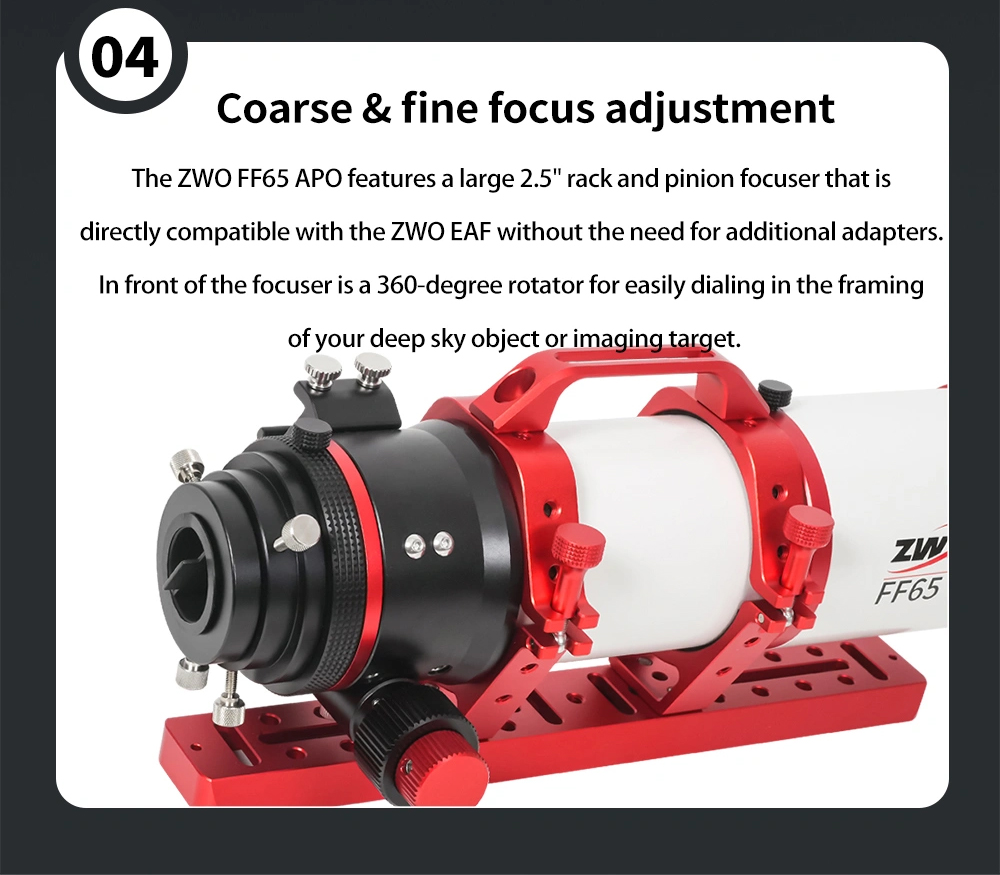
The telescope features a 2.5-inch dual-speed rack-and-pinion focuser. This design supports heavier imaging trains compared to basic Crayford systems. Astrophotographers often attach cooled cameras, filter wheels, off-axis guiders, and tilt plates. The rack-and-pinion mechanism maintains alignment under this weight. The dual-speed system provides both coarse and fine focus adjustment. Fine focus control becomes critical at f/6.4, especially with modern high-resolution sensors. Even minor focus drift can enlarge star profiles. The fine adjustment knob allows precise control during focusing routines.
Additionally, the focuser assembly includes a built-in 360-degree rotator. This feature enables accurate framing of targets without loosening threaded connections. Users can rotate the imaging train while maintaining mechanical integrity. This capability simplifies composition, particularly for extended nebulae that require specific orientation.
The optical tube weighs approximately 2 kilograms. This low mass supports portable imaging setups. It reduces strain on mounts and encourages field deployment under dark skies. Despite its light weight, the telescope maintains mechanical robustness.
Backfocus design and system compatibility
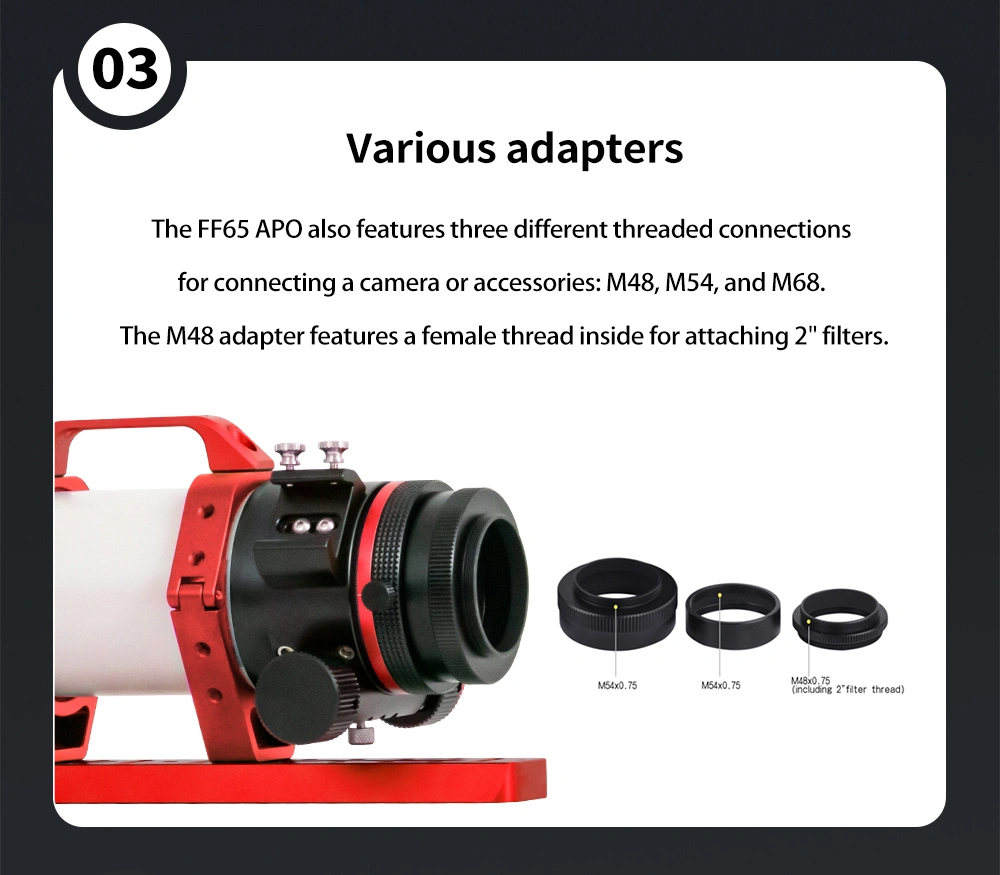
Because the FF65 APO integrates its field correction, the backfocus configuration becomes more straightforward. ZWO specifies the required distances clearly in official documentation. Users attach cameras through standard threaded interfaces such as M68, M54, and M48. These connections reduce tilt and mechanical play compared to slip-fit adapters.
Threaded integration improves repeatability. When users disassemble and reassemble their imaging trains, they return to consistent alignment. This predictability matters during multi-night imaging projects.
The defined backfocus distances allow direct integration with filter wheels and cameras without experimental spacing. Consequently, setup time decreases. Beginners avoid confusion, while experienced imagers benefit from reduced troubleshooting.
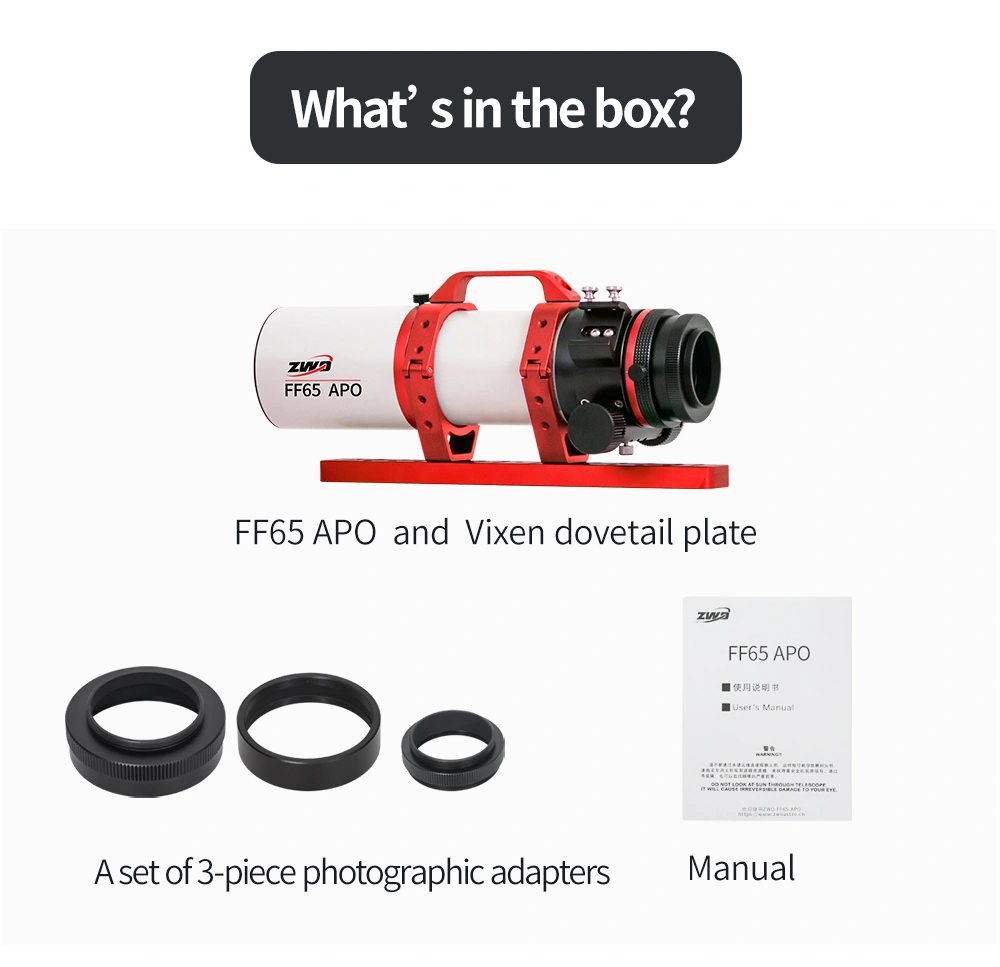
Although ZWO designs the FF65 APO to complement its own cameras and accessories, the telescope remains brand-neutral. The standard thread sizes ensure compatibility with third-party components. This flexibility broadens its application within diverse imaging ecosystems.
Key specifications, price, and availability
Here are the key specifications of the ZWO FF APO refractor:
| Focal Ratio | f/6.4 |
| Optical Design | Refractor |
| Number of Refractor Elements | 5 (Quintuplet) |
| Focal Length (mm) | 416 |
| Image Circle | 44 mm |
| Focuser Style | Rack & Pinion |
| Focuser Size | 2.5″ |
| Focuser Speed | Dual Speed |
| Telescope Outer Diameter (in.) | 3.66 |
| Refractor OTA Length – Extended (in.) | 16.5 |
| Refractor OTA Length – Retracted (in.) | 12.9 |
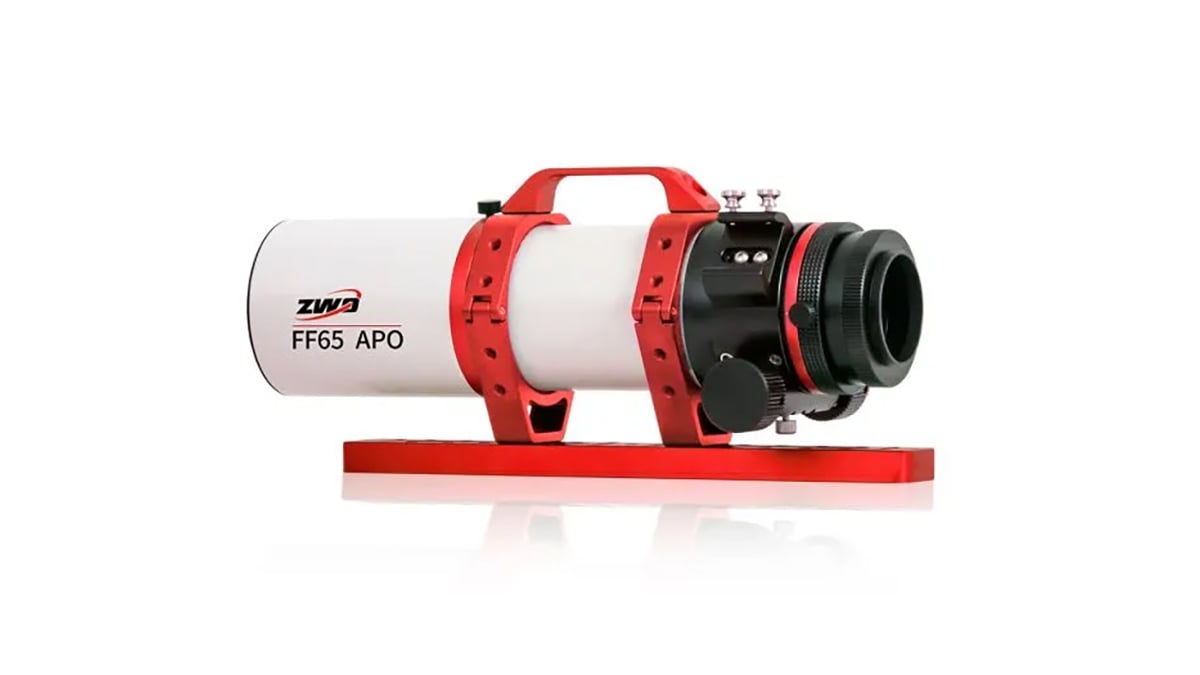
The refractor is priced at $899 and is available for ordering.
Order ZWO FF65 APO at High Point Scientific for $899
The FF65 APO excels in wide-field deep-sky imaging. Its optical scale favors large nebulae, molecular clouds, and open clusters. Objects such as the Rosette Nebula, North America Nebula, and extended Milky Way regions fit comfortably within its field.
The 44 mm image circle allows full-frame composition without severe edge degradation. Consequently, astrophotographers can exploit the full sensor area of modern CMOS cameras. This advantage reduces the need for cropping and preserves image resolution.
Furthermore, the moderate focal length works well under varied sky conditions. In light-polluted environments, narrowband filters can isolate emission lines effectively. In dark skies, broadband imaging benefits from the telescope’s color correction and contrast.
While imaging remains its primary role, the FF65 APO can support visual use with appropriate accessories. The apochromatic design maintains sharp lunar detail and contrast. However, its optical configuration clearly prioritizes imaging geometry over high-magnification visual work.
Clear skies!
See more from DIYPhotography.net on Google
Add DIYPhotography.net as a trusted source. This makes
our stories more likely to appear in your Google Search results.
 Add as a preferred source on Google

Soumyadeep Mukherjee
Soumyadeep Mukherjee is an award-winning astrophotographer from India. He has a doctorate degree in Linguistics. His work extends to the sub-genres of nightscape, deep sky, solar, lunar and optical phenomenon photography. He is also a photography educator and has conducted numerous workshops. His works have appeared in over 40 books & magazines including Astronomy, BBC Sky at Night, Sky & Telescope among others, and in various websites including National Geographic, NASA, Forbes. He was the first Indian to win “Astronomy Photographer of the Year” award in a major category.


Join the Discussion
DIYP Comment Policy
Be nice, be on-topic, no personal information or flames.