
























Egg Nebula: Hubble Captures Light Show Around a Rapidly Dying Star
Feb 10, 2026
Soumyadeep Mukherjee
Soumyadeep Mukherjee is an award-winning astrophotographer from India. He has a doctorate degree in Linguistics. His work extends to the sub-genres of nightscape, deep sky, solar, lunar and optical phenomenon photography. He is also a photography educator and has conducted numerous workshops. His works have appeared in over 40 books & magazines including Astronomy, BBC Sky at Night, Sky & Telescope among others, and in various websites including National Geographic, NASA, Forbes. He was the first Indian to win “Astronomy Photographer of the Year” award in a major category.
Share:
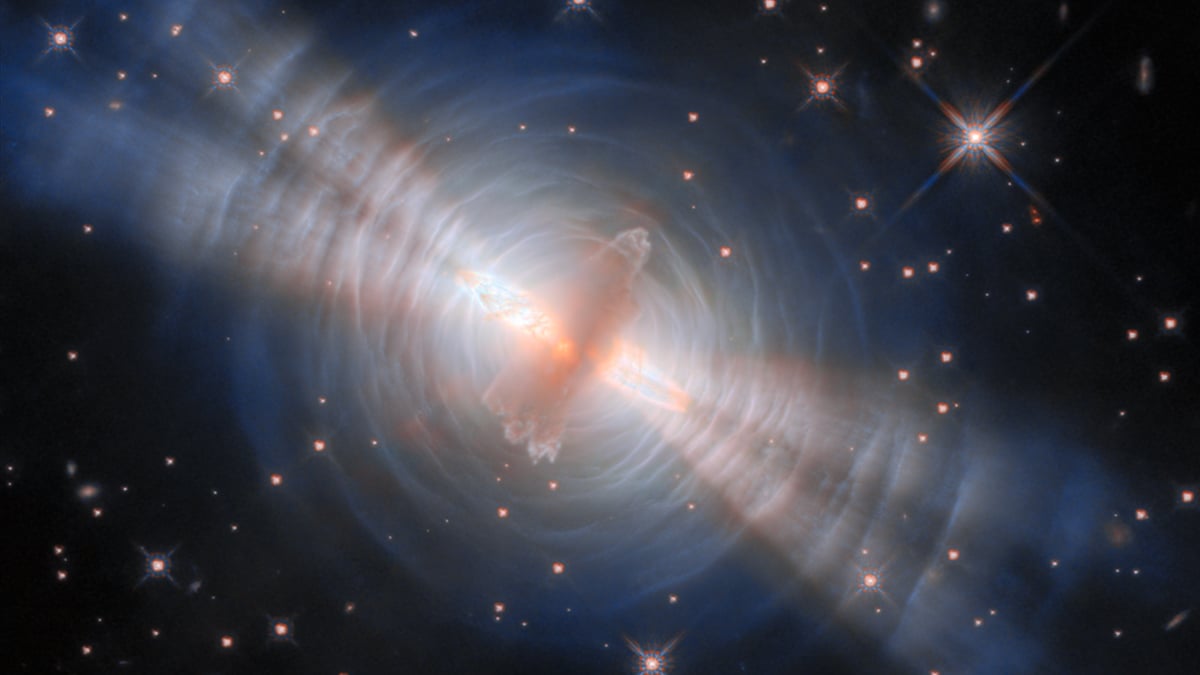
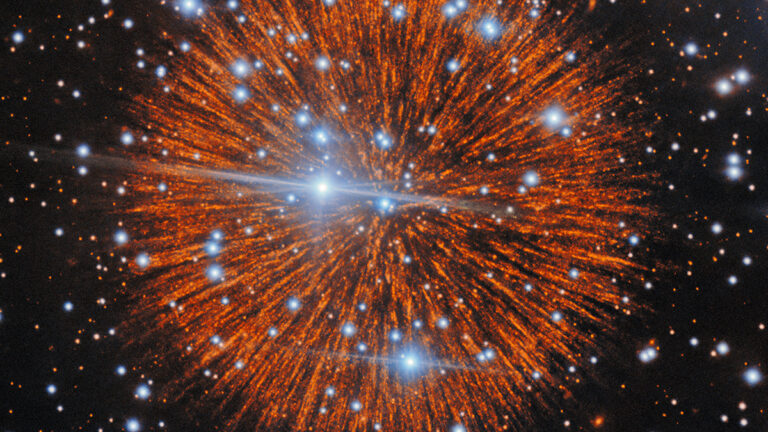
The late evolutionary stages of low- to intermediate-mass stars involve intense mass loss, asymmetric outflows, and rapid structural change. During this brief transition between the asymptotic giant branch and the planetary nebula phase, circumstellar envelopes become optically thick and dynamically complex. The NASA/ESA Hubble Space Telescope has now captured one of the clearest visible-light images of this process in action. The target is the Egg Nebula, also known as CRL 2688, located about 1,000 light-years away in the constellation Cygnus. This object represents a pre-planetary nebula, a short-lived stage that precedes full ionization of the expelled gas.
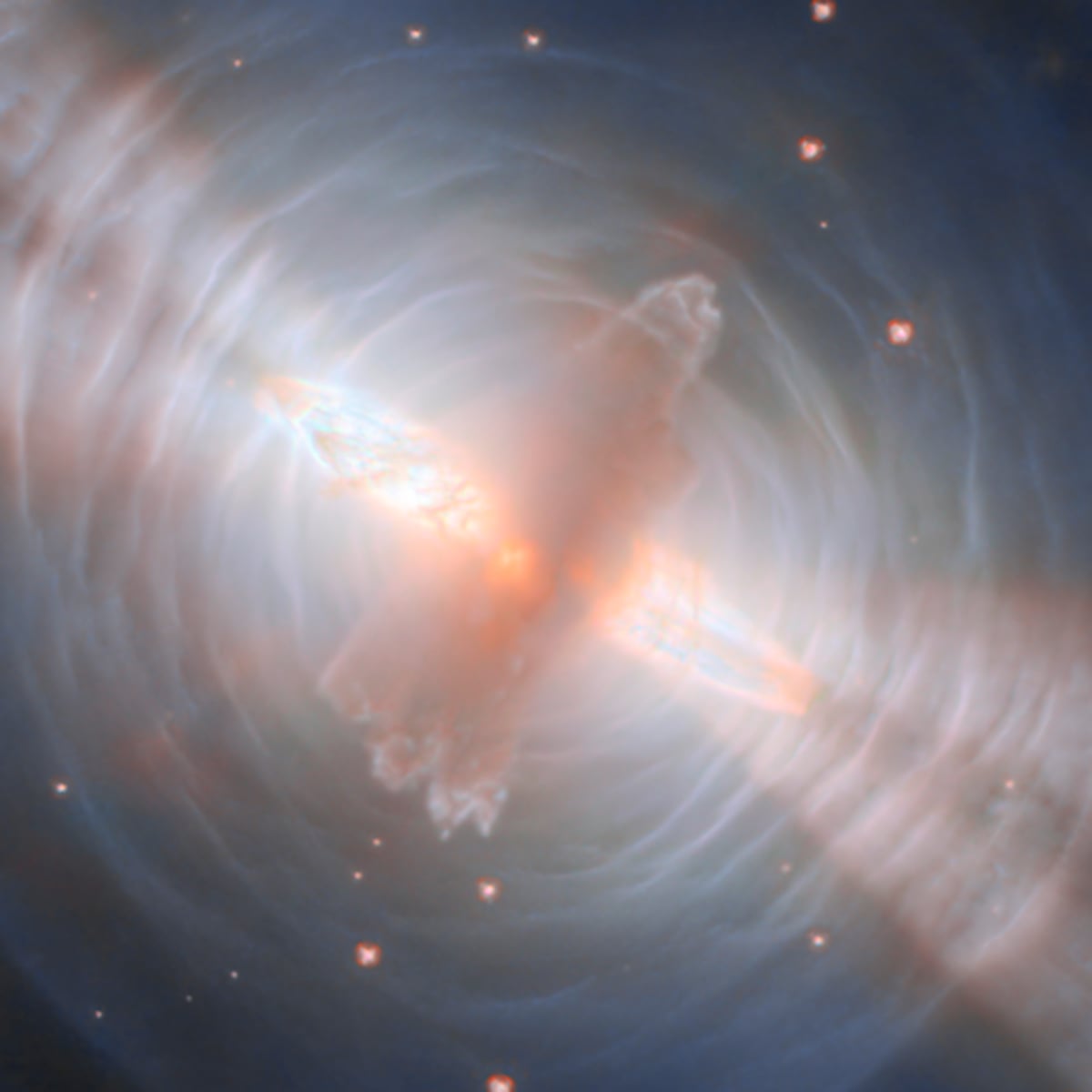
The new Hubble image exposes sharp polar lobes, dense equatorial dust, and multiple concentric arcs. These features document how a Sun-like star restructures its surroundings in its final active phase. The image provides observational evidence that helps refine models of stellar mass loss and nebular shaping.
A transitional object between two stellar states
Stars similar in mass to the Sun spend most of their lives fusing hydrogen into helium in their cores. Later, they expand into red giants and begin helium fusion. Eventually, nuclear fuel in the core declines. As a result, the outer layers become unstable and loosely bound.
During the asymptotic giant branch phase, strong stellar winds drive substantial mass loss. The star expels gas and dust at significant rates. Over time, this material forms a thick circumstellar envelope. The Egg Nebula shows a system that has recently completed a phase of heavy mass loss.
However, the central core has not yet become hot enough to ionize the surrounding gas. Therefore, the nebula does not shine primarily through emission lines, as mature planetary nebulae do. Instead, the visible light we observe is largely reflected and scattered starlight. This distinction confirms that CRL 2688 remains in the pre-planetary nebula stage.
Because this stage lasts only a few thousand years, astronomers rarely observe it in detail. Consequently, nearby examples like the Egg Nebula hold exceptional scientific value.
Hubble’s view: Lobes and escaping light
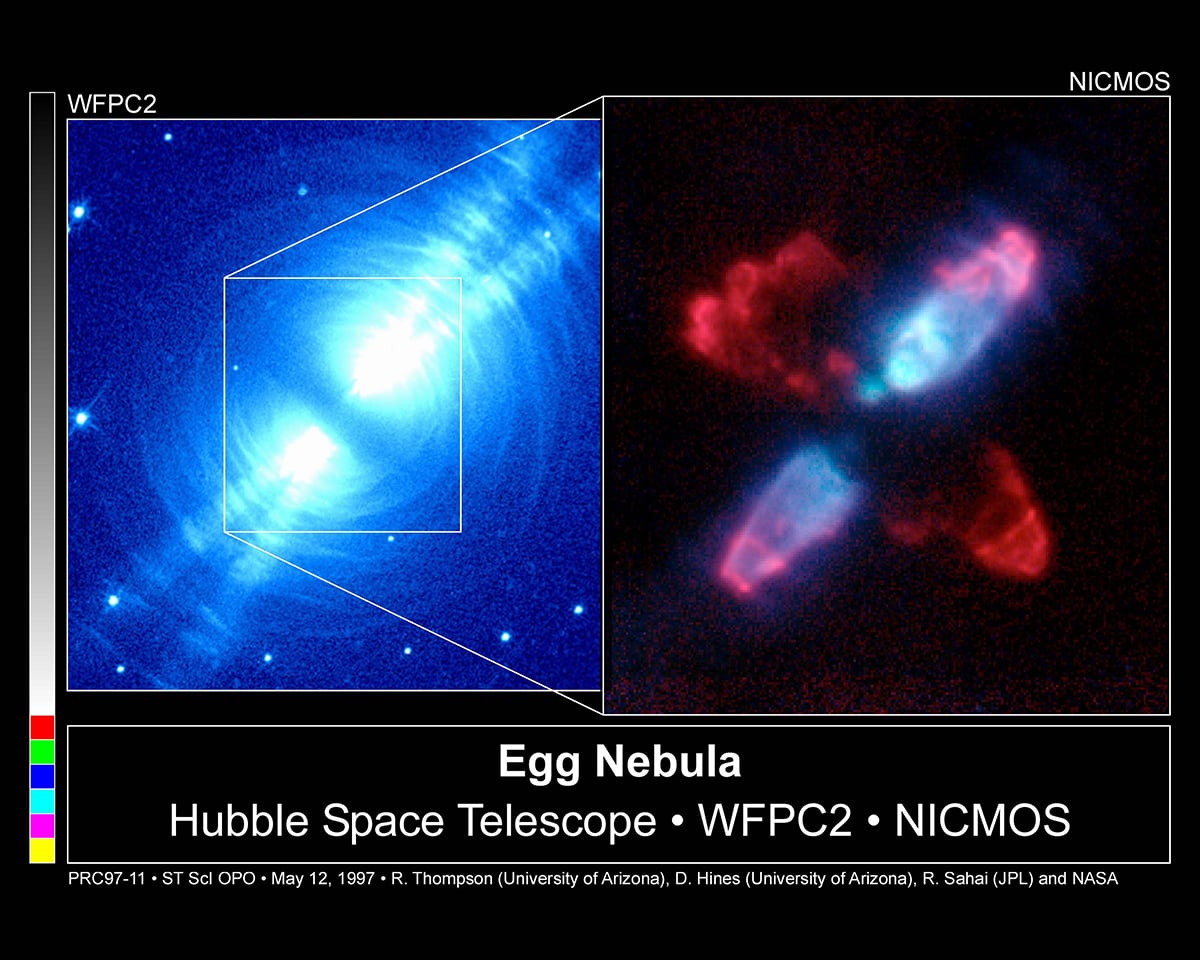
The latest Hubble image reveals a sharply defined polar structure. Two elongated lobes extend in opposite directions from the obscured central star. These lobes align along a polar axis, while a dense equatorial dust lane cuts across the middle.
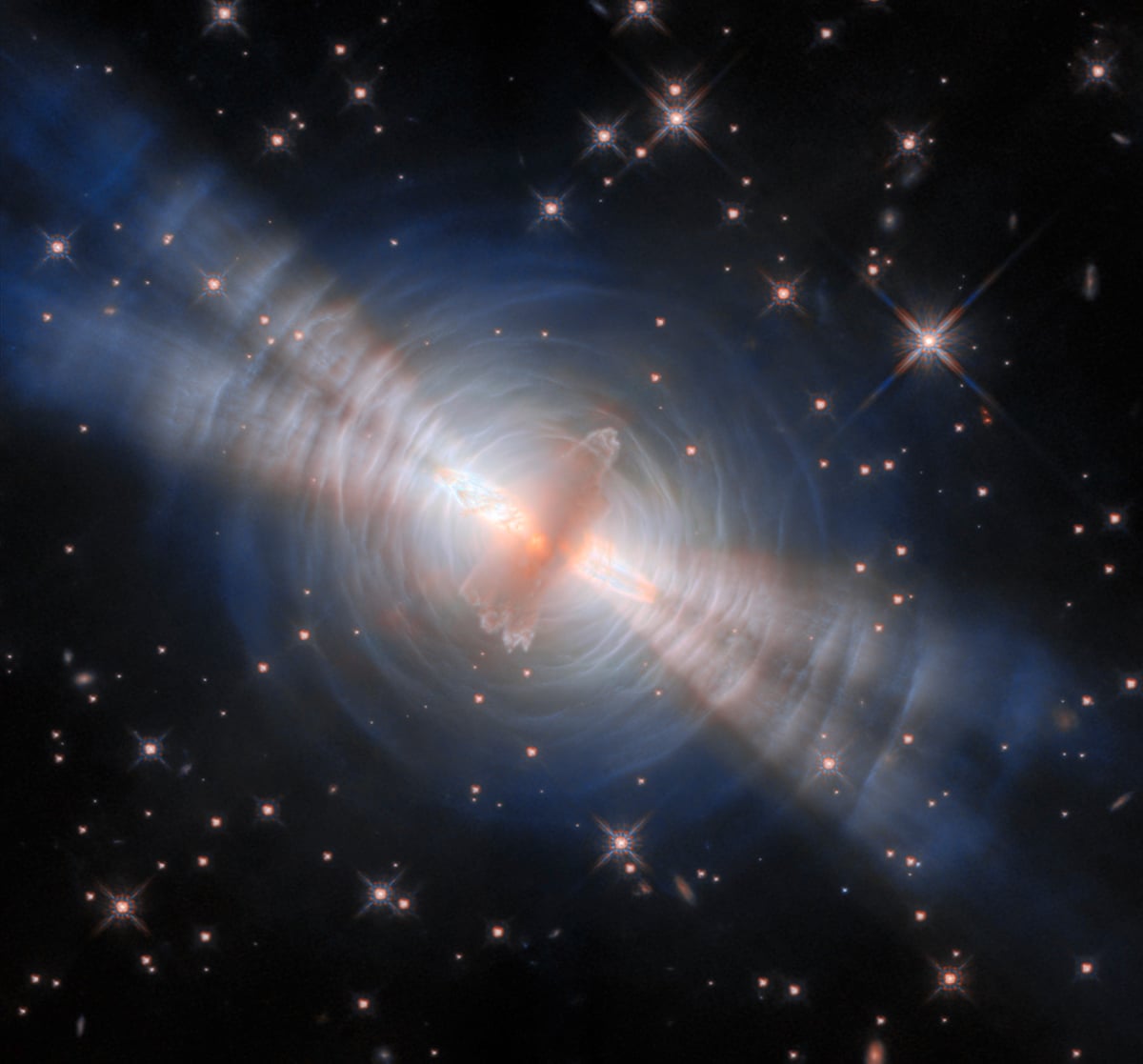
The central star itself remains hidden in visible wavelengths. A thick disk or torus of dust blocks direct light along the equatorial plane. However, light escapes more easily along the poles, where the density is lower. As a result, intense beams illuminate the lobes and produce the striking light patterns visible in the image. This geometry demonstrates that mass loss during the final red giant phase was not spherical. Instead, the outflows became strongly axisymmetric. Such asymmetry challenges earlier simplified models of stellar evolution.
Moreover, the image displays multiple concentric arcs surrounding the central region. These arcs likely trace episodic enhancements in mass loss. Each arc represents a separate phase of material ejection. By analyzing their spacing, astronomers can estimate timescales of variability in the dying star. Thus, the Egg Nebula functions as a historical record. Its structure preserves evidence of how the star shed its outer layers over time.
The role of dust in shaping the nebula
Dust formation plays a central role in the appearance of the Egg Nebula. As the expelled gas expands and cools, heavier elements condense into microscopic grains. These grains absorb and scatter visible light efficiently. Because of this scattering, the nebula shines even though the gas is not yet fully ionized. Light from the hidden central star reflects off dust particles, making the lobes visible. At the same time, thick dust in the equatorial plane produces deep shadows.
This interaction between radiation and dust creates the characteristic “light show” seen in the Hubble image. However, the phenomenon reflects physical processes rather than mere visual contrast. The presence of a dense equatorial disk also suggests a shaping mechanism. A companion star can gravitationally channel outflows and help form a disk. Although direct confirmation of a companion in CRL 2688 remains challenging, the morphology strongly hints at such influence.
The Egg Nebula contributes to an ongoing debate in astrophysics. Researchers seek to determine how common binary interactions are in shaping planetary nebulae. Observations like this strengthen the case that companions often play a significant role.
From pre-planetary nebula to planetary nebula
The Egg Nebula will continue to evolve rapidly. As the central core contracts, its temperature will increase. Eventually, it will emit sufficient ultraviolet radiation to ionize the surrounding gas.
When ionization begins, the nebula will transition into a planetary nebula. The gas will glow in characteristic emission lines, particularly from hydrogen and oxygen. At that stage, the central object will become a white dwarf.
A white dwarf no longer sustains nuclear fusion. Instead, it represents the exposed, dense core of the former red giant. It will gradually cool over billions of years.
Meanwhile, the expelled material will disperse into interstellar space. That material contains carbon, nitrogen, and other elements synthesized inside the star. Consequently, the death of a Sun-like star enriches the surrounding galaxy with heavy elements.
This enrichment process links stellar evolution to galactic chemistry. The atoms that form future stars and planets originate in such late-stage stellar outflows. By observing the Egg Nebula, astronomers directly witness part of this cosmic recycling process.
A structured and dynamic end to stellar life
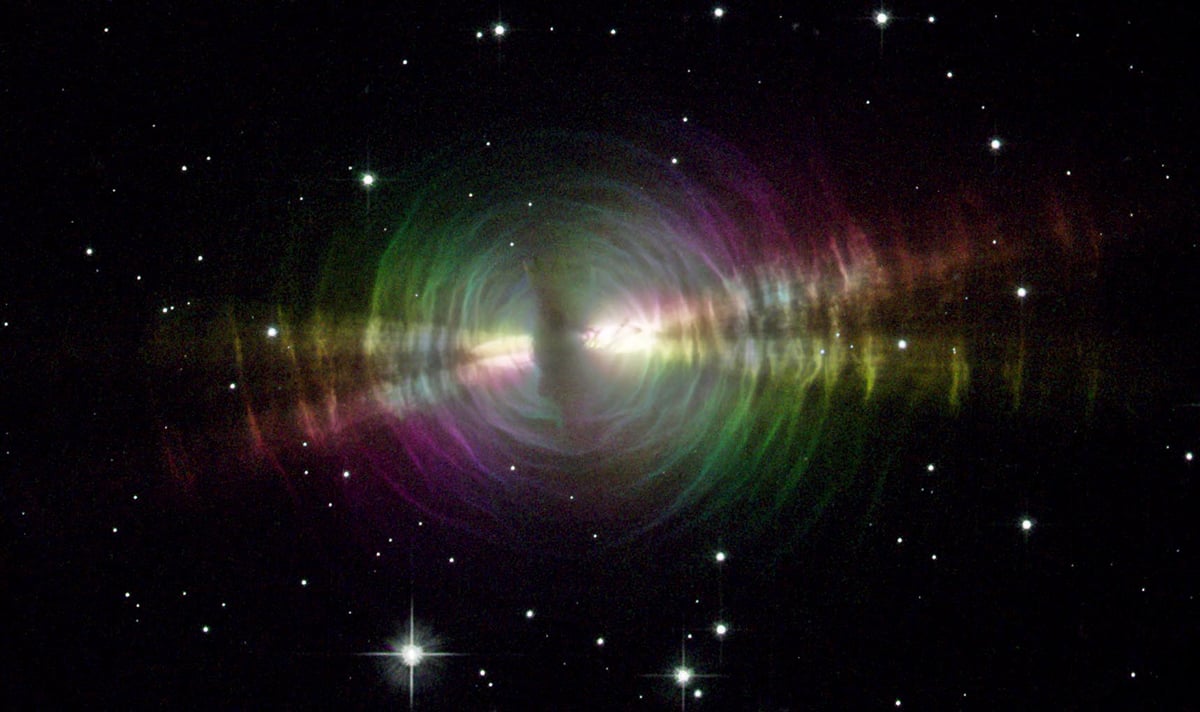
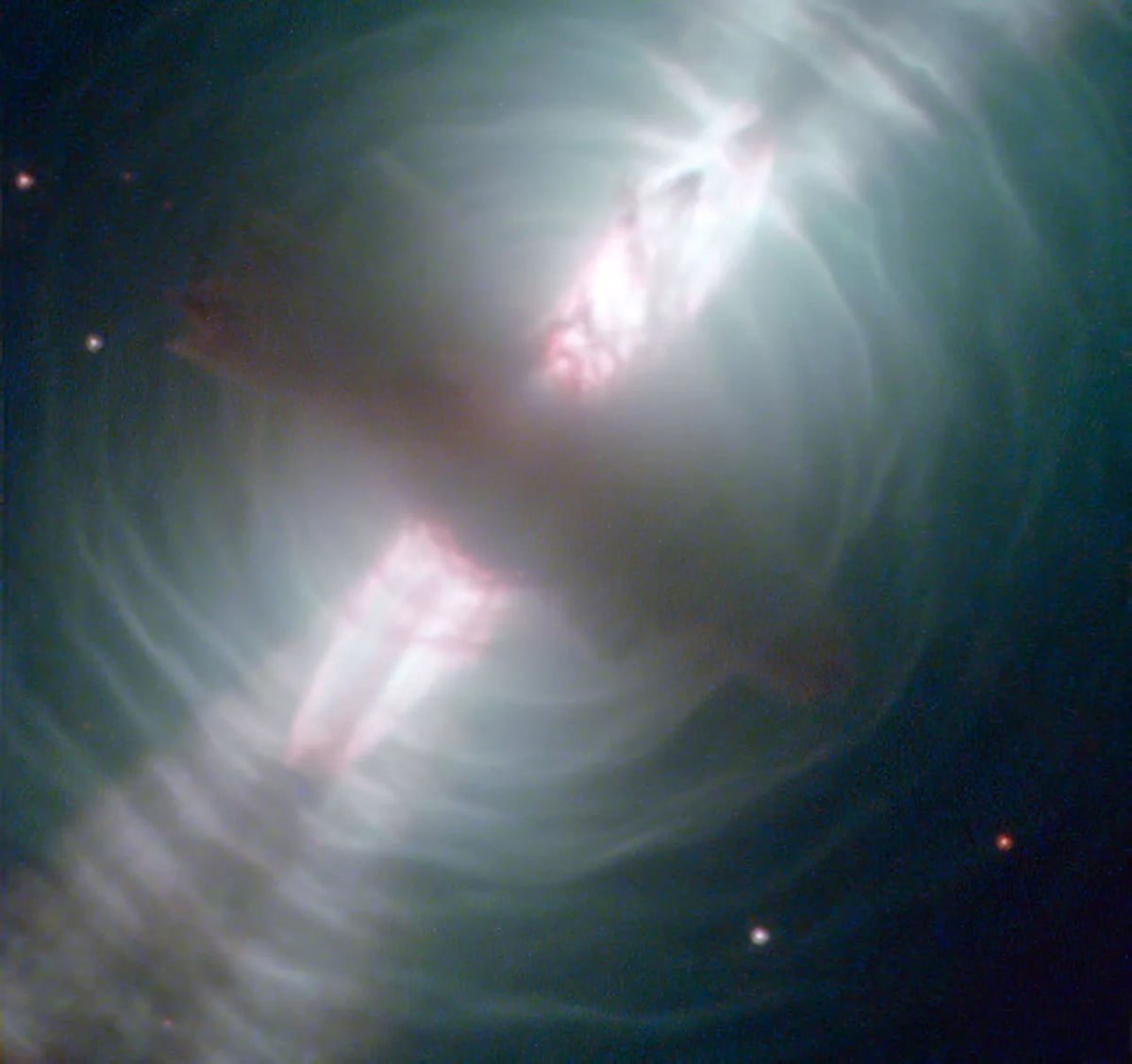
The Hubble Space Telescope has observed the Egg Nebula in the past. However, the latest image benefits from improved data processing and enhanced contrast. These refinements allow astronomers to examine fine structural details with greater precision.
The new Hubble image of the Egg Nebula underscores a central lesson in stellar astrophysics. The end of a Sun-like star is neither quiet nor symmetrical. Instead, it involves directional outflows, episodic mass loss, and complex interactions between radiation and dust. Importantly, the Egg Nebula captures a fleeting stage. The pre-planetary nebula phase bridges the red giant and planetary nebula states. Because this interval is brief, detailed observations remain rare.
In time, the nebula will brighten as ultraviolet radiation floods the surrounding gas. Its appearance will shift from reflected light to emission-dominated glow. Eventually, the structure will disperse into the galaxy.
Clear skies!
See more from DIYPhotography.net on Google
Add DIYPhotography.net as a trusted source. This makes
our stories more likely to appear in your Google Search results.
 Add as a preferred source on Google

Soumyadeep Mukherjee
Soumyadeep Mukherjee is an award-winning astrophotographer from India. He has a doctorate degree in Linguistics. His work extends to the sub-genres of nightscape, deep sky, solar, lunar and optical phenomenon photography. He is also a photography educator and has conducted numerous workshops. His works have appeared in over 40 books & magazines including Astronomy, BBC Sky at Night, Sky & Telescope among others, and in various websites including National Geographic, NASA, Forbes. He was the first Indian to win “Astronomy Photographer of the Year” award in a major category.
Join the Discussion
DIYP Comment Policy
Be nice, be on-topic, no personal information or flames.