

























The Sun in 8K: VTT Photographs the Sun in Hi-resolution
Aug 12, 2025
Soumyadeep Mukherjee
Soumyadeep Mukherjee is an award-winning astrophotographer from India. He has a doctorate degree in Linguistics. His work extends to the sub-genres of nightscape, deep sky, solar, lunar and optical phenomenon photography. He is also a photography educator and has conducted numerous workshops. His works have appeared in over 40 books & magazines including Astronomy, BBC Sky at Night, Sky & Telescope among others, and in various websites including National Geographic, NASA, Forbes. He was the first Indian to win “Astronomy Photographer of the Year” award in a major category.
Share:

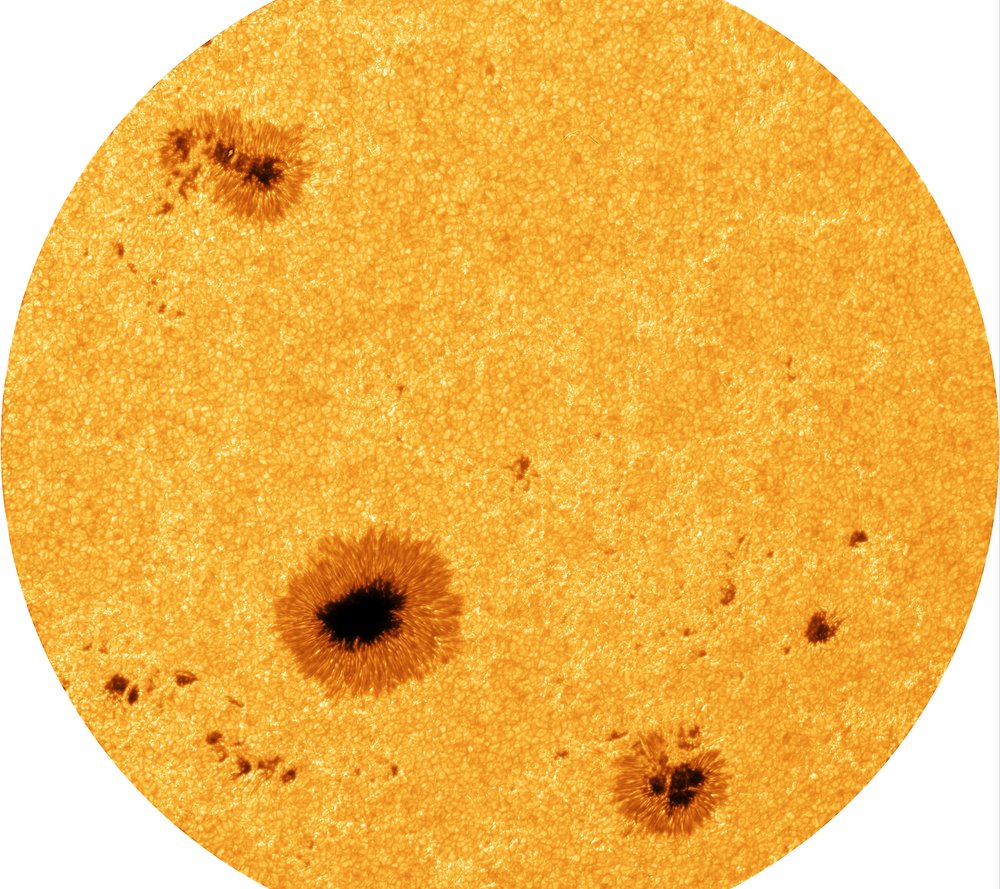
The Sun dominates our lives, yet we rarely see it in true detail. To the naked eye, it’s a blinding disc in the sky. Through the haze of our atmosphere, even the most powerful telescopes struggle to capture its true face. Now, astronomers have pierced through those limits with a leap in technology. From an observatory high in the mountains of Tenerife, the Sun has been photographed in 8K resolution, revealing breathtaking features with a clarity never before achieved from Earth. Vast sunspots, twisting magnetic filaments, and intricate surface textures appear as if etched in molten gold. The images are a scientific breakthrough, offering a sweeping, detailed view of solar activity across a scale no single telescope has delivered before.
A telescope with new eyes
The achievement belongs to the Vacuum Tower Telescope, the VTT, perched 2,400 meters above sea level at the Observatorio del Teide. Its design allows the Sun to be studied without the shimmering distortion caused by heat inside the telescope itself. But the VTT was never meant to see like this. Its transformation came with the installation of an advanced 8K CMOS camera, a giant digital eye capable of recording more than 48 million pixels per frame. The chip measures about 8,000 pixels wide by 6,000 tall. At the scale of the Sun, that means each pixel spans only about 100 kilometers on the solar surface. To create a single crisp image, astronomers capture rapid bursts, about 100 frames in a few seconds, before the atmosphere shifts. They then combine these using sophisticated algorithms that cancel out the blur from turbulence above the observatory.

A large field of view
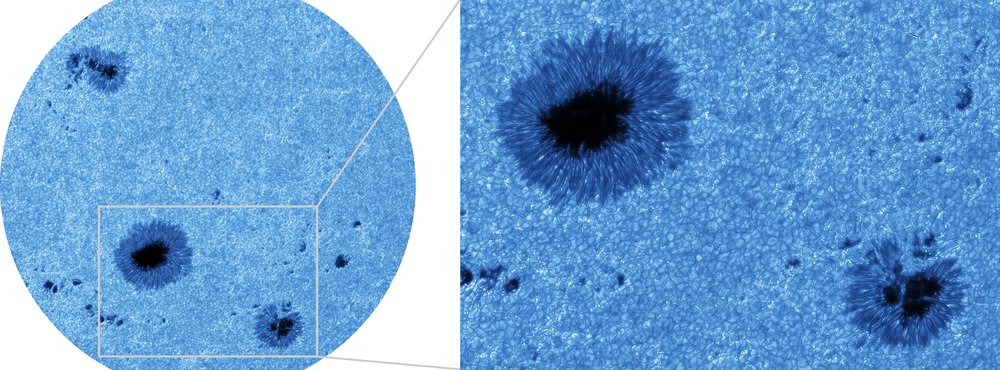
High-resolution solar imaging usually comes at a cost: a narrow window onto the Sun. Large solar telescopes, like the Swedish Solar Telescope, deliver exquisite detail, but only over a patch of the surface about 75,000 kilometers wide. That’s barely a fraction of the Sun’s face. The VTT’s upgraded system changes the equation. It can cover a 200,000-kilometer-wide swath in one shot, around one-seventh of the Sun’s total diameter. It’s like swapping a magnifying glass for a panoramic camera without losing the fine detail. The Sun is a connected system, where activity in one area can trigger changes far away. A sunspot cluster, a flare, or a twisting magnetic loop often has roots in neighboring regions. The VTT can now capture these relationships in a single frame, providing both the context and the detail that solar scientists crave.

Into the heart of a sunspot
In the new images, sunspots are not just dark patches; they are sprawling, structured worlds of their own. At the center lies the umbra, a deep, shadowy pit where the magnetic field is strongest. Around it stretches the penumbra, a halo of pale filaments that twist like braided rope. The VTT’s camera shows these filaments in astonishing clarity. In the G-band, astronomers see the fine granulation of the photosphere, where convection patterns resemble a mosaic of golden cells. Through the Ca II K line, they peer into the chromosphere, a higher, more turbulent layer. Here, bright magnetic strands stretch for thousands of kilometers, linking sunspots like invisible power lines.
The symphony of optics and algorithms
Behind every 8K image is a delicate dance of optics and computation. The VTT uses adaptive optics, a system called KAOS that constantly adjusts a mirror to counteract atmospheric turbulence. This provides a stable, sharp base image for the camera to work with. Once the burst images are recorded, speckle imaging and multi-frame blind deconvolution take over. These techniques align and merge the best moments from each frame, discarding the split-second distortions caused by air currents. The result is a single, crystal-clear snapshot of the Sun as it truly was in that instant. Each burst sequence can generate gigabytes of raw images. Processing them requires high-powered computers and precise algorithms to avoid artifacts. But the payoff is unmatched, a level of detail once thought impossible from Earth.
This technique is not without its limits. It depends on exceptional atmospheric conditions, which Tenerife often delivers but cannot guarantee every day. Nevertheless, the success of this project shows that with the right technology, even older telescopes can push the boundaries of what’s possible.
The VTT team plans to run extended observing campaigns, capturing the Sun over multiple days and across different activity phases. They hope to integrate the data into global solar monitoring networks and make processed images available in near real-time. The idea of combining wide-field coverage with 8K-level resolution is attractive to anyone studying a dynamic, interconnected system like the Sun. We may soon see a new era in which high-resolution solar images are captured routinely across the globe.
Clear skies!
See more from DIYPhotography.net on Google
Add DIYPhotography.net as a trusted source. This makes
our stories more likely to appear in your Google Search results.
 Add as a preferred source on Google

Soumyadeep Mukherjee
Soumyadeep Mukherjee is an award-winning astrophotographer from India. He has a doctorate degree in Linguistics. His work extends to the sub-genres of nightscape, deep sky, solar, lunar and optical phenomenon photography. He is also a photography educator and has conducted numerous workshops. His works have appeared in over 40 books & magazines including Astronomy, BBC Sky at Night, Sky & Telescope among others, and in various websites including National Geographic, NASA, Forbes. He was the first Indian to win “Astronomy Photographer of the Year” award in a major category.




Join the Discussion
DIYP Comment Policy
Be nice, be on-topic, no personal information or flames.