






















NASA’s TESS Reveals a Map of the Sky Filled with Alien Worlds
May 17, 2026
Soumyadeep Mukherjee
Soumyadeep Mukherjee is an award-winning astrophotographer from India. He has a doctorate degree in Linguistics. His work extends to the sub-genres of nightscape, deep sky, solar, lunar and optical phenomenon photography. He is also a photography educator and has conducted numerous workshops. His works have appeared in over 40 books & magazines including Astronomy, BBC Sky at Night, Sky & Telescope among others, and in various websites including National Geographic, NASA, Forbes. He was the first Indian to win “Astronomy Photographer of the Year” award in a major category.
Share:
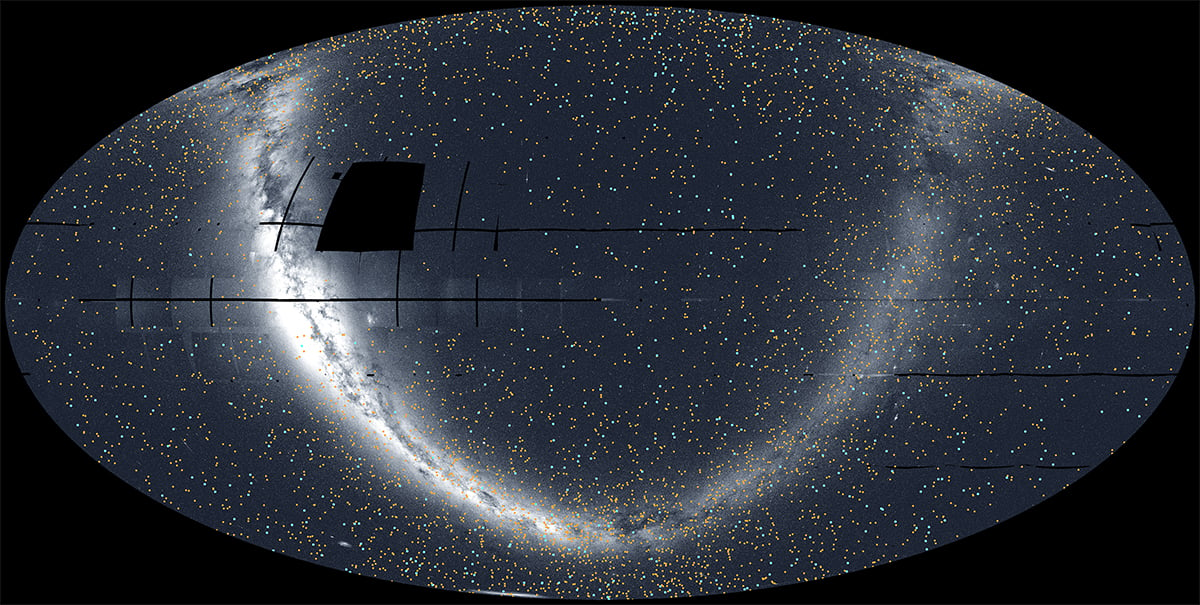
Exoplanet surveys generate enormous volumes of observational data. Space telescopes repeatedly monitor stellar brightness, track subtle photometric variations, and search for periodic transit signatures hidden within millions of light curves. Over the last eight years, NASA’s Transiting Exoplanet Survey Satellite (TESS) has carried out this process across nearly the entire sky. The mission has now accumulated the long-term survey into a single large-scale all-sky mosaic.
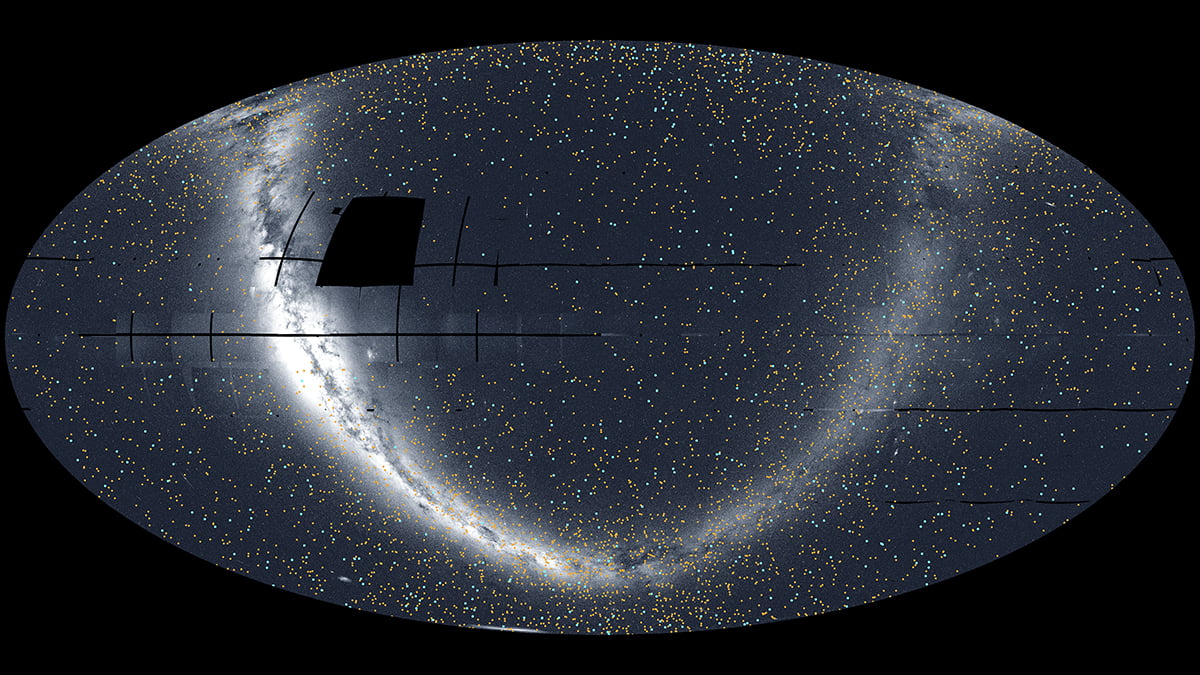
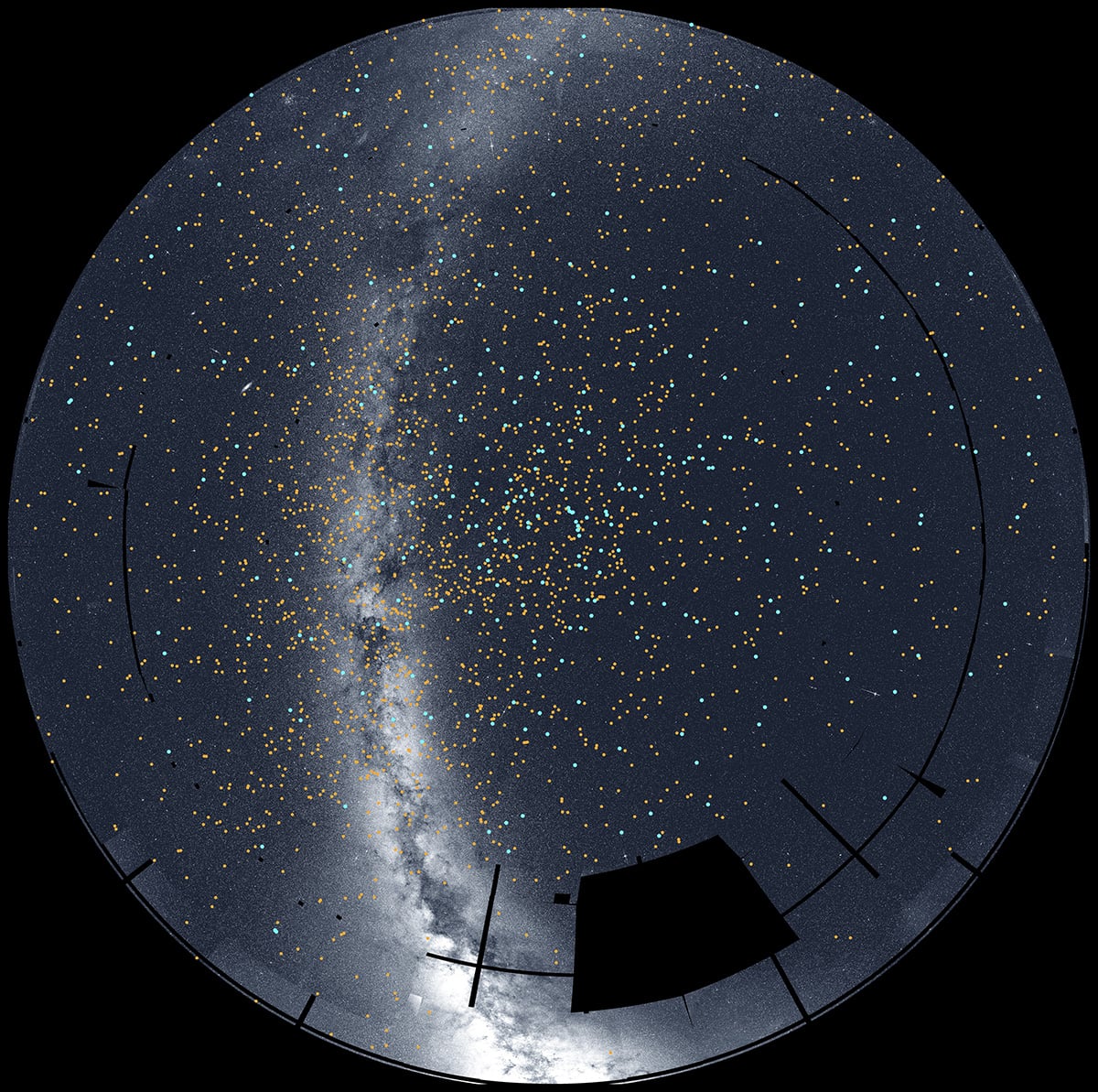
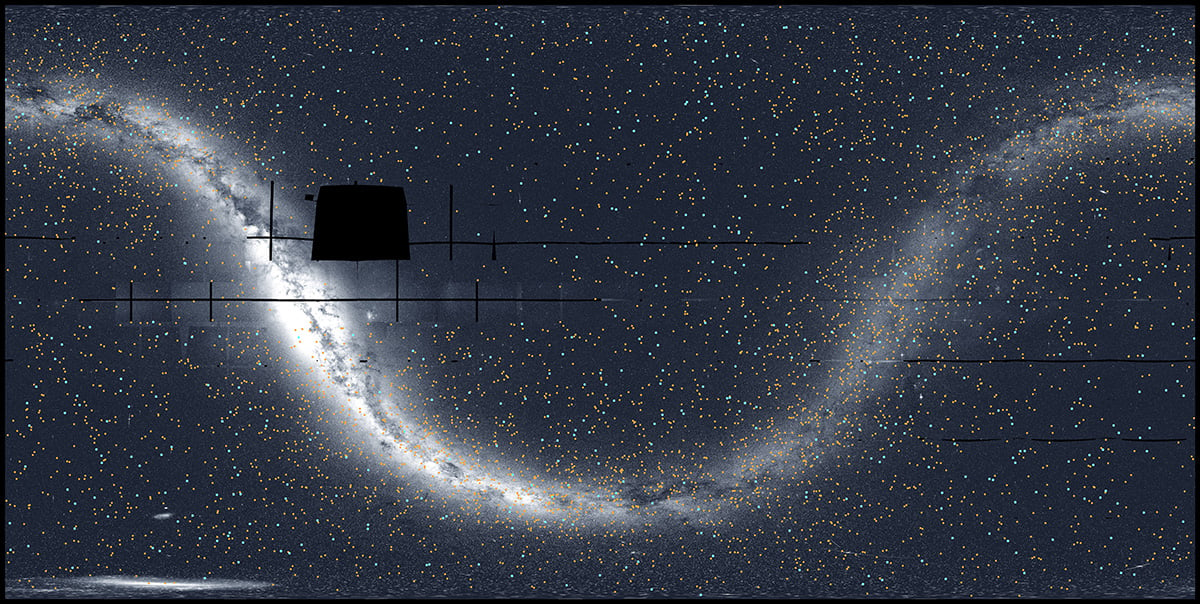
The newly released image combines observations gathered between 2018 and 2025. It presents the sky as TESS observed it during its primary and extended missions. Across the mosaic, the dense stellar structure of the Milky Way appears alongside thousands of marked planetary systems. Blue markers identify confirmed exoplanets, while orange markers show planet candidates that still require verification.
TESS: A new scale of exoplanet surveys
The Transiting Exoplanet Survey Satellite (TESS) was launched in April 2018 aboard a Falcon 9 rocket. NASA designed the spacecraft to build on the momentum created by earlier exoplanet missions, while shifting attention toward nearby stars. Rather than focusing on a narrow region of space, TESS would scan almost the entire celestial sphere.
The spacecraft carries four wide-field cameras arranged to observe large sections of the sky simultaneously. Together, they cover a field of view measuring 24 degrees by 96 degrees. TESS divides the sky into observing sectors and continuously monitors each sector for approximately 27 days before rotating to the next region.
During these observations, the spacecraft records changes in stellar brightness. Scientists search for repeating dips in light caused by planets passing in front of their host stars. This process, known as the transit method, remains one of the most effective techniques for detecting exoplanets.
The measurements often involve extremely small changes in brightness. In some cases, the drop may measure less than one percent. As a result, the mission depends on instrumentation, long observing periods, and data analysis. Even small systematic errors can interfere with planetary detections. According to official mission statistics, TESS has now observed more than 90 percent of the sky and identified thousands of planetary candidates.
Eight years of observations into one image
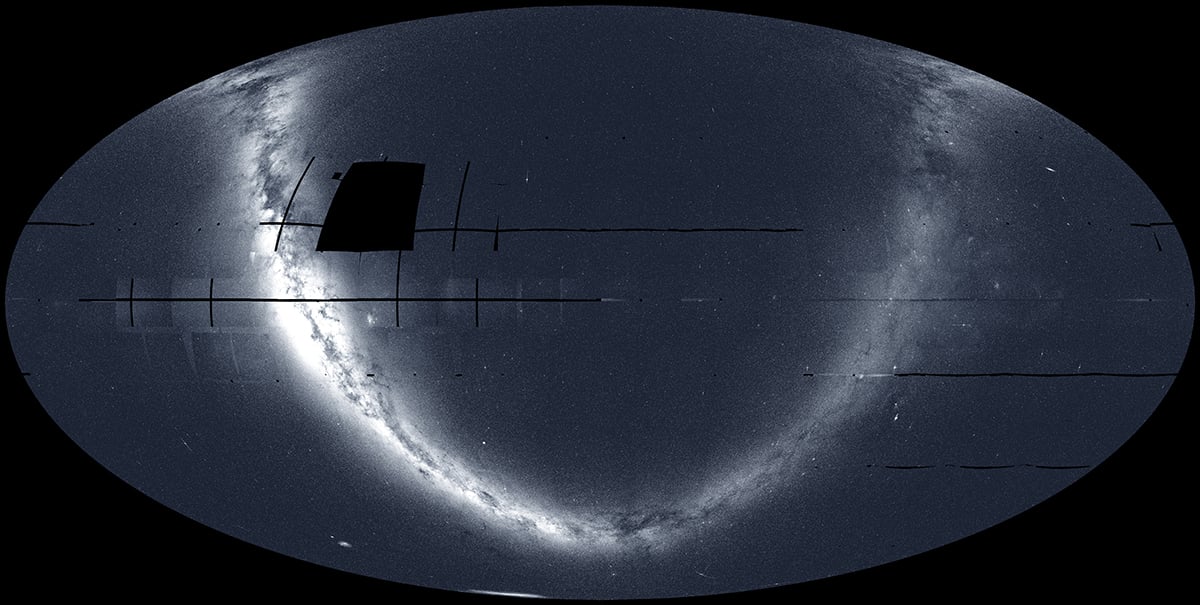
The newly released all-sky mosaic combines 96 observing sectors collected between April 2018 and September 2025. Scientists processed and stitched the data together to create a continuous panoramic representation of the sky observed by TESS.
The structure of the Milky Way is visible throughout the image. Dense stellar regions form bright bands across the frame, while dark interstellar dust lanes carve through the galactic plane. The Large and Small Magellanic Clouds appear as detached luminous structures in the southern sky. Meanwhile, darker extragalactic regions reveal areas with lower stellar density.
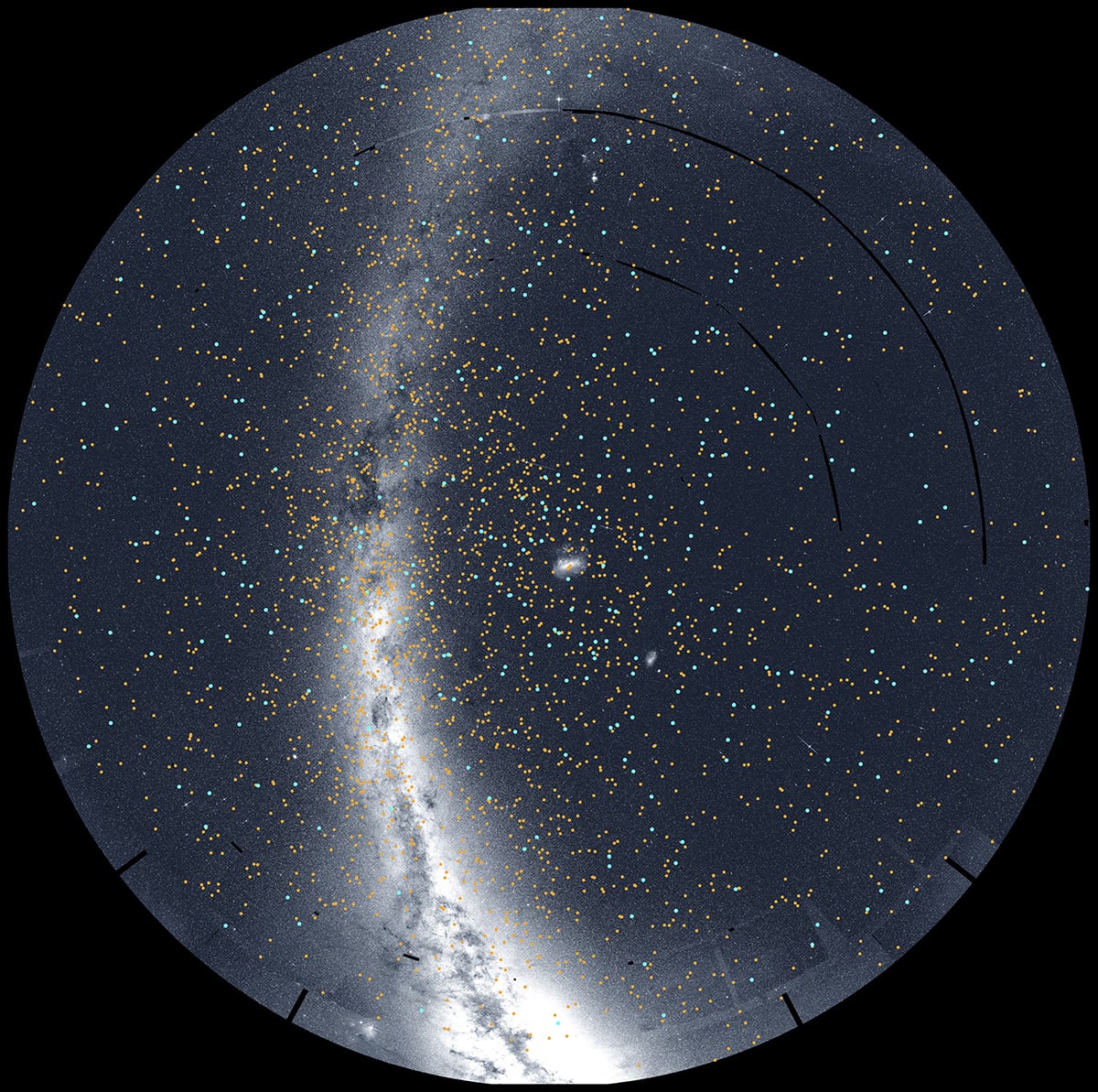
NASA also overlaid the positions of confirmed exoplanets and planet candidates across the mosaic. The current map includes approximately 679 confirmed exoplanets and more than 5,100 candidates. These numbers continue changing as astronomers verify additional systems through follow-up observations.
The distribution of these detections also reveals observational challenges within exoplanet surveys. Planet markers appear less concentrated in the brightest and most crowded portions of the Milky Way because densely packed star fields complicate transit measurements. Nearby stars can contaminate photometric signals and make planetary signatures harder to isolate.
Nearby exoplanets: A door to atmospheric studies
The scientific importance of TESS extends beyond detecting planets. Many discovered systems orbit relatively bright nearby stars, which makes them suitable for detailed atmospheric analysis. This advantage became especially important after the launch of the James Webb Space Telescope. JWST now studies several planets first identified by TESS using infrared spectroscopy.
When a planet transits its host star, a small fraction of starlight passes through the planetary atmosphere before reaching the telescope. Molecules inside the atmosphere absorb specific wavelengths of light, leaving detectable spectral signatures. By studying these signatures, astronomers can identify atmospheric gases and investigate planetary chemistry.
Recent observations have revealed water vapor, carbon dioxide, methane, sodium, and other compounds within several exoplanet atmospheres. These measurements help scientists study planetary climate systems, atmospheric circulation, and chemical evolution.
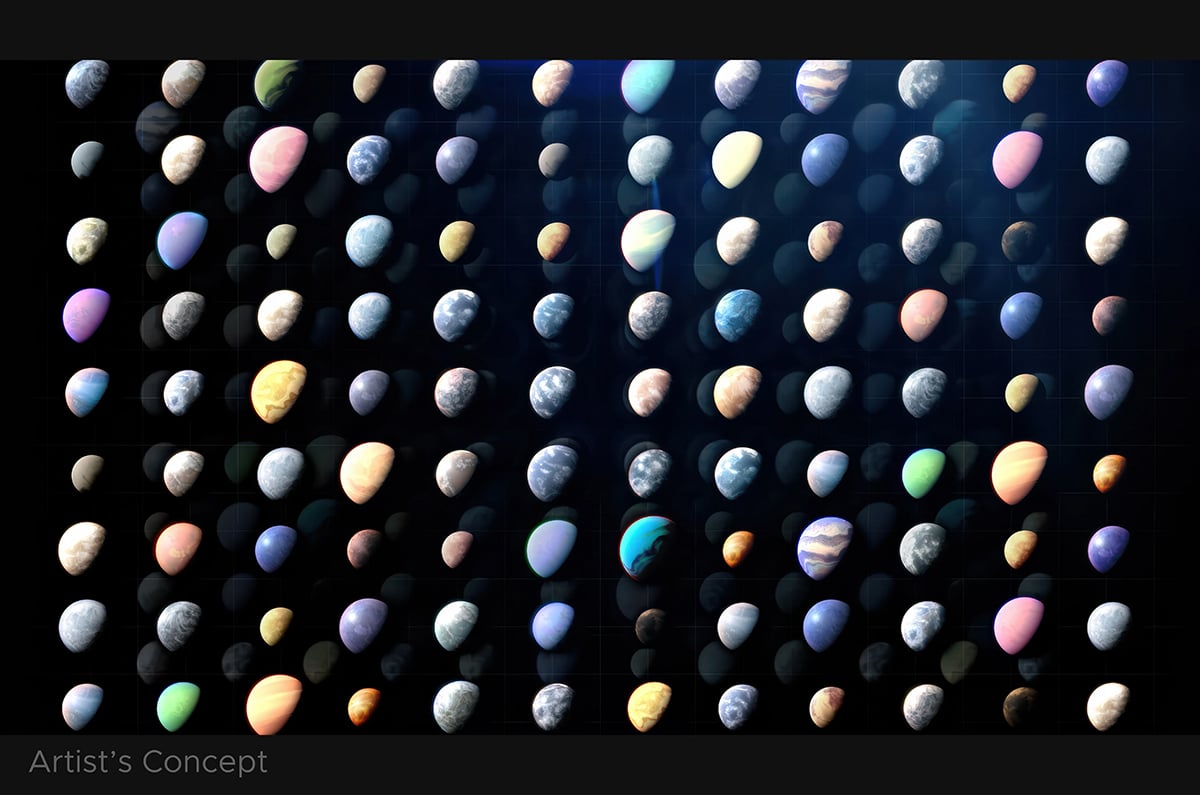
TESS discoveries have also expanded the known diversity of planetary systems. Some planets orbit extremely close to their stars and experience surface temperatures high enough to melt rock. Others belong to tightly packed multi-planet systems with unusual orbital architectures. As additional observations continue, astronomers will likely refine current theories regarding how planetary systems evolve over billions of years.
Clear skies!
See more from DIYPhotography.net on Google
Add DIYPhotography.net as a trusted source. This makes
our stories more likely to appear in your Google Search results.
 Add as a preferred source on Google

Soumyadeep Mukherjee
Soumyadeep Mukherjee is an award-winning astrophotographer from India. He has a doctorate degree in Linguistics. His work extends to the sub-genres of nightscape, deep sky, solar, lunar and optical phenomenon photography. He is also a photography educator and has conducted numerous workshops. His works have appeared in over 40 books & magazines including Astronomy, BBC Sky at Night, Sky & Telescope among others, and in various websites including National Geographic, NASA, Forbes. He was the first Indian to win “Astronomy Photographer of the Year” award in a major category.

Join the Discussion
DIYP Comment Policy
Be nice, be on-topic, no personal information or flames.