





















NASA’s SPHEREx Produces the First Complete Infrared Map of the Sky
Dec 19, 2025
Soumyadeep Mukherjee
Soumyadeep Mukherjee is an award-winning astrophotographer from India. He has a doctorate degree in Linguistics. His work extends to the sub-genres of nightscape, deep sky, solar, lunar and optical phenomenon photography. He is also a photography educator and has conducted numerous workshops. His works have appeared in over 40 books & magazines including Astronomy, BBC Sky at Night, Sky & Telescope among others, and in various websites including National Geographic, NASA, Forbes. He was the first Indian to win “Astronomy Photographer of the Year” award in a major category.
Share:

Recently, NASA achieved something astronomy had never done before. A single space telescope mapped the entire sky in infrared light using 102 distinct wavelength bands. This was not a visual survey. Rather, it was a calibrated spectral measurement of the universe at every observable direction. The mission responsible was SPHEREx, and its first full-sky dataset now stands as one of the most information-dense astronomical surveys ever produced. The map represents a fundamental shift in how astronomers study the universe at large scales. Instead of focusing on individual objects, SPHEREx measures the statistical structure of the cosmos. It captures how stars, galaxies, dust, and gas emit infrared light across cosmic time. The result is a dataset built not for display, but for precision science.
The mission design behind SPHEREx
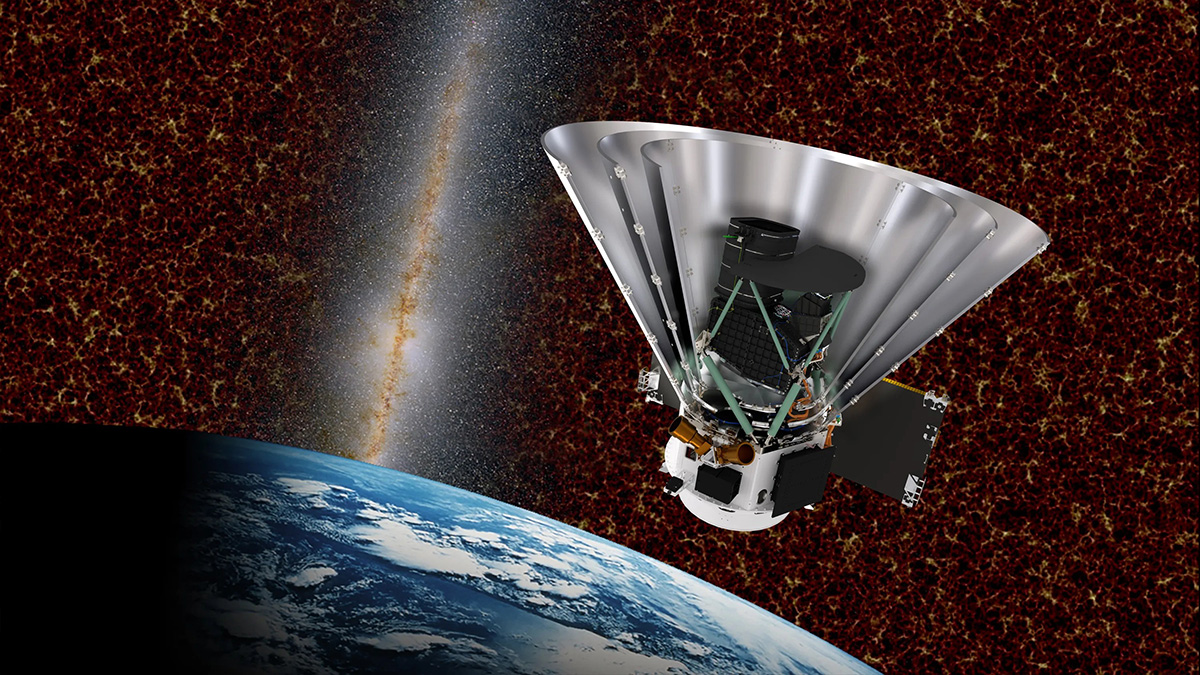
SPHEREx, short for Spectro-Photometer for the History of the Universe, Epoch of Reionization, and Ices Explorer, launched on March 11, 2025. NASA designed it as a wide-field survey instrument rather than a traditional observatory. It does not track targets. It scans continuously.
The telescope operates in low Earth orbit. Its observing strategy relies on Earth’s motion around the Sun. As the planet orbits, SPHEREx sweeps across new sky regions each day. Over six months, this motion allows it to cover the entire celestial sphere. By December 2025, SPHEREx had completed its first full pass.
At the heart of the mission lies spectroscopy. SPHEREx measures infrared light from 0.75 to 5 microns. It splits this light into 102 narrow wavelength bands using a set of fixed filters. Each sky position receives a low-resolution spectrum. That spectrum carries information about distance, temperature, and chemical composition. This approach sacrifices sharp detail but gains uniform, spectral coverage of the entire universe.
The first all-sky map
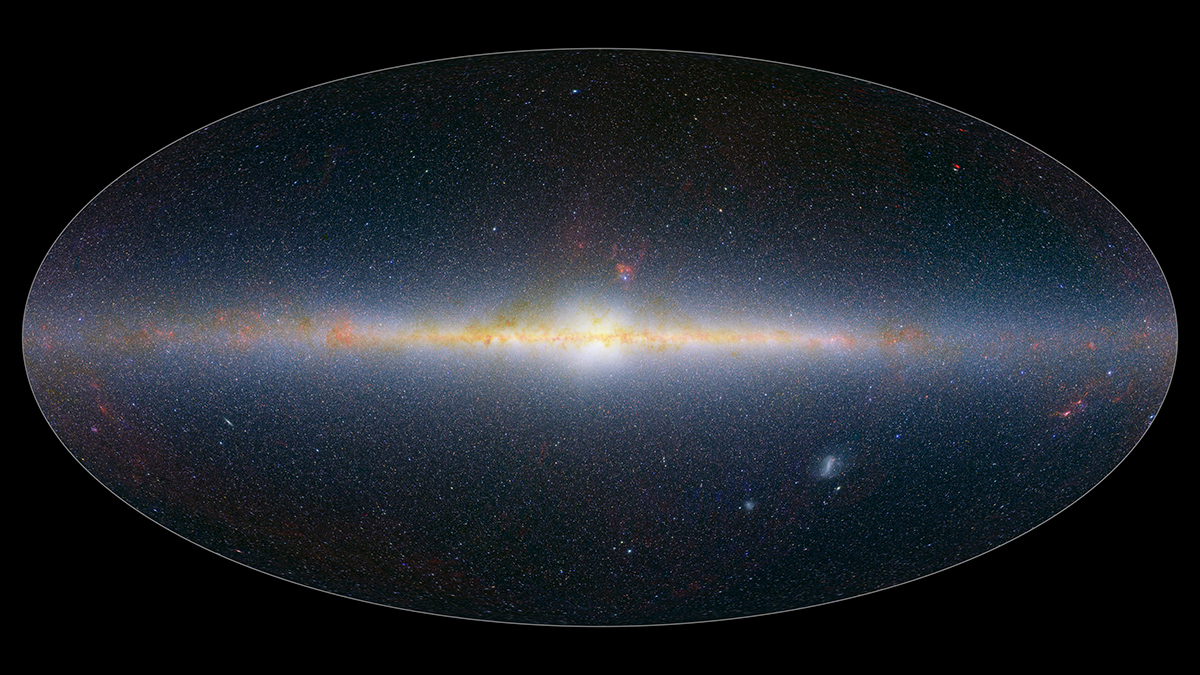
The released SPHEREx map is a visual translation of infrared data. NASA assigns colors to specific wavelength ranges to make the data interpretable. The image reveals familiar structures, but for unfamiliar reasons. The Milky Way dominates the center of the map. It appears thick, bright, and textured. Infrared light reveals dust that blocks visible starlight. It also traces cold material where stars form. The galaxy’s spiral structure becomes clearer when viewed this way.
Beyond the Milky Way, the sky fills with distant galaxies. They appear evenly distributed across both hemispheres. This uniformity matters. It reflects the large-scale structure of the universe. SPHEREx detects galaxies not as isolated objects, but as part of a cosmic pattern.
Some infrared bands highlight hot stars. Others emphasize warm dust. Certain wavelengths isolate emission from ionized hydrogen. Together, these measurements allow scientists to separate physical processes that overlap in visible light. NASA stresses that the public image represents only a fraction of the data. The full-resolution spectral maps are far larger and far more detailed. Scientists work directly with those measurements, not the compressed visuals.
Rationale behind the survey
Astronomy has long lacked a complete infrared spectral map of the sky. Previous missions surveyed in infrared, but not with this combination of wavelength coverage and uniformity. One primary science goal involves cosmic inflation. This event occurred fractions of a second after the Big Bang. It shaped how matter spread through space. Inflation left subtle statistical signatures in galaxy distribution. Detecting those signatures requires large, uniform datasets.
SPHEREx provides exactly that. By measuring infrared spectra across the sky, it estimates galaxy distances on a massive scale. This allows astronomers to build three-dimensional maps of cosmic structure. Those maps test inflation models directly.
Another goal focuses on galaxy formation. SPHEREx measures the total infrared light emitted by galaxies over time. This includes faint galaxies beyond direct detection. That integrated light reveals when stars formed and how rapidly galaxies grew. Closer to home, SPHEREx studies the Milky Way’s chemistry. Infrared spectroscopy detects water ice, carbon dioxide, and organic molecules in cold regions. These materials play a key role in planet formation. Mapping their distribution helps explain how common planetary building blocks are.

A new baseline for infrared astronomy
SPHEREx does not compete with high-resolution telescopes. It complements them. The James Webb Space Telescope observes small areas in extreme detail. Hubble excels in optical imaging. Ground-based observatories probe radio and submillimeter wavelengths. SPHEREx connects all of them. Its all-sky data identifies targets worth deeper study. It flags unusual galaxies. It highlights chemically rich regions. Other telescopes then follow up with focused observations. This survey-first model has driven many major discoveries. Missions like IRAS, COBE, and WISE paved the way. SPHEREx advances the concept with far greater spectral detail.
The first SPHEREx all-sky map is a baseline. It establishes a new standard for infrared surveys. As additional maps accumulate, the data will grow deeper. Structures will sharpen statistically, and measurements will improve. SPHEREx delivers context and shows how everything fits together. The mission will complete four full-sky surveys over two years. Each pass improves sensitivity. Repeated observations reduce errors and reveal faint structures.
Clear skies!
See more from DIYPhotography.net on Google
Add DIYPhotography.net as a trusted source. This makes
our stories more likely to appear in your Google Search results.
 Add as a preferred source on Google

Soumyadeep Mukherjee
Soumyadeep Mukherjee is an award-winning astrophotographer from India. He has a doctorate degree in Linguistics. His work extends to the sub-genres of nightscape, deep sky, solar, lunar and optical phenomenon photography. He is also a photography educator and has conducted numerous workshops. His works have appeared in over 40 books & magazines including Astronomy, BBC Sky at Night, Sky & Telescope among others, and in various websites including National Geographic, NASA, Forbes. He was the first Indian to win “Astronomy Photographer of the Year” award in a major category.

Join the Discussion
DIYP Comment Policy
Be nice, be on-topic, no personal information or flames.