




















NASA releases Stunning Multiwavelength Image of Andromeda Galaxy
Jun 27, 2025
Soumyadeep Mukherjee
Soumyadeep Mukherjee is an award-winning astrophotographer from India. He has a doctorate degree in Linguistics. His work extends to the sub-genres of nightscape, deep sky, solar, lunar and optical phenomenon photography. He is also a photography educator and has conducted numerous workshops. His works have appeared in over 40 books & magazines including Astronomy, BBC Sky at Night, Sky & Telescope among others, and in various websites including National Geographic, NASA, Forbes. He was the first Indian to win “Astronomy Photographer of the Year” award in a major category.
Share:

NASA has released a spectacular new image of the Andromeda Galaxy. The image is a colorful composite of data collected across the electromagnetic spectrum. It combines views from some of the world’s most powerful space and ground-based observatories. The result is a breathtaking new look at our closest large galactic neighbor. This effort, led by NASA’s Chandra X-ray Observatory, includes data from over half a dozen telescopes. Each instrument captured a different “layer” of the galaxy. These layers were then combined to create one unified image. The result isn’t just beautiful. It tells us a deeper story about the structure, behavior, and history of Andromeda.
Andromeda galaxy
Andromeda, also known as Messier 31 (M31), is the nearest spiral galaxy to the Milky Way. It lies about 2.5 million light-years away. It’s massive, roughly the same size as our own galaxy, and contains about a trillion stars. Astronomers believe Andromeda and the Milky Way will eventually merge, billions of years from now. Because it is so close, Andromeda is one of the best galaxies for astronomers to study in detail. It has been observed for centuries, but modern telescopes now reveal new information with each pass.
A multiwavelength masterpiece
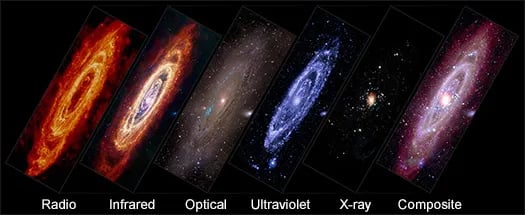
The new image from NASA is not a regular photo. It’s a composite made from X-ray, ultraviolet, optical, infrared, and radio data. Each type of light reveals different features of the galaxy.
Here’s what each wavelength adds to the picture:
- X-rays (Chandra and XMM-Newton): These show very hot gas and compact objects like neutron stars and black holes. X-ray light highlights some of the most energetic regions in the galaxy.
- Ultraviolet (GALEX): Ultraviolet light reveals young, hot, massive stars. These stars are often found in star-forming regions, helping scientists locate where new stars are being born.
- Optical (Ground-based telescopes): This is the type of light visible to our eyes. It shows the general structure of the galaxy, including its spiral arms.
- Infrared (Spitzer, IRAS, Planck, Herschel): Infrared light comes from cooler objects like dust clouds and star-forming regions hidden in gas.
- Radio (Westerbork Synthesis Radio Telescope): Radio waves show cold gas and energetic jets from dying stars or black holes.
Each telescope contributes something unique. Together, they create a full, three-dimensional view of the galaxy.

Honoring a pioneer: Vera Rubin
The composite image also pays tribute to astronomer Vera Rubin. Rubin was a pioneer in the study of galaxy rotation. Her work in the 1960s showed that stars in spiral galaxies rotate faster than expected. This led to the discovery of dark matter. Andromeda played a major role in Rubin’s research. She used it to help prove that most of the mass in galaxies is invisible. This mass, now called dark matter, doesn’t emit light but exerts a gravitational pull. To honor Rubin, NASA made her data central to this new project. Her legacy continues to guide astronomers studying galaxies like Andromeda.
Sonification: Hearing the galaxy
NASA also released a unique feature along with the image. It’s called sonification. In this project, scientists turned data into sound. Each wavelength of light is represented by a different musical tone. As the sonification moves across the galaxy, you can hear variations in pitch and volume. For example, X-ray data might sound like high-pitched electronic tones. Infrared light might sound like deep, smooth hums. The brightness of a source increases the volume. This isn’t just for fun. Sonification helps blind and visually impaired people explore astronomy. It also gives everyone a new way to experience the cosmos.
You can listen to the sonified version of Andromeda here.
NASA’s new multiwavelength image of Andromeda blends data from across the light spectrum to show our galactic neighbor in stunning detail. It reveals star birth, black hole activity, and the structure of a trillion-star system. The image honors the past with a nod to Vera Rubin. It points to the future by helping us understand the galaxy we may one day merge with. It invites everyone, scientists and the public alike, to see and even hear the wonders of the universe.
Clear skies!
See more from DIYPhotography.net on Google
Add DIYPhotography.net as a trusted source. This makes
our stories more likely to appear in your Google Search results.
 Add as a preferred source on Google

Soumyadeep Mukherjee
Soumyadeep Mukherjee is an award-winning astrophotographer from India. He has a doctorate degree in Linguistics. His work extends to the sub-genres of nightscape, deep sky, solar, lunar and optical phenomenon photography. He is also a photography educator and has conducted numerous workshops. His works have appeared in over 40 books & magazines including Astronomy, BBC Sky at Night, Sky & Telescope among others, and in various websites including National Geographic, NASA, Forbes. He was the first Indian to win “Astronomy Photographer of the Year” award in a major category.
Related Posts
 NASA Reshoots Iconic Image 20 Years Later. Releases Hubble’s Largest Image Ever of Andromeda.
 Hubble photo shows that Milky Way will collide with Andromeda galaxy. Are we doomed?
 Extraordinary photo of Andromeda Galaxy wins Astronomy Photographer of the Year 2020
 ZWO Astronomy Photographer of the Year 2025 Shines With Mesmerizing Andromeda Galaxy Portrait
Join the Discussion
DIYP Comment Policy
Be nice, be on-topic, no personal information or flames.
One response to “NASA releases Stunning Multiwavelength Image of Andromeda Galaxy”
Correction: “This led to the discovery of we don’t know what the hell it is!” We’re going to call it uh, light matter, or maybe dark matter, take your pick. The direct connection to dimensions 5-7 is what makes the galaxies spin the way they do, not stupid matter. Got it? Holographic Model? I was an Astronomy major for 1 year, and even I know this!