






















Cosmic Jet from the Dawn of Time: Chandra Reveals a Supermassive Surprise
Jun 16, 2025
Soumyadeep Mukherjee
Soumyadeep Mukherjee is an award-winning astrophotographer from India. He has a doctorate degree in Linguistics. His work extends to the sub-genres of nightscape, deep sky, solar, lunar and optical phenomenon photography. He is also a photography educator and has conducted numerous workshops. His works have appeared in over 40 books & magazines including Astronomy, BBC Sky at Night, Sky & Telescope among others, and in various websites including National Geographic, NASA, Forbes. He was the first Indian to win “Astronomy Photographer of the Year” award in a major category.
Share:

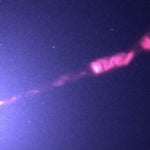
Astronomers have just uncovered one of the most dramatic sights in the universe. NASA’s Chandra X-ray Observatory has captured a powerful jet of energy blasting from a quasar over 11.6 billion light-years away. The object, known as PSO J161+1807 or J1610+1811, is a cosmic beacon from the early universe. It existed during the “cosmic noon,” a period when galaxies were rapidly forming stars. What makes this discovery even more remarkable is the jet’s size, speed, and brightness.
A quasar from the early universe
J1610+1811 is a quasar. A quasar is a supermassive black hole at the center of a young galaxy. It pulls in huge amounts of gas and dust. As material spirals into the black hole, it heats up and emits massive amounts of light. Some quasars also shoot out jets of high-energy particles. These jets travel close to the speed of light.
This particular quasar existed just 2 billion years after the Big Bang. That makes it one of the oldest known objects with such a powerful jet. Because light takes time to travel, we’re seeing this quasar as it looked over 11.6 billion years ago.

The cosmic jet is huge
The jet coming from J1610+1811 stretches for 300,000 light-years. That’s about three times the diameter of our Milky Way galaxy. It’s one of the longest jets ever seen at such a great distance. The sheer scale is difficult to imagine. This one feature from a single galaxy stretches across a vast portion of space. The jet is invisible in optical light, but it shines brightly in X-rays. That’s where Chandra comes in.
Chandra’s X-ray eyes
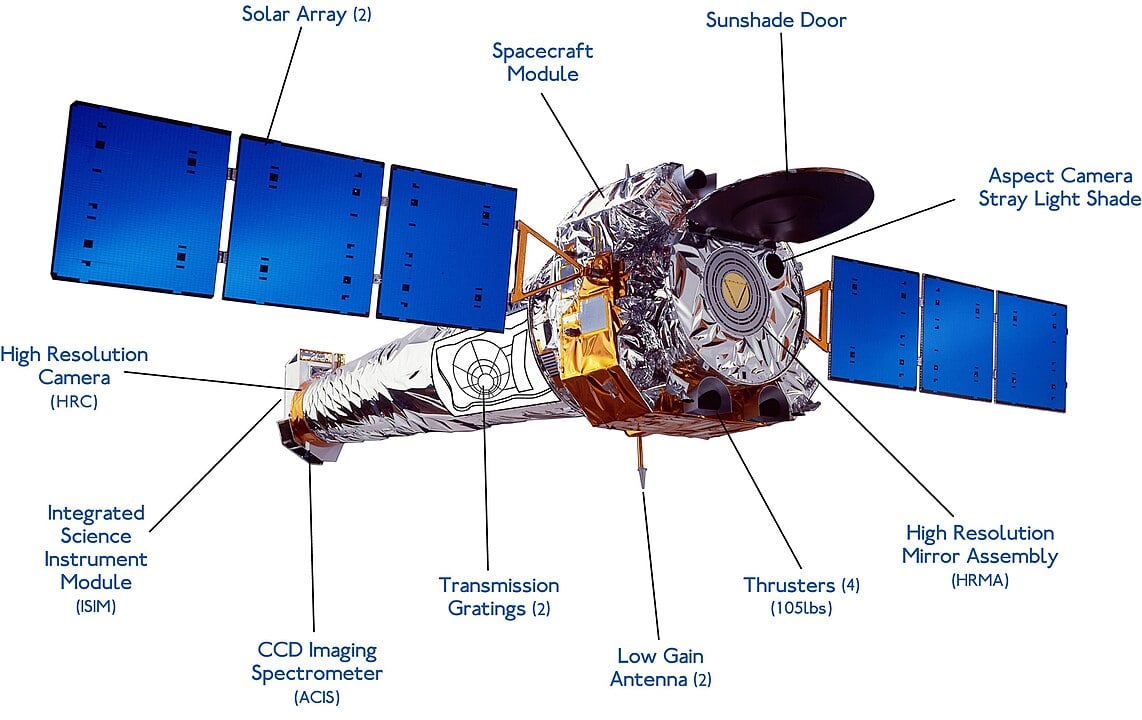
NASA’s Chandra X-ray Observatory detected the jet using its specialized detectors. Chandra sees X-rays, a form of high-energy light that human eyes can’t see. These X-rays come from particles in the jet moving at relativistic speeds, between 92% and 98% of the speed of light. But the X-rays didn’t originate from the quasar directly. Instead, they came from a clever process called inverse Compton scattering.
Boosted by the Cosmic Microwave Background
The universe is filled with faint radiation from the Big Bang. It’s called the cosmic microwave background (CMB). In the early universe, the CMB was denser and hotter than it is today. Particles in the jet collide with CMB photons. These collisions give the photons more energy, boosting them into the X-ray range. This process, called inverse Compton scattering, lights up the jet in X-rays. Chandra captured that glow. Because the CMB was brighter billions of years ago, these jets shine more clearly in the early universe. The universe itself acts like a cosmic flashlight, revealing hidden structures from long ago.
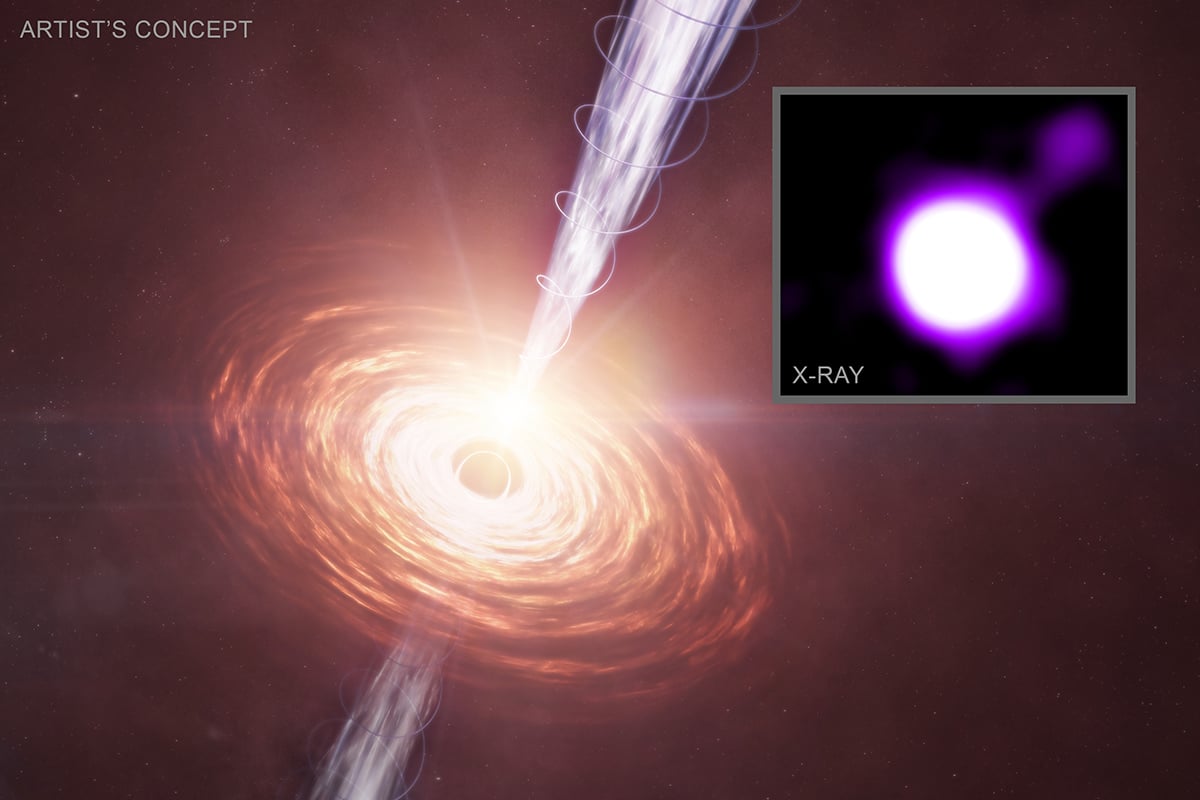
Artist’s visualization
NASA released an artist’s illustration of the scene. It shows the black hole at the center of a glowing disk. Two silver jets shoot out in opposite directions. One jet, pointed toward us, shines brightly thanks to relativistic effects. It’s an artistic guess, but it captures the incredible scale and power of J1610+1811.
This discovery is a cosmic time machine. It provides us with a window into how the universe functioned billions of years ago. J1610+1811 is not just a dot in the sky. It’s a roaring engine from the dawn of time, blasting energy across space. Thanks to Chandra and VLA, we can see it today. We can measure its power, map its direction, and study its role in galaxy evolution. And as long as telescopes like Chandra continue to observe, more discoveries like this await.
Clear skies!
See more from DIYPhotography.net on Google
Add DIYPhotography.net as a trusted source. This makes
our stories more likely to appear in your Google Search results.
 Add as a preferred source on Google

Soumyadeep Mukherjee
Soumyadeep Mukherjee is an award-winning astrophotographer from India. He has a doctorate degree in Linguistics. His work extends to the sub-genres of nightscape, deep sky, solar, lunar and optical phenomenon photography. He is also a photography educator and has conducted numerous workshops. His works have appeared in over 40 books & magazines including Astronomy, BBC Sky at Night, Sky & Telescope among others, and in various websites including National Geographic, NASA, Forbes. He was the first Indian to win “Astronomy Photographer of the Year” award in a major category.


Join the Discussion
DIYP Comment Policy
Be nice, be on-topic, no personal information or flames.