






















Hubble Revisits a Microlensing Event: A Preview of Roman Telescope
May 13, 2026
Soumyadeep Mukherjee
Soumyadeep Mukherjee is an award-winning astrophotographer from India. He has a doctorate degree in Linguistics. His work extends to the sub-genres of nightscape, deep sky, solar, lunar and optical phenomenon photography. He is also a photography educator and has conducted numerous workshops. His works have appeared in over 40 books & magazines including Astronomy, BBC Sky at Night, Sky & Telescope among others, and in various websites including National Geographic, NASA, Forbes. He was the first Indian to win “Astronomy Photographer of the Year” award in a major category.
Share:
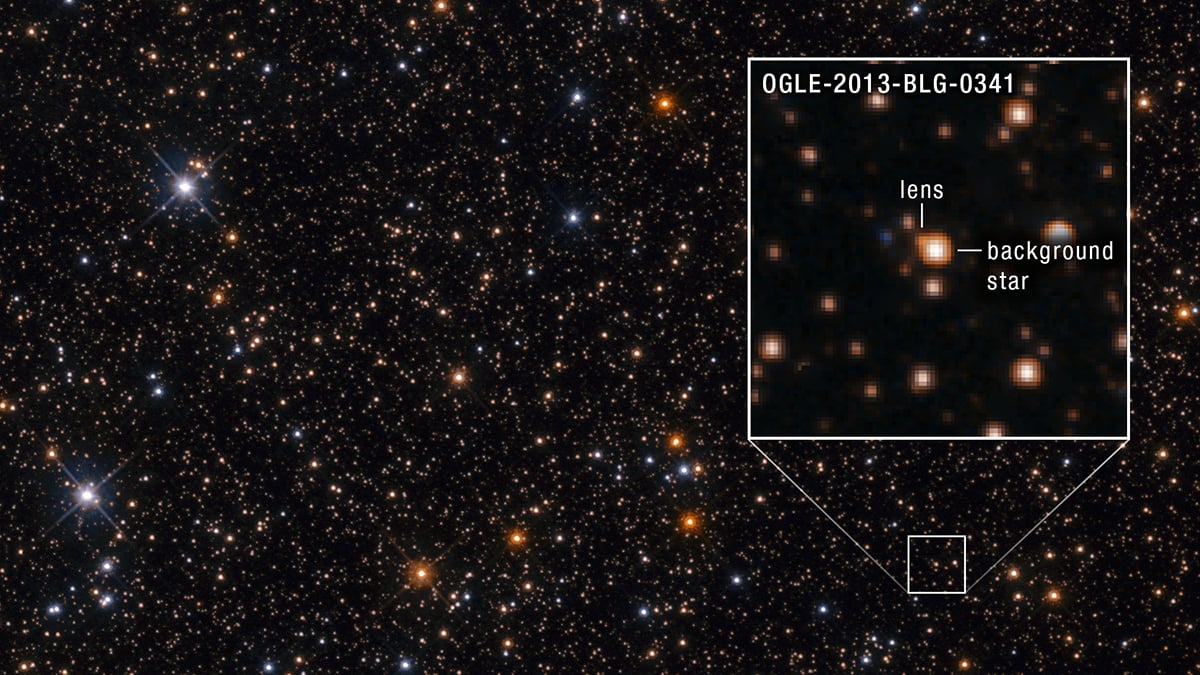
Astronomers often describe gravitational microlensing as one of the most demanding techniques in observational astrophysics. A newly released observation from NASA’s Hubble Space Telescope has returned attention to one of these events. The target, known as OGLE-2013-BLG-0341, first appeared in astronomical data more than a decade ago. At the time, astronomers detected an unusual brightening in a distant star toward the Galactic bulge. The observations eventually revealed a low-mass exoplanet orbiting the foreground star.
Years later, Hubble revisited the same region and resolved the stars involved in the event. This image offers a preview of the type of science NASA expects from the upcoming Nancy Grace Roman Space Telescope. Roman will conduct one of the largest microlensing surveys ever attempted. Scientists expect the mission to detect thousands of exoplanets across the Milky Way, including cold worlds and rogue planets that are currently difficult to study with existing methods.
A decade-old brightening event
The original microlensing event appeared in 2013 during observations from the Optical Gravitational Lensing Experiment, widely known as OGLE. The project monitors millions of stars toward the dense central regions of the Milky Way. Astronomers search these star fields for temporary changes in brightness that may indicate gravitational lensing events.
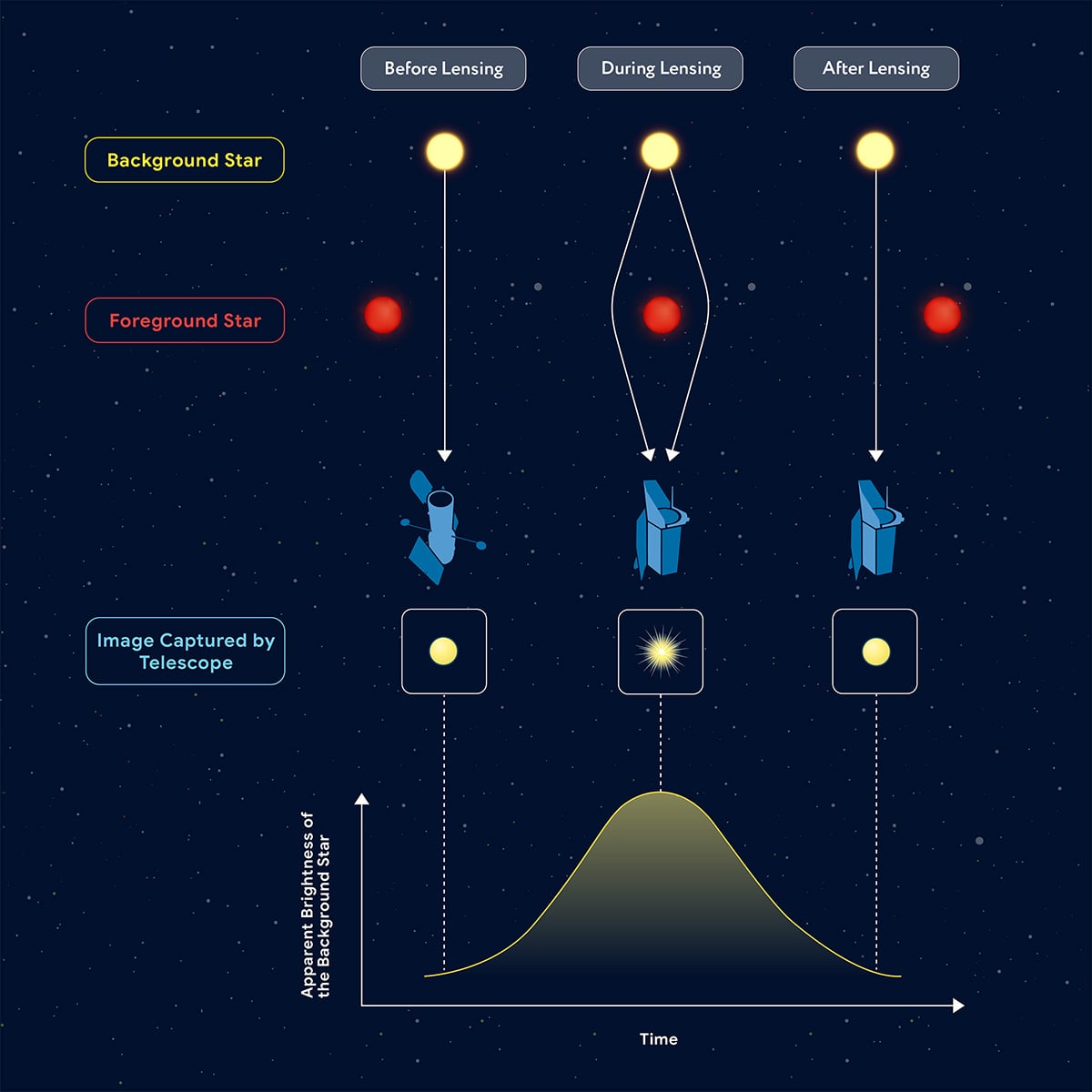
In this case, a foreground object passed almost perfectly in front of a more distant background star. According to general relativity, gravity bends the path of light traveling near a massive object. As the alignment developed, the foreground object magnified the background star’s light and created a measurable brightening signal.
During the 2013 event, astronomers noticed additional distortions in the light curve. These deviations suggested the presence of a low-mass planet orbiting the foreground lens star. Later analysis confirmed the existence of the planet now designated OGLE-2013-BLG-0341L Bb.
NASA classifies the object as a super-Earth with a mass roughly 1.66 times greater than Earth’s. The planet orbits relatively far from its host star compared to many exoplanets detected through transit surveys.
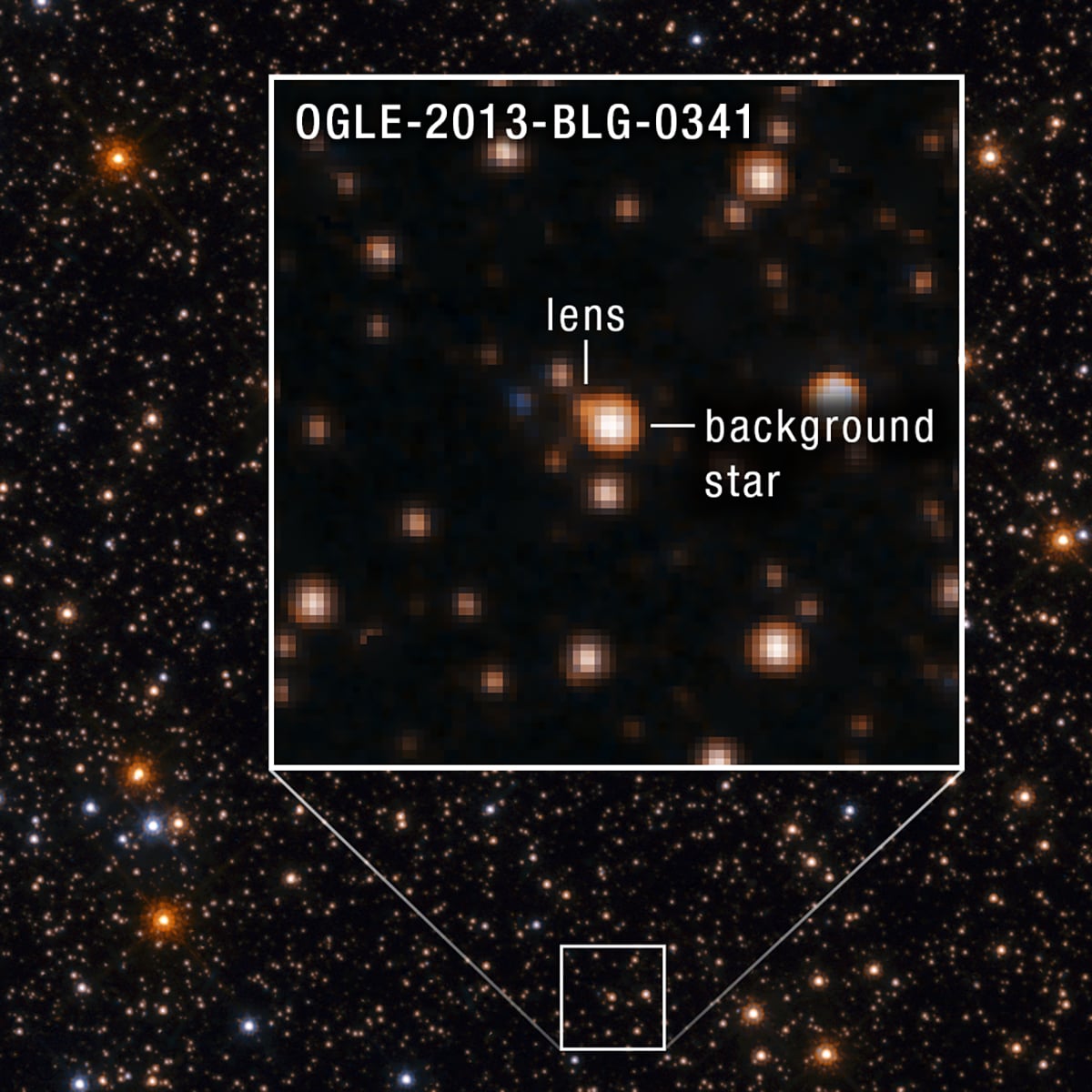
Hubble resolves the lens and source stars
When the microlensing event occurred in 2013, telescopes could not distinguish the foreground lens star from the distant background source star. The alignment placed both objects so close together that they appeared merged into a single unresolved point of light.
Over the years, the foreground and background stars drifted apart due to their independent motion through space. The separation remained extremely small, but Hubble’s angular resolution allowed astronomers to resolve the two objects individually.
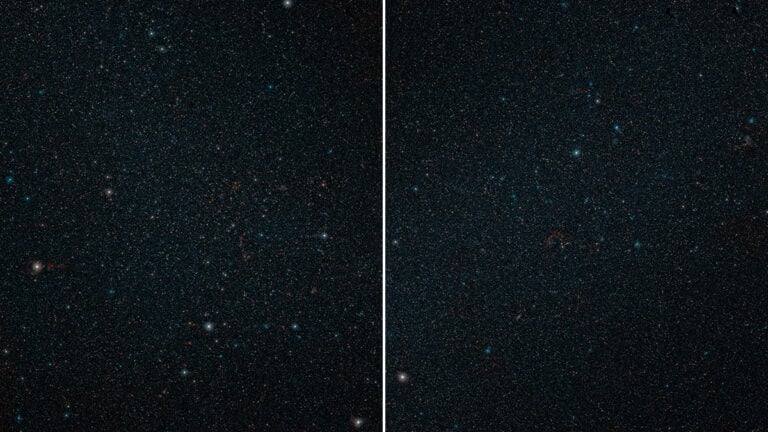
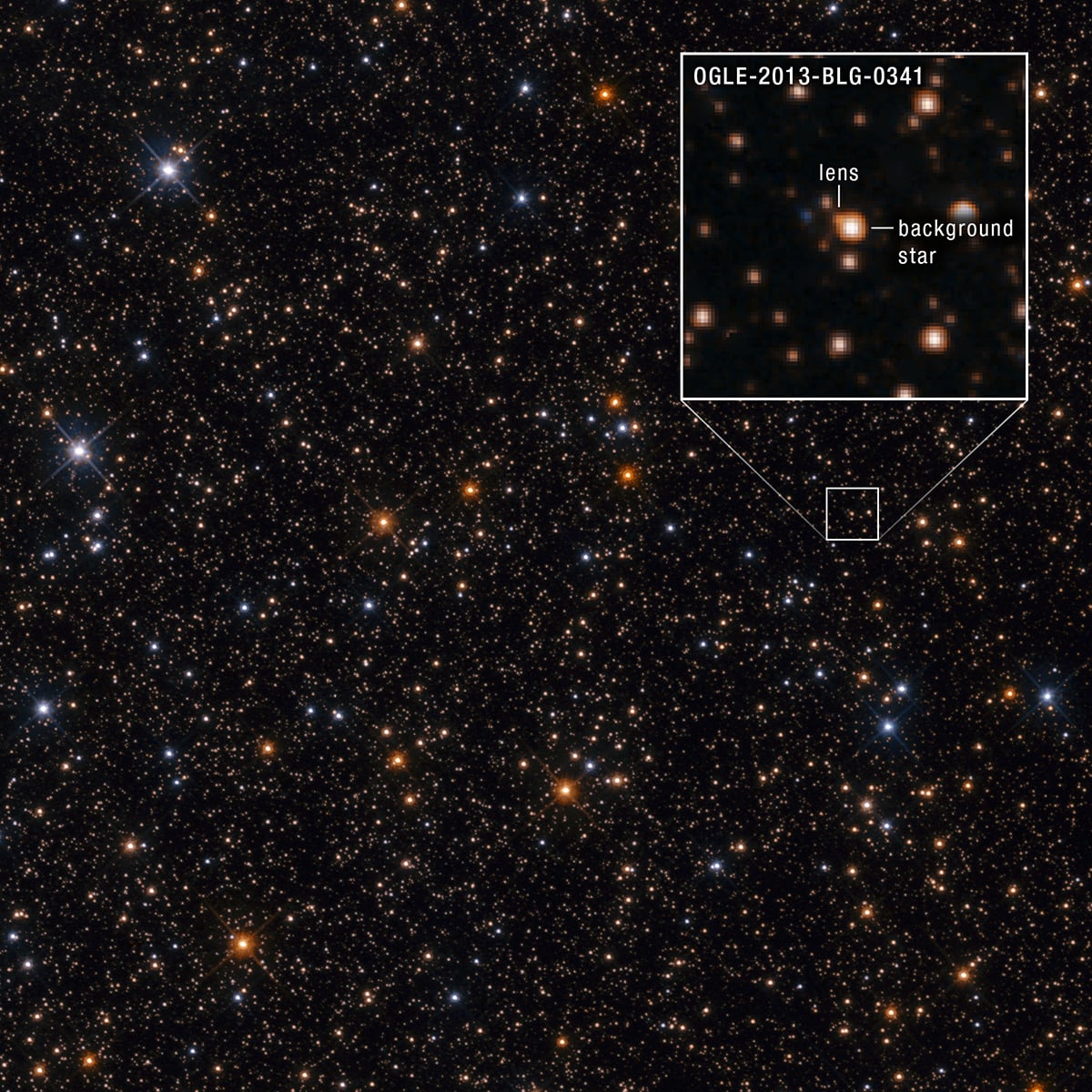
The new image shows two faint reddish sources sitting close together inside a crowded stellar field. One object represents the foreground lens system responsible for the microlensing event. The second object marks the distant background star whose light underwent gravitational magnification during the alignment.
The ability to resolve the stars also helps astronomers eliminate alternative explanations for the original signal. In crowded regions near the Galactic center, multiple stars can overlap along the same line of sight. Follow-up observations reduce confusion and strengthen confidence in the planetary interpretation.
Microlensing for identifying planetary systems
The transit method is the dominant method for modern exoplanet discoveries. Missions such as Kepler and TESS detect planets when they pass in front of their stars and block a small fraction of starlight. That technique has transformed planetary science during the past two decades.
However, transit surveys strongly favour planets orbiting close to their stars. Large planets also produce deeper brightness dips and become easier to detect. As a result, many known exoplanets differ substantially from the architecture of our own solar system.
The microlensing method remains sensitive to planets orbiting farther from their stars, including cold super-Earths and ice giants. These objects receive less stellar radiation and often reside beyond the so-called snow line, where volatile compounds freeze into ice during planetary formation.
Microlensing also detects planets around faint stars that emit little visible light. In some cases, the method can reveal rogue planets drifting through interstellar space without a host star. Researchers can even use microlensing to study brown dwarfs, neutron stars, and isolated black holes.
Roman Telescope: Expanding microlensing science
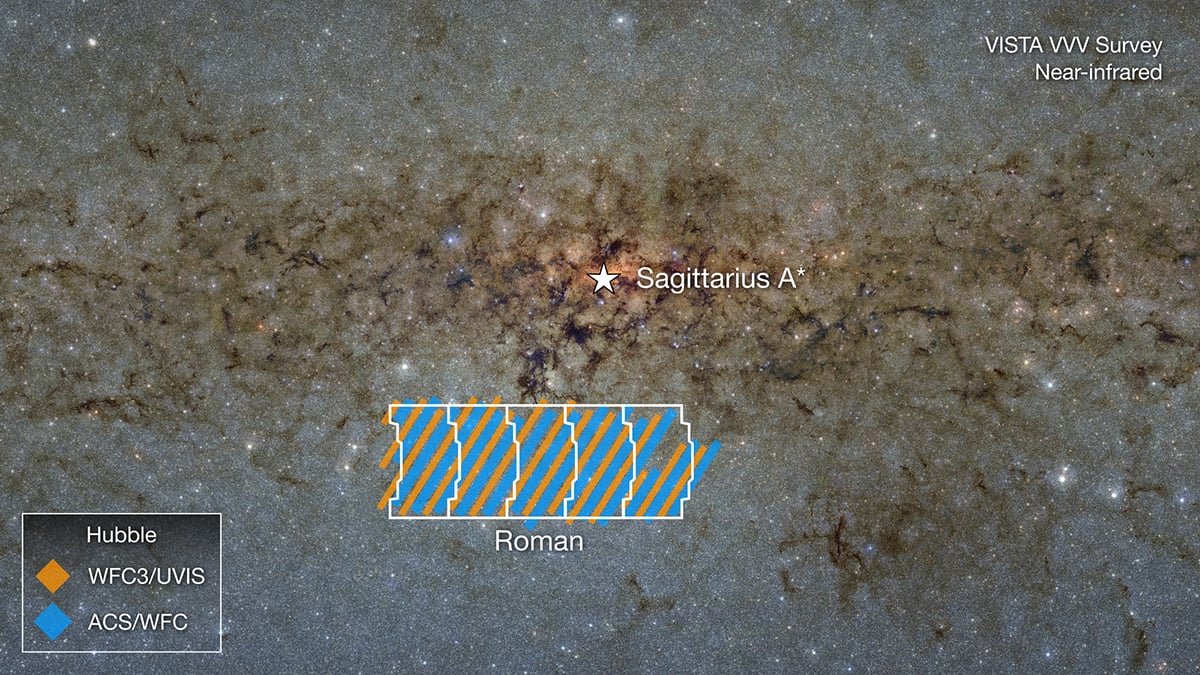
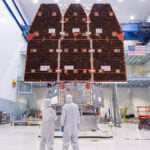
NASA’s Nancy Grace Roman Space Telescope will soon become the most powerful observatory ever dedicated to microlensing exoplanet surveys. The mission aims to monitor dense star fields near the Galactic bulge with extraordinary sensitivity and stability.
Roman will repeatedly observe millions of stars while searching for tiny changes in brightness caused by gravitational lensing events. Because the telescope operates above Earth’s atmosphere, it will achieve cleaner and more stable measurements than most ground-based surveys. Scientists expect Roman to discover thousands of new exoplanets during its mission lifetime. Many of these worlds may resemble planets currently underrepresented in exoplanet catalogs.
Researchers anticipate detections of cold super-Earths, ice giants, and planets orbiting far from their host stars. Roman may also uncover a significant population of rogue planets wandering independently through the galaxy. The mission’s observing strategy differs from earlier exoplanet surveys. Roman will study enormous stellar populations toward the Milky Way’s crowded center.
Roman will also combine photometric measurements with astrometric observations. These data will help scientists estimate the masses and distances of otherwise invisible objects. Researchers hope to study isolated neutron stars and black holes through these measurements.
Clear skies!
See more from DIYPhotography.net on Google
Add DIYPhotography.net as a trusted source. This makes
our stories more likely to appear in your Google Search results.
 Add as a preferred source on Google

Soumyadeep Mukherjee
Soumyadeep Mukherjee is an award-winning astrophotographer from India. He has a doctorate degree in Linguistics. His work extends to the sub-genres of nightscape, deep sky, solar, lunar and optical phenomenon photography. He is also a photography educator and has conducted numerous workshops. His works have appeared in over 40 books & magazines including Astronomy, BBC Sky at Night, Sky & Telescope among others, and in various websites including National Geographic, NASA, Forbes. He was the first Indian to win “Astronomy Photographer of the Year” award in a major category.

Join the Discussion
DIYP Comment Policy
Be nice, be on-topic, no personal information or flames.