





















Hubble Photographs the Most Massive Black Hole in the Universe
Aug 16, 2025
Soumyadeep Mukherjee
Soumyadeep Mukherjee is an award-winning astrophotographer from India. He has a doctorate degree in Linguistics. His work extends to the sub-genres of nightscape, deep sky, solar, lunar and optical phenomenon photography. He is also a photography educator and has conducted numerous workshops. His works have appeared in over 40 books & magazines including Astronomy, BBC Sky at Night, Sky & Telescope among others, and in various websites including National Geographic, NASA, Forbes. He was the first Indian to win “Astronomy Photographer of the Year” award in a major category.
Share:
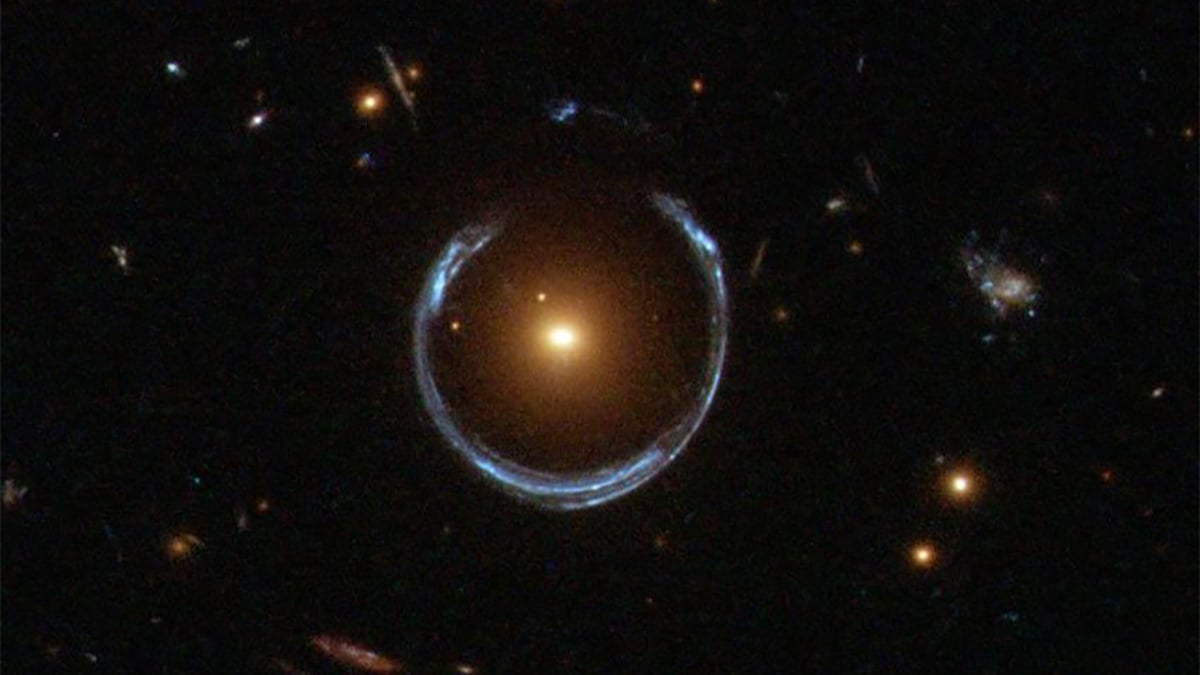
Astronomers have long searched for the heaviest black holes in the universe. These giants, called ultramassive black holes, contain tens of billions of solar masses. Until recently, most were found only in the brightest quasars, where their feeding activity makes them visible across space. The new measurement from the Cosmic Horseshoe galaxy changes that picture. Using Hubble Space Telescope images and detailed maps of stellar motion, researchers have identified a dormant black hole with a mass of about 36 billion Suns.
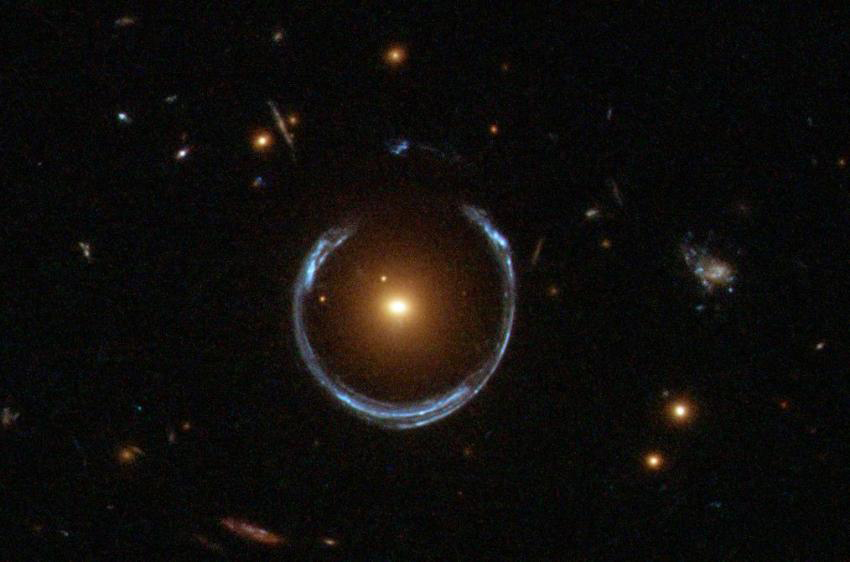
Cosmic horseshoe
At the center sits a luminous red galaxy that acts as the gravitational lens. Behind it lies a blue, star-forming galaxy. The foreground galaxy bends the background light into an almost complete ring. Hubble recorded this alignment in remarkable detail. The system is one of the clearest Einstein rings known. The background galaxy lies at a redshift of about 2.4. We see it as it looked only a few billion years after the Big Bang. The lens galaxy is much closer, at a redshift of about 0.44. Together they create the “Cosmic Horseshoe.”
Gravity is making a ring
Gravity bends light when mass sits between us and a more distant source. General relativity predicts this effect. If the alignment is tight, light from the background galaxy forms arcs. With near-perfect alignment, those arcs close into a ring. The lens magnifies the background galaxy, revealing features we could not otherwise see. The lens also acts as a scale for mass. The larger the ring, the more mass within the central region. That mass includes stars, gas, and dark matter. In extreme cases, it also includes a central black hole. Hubble has documented many lenses that serve this role, but the Cosmic Horseshoe stands out for its clarity and size.
Measuring an ultramassive black hole
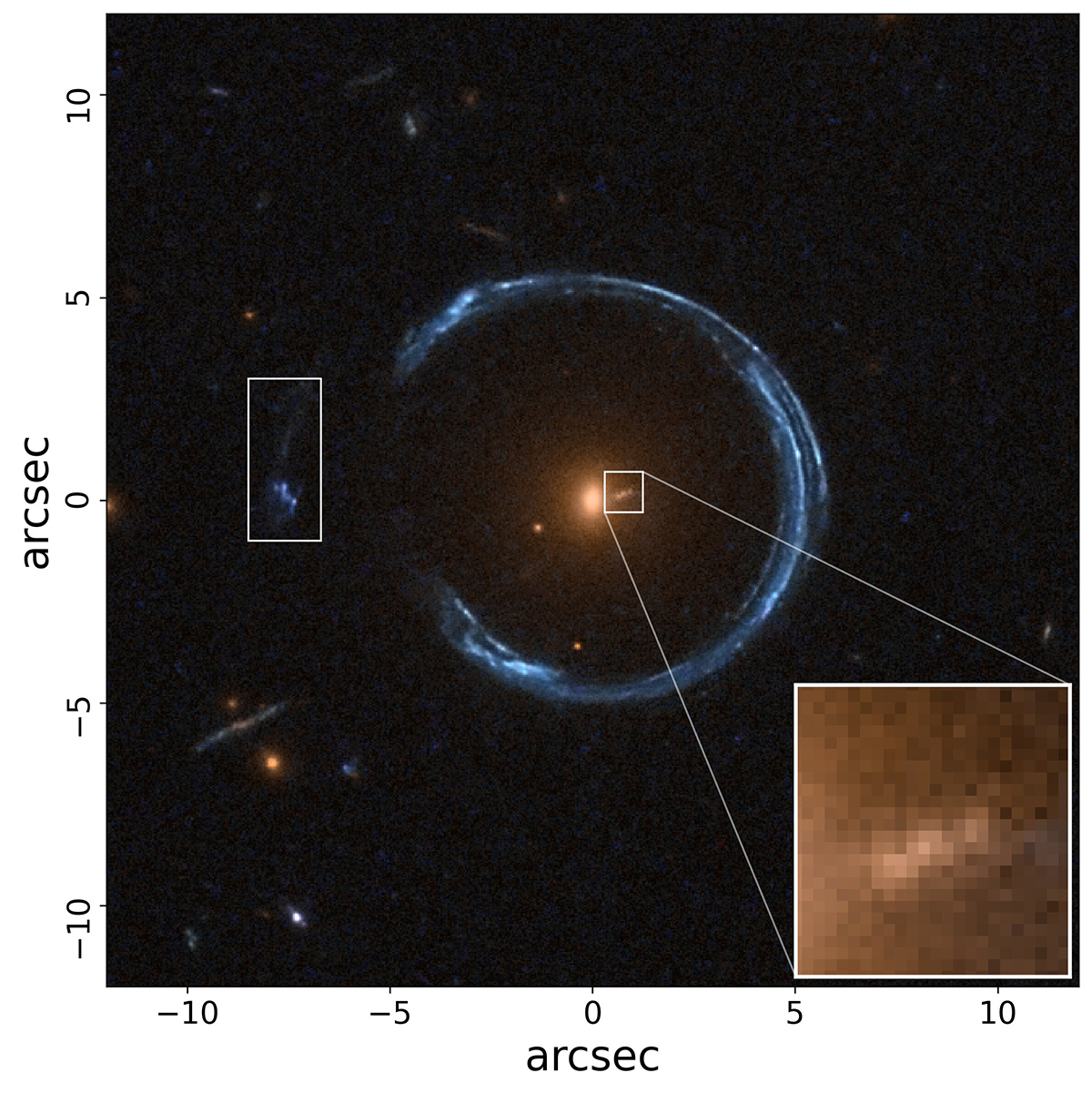
The Cosmic Horseshoe is now linked to a major result. Researchers report a black hole with a mass of about 3.6×10¹⁰ Suns. That is 36 billion solar masses. The team combined two powerful datasets. They modeled the ring geometry from Hubble imaging. They also mapped stellar motions across the lens galaxy. The motion data came from integral-field spectroscopy. Together, these observations lock down the mass near the galaxy center. The analysis indicates an ultramassive black hole with strong statistical support.
The “massive” numbers
A 36-billion-solar-mass black hole is extreme. It sits far above the mass of the Milky Way’s central black hole. It also challenges simple growth models. Massive galaxies and their black holes appear to co-evolve. Astronomers describe tight links between black hole mass and stellar velocity dispersion. At the highest masses, those relations may steepen. The new measurement places the Horseshoe’s black hole above standard trends. That suggests different growth paths for the most massive systems. Mergers likely played a role over cosmic time. The lens galaxy resembles the brightest galaxy in a group. Such galaxies often sit in dense environments. Repeated mergers can drive rapid black hole growth.
From image to results
The ring’s geometry sets the total mass in projection. But stars and dark matter contribute most of that mass. To isolate the black hole, astronomers need stellar motions near the center. Integral-field spectroscopy maps those motions across many small regions. The Cosmic Horseshoe offers both ingredients. Hubble resolves the ring and the lens morphology. Spectroscopy delivers a velocity field and dispersion map. Models then test different mass components. These include stars, a dark matter halo, and a central point mass. The favored model requires a huge black hole to match the inner kinematics. The preference remains even under multiple systematic checks.
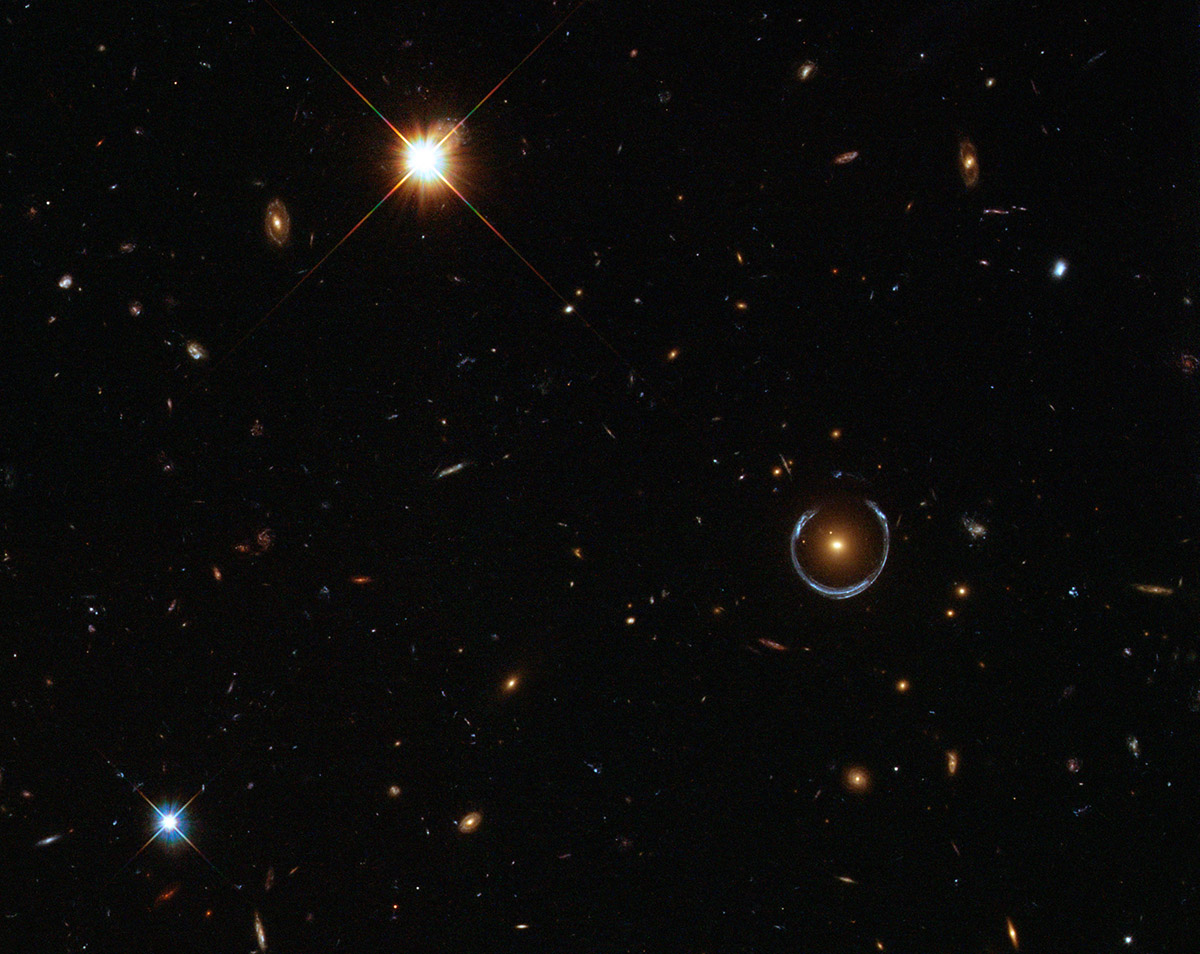
Hubble continues to deliver sharp imaging for bright lenses. In the future, other facilities can provide spectroscopy, and new missions will enlarge the sample and improve statistics. With larger samples, astronomers can map black hole growth across time; test whether extreme masses always sit above standard relations. They can track how the environment shapes the most massive systems. The Cosmic Horseshoe result sets a strong benchmark for this work.
Clear skies!
See more from DIYPhotography.net on Google
Add DIYPhotography.net as a trusted source. This makes
our stories more likely to appear in your Google Search results.
 Add as a preferred source on Google

Soumyadeep Mukherjee
Soumyadeep Mukherjee is an award-winning astrophotographer from India. He has a doctorate degree in Linguistics. His work extends to the sub-genres of nightscape, deep sky, solar, lunar and optical phenomenon photography. He is also a photography educator and has conducted numerous workshops. His works have appeared in over 40 books & magazines including Astronomy, BBC Sky at Night, Sky & Telescope among others, and in various websites including National Geographic, NASA, Forbes. He was the first Indian to win “Astronomy Photographer of the Year” award in a major category.

Join the Discussion
DIYP Comment Policy
Be nice, be on-topic, no personal information or flames.