




















Hubble photographs a Portrait of a Galaxy Cluster
Jul 7, 2025
Soumyadeep Mukherjee
Soumyadeep Mukherjee is an award-winning astrophotographer from India. He has a doctorate degree in Linguistics. His work extends to the sub-genres of nightscape, deep sky, solar, lunar and optical phenomenon photography. He is also a photography educator and has conducted numerous workshops. His works have appeared in over 40 books & magazines including Astronomy, BBC Sky at Night, Sky & Telescope among others, and in various websites including National Geographic, NASA, Forbes. He was the first Indian to win “Astronomy Photographer of the Year” award in a major category.
Share:
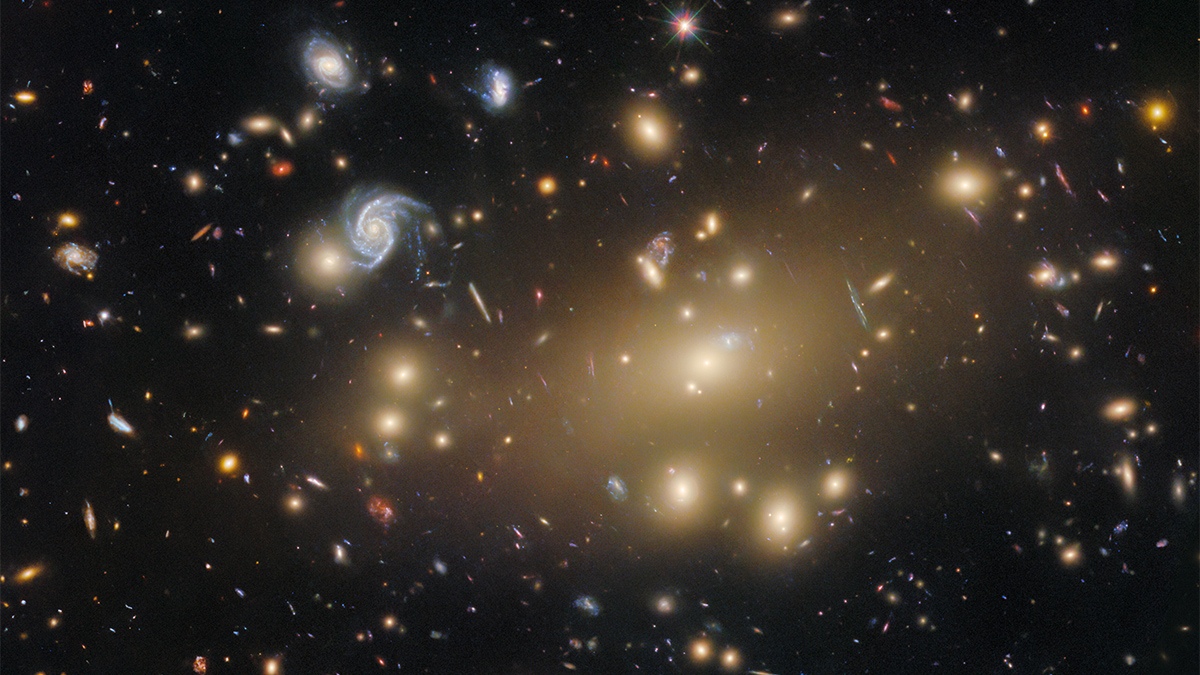
Deep in the constellation Cetus, nearly 2.8 billion light-years from Earth, lies a massive galaxy cluster. This cosmic giant is known as Abell 209. It contains hundreds of galaxies bound together by gravity. These galaxies are drifting through space as one enormous structure. The Hubble Space Telescope recently captured a spectacular view of Abell 209. The image is part of Hubble’s “Picture of the Week” series. Released in early July 2025, it reveals golden elliptical galaxies and faint bluish spirals. But beyond the beauty lies cutting-edge science. This image helps astronomers study galaxy evolution and the mysterious forces of dark matter and gravity.
Abell 209
The galaxy cluster Abell 209 is part of the Abell catalogue, a list of galaxy clusters compiled by astronomer George O. Abell in 1958. The catalogue includes thousands of clusters identified in photographic plates. Abell 209 stands out for its size and brightness. This cluster belongs to the class of massive galaxy clusters. It holds hundreds of galaxies and a huge amount of hot gas. The total mass is more than a quadrillion times the mass of the Sun. That’s a number with 15 zeroes. Such clusters are rare and important. They are like cities of galaxies, where cosmic interactions shape the universe.
The view from Hubble
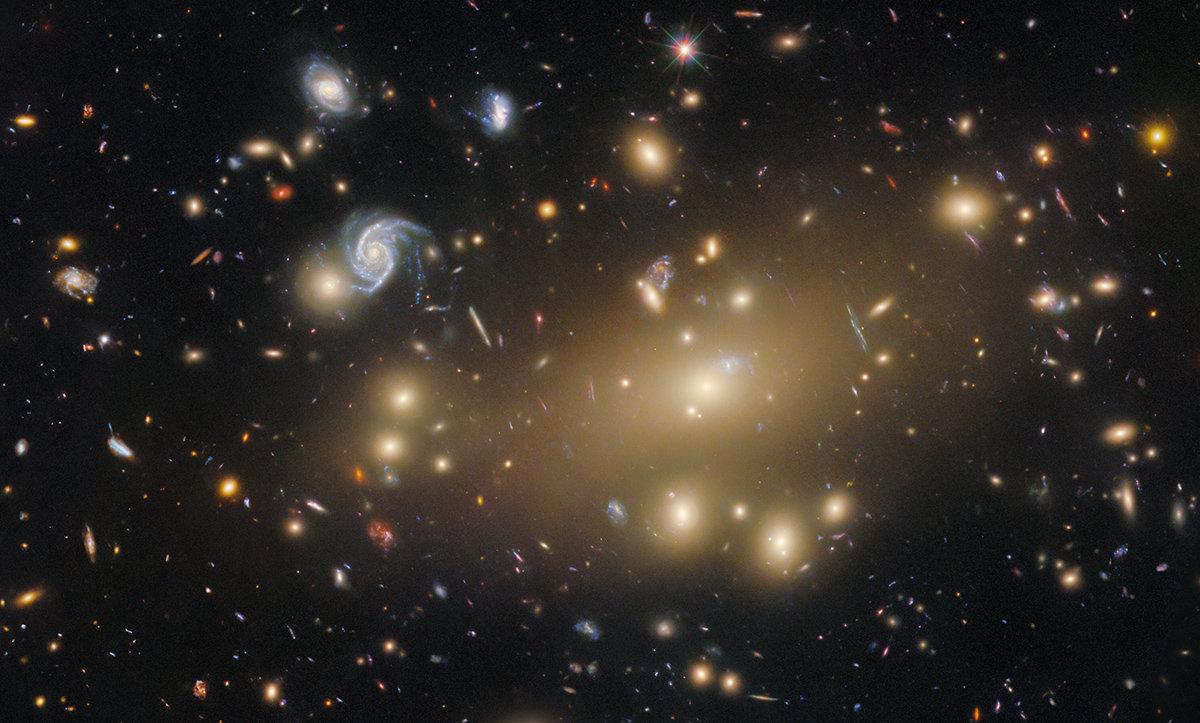
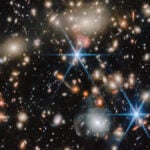
The new image of Abell 209 is stunning. It shows a swarm of galaxies in glowing shades of gold and yellow. Most of these are elliptical galaxies, which are smooth, featureless, and old. They don’t have much gas or dust left to form new stars. These galaxies are ancient and quiet. Among the elliptical galaxies are a few spiral galaxies. These are bluish. Their arms show ongoing star formation. The mix of red, yellow, and blue reveals the ages and activity levels of different galaxies. The galaxies are not all in the same plane. Some are in front of or behind others. Together, they form a thick wall of matter in space.
Gravitational Lensing in the image
One of the most important features of Abell 209 is gravitational lensing. The massive cluster bends space and time. This is a prediction of Einstein’s general theory of relativity. Light from background galaxies travels through this warped space. As a result, it bends and stretches. This creates arcs and distorted shapes around the cluster. Some background galaxies appear smeared out into curved lines. Gravitational lensing is not just a pretty effect. It helps scientists map the mass of the cluster and reveals where dark matter is hiding. It also allows astronomers to view extremely distant galaxies that would otherwise be too faint to see. Even though the arcs in this Hubble image are faint, they are real. They serve as evidence of lensing and offer valuable data.
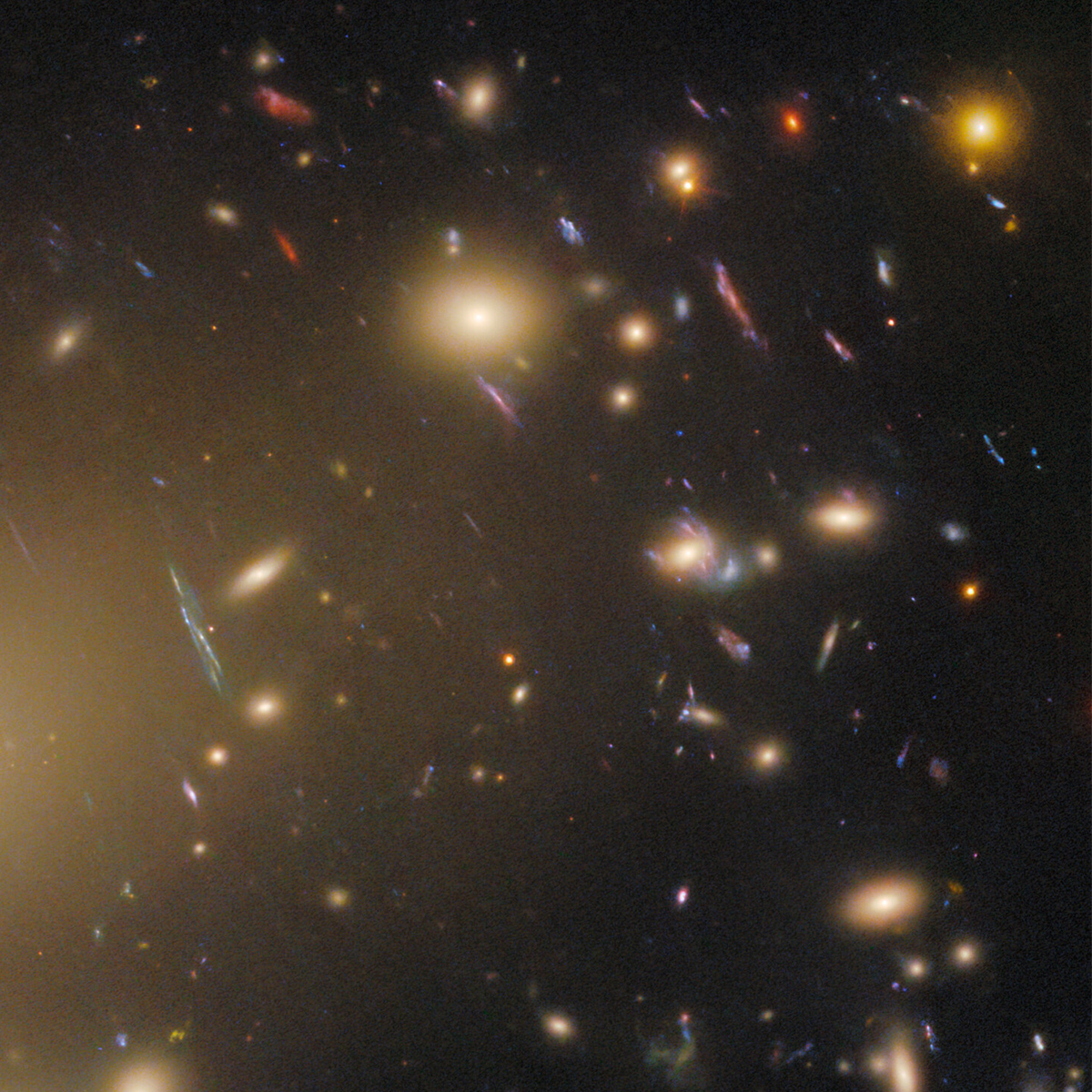
When we look at the Hubble image of Abell 209, we see more than glowing dots. We see ancient galaxies, shaped by time and gravity, and a vast structure billions of light-years away. We see the fingerprints of dark matter and the bending of space.
Clear skies!
See more from DIYPhotography.net on Google
Add DIYPhotography.net as a trusted source. This makes
our stories more likely to appear in your Google Search results.
 Add as a preferred source on Google

Soumyadeep Mukherjee
Soumyadeep Mukherjee is an award-winning astrophotographer from India. He has a doctorate degree in Linguistics. His work extends to the sub-genres of nightscape, deep sky, solar, lunar and optical phenomenon photography. He is also a photography educator and has conducted numerous workshops. His works have appeared in over 40 books & magazines including Astronomy, BBC Sky at Night, Sky & Telescope among others, and in various websites including National Geographic, NASA, Forbes. He was the first Indian to win “Astronomy Photographer of the Year” award in a major category.
Join the Discussion
DIYP Comment Policy
Be nice, be on-topic, no personal information or flames.