























Ash Creeps Across Mars: Mars Express Captures Decades of Surface Change
May 9, 2026
Soumyadeep Mukherjee
Soumyadeep Mukherjee is an award-winning astrophotographer from India. He has a doctorate degree in Linguistics. His work extends to the sub-genres of nightscape, deep sky, solar, lunar and optical phenomenon photography. He is also a photography educator and has conducted numerous workshops. His works have appeared in over 40 books & magazines including Astronomy, BBC Sky at Night, Sky & Telescope among others, and in various websites including National Geographic, NASA, Forbes. He was the first Indian to win “Astronomy Photographer of the Year” award in a major category.
Share:
Planetary scientists often describe Mars as a world shaped by ancient processes. Most of its volcanoes became inactive billions of years ago. Its magnetic field vanished early in its history, and surface water gradually disappeared as the atmosphere thinned. Yet orbital observations continue to show that Mars remains an evolving planet. Wind erosion, dust transport, seasonal ice activity, and subsurface volatile loss still modify the landscape across large regions.
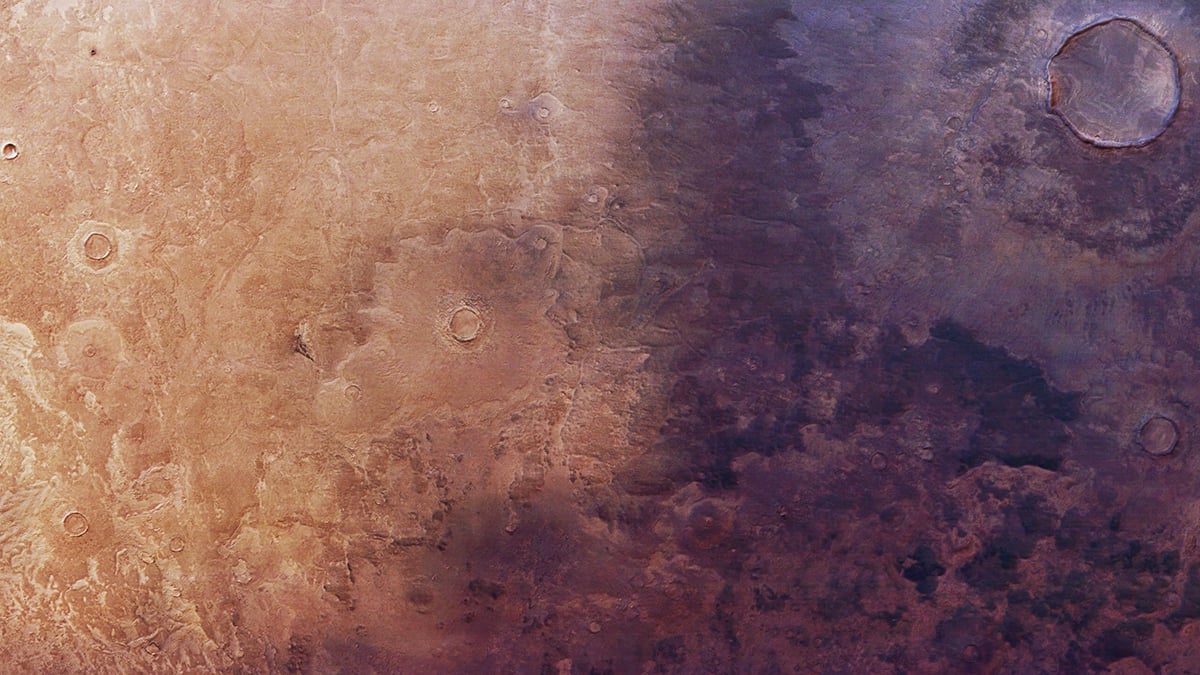
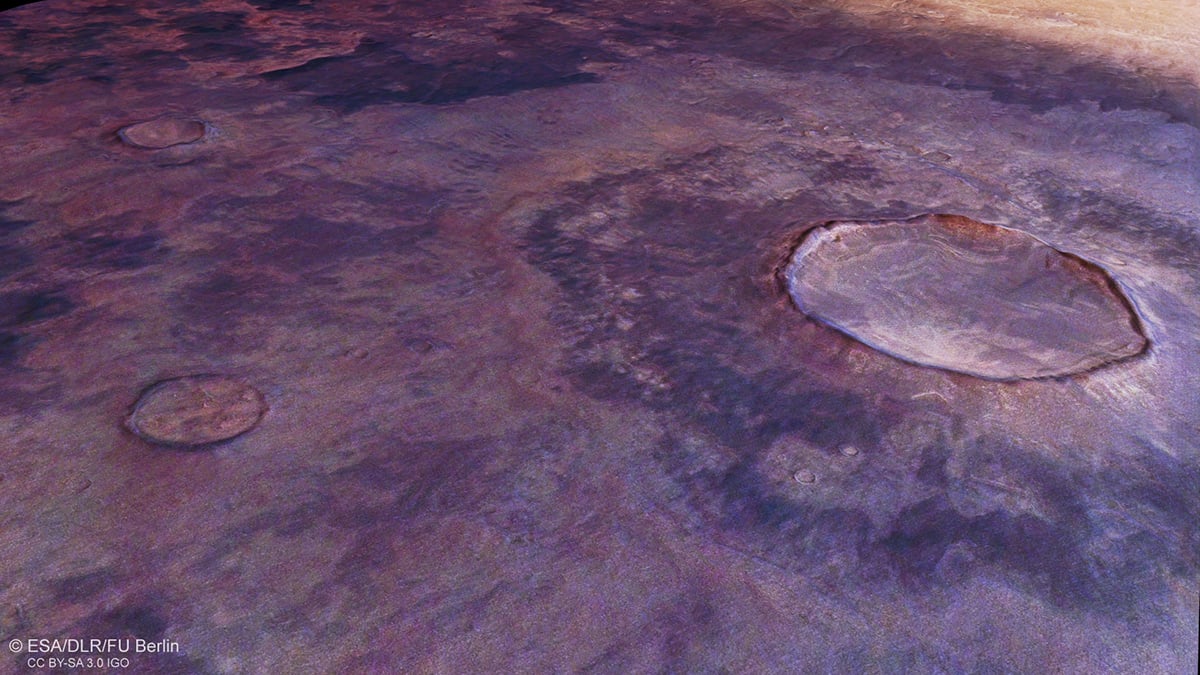
New observations from the European Space Agency’s Mars Express spacecraft now provide one of the clearest examples of these ongoing changes. The latest images focus on Utopia Planitia, a vast basin in the northern hemisphere of Mars. When scientists compared recent observations with photographs taken by NASA’s Viking orbiters in 1976, they found that a broad deposit of dark volcanic material had expanded across the surface during the past five decades. The change is evident across hundreds of kilometers and stands out strongly against the lighter, reddish terrain surrounding it.
Mars Express captures large-scale changes on the Martian surface
ESA’s Mars Express spacecraft arrived at Mars in December 2003 and has remained operational ever since. Over the years, the mission has mapped valleys, volcanoes, glaciers, layered deposits, and atmospheric structures across the planet. Its High-Resolution Stereo Camera became especially important for geological studies because it provides detailed color and topographic imaging across wide regions.
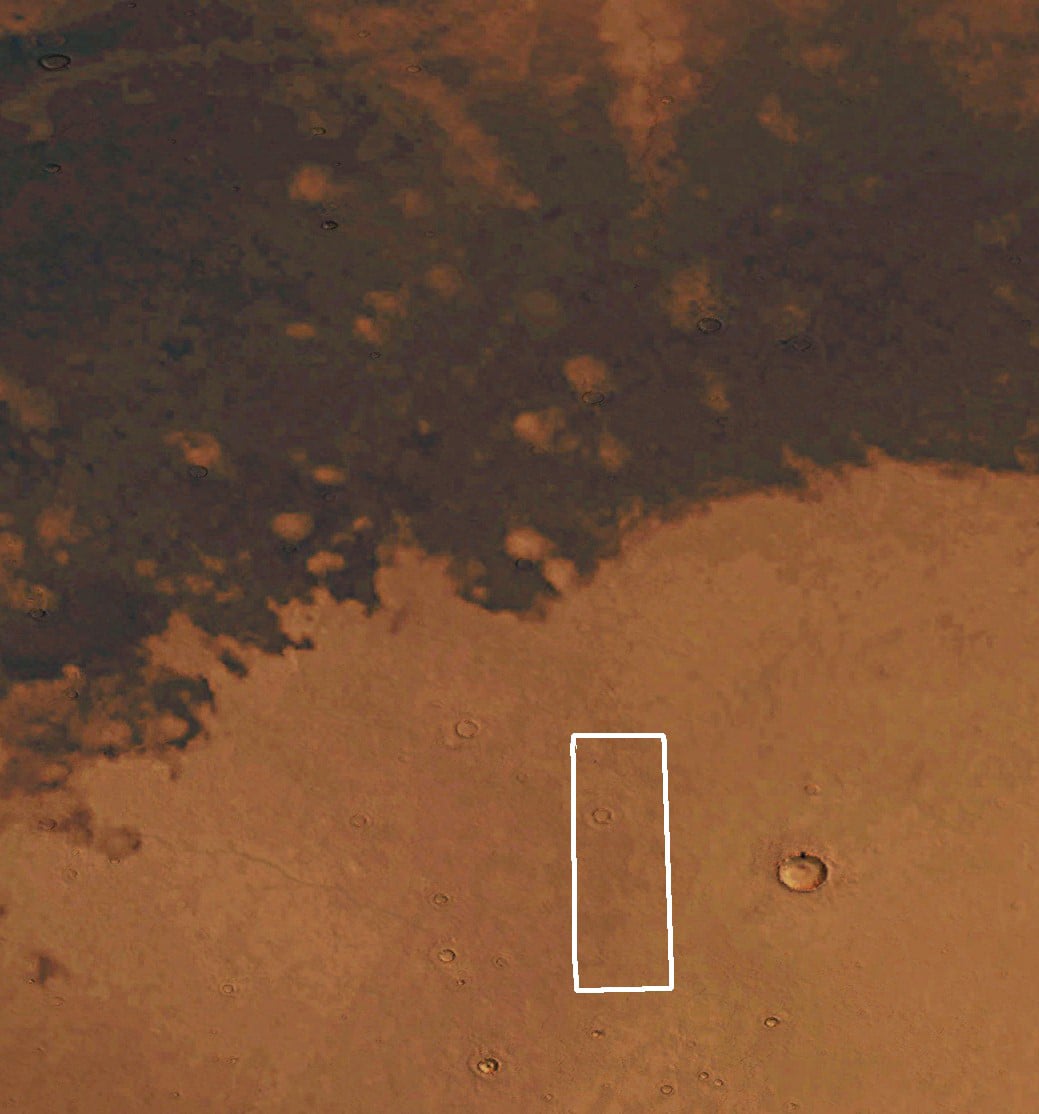
The newly released observations came from images collected during a November 2024 flyover of Utopia Planitia. Scientists noticed the extent of the dark terrain visible in the region. However, the real significance emerged after comparisons with Viking-era photographs from the 1970s.
The side-by-side comparison revealed that the dark material now occupies a much larger area than it did nearly fifty years ago. In planetary geology, such visible changes over a relatively short interval attract serious attention. Most Martian landforms evolve slowly across geological timescales. Craters remain preserved for millions of years, and many volcanic structures date back to the planet’s earliest history. Against that backdrop, a noticeable surface transformation over the past few decades appears remarkable.
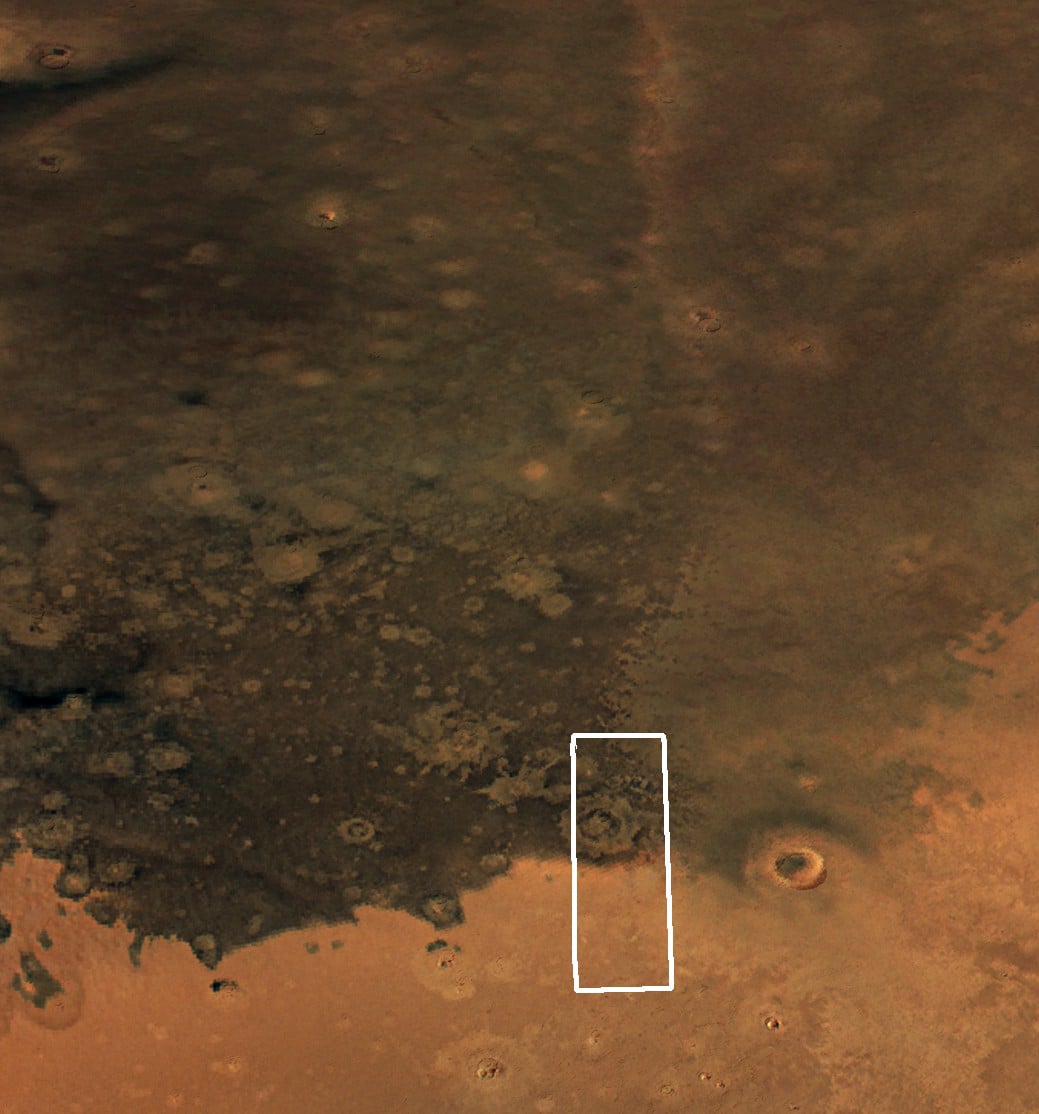
The current observations suggest that these processes continue to this day. The dark material appears to spread outward in irregular patterns, almost like a stain expanding across the landscape. Wind likely drives much of that movement. Mars possesses an atmosphere only about one percent as dense as Earth’s atmosphere, yet strong seasonal winds still transport enormous amounts of dust and sand.
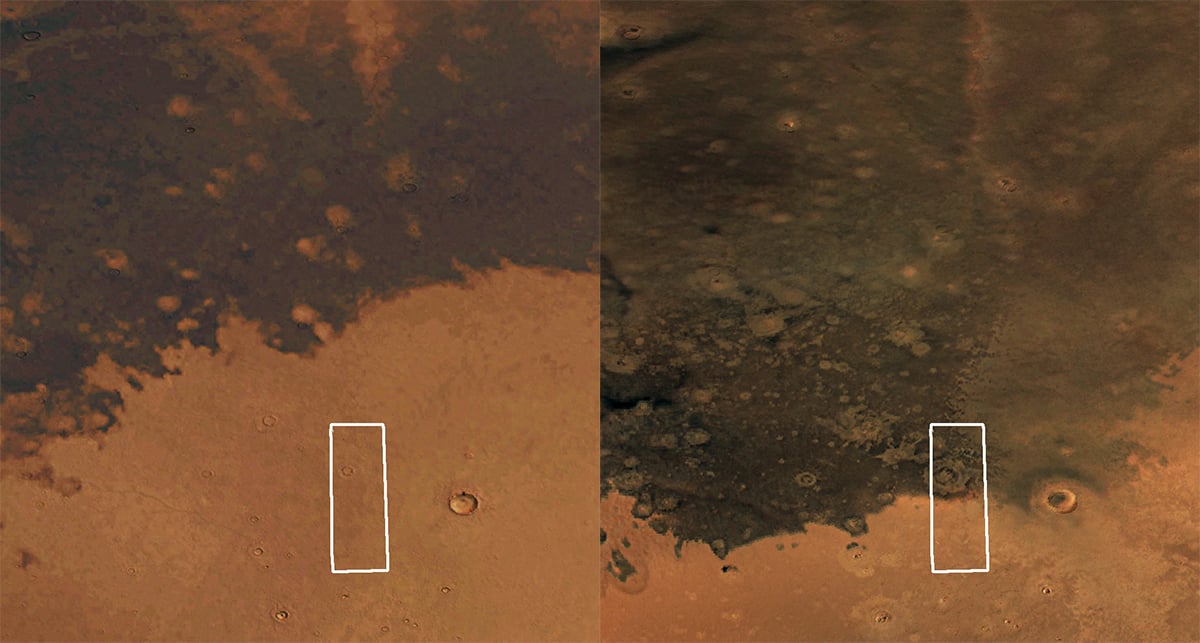
How the dark material is spreading
Researchers still do not fully agree on the exact mechanism responsible for the expanding dark deposits. ESA currently considers two major possibilities, and both involve atmospheric activity.
The first explanation suggests that Martian winds actively transport volcanic ash across the surface. Fine-grained sediments can travel long distances during seasonal storms and regional wind events. Over decades, repeated transport may gradually extend the dark material into neighboring regions. Mars experiences frequent dust storms, and some eventually grow large enough to surround the entire planet. These storms can redistribute sediments on continental scales.
The second explanation focuses less on movement and more on exposure. Mars constantly accumulates thin coatings of bright reddish dust across much of its surface. In this scenario, the dark volcanic material may already exist beneath the terrain while winds slowly remove the lighter dust layer above it. As the covering dust disappears, darker deposits become visible from orbit.
Both explanations remain plausible, and they may even occur together. Wind could simultaneously expose older deposits while also transporting fresh volcanic sediments across nearby terrain. Future observations may help researchers determine which process dominates.
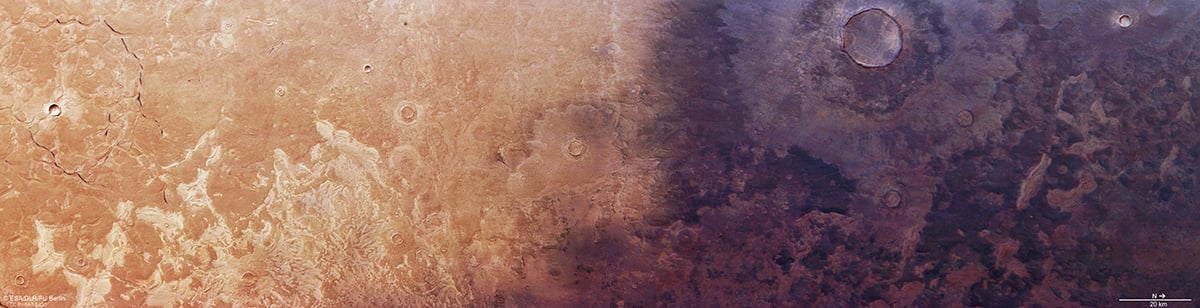
Utopia Planitia: Clues to ancient Martian history
The location of the discovery adds another layer of scientific importance. Utopia Planitia ranks among the largest known impact basins in the Solar System. The basin spans roughly 3,300 kilometers and occupies a major portion of Mars’ northern lowlands. Scientists believe a massive asteroid impact created the depression early in Martian history.
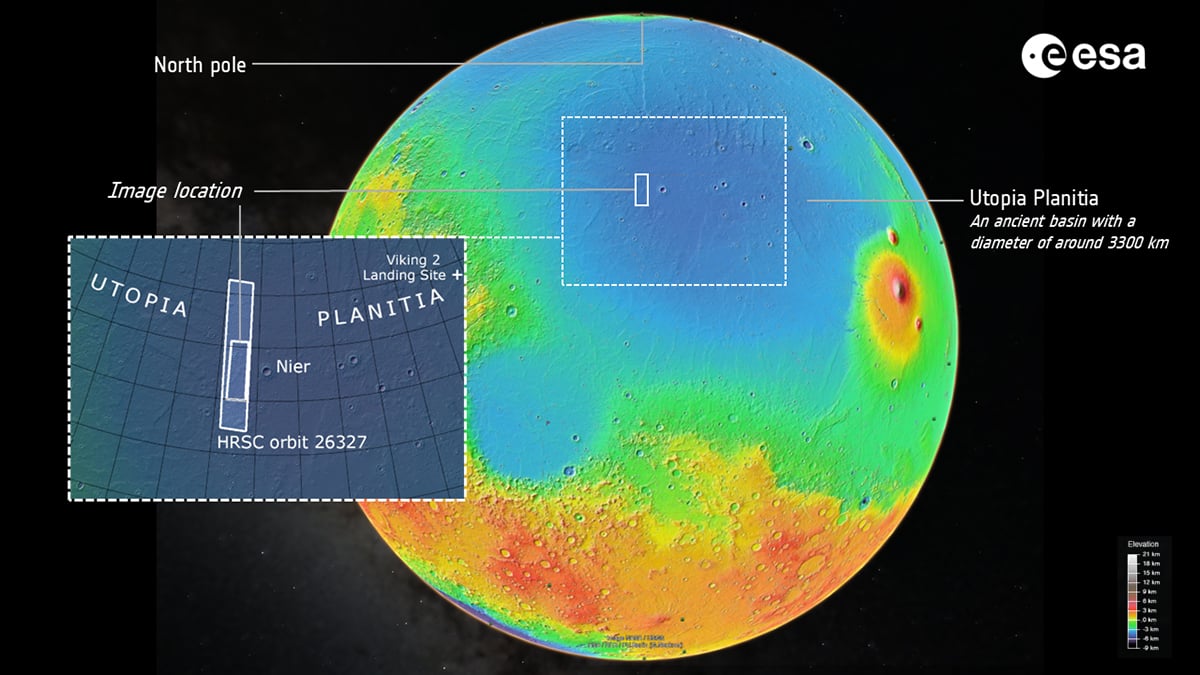
For decades, planetary researchers have suspected that the northern lowlands once hosted large bodies of water. Some climate models suggest an ancient ocean may have covered parts of this region billions of years ago. Utopia Planitia frequently appears in those discussions because of its low elevation and broad sedimentary plains.
Interest in the region increased further after China’s Zhurong rover landed there in 2021. The rover detected geological structures and sedimentary patterns that some scientists interpret as possible shoreline or coastal deposits. Although debate continues, the findings strengthened the idea that water once shaped parts of the basin.
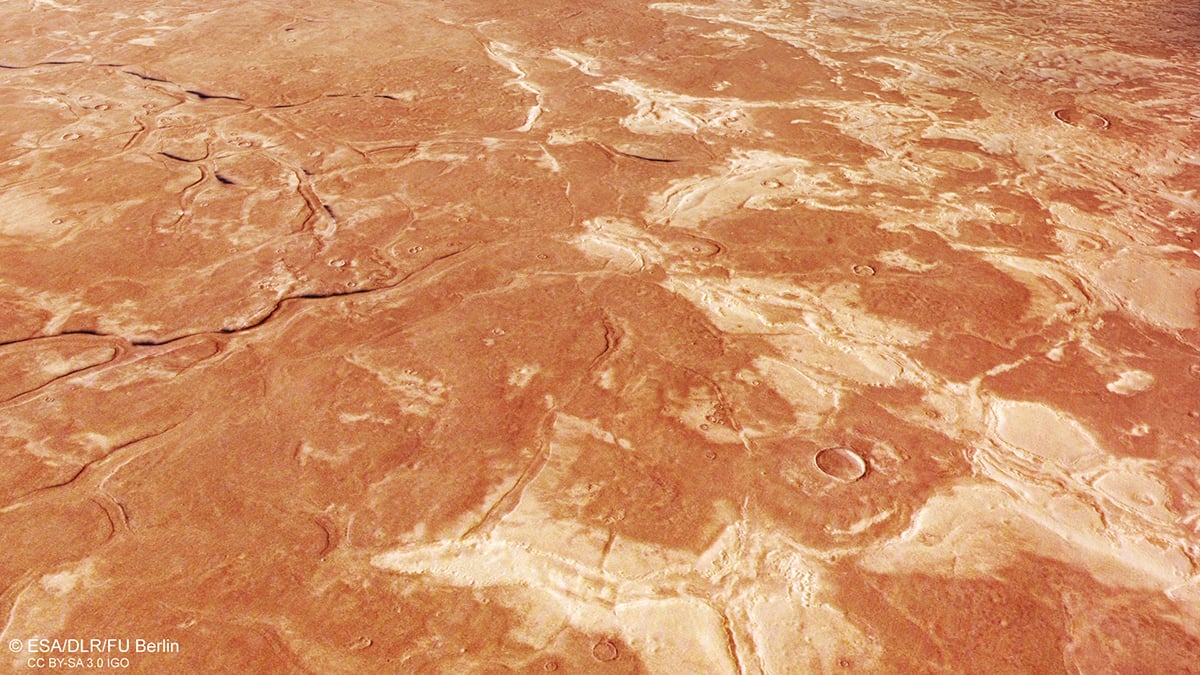
The new Mars Express images reveal several additional geological features tied to climate and volatile activity. One of the most striking involves scalloped depressions scattered across the terrain. These shallow pits form when subsurface ice gradually disappears. On Mars, ice can transition directly from solid to vapor through sublimation without melting into liquid water first. As buried ice vanishes, the overlying ground collapses and produces rounded depressions.
Clear skies!
See more from DIYPhotography.net on Google
Add DIYPhotography.net as a trusted source. This makes
our stories more likely to appear in your Google Search results.
 Add as a preferred source on Google

Soumyadeep Mukherjee
Soumyadeep Mukherjee is an award-winning astrophotographer from India. He has a doctorate degree in Linguistics. His work extends to the sub-genres of nightscape, deep sky, solar, lunar and optical phenomenon photography. He is also a photography educator and has conducted numerous workshops. His works have appeared in over 40 books & magazines including Astronomy, BBC Sky at Night, Sky & Telescope among others, and in various websites including National Geographic, NASA, Forbes. He was the first Indian to win “Astronomy Photographer of the Year” award in a major category.




Join the Discussion
DIYP Comment Policy
Be nice, be on-topic, no personal information or flames.