






















When Mars Looks Like Home: Perseverance’s “Falbreen” Panorama
Aug 9, 2025
Soumyadeep Mukherjee
Soumyadeep Mukherjee is an award-winning astrophotographer from India. He has a doctorate degree in Linguistics. His work extends to the sub-genres of nightscape, deep sky, solar, lunar and optical phenomenon photography. He is also a photography educator and has conducted numerous workshops. His works have appeared in over 40 books & magazines including Astronomy, BBC Sky at Night, Sky & Telescope among others, and in various websites including National Geographic, NASA, Forbes. He was the first Indian to win “Astronomy Photographer of the Year” award in a major category.
Share:

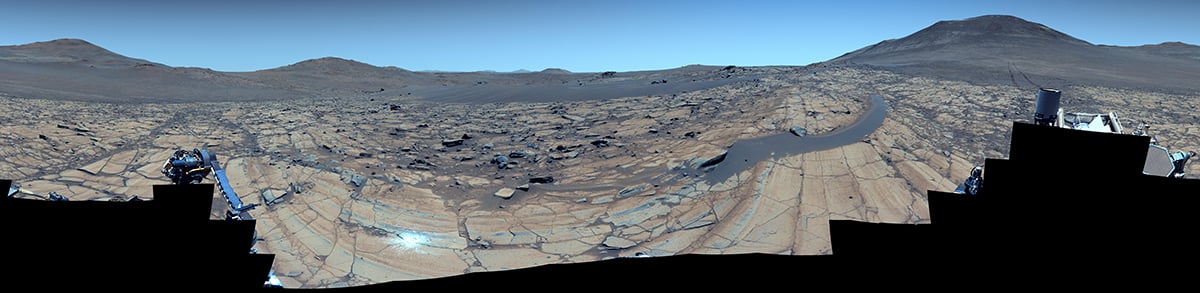
On May 26, 2025, on its 1,516th Martian day (Sol 1516), NASA’s Perseverance rover paused at a spot nicknamed “Falbreen.” There, equipped with its trusty Mastcam-Z, it captured a remarkable 360-degree panorama, one of the clearest vistas of Mars yet. The image stunned both scientists and the public with its deceivingly blue sky. Behind that beauty lay a careful blend of engineering, geology, and a dash of artistic flair.
The art and science of a perfect shot
Perseverance assembled the panorama from 96 high-resolution frames, each taken by its advanced Mastcam-Z instrument. This camera system, developed by Arizona State University and Malin Space Science Systems, offers stereo, multispectral imaging with impressive zoom, a leap over its predecessor, Curiosity’s Mastcam. The team waited for optimal conditions: low dust, stable lighting, and clear skies. The result is a mosaic so sharp that distant hills, as far as 40 miles (65 kilometers) away, came into view, etched in detail.
A sky that looks like home, but isn’t
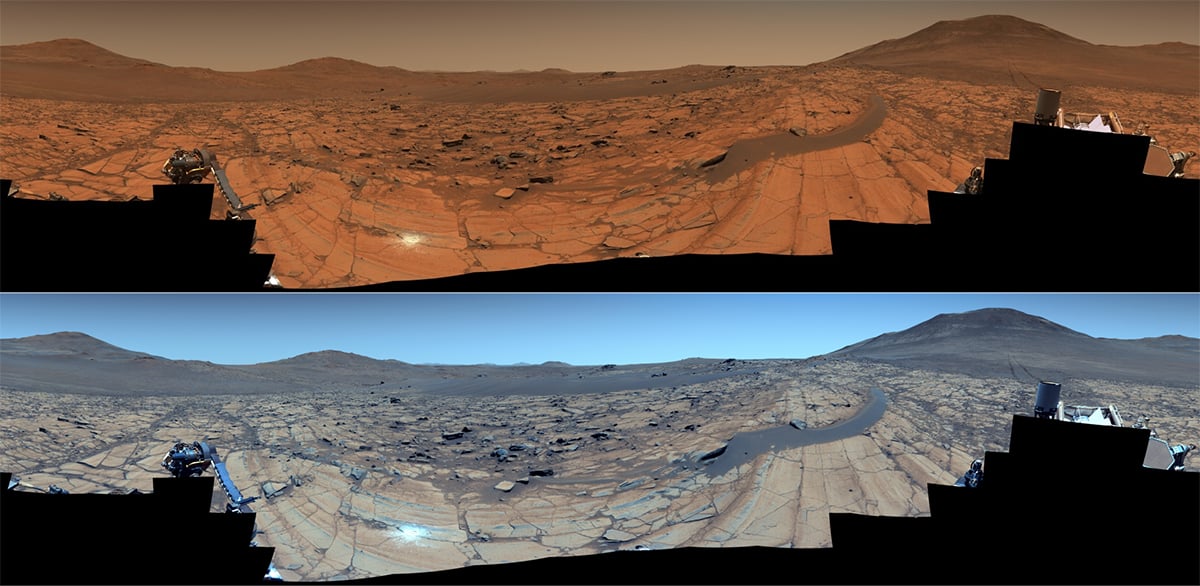
What took people’s breath away wasn’t just the terrain, it was the sky. In the enhanced-color version, the sky glows a vivid blue, as if lifted from an Earth-bound desert scene. These stronger contrasts weren’t real; they were a product of deliberate processing to highlight terrain features and sky clarity. In the natural-color rendition, Mars reveals its true face: a reddish sky, dusty and warm, shaped by fine iron-oxide particles suspended in the thin atmosphere. Only during sunrise or sunset does faint blue emerge around the Sun due to specific scattering effects.
What the panorama shows
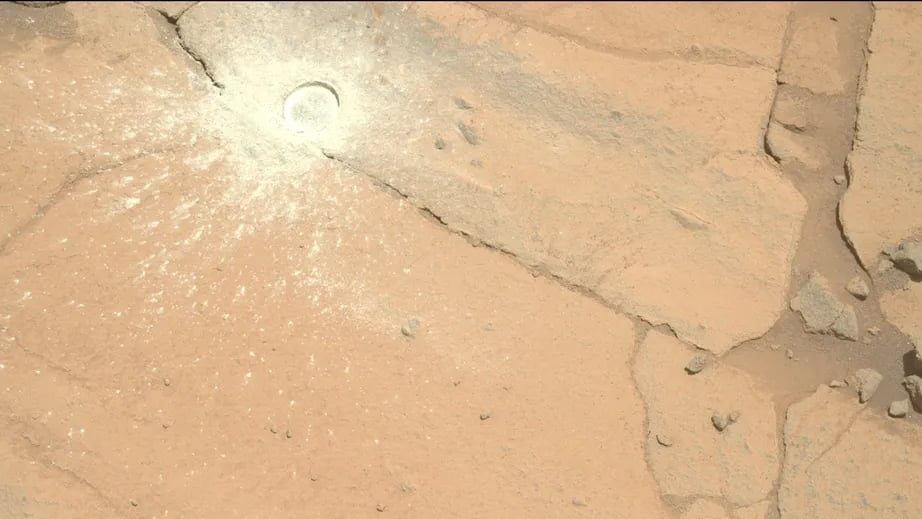
Looking closely, you can spot a “float rock”, a solitary boulder resting upon a crescent-shaped sand ripple about 14 feet (4.4 meters) from the rover. Scientists suspect it was moved by some ancient force, wind, water, or landslide, before the sand ripple formed around it. To the left of center in the panorama lies a bright abrasion patch, a five-centimeter (two-inch) area ground by Perseverance’s diamond-dust-tipped abrading tool, exposing fresher rock. This was the rover’s 43rd abrasion, part of its careful strategy to study and eventually sample Mars’s subsurface.
The image also highlights a clear geological boundary: lighter-toned, olivine-rich rocks near the rover, contrasting with darker, clay-bearing terrain farther away. This boundary suggests the site comprises some of the oldest terrain Perseverance has encountered, potentially predating even the Jezero Crater floor itself. Even Perseverance’s own journey figures in the story. Its tracks sweep across the Martian surface, heading toward a previous site named “Kenmore.” These lines in the dust form a map, evidence of where the rover has been and hints at where it’s heading next.
A surreal final image
To stitch together 96 frames, the team calibrated lighting, aligned exposures, corrected distortions, and masked camera artifacts. They also prepared multiple versions: enhanced for visual storytelling, and natural for scientific accuracy. Mastcam-Z also uses its calibration targets, colored swatches, and grayscale references aboard the rover to ensure color fidelity. These calibration tools help scientists adjust images regardless of changing conditions.
Panoramas like Falbreen help scientists pick sampling sites more wisely. They can study layering, grain patterns, and erosion to discern where to drill next. The broader context of geological features enhances scientific decisions. As NASA sets its sights on crewed journeys, first lunar, then Martian, images like this shape our expectations.
Clear skies!
See more from DIYPhotography.net on Google
Add DIYPhotography.net as a trusted source. This makes
our stories more likely to appear in your Google Search results.
 Add as a preferred source on Google

Soumyadeep Mukherjee
Soumyadeep Mukherjee is an award-winning astrophotographer from India. He has a doctorate degree in Linguistics. His work extends to the sub-genres of nightscape, deep sky, solar, lunar and optical phenomenon photography. He is also a photography educator and has conducted numerous workshops. His works have appeared in over 40 books & magazines including Astronomy, BBC Sky at Night, Sky & Telescope among others, and in various websites including National Geographic, NASA, Forbes. He was the first Indian to win “Astronomy Photographer of the Year” award in a major category.
Related Posts
 NASA Perseverance rover spots poor broken Ingenuity helicopter in a recent Mars photo
 Perseverance Rover Photographs the “Clearest Sign Yet” of Life on Mars
 A Faint Smudge from Mars: Did Perseverance Really Capture Interstellar Comet 3I/ATLAS?
 NASA’s Perseverance Finds Buried Ancient River Delta on Mars
Join the Discussion
DIYP Comment Policy
Be nice, be on-topic, no personal information or flames.