






















Askar 111F Flat-Field: A New Quadruplet Full-Frame Refractor
May 14, 2026
Soumyadeep Mukherjee
Soumyadeep Mukherjee is an award-winning astrophotographer from India. He has a doctorate degree in Linguistics. His work extends to the sub-genres of nightscape, deep sky, solar, lunar and optical phenomenon photography. He is also a photography educator and has conducted numerous workshops. His works have appeared in over 40 books & magazines including Astronomy, BBC Sky at Night, Sky & Telescope among others, and in various websites including National Geographic, NASA, Forbes. He was the first Indian to win “Astronomy Photographer of the Year” award in a major category.
Share:
Today, astrophotography places enormous demands on optical systems. The refractor market has started moving toward a very specific type of refractor over the last few years. Astrophotographers now require telescopes that are ready for large sensors, require minimal spacing adjustments, and maintain strong correction across the entire frame.
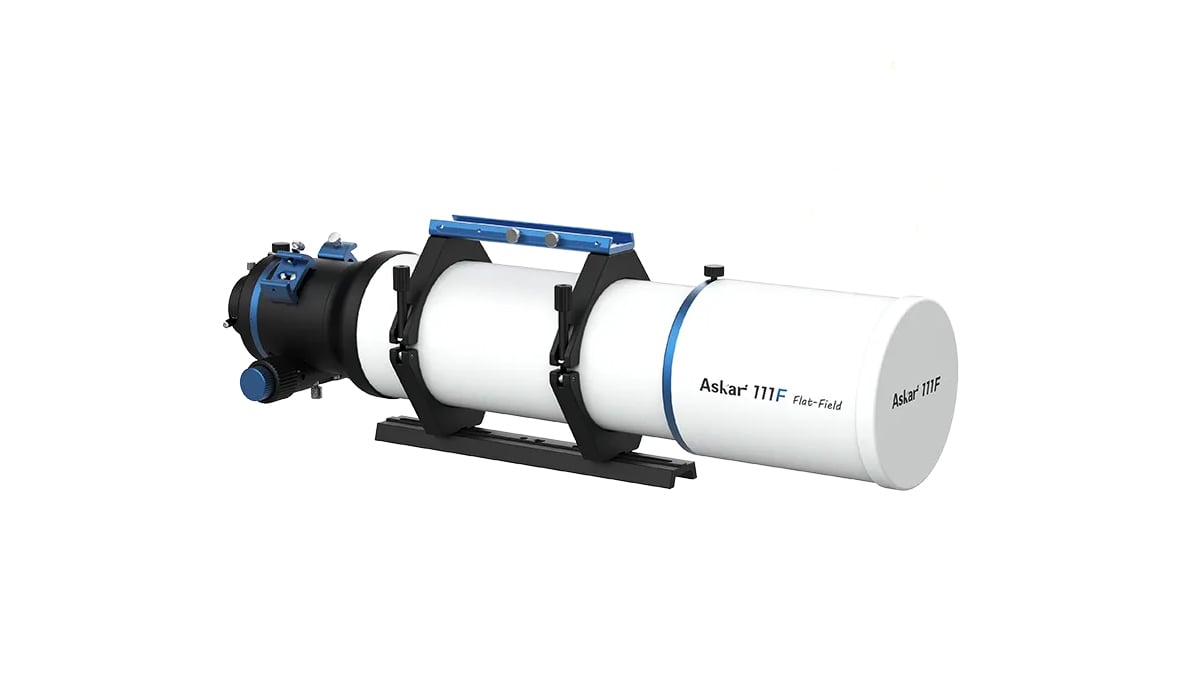
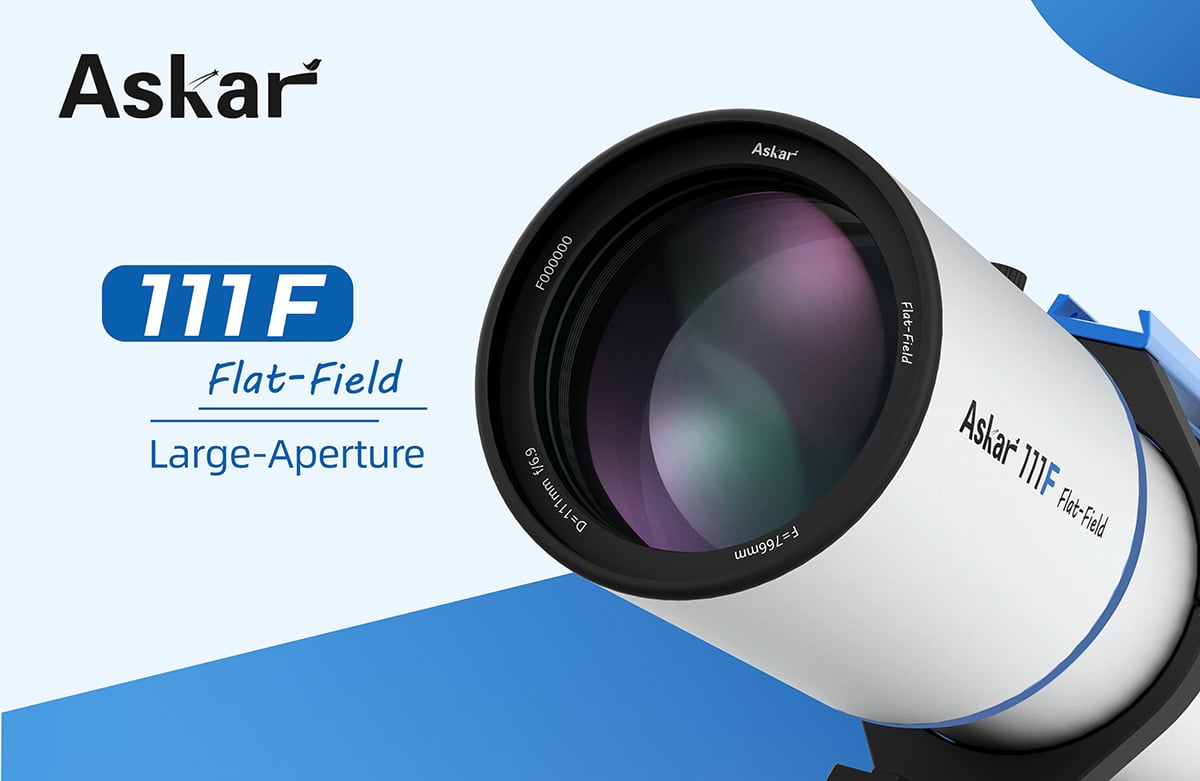
The Askar 111F Flat-Field is the newest addition to this list. The telescope features a quadruplet APO optical system combined with an internal correcting element, designed for full-frame imaging. The telescope offers a 766 mm focal length at f/6.9 along with a corrected 44 mm image circle. The 111F combines a large 3-inch focuser, threaded imaging interfaces, and integrated field correction.
A quadruplet optical design
The Askar 111F has a quadruplet APO optical system. The telescope uses four lens elements arranged in a configuration designed to improve correction across the image field. According to the official specifications, the front optical group contains three lens elements, while an additional correcting lens sits near the rear section of the optical path. The design also includes one ED glass element to reduce chromatic aberration.
The 111F eliminates the requirement of a flattener by integrating the correcting optics into the telescope itself. As a result, the imaging train becomes simpler and easier to manage in the field.
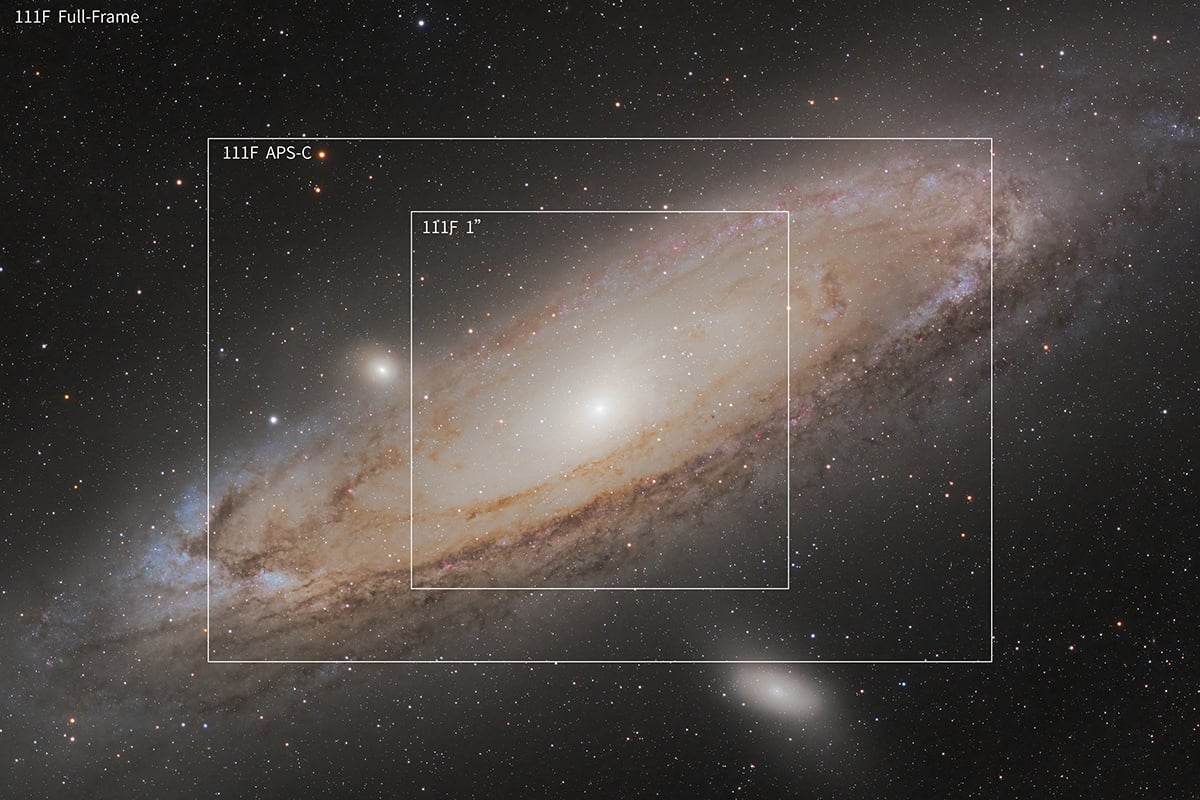
The telescope also supports a 44 mm image circle. This allows the optical system to illuminate full-frame astronomy cameras while maintaining corrected star shapes across the field. That capability has become increasingly important as full-frame CMOS cameras continue to grow in popularity among advanced astrophotographers.
The focal length of 766 mm occupies the middle ground. It offers enough image scale for medium-sized nebulae, galaxy groups, globular clusters, and emission regions while remaining manageable for guiding and framing. Objects such as the Rosette Nebula, the Heart Nebula, M31, M33, the Leo Triplet, and many dark nebula complexes should fit comfortably within its field of view.
Construction of the telescope
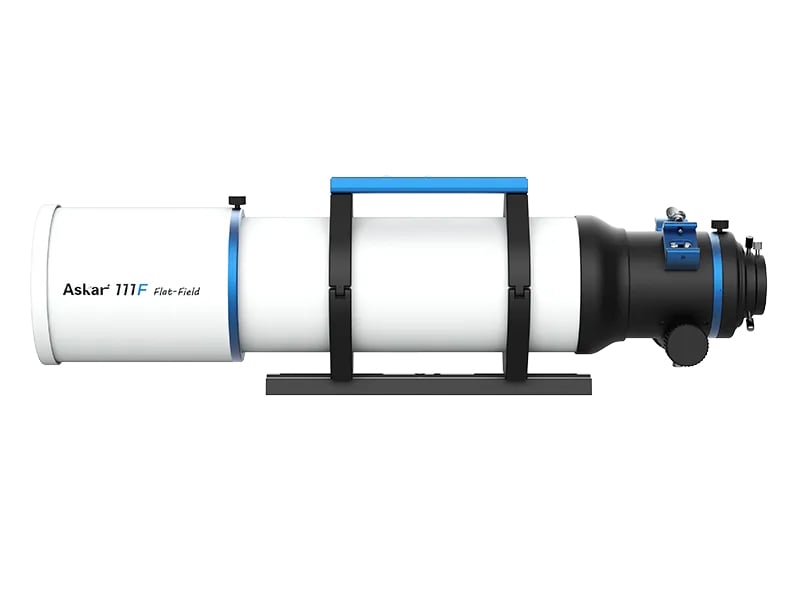
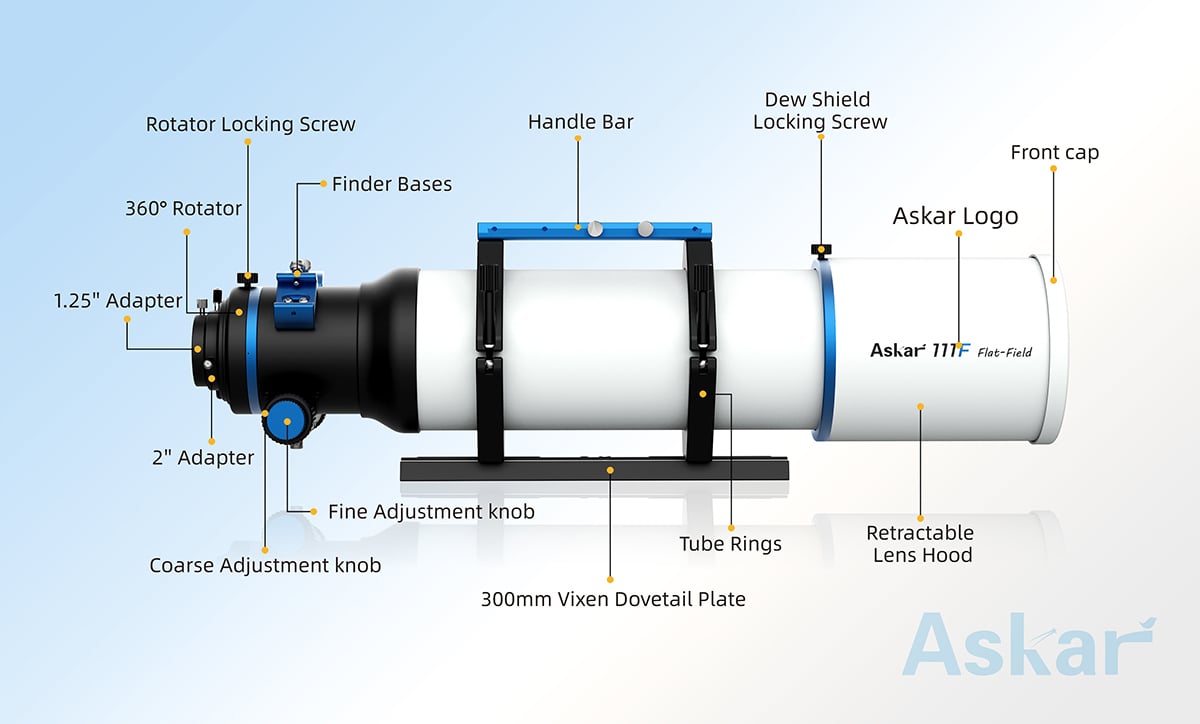
The telescope features a large 3-inch rack-and-pinion dual-speed focuser with a 1:10 fine-focus mechanism. Large focusers have become increasingly important in astrophotography because smaller units often struggle under heavy camera loads. The focuser also includes an integrated 360-degree rotator with degree markings. This feature allows astrophotographers to frame targets precisely without loosening the imaging train or introducing flexure.
Internally, the telescope uses multiple knife-edge baffles to suppress stray reflections and improve image contrast. These baffles reduce scattered light inside the optical tube and help preserve darker backgrounds during deep-sky exposures.
The OTA itself follows a modern CNC-machined design with a retractable dew shield and heavy-duty tube rings. A carrying handle mounts above the rings, while a Vixen-style dovetail plate supports the telescope from below. The overall construction gives the telescope a rigid appearance suited for permanent or semi-permanent imaging setups.
A telescope for full-frame astrophotography
Full-frame sensors, once reserved for extremely expensive imaging systems, have now become accessible to a much larger group of astrophotographers. A telescope intended for full-frame imaging should deliver sharp stars across a much larger image field.
The built-in flat-field correction removes one of the largest obstacles faced by many astrophotographers. External flatteners often require exact spacing measurements. Even a spacing error of one or two millimeters can affect corner star quality significantly. Users frequently spend nights testing spacers and adapters while attempting to optimize performance.
The generous focuser size and threaded imaging train suggest that the 111F can support both lightweight and advanced imaging configurations without major issues.
Another interesting aspect involves the newly released optional 0.74x reducer. With the reducer installed, the telescope gains a wider field of view and a faster effective focal ratio. This option increases flexibility for photographers who regularly image large nebula regions or wide-field deep-sky scenes. Without the reducer, the telescope remains optimized for medium-scale deep-sky imaging. With the reducer attached, it becomes more adaptable for larger objects and wider compositions.
Portability and mount compatibility
The Askar 111F avoids becoming excessively large despite its aperture. According to the official specifications, the OTA weighs approximately 5.74 kg, while the total assembled weight reaches about 6.76 kg with accessories included.
This keeps the telescope within the payload range of many popular equatorial and harmonic mounts currently used for astrophotography. Mounts such as the Sky-Watcher EQ6-R, ZWO AM5, iOptron HEM series, and similar systems should comfortably support the telescope during guided imaging sessions.
The retractable dew shield also improves portability by shortening the transport length of the OTA. Astrophotographers who regularly travel to dark-sky locations prefer refractors that remain compact enough for safe transportation. Although the telescope is not a lightweight travel refractor, it still offers a balance between aperture and portability.
Key specifications, price, and availability
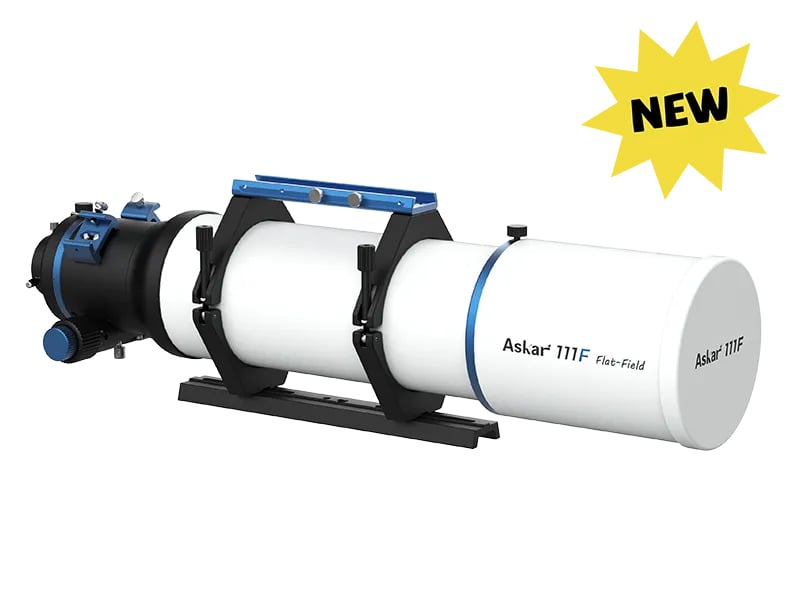
Here are some of the key specifications of Askar 111F:
| Aperture size | 111mm |
| Focal length | 766mm |
| Focal ratio | f/6.9 |
| Objective lens | Quadruplet air-spaced APO(including one ED glass) |
| Image circle | 44mm |
| Total length | 728mm(including the photographic adapter as dew shield contracted) 815mm(including the photographic adapter as dew shield fully stretched) |
| Focuser travel length | 30mm |
| Net weight | 5.74kg |
| Gross weight | 6.76kg |
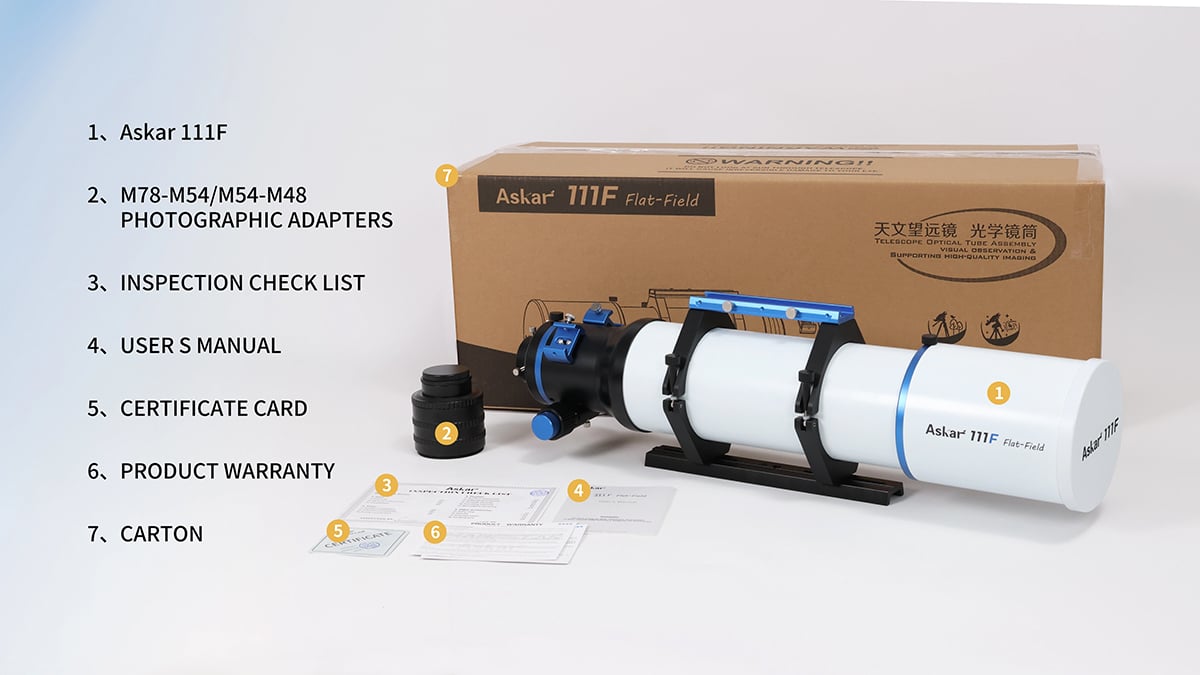
Askar 111F Flat-Field is priced at $1,499. The telescope is available for ordering via the official website.
Clear skies!
See more from DIYPhotography.net on Google
Add DIYPhotography.net as a trusted source. This makes
our stories more likely to appear in your Google Search results.
 Add as a preferred source on Google

Soumyadeep Mukherjee
Soumyadeep Mukherjee is an award-winning astrophotographer from India. He has a doctorate degree in Linguistics. His work extends to the sub-genres of nightscape, deep sky, solar, lunar and optical phenomenon photography. He is also a photography educator and has conducted numerous workshops. His works have appeared in over 40 books & magazines including Astronomy, BBC Sky at Night, Sky & Telescope among others, and in various websites including National Geographic, NASA, Forbes. He was the first Indian to win “Astronomy Photographer of the Year” award in a major category.


Join the Discussion
DIYP Comment Policy
Be nice, be on-topic, no personal information or flames.