





















JWST Captures the Helix Nebula in Unprecedented Detail
Jan 21, 2026
Soumyadeep Mukherjee
Soumyadeep Mukherjee is an award-winning astrophotographer from India. He has a doctorate degree in Linguistics. His work extends to the sub-genres of nightscape, deep sky, solar, lunar and optical phenomenon photography. He is also a photography educator and has conducted numerous workshops. His works have appeared in over 40 books & magazines including Astronomy, BBC Sky at Night, Sky & Telescope among others, and in various websites including National Geographic, NASA, Forbes. He was the first Indian to win “Astronomy Photographer of the Year” award in a major category.
Share:

Planetary nebulae represent one of the final and most complex phases of stellar evolution. When low- to intermediate-mass stars exhaust their nuclear fuel, they expel their outer layers into space. Intense radiation from the exposed stellar core then ionises this material, producing glowing shells of gas and dust. Astronomers have studied these objects for decades, yet many of their internal processes remain poorly understood.
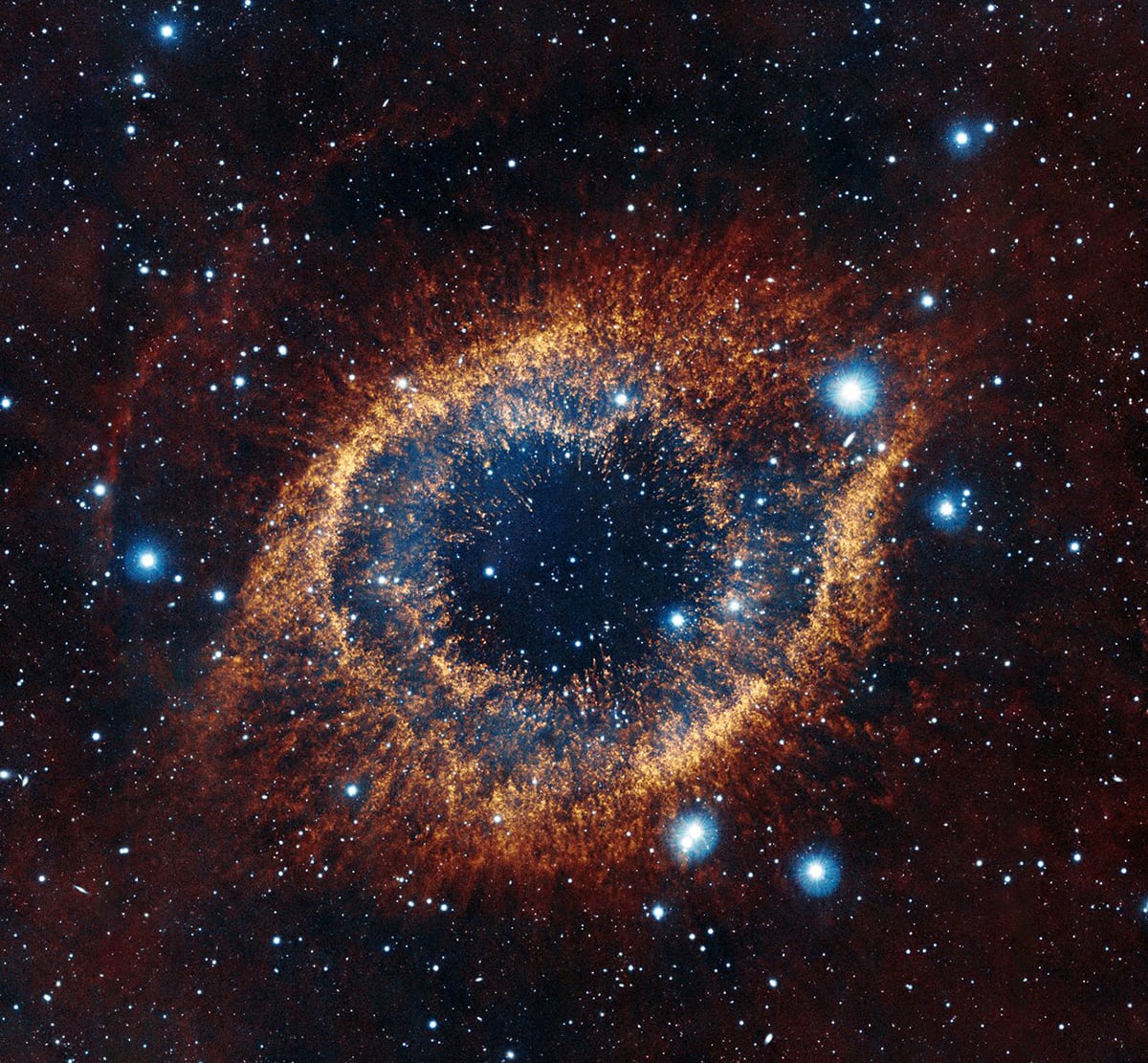
Yesterday, ESA and NASA released a high-resolution near-infrared view of the Helix Nebula captured by JWST’s NIRCam instrument. Although the Helix is one of the closest planetary nebulae to Earth, this image reveals structural complexity never observed before. JWSTresolves sharp temperature gradients, dense molecular knots, and interacting gas layers with remarkable clarity. As a result, the image offers new insight into how stellar winds shape nebulae and how material transitions from ionised gas to molecular clouds. Rather than presenting the Helix as a smooth, symmetrical ring, JWST shows it as a dynamic environment governed by collisions, radiation, and long-term evolution.
The Helix Nebula
The Helix Nebula lies approximately 650 light-years away in the constellation Aquarius. Its proximity makes it one of the most accessible planetary nebulae for detailed study. Astronomers often describe it as a benchmark object, since its large angular size allows fine structures to be resolved even with modest telescopes.
The nebula formed when a Sun-like star reached the end of its red giant phase. Over time, the star lost a significant fraction of its mass through slow stellar winds. Once the outer layers dispersed, the remaining core collapsed into a white dwarf. This remnant now emits strong ultraviolet radiation. That radiation energises the surrounding gas and drives the nebula’s emission.
Earlier observations revealed the Helix’s broad ring-like morphology. However, those views masked the true complexity of the nebula’s interior. JWST’s infrared sensitivity now exposes the interaction between successive mass-loss phases, which is critical for understanding how planetary nebulae evolve.

Infrared observations
JWST primarily observes the universe in the near- and mid-infrared wavelengths. This wavelength range is essential for studying planetary nebulae, since it traces both hot ionised gas and cooler molecular regions. Optical telescopes mainly capture ionised hydrogen and oxygen. Infrared instruments reveal what happens after that gas begins to cool.
The NIRCam observations used for this image detect emission from molecular hydrogen, warm dust, and transitional gas layers. These components define the boundary between stellar ejecta and the surrounding interstellar medium. By resolving them spatially, JWST allows astronomers to track how gas changes phase as it expands away from the star.
In addition, infrared light penetrates dusty regions that absorb visible wavelengths. As a result, JWST can probe dense knots and filaments that previously appeared as dark silhouettes or blurred features.
Stellar winds and the origin of cometary knots
One of the defining features in the JWST image is a dense population of comet-like knots. These structures appear as compact heads with elongated tails pointing away from the central star. Astronomers first identified such knots decades ago. JWST now shows them in extraordinary detail.
These knots form through the interaction of multiple stellar winds. During earlier phases, the star expelled material slowly. Later, faster and hotter winds from the exposed core overtook this older gas. When the fast wind collided with denser clumps, it compressed them and sculpted elongated shapes.
Radiation pressure and ionisation further erode the knots over time. However, their dense cores resist destruction longer than the surrounding gas. JWST captures these structures in various stages of erosion, revealing how long they can survive in harsh environments.
This process demonstrates that planetary nebulae evolve through layered interactions rather than a single expansion event. Each phase of mass loss leaves a distinct imprint on the final structure.

Interpreting the infrared color mapping
The colors in the JWST image represent different infrared wavelengths mapped to visible tones. Although the image does not show true color, it provides a powerful diagnostic tool for interpreting physical conditions.
Blue regions correspond to hotter, ionised gas exposed directly to intense radiation from the white dwarf. These zones mark areas where atoms remain excited, and electrons are frequently stripped.
Yellow regions trace cooler molecular gas, particularly molecular hydrogen. These areas often sit behind dense knots or along protected filaments. The presence of molecules indicates lower temperatures and reduced radiation exposure.
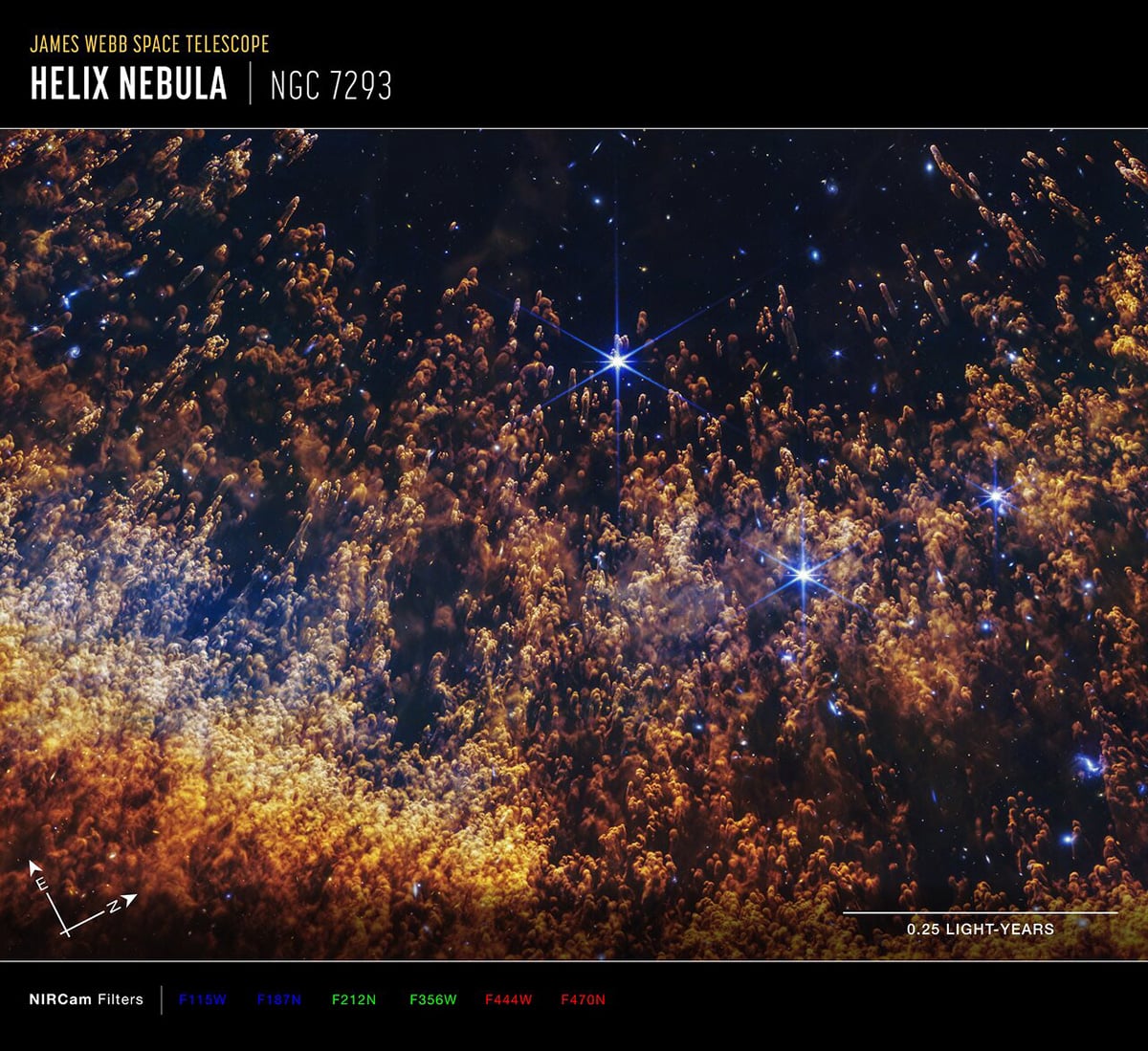
Red regions highlight the coolest material, including dust and dispersed molecular clouds. This gas no longer contributes strongly to the nebula’s visible glow. Instead, it marks the transition to the interstellar medium.
Together, these colors reveal a layered temperature structure. Gas cools steadily as it moves outward. Chemistry changes accordingly. JWST allows astronomers to observe this progression directly.

How JWST complements earlier observations
The Helix Nebula has been observed extensively by Hubble and Spitzer. Hubble revealed sharp optical detail and ionised gas structures. Spitzer traced warm dust and mid-infrared emission. JWST bridges the gap between these perspectives.
With resolution comparable to Hubble and infrared sensitivity exceeding Spitzer’s, JWST exposes fine structures embedded within the nebula. Filaments that once appeared smooth now show internal texture. Knots that looked uniform now reveal a layered composition.
This comparison highlights how observational advances refine scientific understanding. Each telescope added a layer of knowledge. JWST integrates those layers into a coherent physical picture. As a result, astronomers can now test theoretical models of nebular shaping with real data at relevant scales.

Planetary nebulae play a central role in galactic chemical evolution. During their lifetimes, stars convert hydrogen and helium into heavier elements. When they die, they return those elements to space. The Helix Nebula contains carbon-rich material, molecular hydrogen, and dust grains. These components will eventually mix into the interstellar medium. Future stars and planetary systems will form from that enriched material.
JWST’s image shows how efficiently stars redistribute matter. It also shows how long that material remains structured before dispersing. This information is essential for understanding how galaxies evolve over billions of years. In this sense, the Helix Nebula is part of a continuous cycle.
Clear skies!
See more from DIYPhotography.net on Google
Add DIYPhotography.net as a trusted source. This makes
our stories more likely to appear in your Google Search results.
 Add as a preferred source on Google

Soumyadeep Mukherjee
Soumyadeep Mukherjee is an award-winning astrophotographer from India. He has a doctorate degree in Linguistics. His work extends to the sub-genres of nightscape, deep sky, solar, lunar and optical phenomenon photography. He is also a photography educator and has conducted numerous workshops. His works have appeared in over 40 books & magazines including Astronomy, BBC Sky at Night, Sky & Telescope among others, and in various websites including National Geographic, NASA, Forbes. He was the first Indian to win “Astronomy Photographer of the Year” award in a major category.
Related Posts
 James Webb telescope captures Horsehead Nebula’s edge in unprecedented detail
 JWST Reveals Spiral Galaxy NGC 5134 in Unprecedented Detail
 Inside a Lenticular Galaxy: Hubble Captures NGC 7722 in Unprecedented Detail
 A star is born: James Webb Telescope captures supernova remnant in unprecedented detail
Join the Discussion
DIYP Comment Policy
Be nice, be on-topic, no personal information or flames.