





















JWST and Chandra Captures a Collision Between Two Spiral Galaxies
Jan 2, 2026
Soumyadeep Mukherjee
Soumyadeep Mukherjee is an award-winning astrophotographer from India. He has a doctorate degree in Linguistics. His work extends to the sub-genres of nightscape, deep sky, solar, lunar and optical phenomenon photography. He is also a photography educator and has conducted numerous workshops. His works have appeared in over 40 books & magazines including Astronomy, BBC Sky at Night, Sky & Telescope among others, and in various websites including National Geographic, NASA, Forbes. He was the first Indian to win “Astronomy Photographer of the Year” award in a major category.
Share:

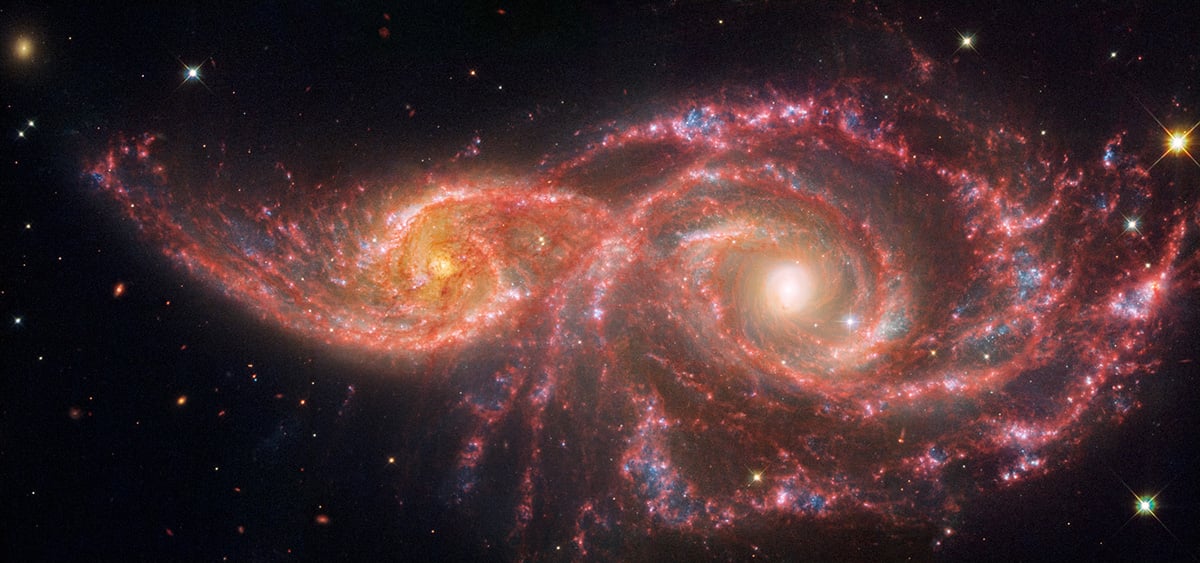
Galaxy interactions drive much of the structural evolution seen in the modern universe. Gravitational encounters reshape disks, compress gas, and regulate star formation over cosmic time. Observing these processes in detail requires sensitivity across multiple wavelengths, especially in dusty and high-energy environments. In late 2025, NASA released a new composite image that meets this requirement. The image combines mid-infrared observations from the James Webb Space Telescope with X-ray data from the Chandra X-ray Observatory. Together, they reveal an active interaction between two spiral galaxies at a critical stage in their encounter.
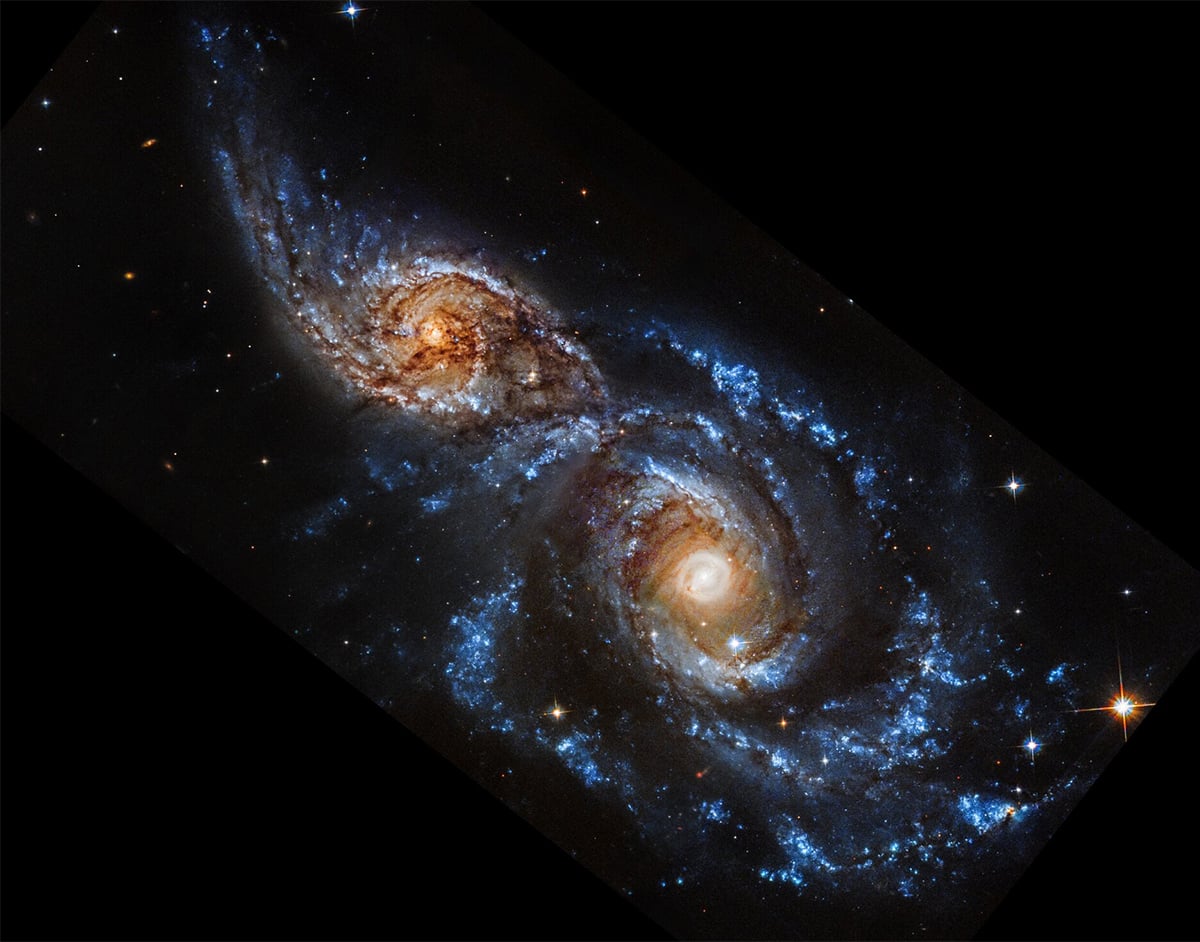
The galaxies, NGC 2207 and IC 2163, lie roughly 120 million light-years from Earth in the constellation Canis Major. Astronomers have long known that these galaxies are interacting. However, JWST now exposes the internal response of gas, dust, and stars to gravitational stress with unprecedented resolution. The image freezes a slow and ongoing physical process that unfolds over hundreds of millions of years. What JWST and Chandra show is how gravity redistributes matter and energy across galactic scales.
The interacting system of NGC 2207 and IC 2163
NGC 2207 dominates the system in mass and size. It displays a broad spiral disk with well-defined arms. IC 2163, by contrast, appears smaller and more distorted. Astronomers believe IC 2163 passed close to NGC 2207 millions of years ago, rather than colliding directly. That close passage initiated the interaction now visible.
As IC 2163 moved past its larger neighbor, tidal forces began to act unevenly across both disks. The gravitational pull stretched stellar orbits and displaced gas clouds. Over time, this process warped spiral arms and altered the internal structure of each galaxy. JWST’s infrared sensitivity now reveals these changes in fine detail.
Warm dust traces the compressed regions within the arms. These regions glow brightly in JWST’s mid-infrared bands. Many remain invisible in optical images due to heavy obscuration. Meanwhile, the overall disk geometry shows signs of distortion that align closely with numerical simulations of tidal encounters.
Although the galaxies remain separate for now, their relative motion continues to slow. Over billions of years, dynamical friction will reduce their orbital energy. Eventually, the system will merge into a single galaxy.
Seeing beyond visible light
The strength of this image lies in its wavelength coverage. JWST observes infrared light, which penetrates dense dust clouds that block optical telescopes. This capability enables astronomers to track star formation that is embedded deep within spiral arms.
In this image, infrared emission outlines filaments of dust and dense molecular material. These structures often mark regions where gravity has compressed gas to the point of collapse. As stars form, they heat nearby dust, which then radiates in the infrared. JWST captures this emission with both sensitivity and spatial precision.

Chandra adds a complementary layer by observing X-rays. X-ray emission traces gas heated to millions of degrees. Such temperatures arise from supernova explosions, stellar winds, and compact binary systems. These processes inject energy into the surrounding medium and influence future star formation.
By combining infrared and X-ray data, astronomers can track both the birth of stars and the energetic feedback that follows. This dual view is essential for understanding how galaxies regulate their own growth during interactions.

Tidal forces, distorted spiral arms, and star formation
One of the most prominent features in the image is the distorted appearance of IC 2163. Its spiral arms curve sharply and appear stretched along one side. This structure reflects the direct influence of tidal forces. When two galaxies interact, gravity does not act uniformly. The side of a galaxy closer to its companion experiences a stronger pull. This differential force elongates stellar orbits and drags gas outward. Over time, spiral arms lose their symmetry.
Models developed decades ago predicted that IC 2163 would show strong tidal compression along the inner edges of its arms. JWST now confirms those predictions observationally. Infrared emission highlights exactly where gas density has increased. NGC 2207 also shows evidence of tidal stress. Its arms appear thicker and more fragmented than those of isolated spiral galaxies. Clumps of infrared emission suggest elevated star formation rates. Chandra detects numerous X-ray sources across the disk, consistent with young stellar populations and recent supernovae.
Galaxy interactions often enhance star formation, and this system follows that pattern. As tidal forces compress gas, they reduce the internal pressure support. Once gas clouds reach critical density, gravitational collapse begins. JWST identifies numerous star-forming regions within both galaxies. Many lie along distorted spiral arms and overlap regions. These locations correspond to areas of strongest compression.
Galaxy evolution models and a dynamic universe
This observation provides a valuable test case for theoretical models. Simulations of interacting galaxies predict specific patterns of distortion, gas flow, and star formation. JWST’s data aligns closely with these predictions. The ability to resolve fine structures strengthens confidence in current models of tidal interaction. It also allows astronomers to refine parameters such as encounter geometry and mass ratio.
Beyond the local universe, these findings have broader relevance. JWST routinely observes distant galaxies that appear irregular or clumpy. Many of those systems likely result from interactions and mergers. Nearby examples, such as NGC 2207, provide the physical context needed to interpret distant observations.

The image of NGC 2207 and IC 2163 captures a universe in motion. Although the interaction unfolds slowly by human standards, its consequences are profound. Spiral arms bend. Gas collapses. Stars ignite and explode. JWST records these processes with remarkable clarity. It transforms abstract gravitational physics into an observable structure. At the same time, Chandra exposes the energetic aftermath of stellar evolution.
Clear skies!
See more from DIYPhotography.net on Google
Add DIYPhotography.net as a trusted source. This makes
our stories more likely to appear in your Google Search results.
 Add as a preferred source on Google

Soumyadeep Mukherjee
Soumyadeep Mukherjee is an award-winning astrophotographer from India. He has a doctorate degree in Linguistics. His work extends to the sub-genres of nightscape, deep sky, solar, lunar and optical phenomenon photography. He is also a photography educator and has conducted numerous workshops. His works have appeared in over 40 books & magazines including Astronomy, BBC Sky at Night, Sky & Telescope among others, and in various websites including National Geographic, NASA, Forbes. He was the first Indian to win “Astronomy Photographer of the Year” award in a major category.




Join the Discussion
DIYP Comment Policy
Be nice, be on-topic, no personal information or flames.