

























A Neighbouring Vista of Stellar Birth: Hubble Captures Active Star Formation
Dec 30, 2025
Soumyadeep Mukherjee
Soumyadeep Mukherjee is an award-winning astrophotographer from India. He has a doctorate degree in Linguistics. His work extends to the sub-genres of nightscape, deep sky, solar, lunar and optical phenomenon photography. He is also a photography educator and has conducted numerous workshops. His works have appeared in over 40 books & magazines including Astronomy, BBC Sky at Night, Sky & Telescope among others, and in various websites including National Geographic, NASA, Forbes. He was the first Indian to win “Astronomy Photographer of the Year” award in a major category.
Share:
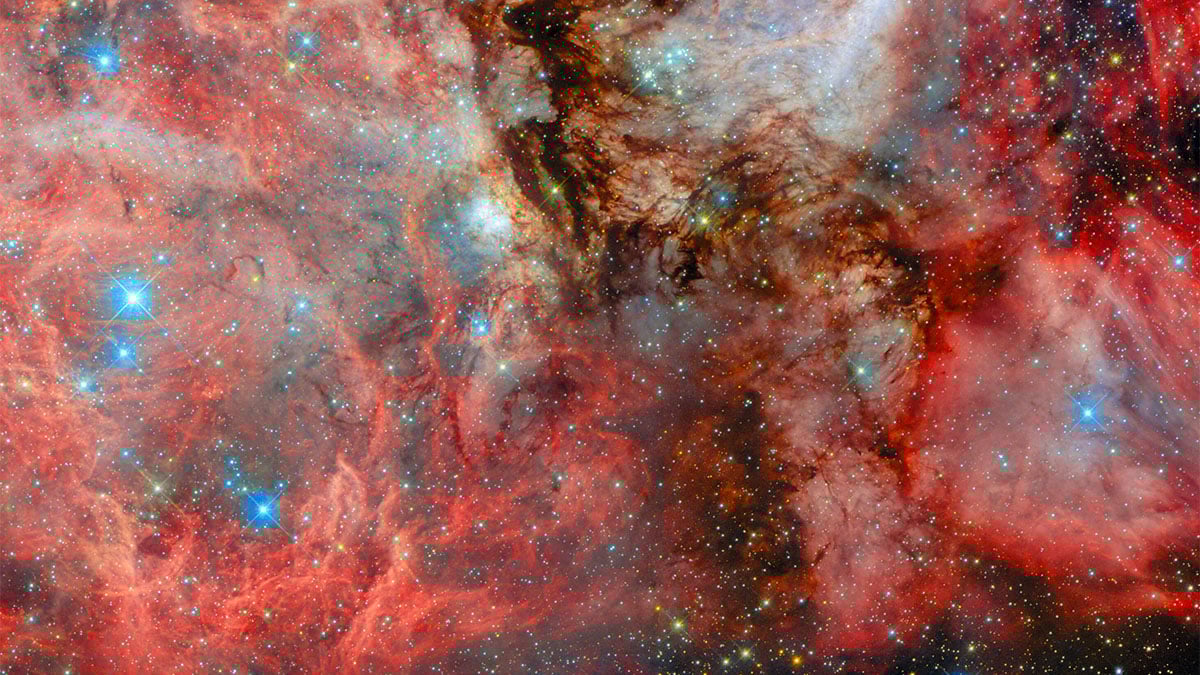
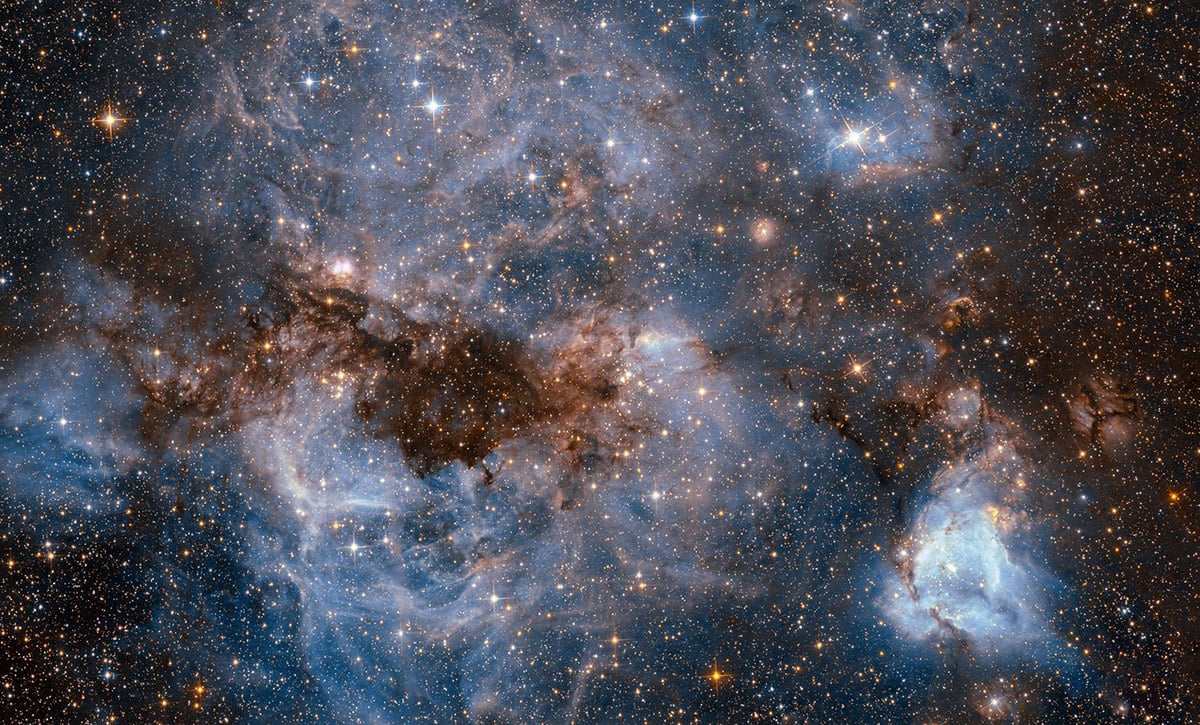
Star formation unfolds inside cold, unstable clouds of gas, shaped by gravity, radiation, and turbulence over millions of years. On 29 December 2025, the Hubble Space Telescope offered a new view into this process with the release of its Picture of the Week, A neighbouring vista of stellar birth. The image focuses on a dense, active region of the N159 star-forming complex in the Large Magellanic Cloud, revealing the physical interaction between newborn stars and their natal environment with exceptional clarity.
N159 lies roughly 160,000 light-years from Earth, within one of the Milky Way’s closest galactic neighbours. From a scientific standpoint, this proximity is critical. It allows astronomers to resolve individual structures inside a massive star-forming cloud while still studying conditions that differ markedly from those in our own galaxy. The Large Magellanic Cloud contains less dust and fewer heavy elements than the Milky Way, making it an important analogue for star formation in earlier cosmic epochs.
The structure of the N159 complex
The Hubble image captures a portion of N159 where the conversion of gas into stars is actively reshaping the cloud itself. Thick concentrations of hydrogen dominate the scene. These clouds are neither smooth nor uniform. Instead, they fragment into knots, ridges, and filaments, each tracing the balance between gravitational collapse and stellar feedback. Some regions glow intensely, while others remain opaque and dark, masking whatever lies behind them.
At the heart of this activity are young, massive stars that have recently emerged from their birth cocoons. Once nuclear fusion ignites in their cores, these stars begin to transform their surroundings almost immediately. Ultraviolet radiation floods the nearby gas, stripping electrons from hydrogen atoms and causing the gas to emit light. This process produces the deep red tones visible throughout the image.
Stellar feedback plays a dual role within N159. In some locations, it suppresses further star formation by dispersing gas before it can collapse. In others, it compresses nearby regions, increasing local density and triggering a new wave of star birth. The image captures this tension. Bright filaments sit beside evacuated cavities, suggesting a cloud caught mid-transformation rather than frozen in a single evolutionary state.

Dark lanes and hidden star formation
Dark lanes cut across the field, formed by especially dense concentrations of dust and gas. These regions absorb and block visible light, appearing as sharp silhouettes against the glowing background. Such structures often mark the coldest and most massive parts of a molecular cloud. Within them, star formation may still be ongoing but remains hidden from optical view.
Infrared observations of N159 have shown that deeply embedded protostars often reside within these dark cores. While Hubble’s optical vision cannot see through the densest dust, it defines the boundaries of these regions with remarkable precision. The contrast between luminous gas and opaque dust provides a three-dimensional sense of depth within the cloud.

The stars visible in the image span a range of colours and brightnesses, reflecting differences in mass and age. Blue-white stars dominate the brightest regions. These are hot, short-lived objects that burn their fuel rapidly and exert the strongest influence on their surroundings. Slightly cooler stars appear more yellow or white, hinting at a broader stellar population forming within the same complex.
This mixture suggests that star formation in N159 has occurred over an extended period rather than in a single burst. Multiple generations of stars likely coexist within the cloud, each shaping the environment inherited by the next.
Scale and significance of N159
N159 itself is vast. The full complex stretches more than 150 light-years across, dwarfing typical star-forming regions in the Milky Way. Its size and mass allow it to sustain star formation over extended periods, producing successive stellar populations. This scale makes N159 an ideal laboratory for studying how feedback from earlier generations of stars influences later ones.
The Large Magellanic Cloud adds another layer of scientific value. Its lower metallicity affects how gas cools and collapses. In metal-poor environments, cooling is less efficient, which can influence the masses of stars that form and the overall rate of star formation.

Hubble’s role in revealing ionised gas
Hubble’s contribution to this observation remains central. Operating in visible and ultraviolet wavelengths, the telescope excels at tracing ionised gas and young stellar populations. Its resolution allows astronomers to separate fine structures that would otherwise blur together, even at the distance of the Large Magellanic Cloud.
Although newer observatories such as the James Webb Space Telescope probe cooler dust and embedded protostars in infrared light, Hubble remains uniquely powerful for mapping the interaction between stars and ionised gas. Together, these observatories provide a more complete picture of star formation across different physical conditions.
Beyond its immediate scientific value, the image carries broader implications. Star-forming regions like N159 are fundamental drivers of galactic evolution. Every star born here will eventually return material to its surroundings through winds or supernova explosions, enriching the interstellar medium with heavier elements.
The region is close enough to study in detail, yet distant enough to highlight the immense scales involved. The physical processes at work operate over millions of years and across light-years of space, yet they follow laws that remain consistent throughout the universe.
Clear skies!
See more from DIYPhotography.net on Google
Add DIYPhotography.net as a trusted source. This makes
our stories more likely to appear in your Google Search results.
 Add as a preferred source on Google

Soumyadeep Mukherjee
Soumyadeep Mukherjee is an award-winning astrophotographer from India. He has a doctorate degree in Linguistics. His work extends to the sub-genres of nightscape, deep sky, solar, lunar and optical phenomenon photography. He is also a photography educator and has conducted numerous workshops. His works have appeared in over 40 books & magazines including Astronomy, BBC Sky at Night, Sky & Telescope among others, and in various websites including National Geographic, NASA, Forbes. He was the first Indian to win “Astronomy Photographer of the Year” award in a major category.


Join the Discussion
DIYP Comment Policy
Be nice, be on-topic, no personal information or flames.