























Hubble’s New Look at N159: Young Stars Carving Bubbles in LMC
Nov 24, 2025
Soumyadeep Mukherjee
Soumyadeep Mukherjee is an award-winning astrophotographer from India. He has a doctorate degree in Linguistics. His work extends to the sub-genres of nightscape, deep sky, solar, lunar and optical phenomenon photography. He is also a photography educator and has conducted numerous workshops. His works have appeared in over 40 books & magazines including Astronomy, BBC Sky at Night, Sky & Telescope among others, and in various websites including National Geographic, NASA, Forbes. He was the first Indian to win “Astronomy Photographer of the Year” award in a major category.
Share:

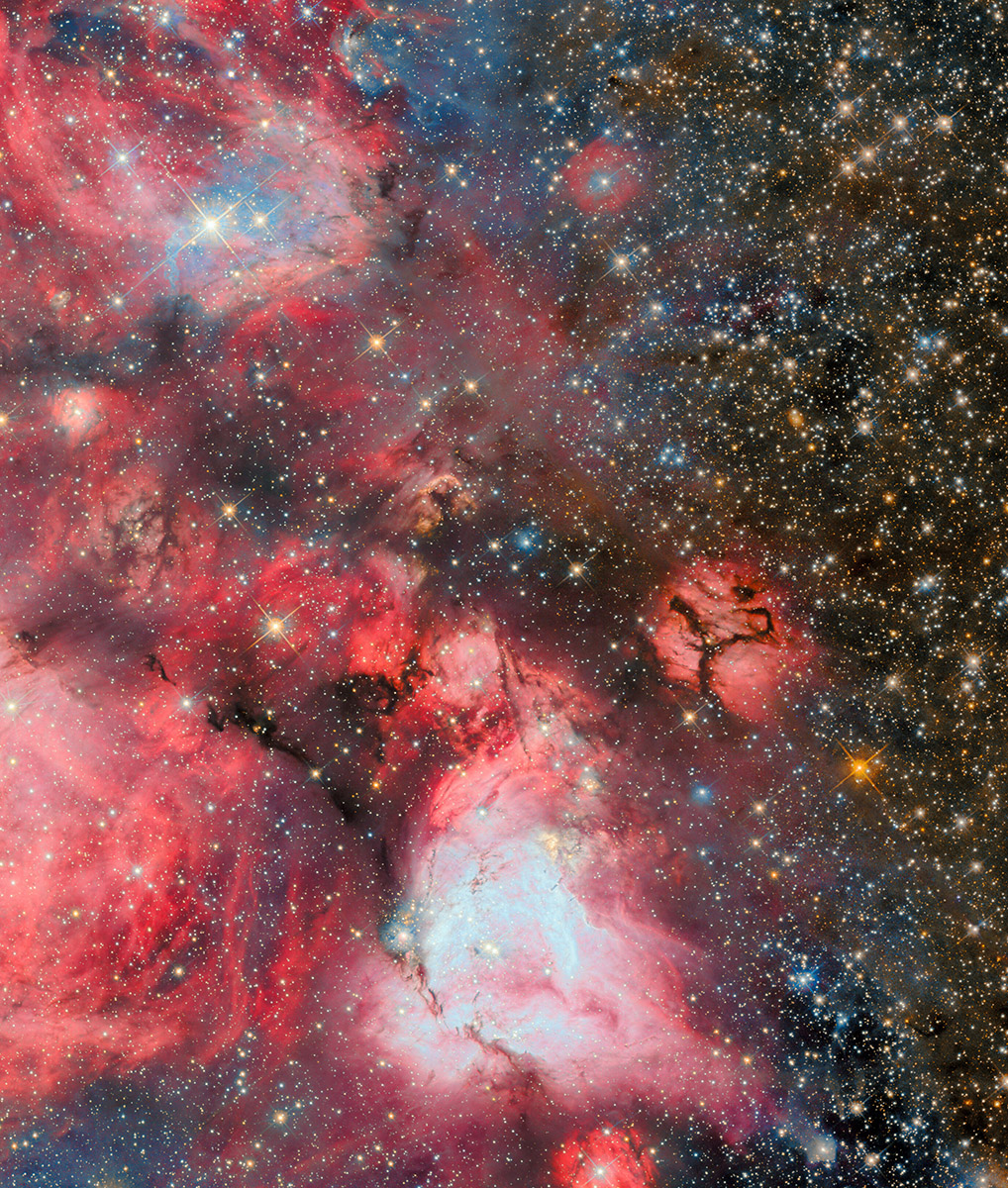
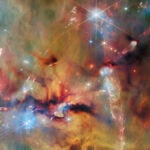
The Hubble Space Telescope has returned with a new image of N159, a large star-forming region in the Large Magellanic Cloud. The scene is dense with activity. Clouds glow in bright red. Dark filaments slice across the frame. Several bubbles open up inside the gas. Each detail points to young stars shaping the cloud from within. N159 sits about 160,000 light-years away, close enough for Hubble to reveal structure that would disappear in most distant galaxies. The new image captures that structure with sharp clarity, giving a direct look at how massive stars affect their surroundings.
How young stars sculpt their birth cloud
The large bubbles visible in the image are not empty by chance. They come from newly formed massive stars that emit strong ultraviolet radiation. That radiation heats and pushes the nearby gas. Over time, the gas expands outward and forms a shell. The centre clears out, letting the background starlight shine through. In N159, these bubbles overlap in several places. Some appear small and tightly edged, showing relatively young activity. Others have grown larger and more diffuse, marking older phases. Together, they trace the recent history of star formation. Each bubble shows where a star turned on and began to carve a small space out of the cloud.
Some stars sit in front of the gas and shine. Others lie behind thick dust lanes. Their light appears dimmer or redder. The dark filaments mark the densest material, where new stars likely remain hidden. The bright red patches show zones of ionised hydrogen, lit by ultraviolet energy. This mix of glowing gas, cold dust, and embedded stars creates a three-dimensional structure. The region is not a smooth cloud. It is a layered, uneven environment with pockets at different stages of collapse or disruption.
Dense pockets can survive longer if they sit behind heavier dust. Exposed areas clear out faster. The contrast between the two shapes the next generation of stars. In N159, both conditions appear side by side, which makes it an ideal laboratory for studying these processes.
The Large Magellanic Cloud
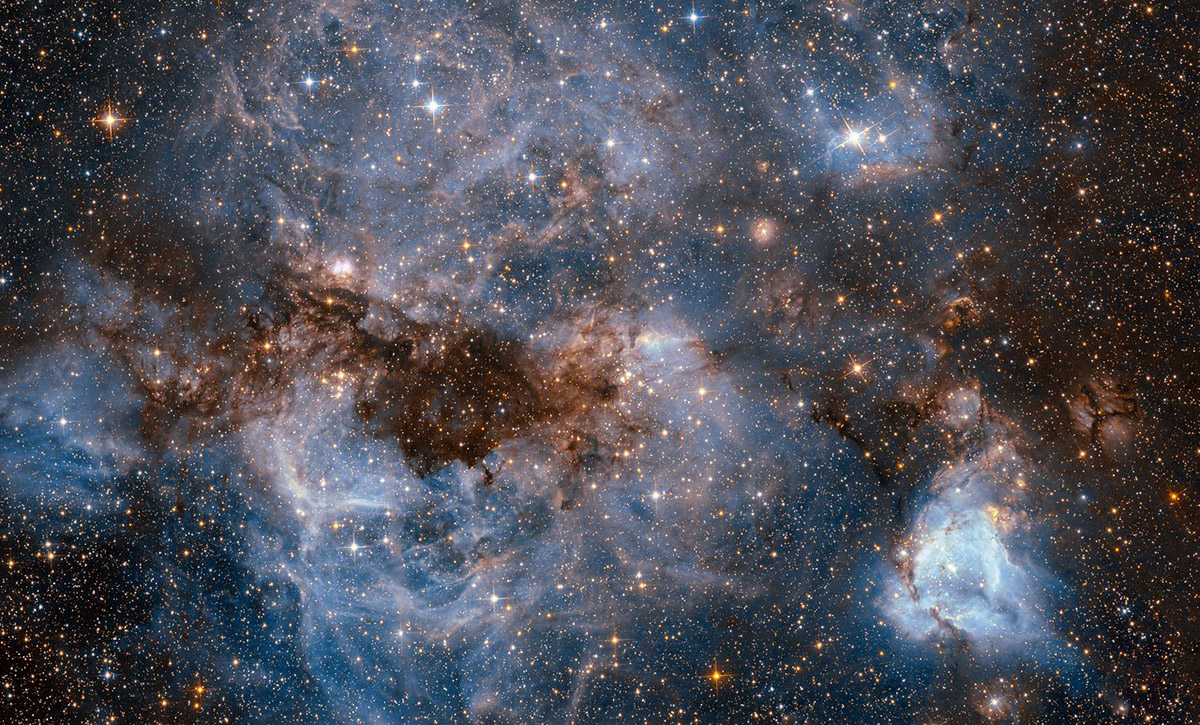
The Large Magellanic Cloud is a smaller and slightly simpler galaxy than the Milky Way. It holds fewer heavy elements, and its dust behaves differently. That difference influences how gas cools and how easily radiation spreads. Because of this, star-forming regions in the LMC offer a useful comparison to similar regions in our own galaxy. N159 provides a chance to see how massive stars form in a lower-metal environment. Even small changes in chemical makeup can alter how clouds collapse or how quickly bubbles expand. By studying N159, astronomers learn which features of star formation remain constant and which vary from one galaxy to another.
The LMC also sits outside the plane of the Milky Way. That position gives us a clearer view with less foreground dust in the way. This clarity helps Hubble capture fine detail in visible light. It is one of the reasons the edges of the bubbles stand out so sharply in the new image.

Stellar feedback and its wider impact
The bubbles in N159 illustrate a larger principle known as stellar feedback. This refers to the way young stars influence the gas around them. It includes radiation, winds, and shock waves. Over millions of years, it also includes supernova explosions. Feedback controls how fast clouds collapse. Too little feedback, and clouds form stars too quickly. Too much feedback, and clouds disperse before they can form many stars. The right balance allows new stars to keep forming while older stars reshape the region.
N159 shows this balance in action. Some areas look bright and strongly ionised. Others appear shielded and dense. Hubble captures the borders between these two conditions. These borders often mark the fronts where winds and radiation meet colder gas. They are the places where compression might trigger new star formation. They are also the places where gas may thin out and stop forming stars. The new image shows both outcomes at once.

A region that continues to evolve
N159 continues to change as new stars form and older stars reshape the cloud. Over time, some bubbles will expand and merge. Dense pockets will collapse into new stars or fade as winds strip them away. The entire region may look very different in a few million years. Hubble’s detailed view offers a snapshot of this moment in the process.
N159’s mix of glowing gas, carved bubbles, and sharp dust lanes provides a straightforward view of a complex process. It shows how stars begin to influence their environment almost immediately. It shows how gas responds to heat, pressure, and motion. And it shows how a region can hold multiple stages of star formation at once.
As star-forming regions go, N159 is both active and informative. It provides compelling evidence of stellar birth and clear signs of feedback at work. The bubbles illustrate the energy young stars release into their surroundings. The dense pockets hint at future stars still waiting to appear. The mix of the two reveals a region in transition.
Clear skies!
See more from DIYPhotography.net on Google
Add DIYPhotography.net as a trusted source. This makes
our stories more likely to appear in your Google Search results.
 Add as a preferred source on Google

Soumyadeep Mukherjee
Soumyadeep Mukherjee is an award-winning astrophotographer from India. He has a doctorate degree in Linguistics. His work extends to the sub-genres of nightscape, deep sky, solar, lunar and optical phenomenon photography. He is also a photography educator and has conducted numerous workshops. His works have appeared in over 40 books & magazines including Astronomy, BBC Sky at Night, Sky & Telescope among others, and in various websites including National Geographic, NASA, Forbes. He was the first Indian to win “Astronomy Photographer of the Year” award in a major category.

Join the Discussion
DIYP Comment Policy
Be nice, be on-topic, no personal information or flames.