





















The Young Stars of Taurus: Hubble Captures a Cosmic Nursery
Jul 1, 2025
Soumyadeep Mukherjee
Soumyadeep Mukherjee is an award-winning astrophotographer from India. He has a doctorate degree in Linguistics. His work extends to the sub-genres of nightscape, deep sky, solar, lunar and optical phenomenon photography. He is also a photography educator and has conducted numerous workshops. His works have appeared in over 40 books & magazines including Astronomy, BBC Sky at Night, Sky & Telescope among others, and in various websites including National Geographic, NASA, Forbes. He was the first Indian to win “Astronomy Photographer of the Year” award in a major category.
Share:

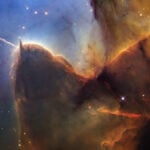
The European Space Agency has released a stunning image from the NASA/ESA Hubble Space Telescope. It shows a vibrant, smoke-like glow surrounding a group of young stars in the Taurus Molecular Cloud. The image, named “The Young Stars of Taurus,” is officially catalogued as GN 04.32.8. It was selected as the Picture of the Week on ESA/Hubble’s website and quickly became a favourite among astronomers and space enthusiasts alike. This region of space lies about 480 light-years from Earth. It is one of the closest star-forming regions to our solar system. The image focuses on a small part of this vast molecular cloud. Yet, within this small patch, Hubble captured immense cosmic activity, stars being born, discs forming planets, and light scattering through interstellar dust.
What Is GN 04.32.8?
GN 04.32.8 is a reflection nebula. That means it doesn’t emit its own light. Instead, it shines because nearby stars light it up. The dust in the nebula reflects and scatters the starlight. This is why the nebula appears smoky and faintly blue. It is a visual treat and a rich source of scientific data.
Hubble used its Wide Field Camera 3 (WFC3) to take this image. The telescope collected light in the V (606 nm) and I (814 nm) bands. These filters allow astronomers to study the nebula in visible light. The final image shows delicate details. We see how light interacts with the dust and gas. We also see young stars at different stages of formation.
A trio of young stars
At the center of the image, three young stars shine brightly. They form a gravitationally bound system. The brightest among them is V1025 Tau. This star is in its early stages of life. It is still surrounded by remnants of the gas and dust cloud that formed it.
Close to V1025 Tau are two T Tauri stars, HP Tau G2 and HP Tau G3. T Tauri stars are important in astronomy. They are young, variable stars that have not yet started nuclear fusion in their cores. These stars are usually less than 10 million years old. They are still contracting and gathering mass. HP Tau G2 and HP Tau G3 are known for their unpredictable brightness. This flickering happens because of the unstable material around them. Dust clouds, jets of gas, and growing planetary discs can all block or reflect their light. Observing such stars helps scientists understand how our Sun might have looked in its youth.

The hidden protostar
Below the main trio, Hubble spotted something even more exciting. A small, orange dot lies at the bottom of the image. A dark, horizontal line cuts through it. This is a protostar, a star that has just formed but hasn’t ignited fusion yet. It is still buried in the dust and gas that made it. The dark line is a protoplanetary disc seen edge-on. These discs are made of gas and dust that orbit around the young star. Over time, the material in the disc may clump together to form planets. Seeing such a disc from the side is rare. Most are tilted or face-on. Edge-on discs give scientists a unique look at their structure.
This protostar is a window into how planets may form. The thick dust disc blocks much of the starlight. Yet, it also glows slightly from the warmth of the hidden star. This delicate balance between light and shadow helps researchers estimate the disc’s mass, size, and shape.

Observational tools and techniques
To capture this image, Hubble used its powerful Wide Field Camera 3. This camera replaced the Wide Field and Planetary Camera 2 in 2009. It can observe in ultraviolet, visible, and near-infrared light. For this image, only visible light filters were used. The field of view is about 2.4 by 2.6 arcminutes. That’s just a tiny patch of sky. Yet, the amount of detail Hubble reveals is astonishing. Hubble’s high resolution lets astronomers pick out features as small as protoplanetary discs. By using multiple filters, astronomers can create a colour image that reveals more than what the eye sees. The colours are close to natural, but they also highlight specific features. Blue light shows where scattering is strongest. Orange and red tones point to denser regions of dust or glowing warm gas.

“The Young Stars of Taurus” is a cosmic snapshot of star and planet formation in action. Hubble’s sharp vision captured glowing stars, scattered light, and a hidden world being born. This one image holds a timeline of stellar evolution, from dusty birth to shining youth.
Clear skies!
See more from DIYPhotography.net on Google
Add DIYPhotography.net as a trusted source. This makes
our stories more likely to appear in your Google Search results.
 Add as a preferred source on Google

Soumyadeep Mukherjee
Soumyadeep Mukherjee is an award-winning astrophotographer from India. He has a doctorate degree in Linguistics. His work extends to the sub-genres of nightscape, deep sky, solar, lunar and optical phenomenon photography. He is also a photography educator and has conducted numerous workshops. His works have appeared in over 40 books & magazines including Astronomy, BBC Sky at Night, Sky & Telescope among others, and in various websites including National Geographic, NASA, Forbes. He was the first Indian to win “Astronomy Photographer of the Year” award in a major category.

Join the Discussion
DIYP Comment Policy
Be nice, be on-topic, no personal information or flames.