
























Hubble Reveals a Cloudy Star Nursery in a Nearby Galaxy
Sep 8, 2025
Soumyadeep Mukherjee
Soumyadeep Mukherjee is an award-winning astrophotographer from India. He has a doctorate degree in Linguistics. His work extends to the sub-genres of nightscape, deep sky, solar, lunar and optical phenomenon photography. He is also a photography educator and has conducted numerous workshops. His works have appeared in over 40 books & magazines including Astronomy, BBC Sky at Night, Sky & Telescope among others, and in various websites including National Geographic, NASA, Forbes. He was the first Indian to win “Astronomy Photographer of the Year” award in a major category.
Share:
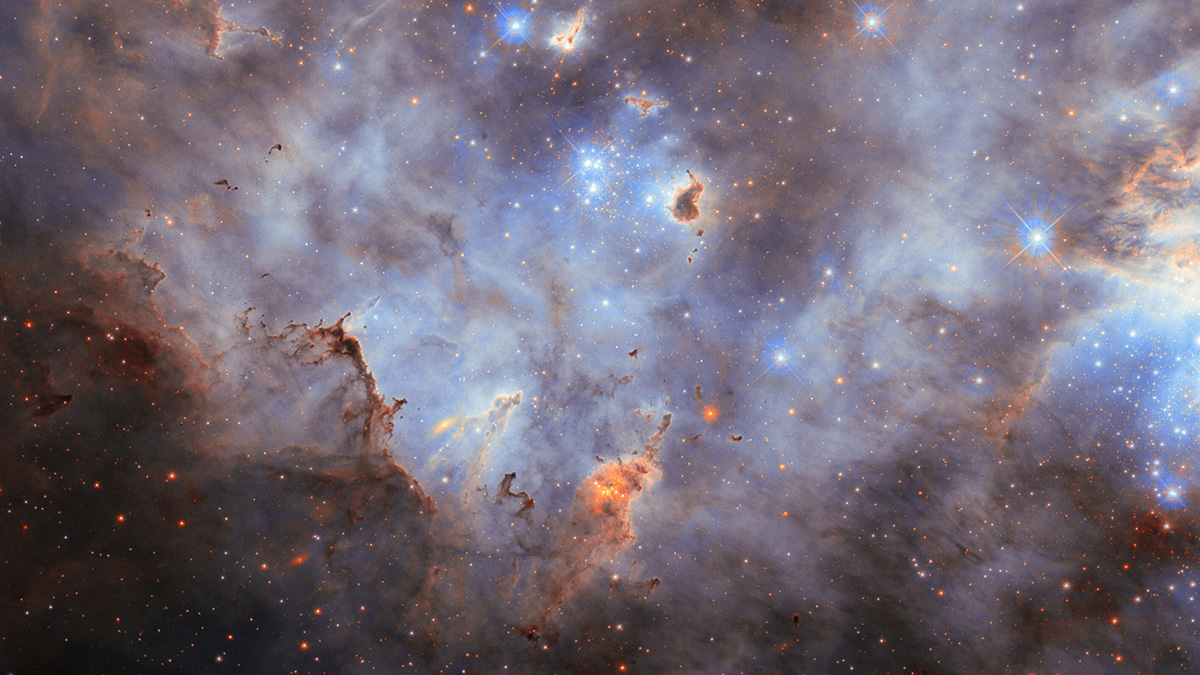
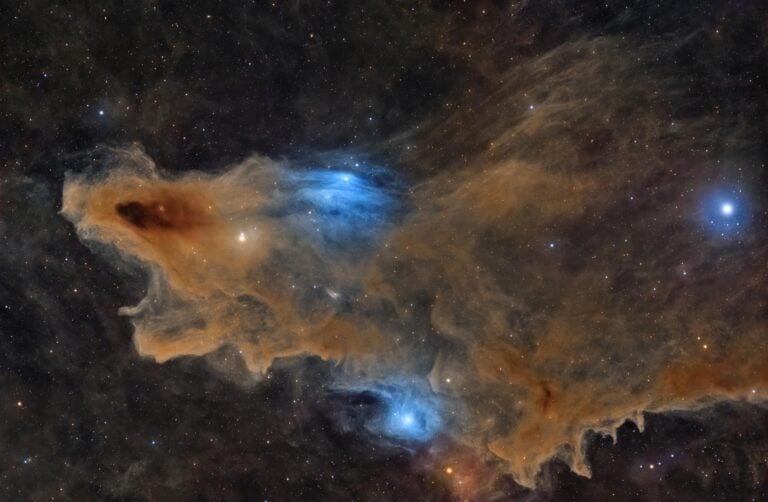
The Hubble Space Telescope has captured a remarkable new image that looks deep into one of our closest galactic neighbors. The picture shows a cloudy star cluster inside the Large Magellanic Cloud (LMC), a small companion galaxy of the Milky Way. The region, known as N11, is a vast site of ongoing star formation. Here, massive young stars light up surrounding gas while thick clouds of dust weave across the scene. By combining observations taken with two different cameras over many years, astronomers created a portrait that highlights both the glittering stars and the complex dust structures around them.
A galactic neighbor filled with star birth
The Large Magellanic Cloud is one of the Milky Way’s closest companions, located about 160,000 light-years away in the southern sky. Although smaller and less orderly than our galaxy, it is rich in regions where stars are born. The best-known is the Tarantula Nebula, but the second-largest site of star formation is N11. This region spans hundreds of light-years and contains several groups of young, massive stars.
The section captured in Hubble’s new image is known as LMC N44C. It is packed with stars that shine through veils of cosmic dust. Intense ultraviolet radiation from the hottest stars shapes the clouds, carving arcs and cavities. These processes demonstrate how stellar nurseries are continually sculpted by the very stars they produce.

The role of star-forming regions
Star-forming regions like N11 are crucial for understanding how galaxies evolve. They contain the raw material for stellar birth: gas and dust. As these materials collapse under gravity, they form new stars, which then inject energy back into their surroundings through radiation and stellar winds. This cycle influences how many stars form, what kind of stars appear, and how galaxies change over time.
The LMC is especially valuable for these studies. Unlike the Milky Way, it has fewer heavy elements, which astronomers call low metallicity. This makes it a good comparison case, since stars here form in conditions that resemble those in the early universe. By observing N11, astronomers can test how well their theories of star formation hold up in different environments.

Two eras of Hubble observations
One of the most striking aspects of this image is how it was built. It combines data from two different instruments on Hubble, collected years apart.
The first set of observations came from the Advanced Camera for Surveys (ACS). Installed on Hubble in 2002, ACS offered sharp, wide-field images that quickly became essential for mapping star clusters. Astronomers used ACS to catalog the stars in N11, measuring their brightness and color. This work covered stars from tiny dwarfs just a tenth the mass of the Sun to giants 100 times heavier. The survey helped outline the full population of stars in the region.
Later, the Wide Field Camera 3 (WFC3) added new observations. Installed in 2009, WFC3 covers a wider range of wavelengths, from ultraviolet to near-infrared. Its strength in studying dust and gas made it ideal for examining the cloudy structures in N11. By combining the ACS star catalog with WFC3’s dust mapping, astronomers built a richer and more complete view.
What the image reveals
At first glance, the image is simply beautiful: a dense star field partly hidden by dark, cloudy streaks. But each detail carries information. The bright, massive stars stand out in blue and white tones, while reddish hues show where light is scattered or absorbed by dust. The arrangement of the clouds reveals how radiation and winds from the hottest stars reshape their surroundings.

The ACS data helped build diagrams that plot star brightness against color, which are crucial for estimating stellar ages and masses. This information revealed how star formation has unfolded in N11 over time. The WFC3 data traced the dust, showing how it blocks and scatters starlight. From that, astronomers can estimate how much dust is present and how it is distributed. Since dust is vital for future star formation, mapping it helps predict how the region will evolve.
Clear skies!
See more from DIYPhotography.net on Google
Add DIYPhotography.net as a trusted source. This makes
our stories more likely to appear in your Google Search results.
 Add as a preferred source on Google

Soumyadeep Mukherjee
Soumyadeep Mukherjee is an award-winning astrophotographer from India. He has a doctorate degree in Linguistics. His work extends to the sub-genres of nightscape, deep sky, solar, lunar and optical phenomenon photography. He is also a photography educator and has conducted numerous workshops. His works have appeared in over 40 books & magazines including Astronomy, BBC Sky at Night, Sky & Telescope among others, and in various websites including National Geographic, NASA, Forbes. He was the first Indian to win “Astronomy Photographer of the Year” award in a major category.


Join the Discussion
DIYP Comment Policy
Be nice, be on-topic, no personal information or flames.