









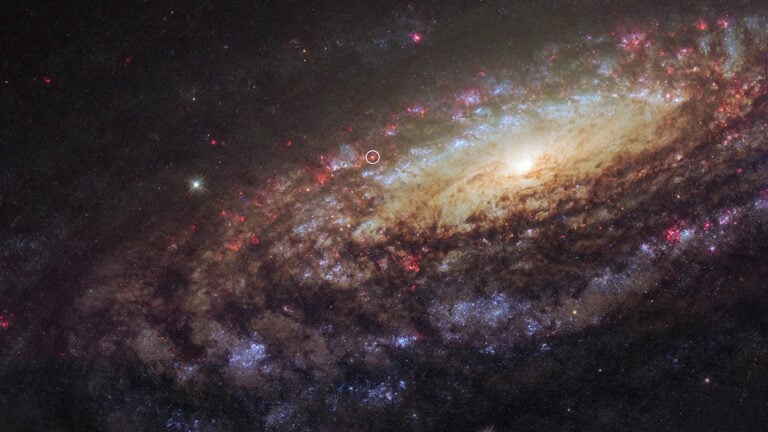














A New Light on Uranus’s Moons: Hubble’s Ultraviolet Image
Jun 28, 2025
Soumyadeep Mukherjee
Soumyadeep Mukherjee is an award-winning astrophotographer from India. He has a doctorate degree in Linguistics. His work extends to the sub-genres of nightscape, deep sky, solar, lunar and optical phenomenon photography. He is also a photography educator and has conducted numerous workshops. His works have appeared in over 40 books & magazines including Astronomy, BBC Sky at Night, Sky & Telescope among others, and in various websites including National Geographic, NASA, Forbes. He was the first Indian to win “Astronomy Photographer of the Year” award in a major category.
Share:

Uranus is one of the most mysterious planets in our Solar System. It rotates on its side. Its seasons last decades. Its faint rings and icy moons orbit in a unique way. Despite being discovered over two centuries ago, Uranus remains poorly understood. Now, the Hubble Space Telescope has given us a new view. In June 2025, ESA and NASA released a stunning image. It shows Uranus and its four largest moons, Titania, Oberon, Ariel, and Umbriel. The photo is more than just beautiful. It reveals new science about these distant icy worlds.
The observation
The image was taken by the Hubble Space Telescope. Hubble used its Wide Field Camera 3 (WFC3) and Advanced Camera for Surveys (ACS). These instruments are powerful. They allow scientists to capture the Solar System in ultraviolet light.
Why ultraviolet? Because UV light shows surface features invisible in visible light. It highlights the way cosmic dust and radiation affect moons over time. It’s like turning on a blacklight in a dark room. New details pop out. This is the first time Uranus’s large moons have been studied this way. The observations took place in 2022 and 2023. Scientists processed the data and shared the results in 2025.
What we see in the image
Uranus sits off-center in the frame. It appears as a soft blue ball. Its rings glow faintly. Four of its major moons appear as small, bright dots. From top-right to bottom-left, they are Titania, Oberon, Umbriel, and Miranda. Ariel is barely separated from the planet’s glow, but its shadow is visible. Each moon orbits at a different distance from Uranus. All of these moons are airless, icy worlds. They reflect sunlight and show signs of complex histories. Until now, most photos have come from Voyager 2 in 1986. Hubble’s new image brings a fresh look.
The discovery
Moons in orbit have a “leading” side (the front) and a “trailing” side (the back). Think of a car driving through falling snow. The front windshield hits more snow than the back. Similarly, a moon’s leading hemisphere collects more dust and particles from space. Scientists thought the trailing sides of Uranus’s moons would be darker. That’s what happens around other planets like Jupiter. The trailing hemispheres often get bombarded by charged particles trapped in the planet’s magnetic field. But Hubble found the opposite for the outer moons, Titania and Oberon. Their leading hemispheres are darker than their trailing ones. That was unexpected.

Why does this happen? The most likely explanation is interplanetary dust. These outer moons are far enough from Uranus that the planet’s magnetic field is weaker. Instead, their leading sides are sweeping up dust as they orbit, just like a car’s windshield collects insects. This dark material may be carbon-rich and originate from tiny objects in the outer Solar System.
The inner moons, Ariel and Umbriel, tell a different story. Hubble did not find major brightness differences between their two sides. They appear more uniform. Why? Because Titania and Oberon might be protecting them. These outer moons may act like giant shields, scooping up most of the incoming dust before it reaches the inner region. In other words, Titania and Oberon are like big brooms sweeping the cosmic dust path ahead. That leaves Ariel and Umbriel in a relatively “cleaner” orbital space.
A closer look at the Moons
Let’s take a quick look at these moons:
- Titania: The largest Uranian moon. Diameter: 1,578 km. Its surface shows deep valleys and impact craters. It may even have a subsurface ocean.
- Oberon: Slightly smaller than Titania. Diameter: 1,523 km. Its surface has many ancient craters. Some show signs of ice flows.
- Ariel: One of the most geologically active Uranian moons. Diameter: 1,158 km. It has fault valleys and ridges.
- Umbriel: A dark and heavily cratered moon. Diameter: 1,170 km. Its surface is more uniform and reflects less sunlight.

The study reveals a surprising dust-cleaning effect. The outer moons are getting darker in the front, not the back. The inner moons are shielded and stay cleaner. It’s a new way to understand how moons interact with their environment. This kind of discovery reminds us why space telescopes matter. Even decades after launch, Hubble continues to reveal secrets from the outer Solar System. And Uranus, once called the “forgotten planet,” is finally getting the attention it deserves.
Clear skies!
See more from DIYPhotography.net on Google
Add DIYPhotography.net as a trusted source. This makes
our stories more likely to appear in your Google Search results.
 Add as a preferred source on Google

Soumyadeep Mukherjee
Soumyadeep Mukherjee is an award-winning astrophotographer from India. He has a doctorate degree in Linguistics. His work extends to the sub-genres of nightscape, deep sky, solar, lunar and optical phenomenon photography. He is also a photography educator and has conducted numerous workshops. His works have appeared in over 40 books & magazines including Astronomy, BBC Sky at Night, Sky & Telescope among others, and in various websites including National Geographic, NASA, Forbes. He was the first Indian to win “Astronomy Photographer of the Year” award in a major category.



Join the Discussion
DIYP Comment Policy
Be nice, be on-topic, no personal information or flames.