















Photographer Captures Four “Artificial Stars” in the Night Sky
Nov 12, 2026
Soumyadeep Mukherjee
Soumyadeep Mukherjee is an award-winning astrophotographer from India. He has a doctorate degree in Linguistics. His work extends to the sub-genres of nightscape, deep sky, solar, lunar and optical phenomenon photography. He is also a photography educator and has conducted numerous workshops. His works have appeared in over 40 books & magazines including Astronomy, BBC Sky at Night, Sky & Telescope among others, and in various websites including National Geographic, NASA, Forbes. He was the first Indian to win “Astronomy Photographer of the Year” award in a major category.
Share:
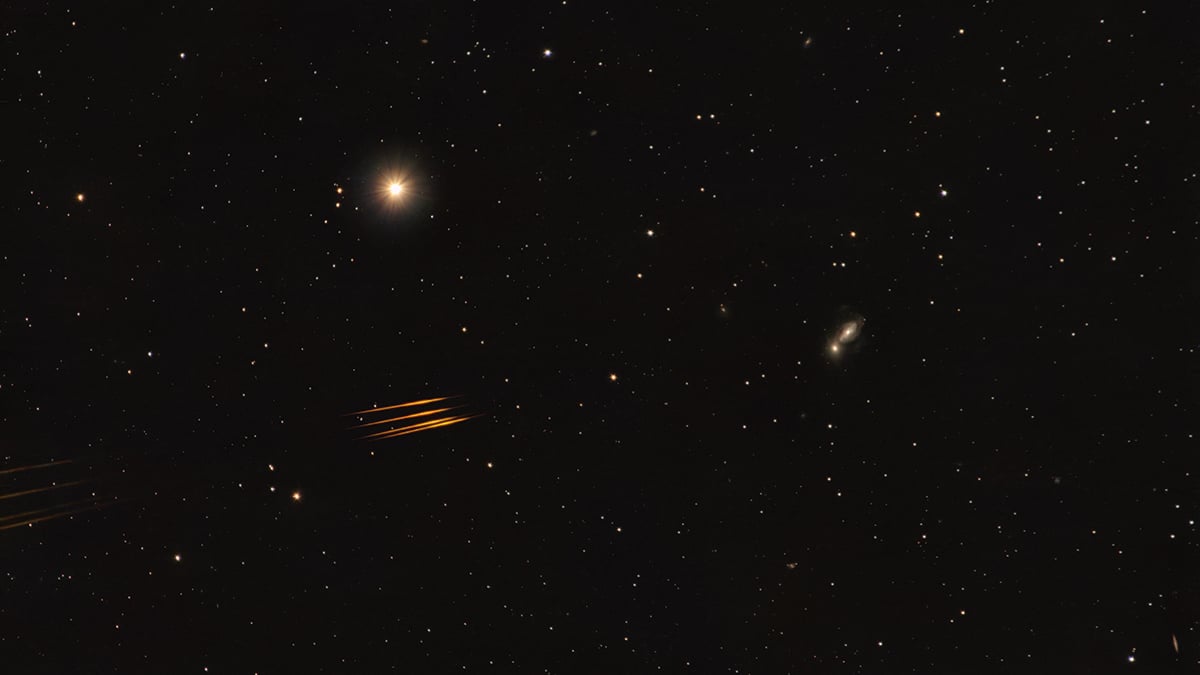
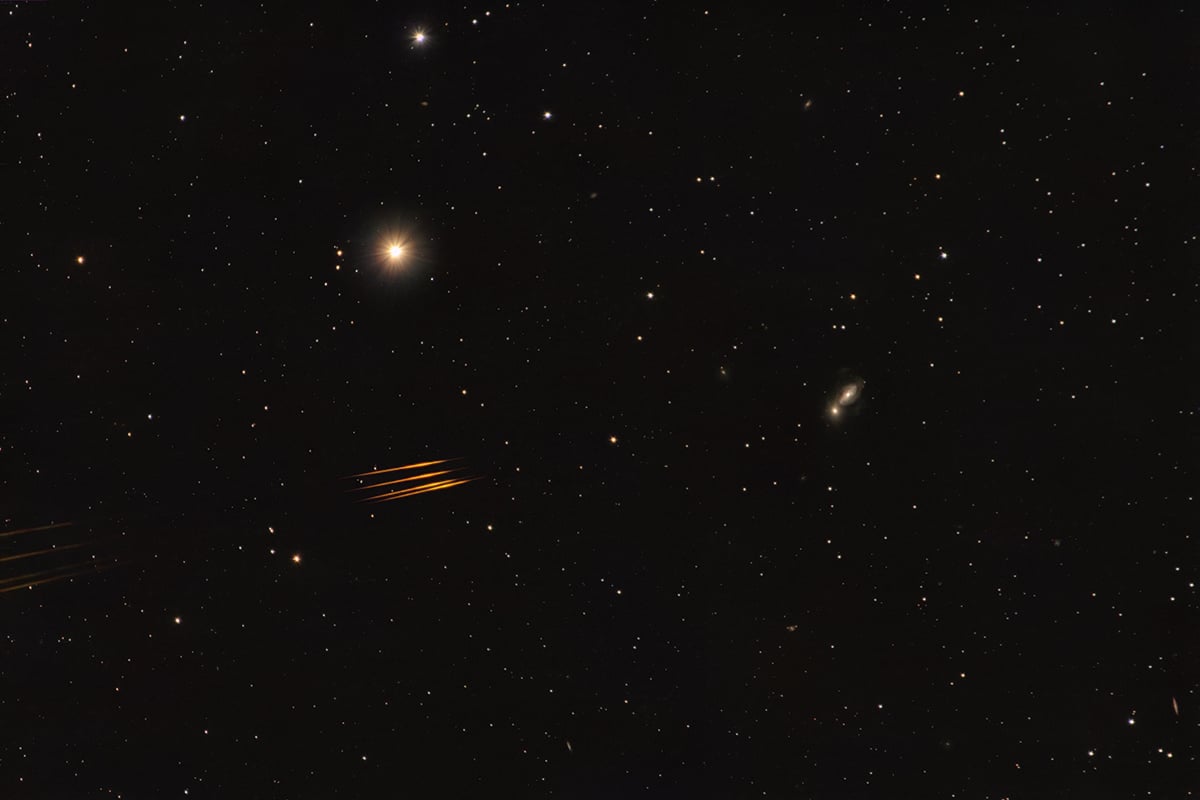
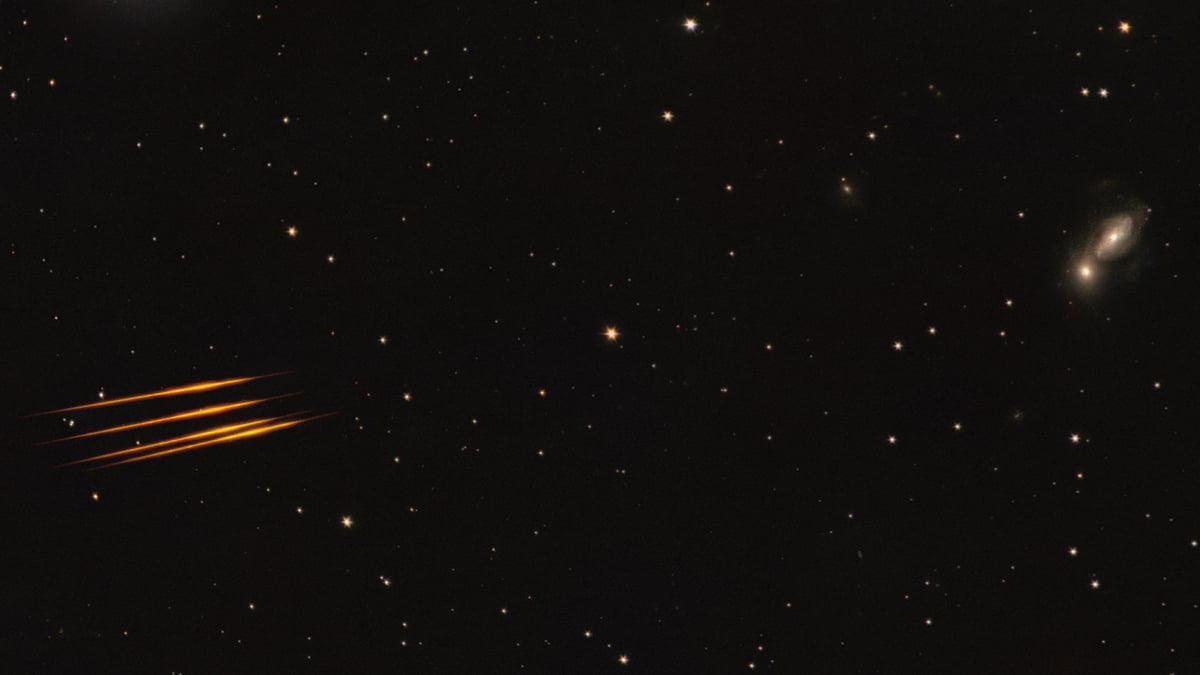
Four yellow streaks appear above the horizon in a photograph taken at the European Southern Observatory’s (ESO) Paranal Observatory in Chile. They look like powerful laser beams reaching towards distant galaxies. In fact, they are creating four artificial stars high above the ground.
The photograph shows a technique that astronomers use to overcome atmospheric turbulence and improve the sharpness of their observations. Photographer A. Berdeu took it from approximately 2.5 kilometers away from the Very Large Telescope (VLT).
Four lasers create artificial stars above the VLT
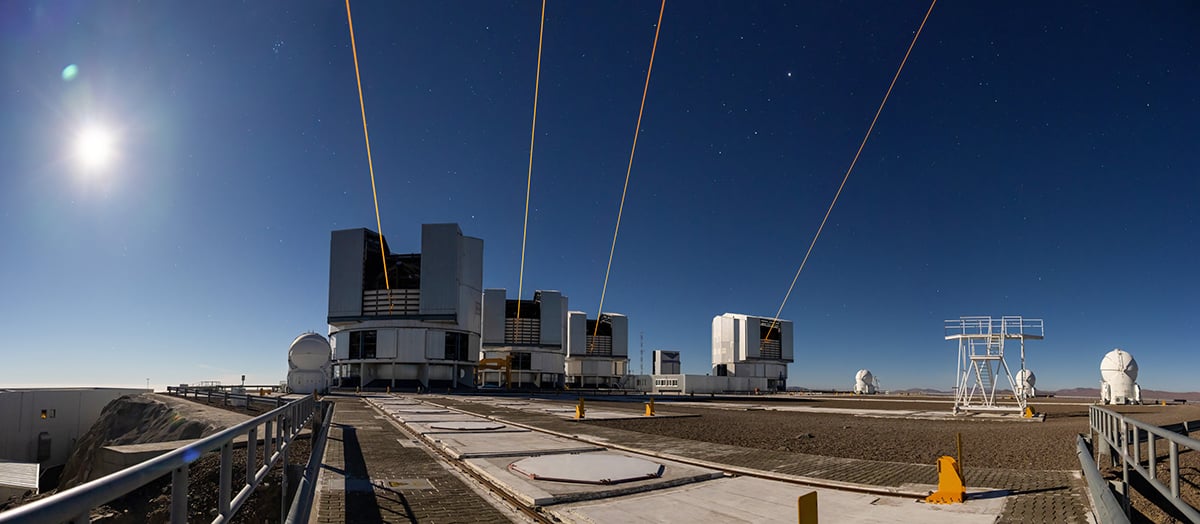
The lasers in Berdeu’s photograph come from ESO’s Very Large Telescope at Paranal Observatory. The facility stands in Chile’s Atacama Desert, where dry air, high altitude, and relatively stable atmospheric conditions make it an excellent location for astronomy. Its four Unit Telescopes each have an 8.2-metre primary mirror.
Each telescope has access to a laser guide star system. The lasers send powerful beams upwards through Earth’s atmosphere. Some light scatters off air molecules along the way, making the lower sections of the beams faintly visible in photographs. The beams become progressively fainter as the surrounding atmosphere grows thinner.
At approximately 90 kilometers above the surface, the lasers reach a region rich in sodium atoms. These atoms absorb energy from the laser light and become excited. They then release some of that energy as light, making the region glow. From the ground, the illuminated area resembles a star.
Why the artificial stars look like long streaks
The shape of the four artificial stars is one of the most interesting details in the photograph. Rather than appearing as four compact points, they look like elongated yellow streaks extending down towards the telescopes.
The sodium atoms occupy a layer approximately 5–10 kilometers thick. The laser beams excite atoms throughout this region, so the resulting light comes from different heights. Berdeu photographed the scene from about 2.5 kilometers away. From that position, the camera sees the glowing sodium layer from an angle. The different illuminated regions appear stretched along the direction of the beams.
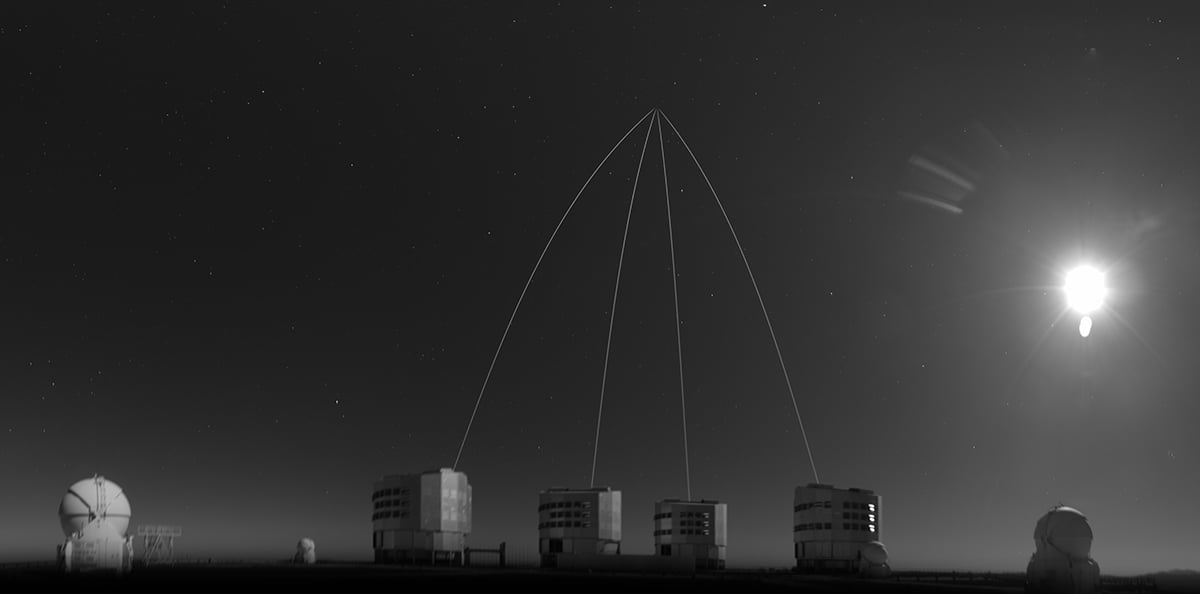
An astronomer standing beside the telescopes looks upwards along the laser beams. From this position, the illuminated sodium atoms appear as compact points of light. These are the artificial stars that the adaptive optics system uses as reference sources.
The lasers help study a supermassive black hole
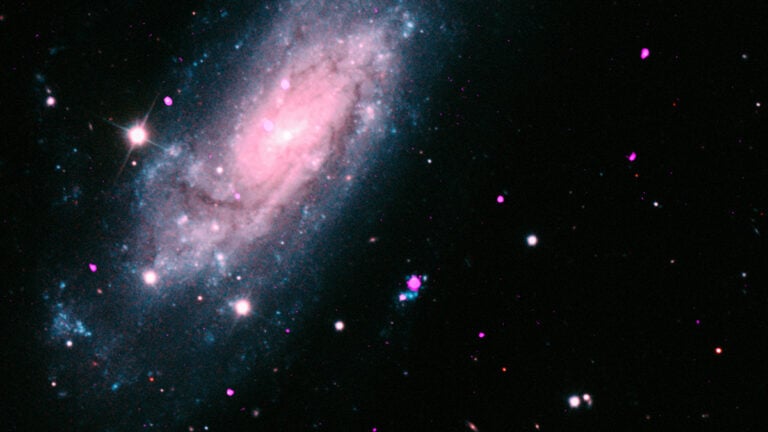
The photograph also has a specific astronomical target. The lasers supported observations of the supermassive black hole at the center of NGC 3227, one of the galaxies visible to the right of the image. This galaxy belongs to a class known as active galaxies. Its central region produces intense radiation as the black hole pulls in surrounding gas.
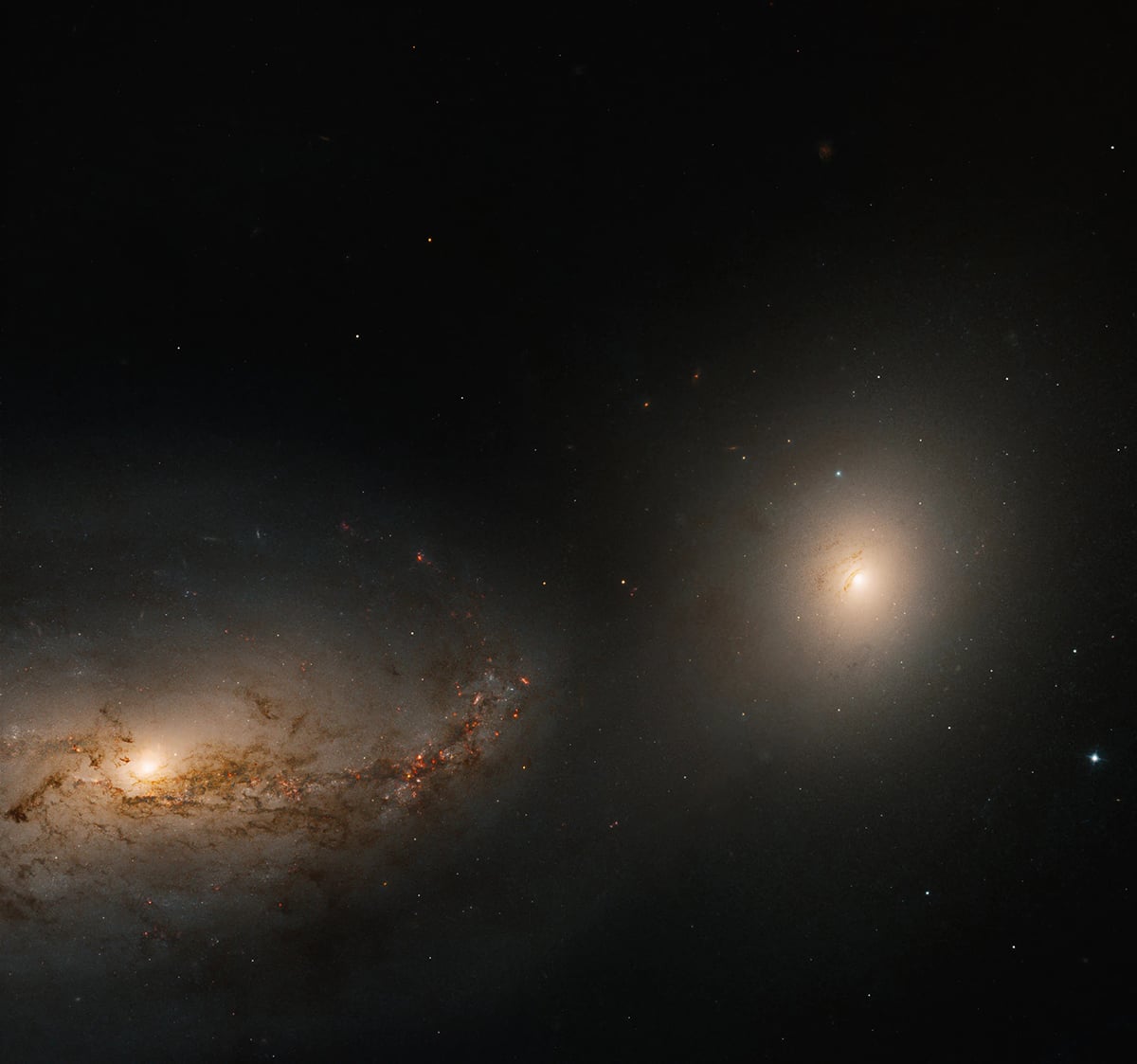
The black hole itself does not emit light. The intense radiation comes from the material around it. As gas moves towards the black hole, it heats up and forms a bright accretion flow. Studying this region helps astronomers understand how supermassive black holes consume matter and influence their host galaxies.
ESO astronomer James Leftley is studying several active galaxies using two instruments, GRAVITY and MATISSE. Both operate at the Very Large Telescope Interferometer (VLTI). This facility combines light collected by multiple telescopes, allowing astronomers to examine extremely fine details in distant objects.
Clear skies!
See more from DIYPhotography.net on Google
Add DIYPhotography.net as a trusted source. This makes
our stories more likely to appear in your Google Search results.
 Add as a preferred source on Google

Soumyadeep Mukherjee
Soumyadeep Mukherjee is an award-winning astrophotographer from India. He has a doctorate degree in Linguistics. His work extends to the sub-genres of nightscape, deep sky, solar, lunar and optical phenomenon photography. He is also a photography educator and has conducted numerous workshops. His works have appeared in over 40 books & magazines including Astronomy, BBC Sky at Night, Sky & Telescope among others, and in various websites including National Geographic, NASA, Forbes. He was the first Indian to win “Astronomy Photographer of the Year” award in a major category.


Join the Discussion
DIYP Comment Policy
Be nice, be on-topic, no personal information or flames.