




















Falcon 9 Rocket Lights Up the Night Sky Above Kitt Peak Observatory
Nov 3, 2026
Soumyadeep Mukherjee
Soumyadeep Mukherjee is an award-winning astrophotographer from India. He has a doctorate degree in Linguistics. His work extends to the sub-genres of nightscape, deep sky, solar, lunar and optical phenomenon photography. He is also a photography educator and has conducted numerous workshops. His works have appeared in over 40 books & magazines including Astronomy, BBC Sky at Night, Sky & Telescope among others, and in various websites including National Geographic, NASA, Forbes. He was the first Indian to win “Astronomy Photographer of the Year” award in a major category.
Share:
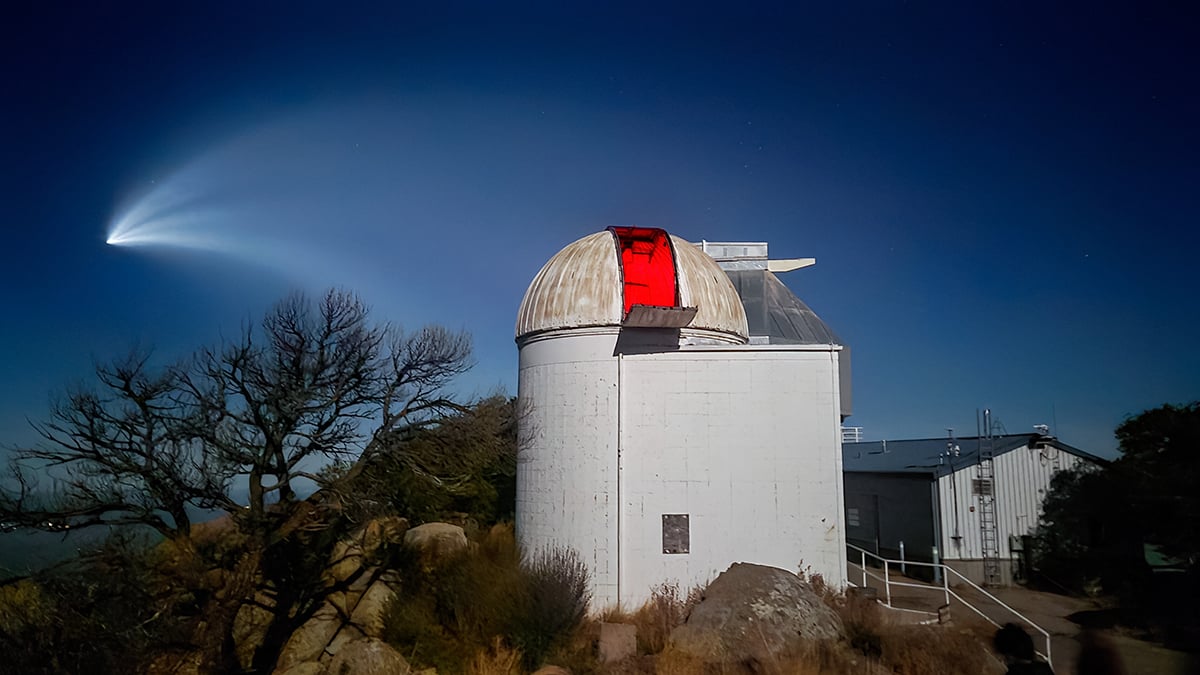
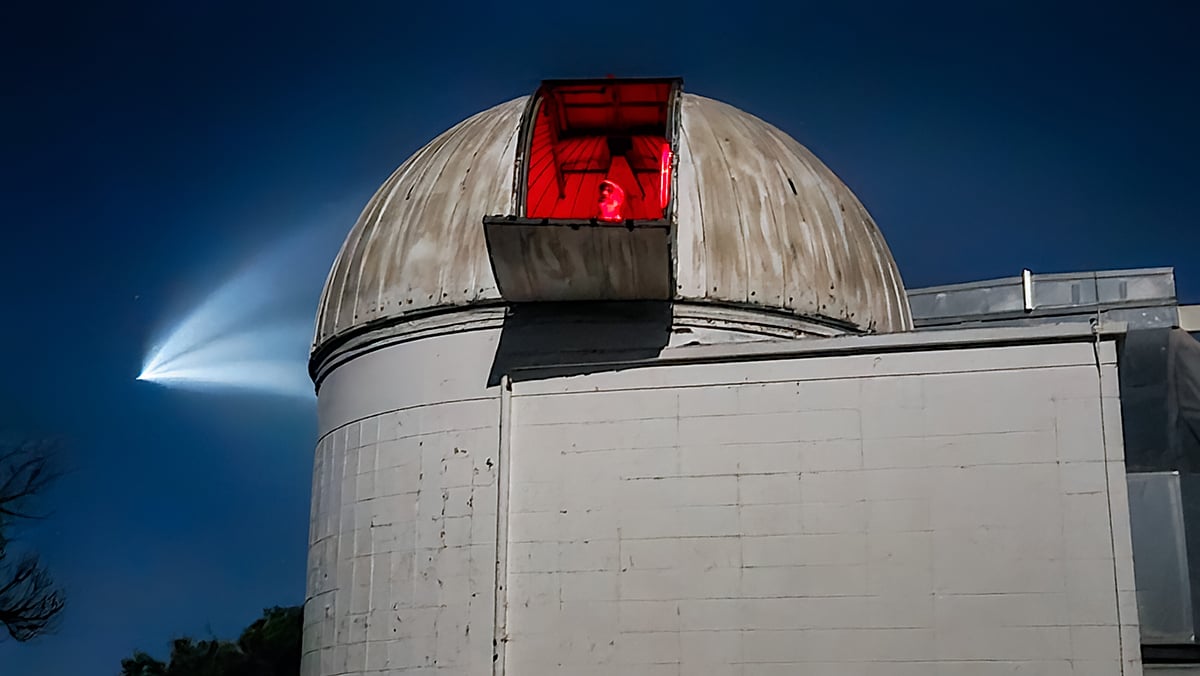
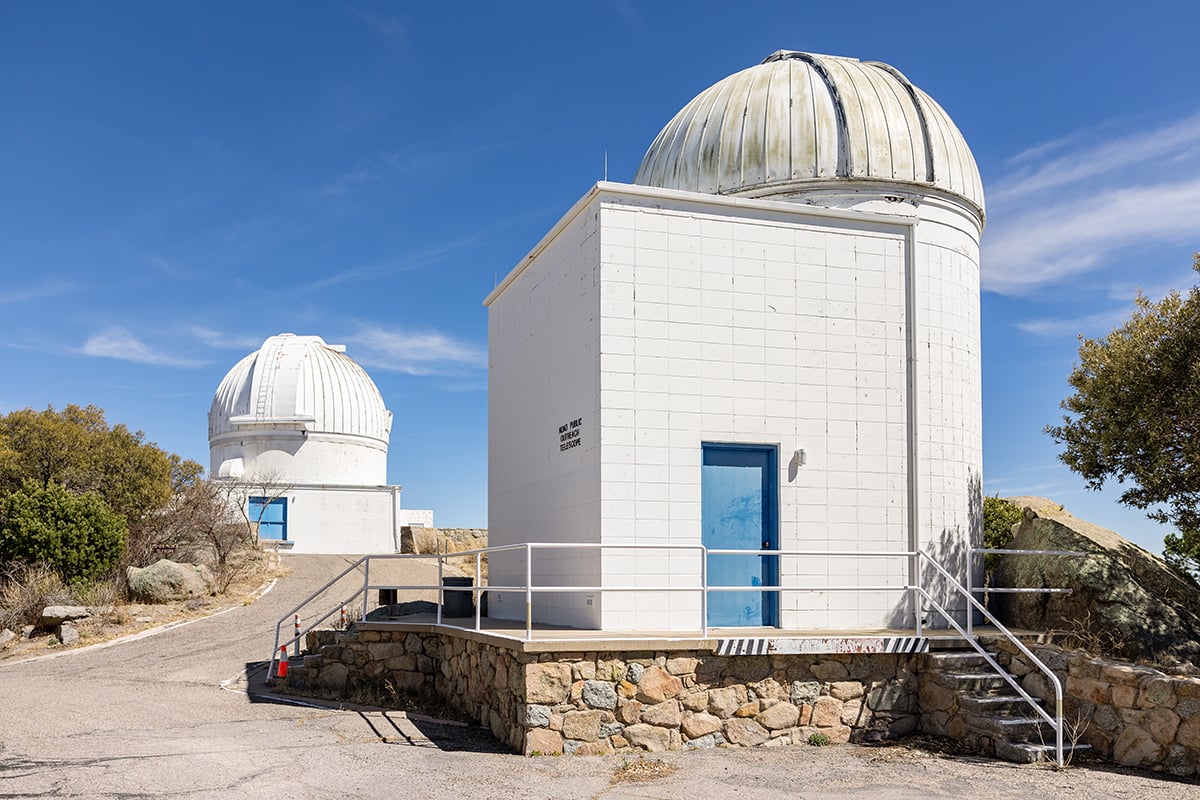
A SpaceX Falcon 9 rocket launched from California, climbed into the upper atmosphere, and left behind a glowing exhaust plume. Hundreds of miles away, at Kitt Peak National Observatory in Arizona, photographer P. McMahon caught the spectacle above two telescope domes. The images show the Visitor Center’s Levine 0.4-meter Telescope, the WIYN 3.5-meter Telescope, and the expanding plume beneath them.
A Falcon 9 launch seen from 550 miles away
Vandenberg Space Force Base sits on the California coast and serves as an important launch facility for SpaceX. The company regularly sends Falcon 9 rockets from here, particularly on missions that require polar or other high-inclination orbits. These trajectories take spacecraft over or near the polar regions as they circle Earth.
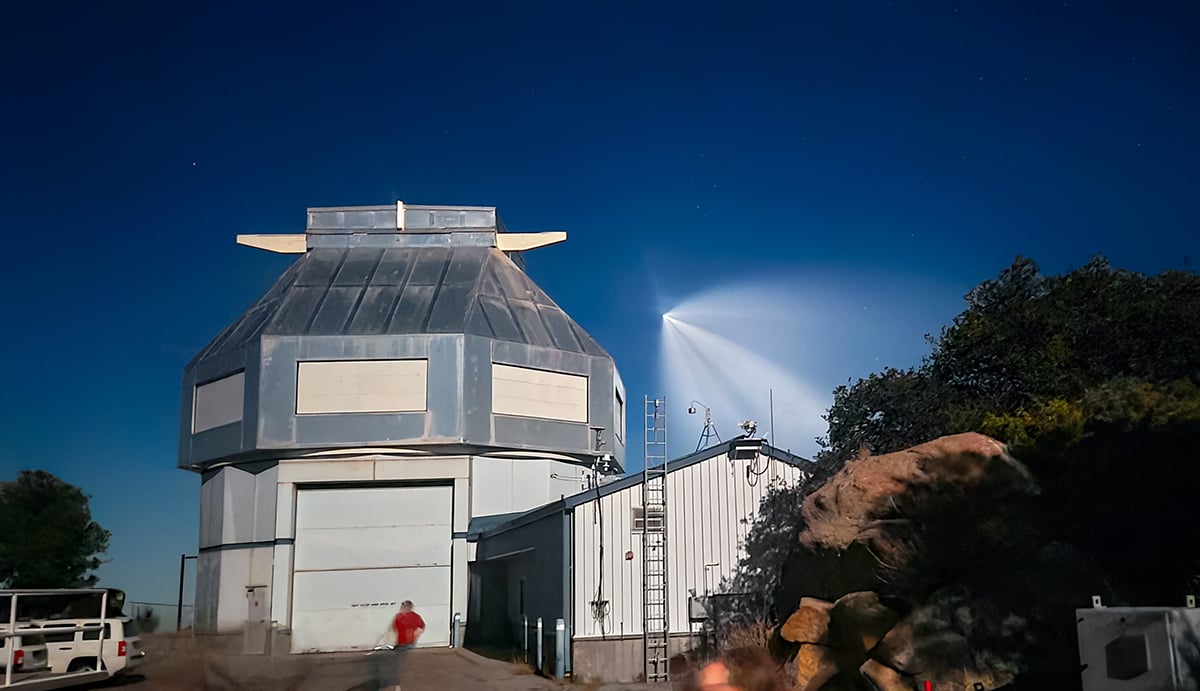
Kitt Peak lies southwest of Tucson, in Arizona’s Quinlan Mountains. At roughly 550 miles from Vandenberg, the observatory is far beyond the area where people would normally gather to watch a launch. But rocket exhaust can remain visible over considerable distances when the launch takes place around sunset or sunrise.
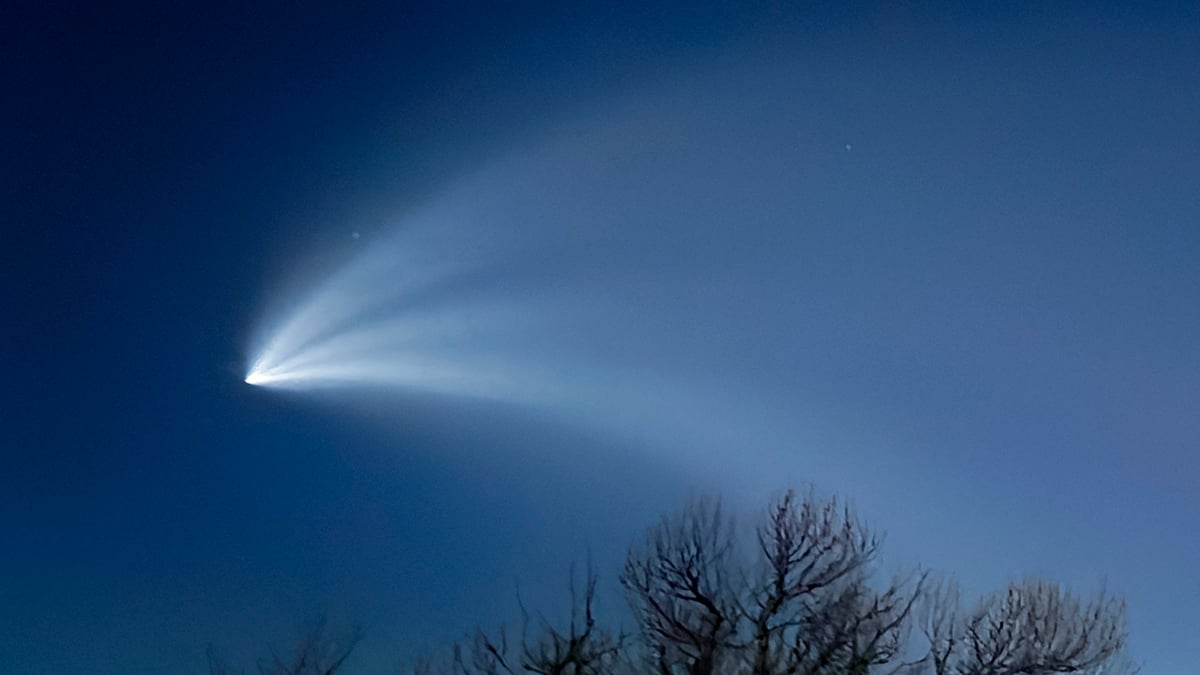
As the vehicle climbs, its exhaust expands into the increasingly thin atmosphere. The plume can spread across a surprisingly large area, making it easier to spot than the rocket itself. From a distant location, observers might lose sight of the vehicle but continue watching its illuminated exhaust.
Rocket’s exhaust remains visible after sunset
The explanation for this lies in Earth’s curvature and the height of the rocket. When the Sun sets, the ground enters Earth’s shadow first. Objects much higher above the surface can continue receiving direct sunlight for some time. A rocket climbing through the upper atmosphere can therefore remain illuminated after sunset at a distant observing location.
This is known as the twilight effect. It also explains why satellites sometimes remain visible in the evening sky. Although an observer on the ground sees darkness, a satellite several hundred miles above Earth may still receive sunlight. The rocket’s expanding exhaust creates a much larger feature, making the effect particularly striking.
The plume can also change shape as the rocket continues its flight. Falling atmospheric pressure allows the exhaust to expand, creating broad structures that can look very different from the narrow trail seen near the launch pad. In some launches, the expanding cloud develops a rounded shape that resembles a jellyfish. Skywatchers often use the informal term “rocket jellyfish” to describe these displays.
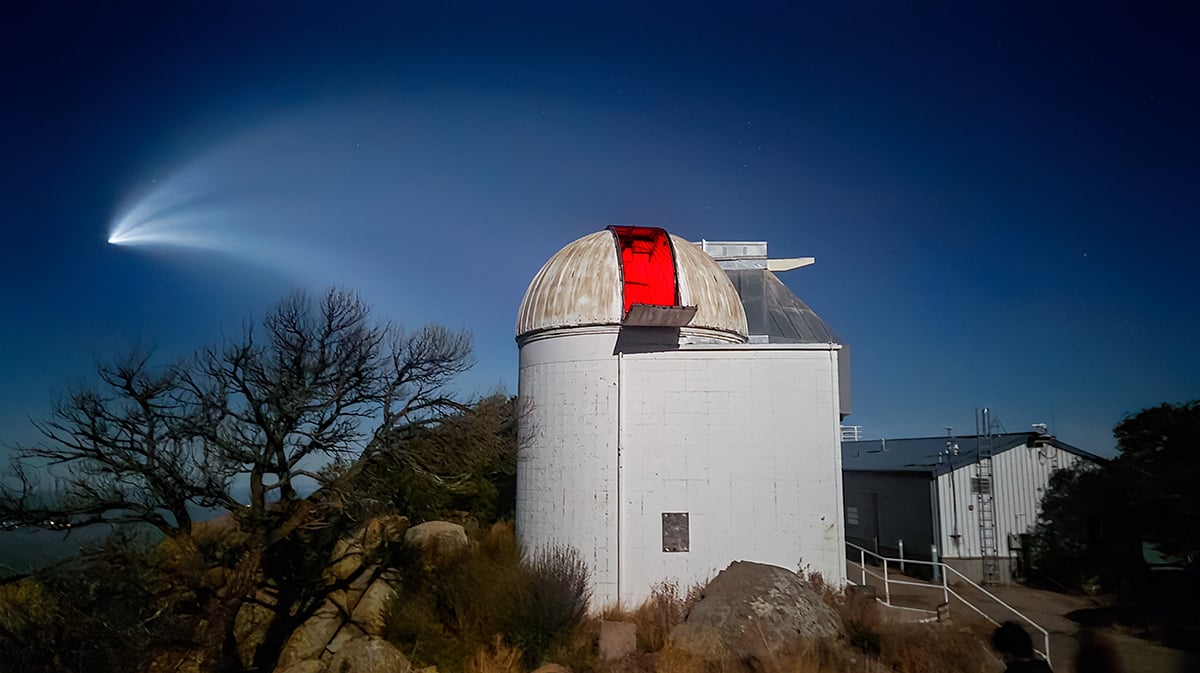
The telescopes beneath the glowing plume
The foreground telescopes are the Levine 0.4-meter Telescope and the WIYN 3.5-meter Telescope at the Kitt Peak Visitor Center.
The Levine telescope serves a different role from the large research instruments on the mountain. It forms part of the visitor facilities, where people can take part in educational and public observing activities. Visitors can experience astronomical observing without needing access to a professional research telescope.
The WIYN 3.5-meter Telescope, on the other hand, is one of the major research telescopes at Kitt Peak National Observatory. Its primary mirror measures 3.5 meters (11.5 feet) across, giving astronomers the light-gathering power needed to study distant stars, galaxies, and other celestial objects.
Clear skies!
See more from DIYPhotography.net on Google
Add DIYPhotography.net as a trusted source. This makes
our stories more likely to appear in your Google Search results.
 Add as a preferred source on Google

Soumyadeep Mukherjee
Soumyadeep Mukherjee is an award-winning astrophotographer from India. He has a doctorate degree in Linguistics. His work extends to the sub-genres of nightscape, deep sky, solar, lunar and optical phenomenon photography. He is also a photography educator and has conducted numerous workshops. His works have appeared in over 40 books & magazines including Astronomy, BBC Sky at Night, Sky & Telescope among others, and in various websites including National Geographic, NASA, Forbes. He was the first Indian to win “Astronomy Photographer of the Year” award in a major category.



Join the Discussion
DIYP Comment Policy
Be nice, be on-topic, no personal information or flames.