












Euclid Telescope Finds a New Comet While Photographing Distant Galaxies
Oct 26, 2026
Soumyadeep Mukherjee
Soumyadeep Mukherjee is an award-winning astrophotographer from India. He has a doctorate degree in Linguistics. His work extends to the sub-genres of nightscape, deep sky, solar, lunar and optical phenomenon photography. He is also a photography educator and has conducted numerous workshops. His works have appeared in over 40 books & magazines including Astronomy, BBC Sky at Night, Sky & Telescope among others, and in various websites including National Geographic, NASA, Forbes. He was the first Indian to win “Astronomy Photographer of the Year” award in a major category.
Share:
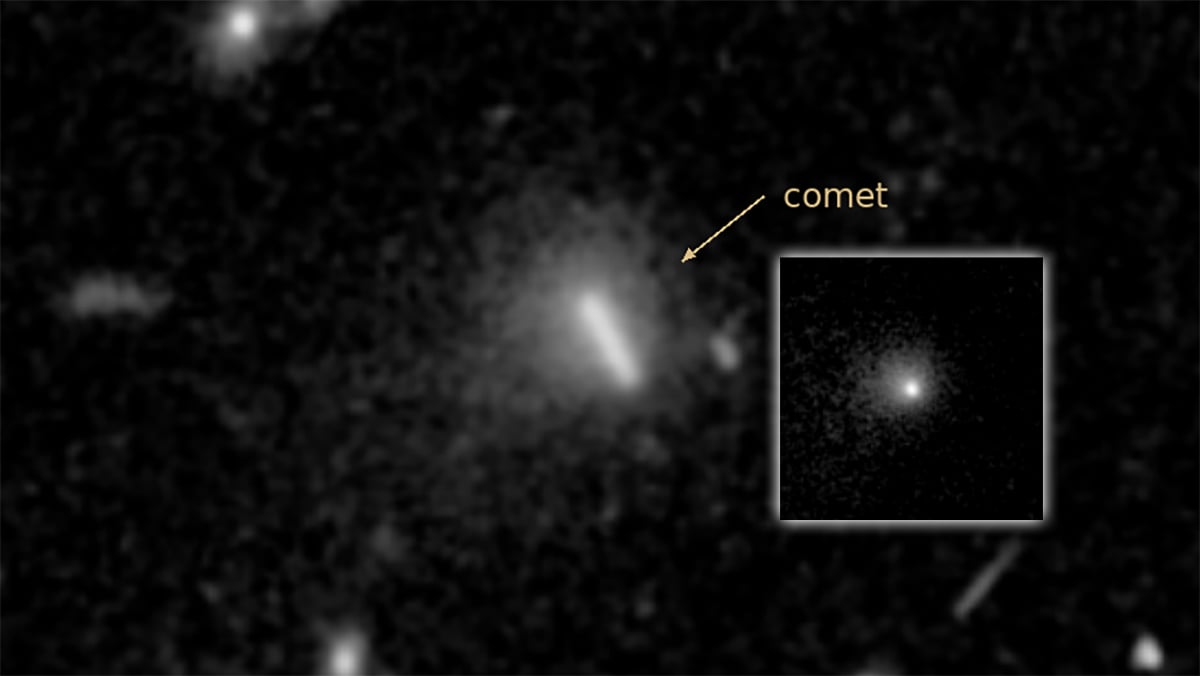
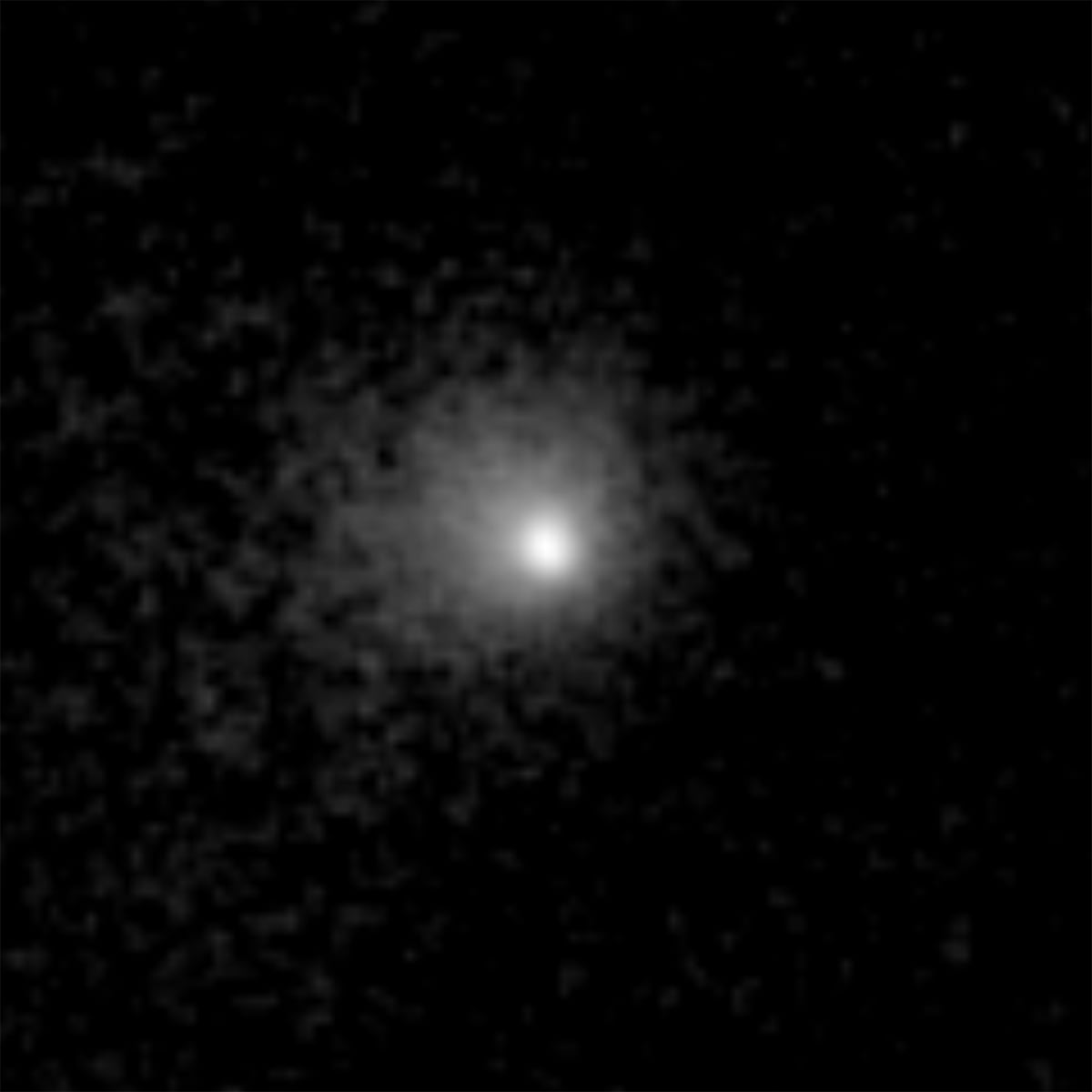
A streak in a series of space telescope images caught the attention of Mikko Pöntinen, a PhD student at the University of Helsinki. Pöntinen used software he had developed to track moving objects, then searched other images for the same streak. He found it in several more observations. A closer look revealed a faint cloud around the object, suggesting that he had found an active comet.
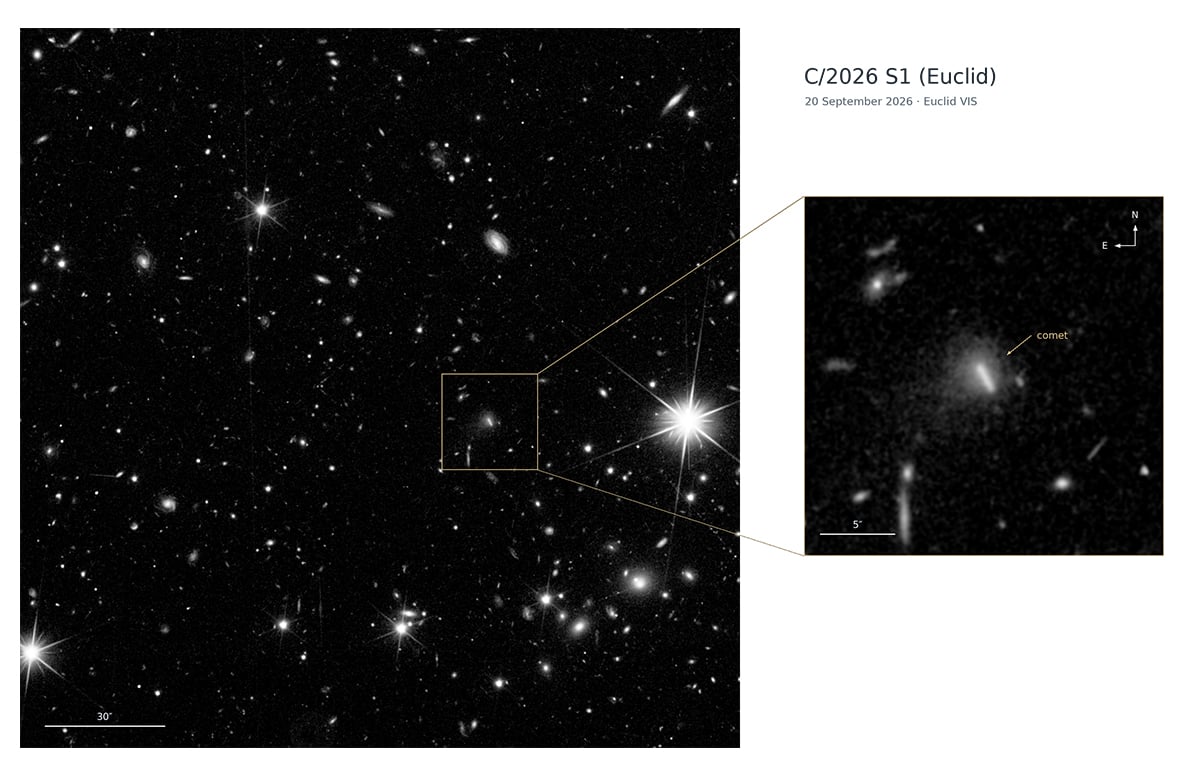
The observations came from the European Space Agency’s Euclid space telescope, which was surveying a region of the sky between 16 and 24 September 2026. Follow-up observations confirmed that the object was a previously unknown comet. The International Astronomical Union’s Minor Planet Center recognised it and assigned it the name C/2026 S1 (Euclid). It was the first new comet discovered by Euclid.
A comet among thousands of distant galaxies
Euclid captured the comet while observing the Euclid Deep Field North, a region selected for detailed studies of the distant Universe. The mission aims to map more than one-third of the sky during its planned six-year survey. Its images will help scientists examine billions of galaxies and trace how cosmic structures have changed over time.
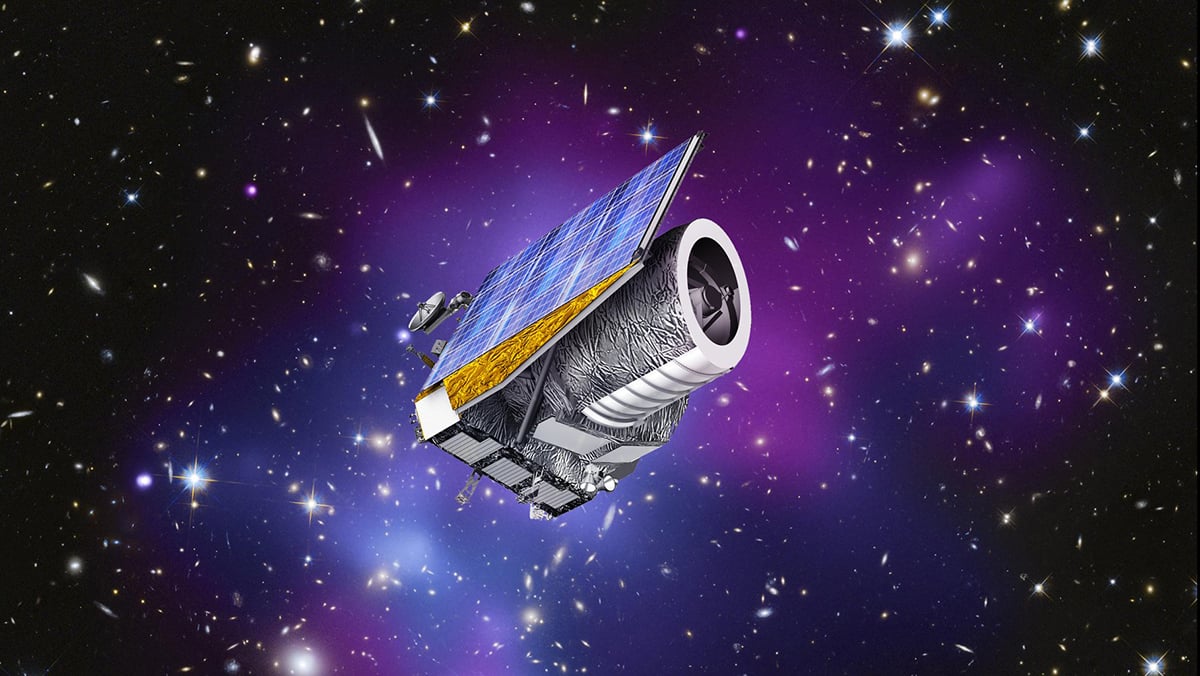
The spacecraft carries two scientific instruments. Its visible-light camera, VIS, records the shapes of galaxies in fine detail. Its near-infrared instrument, NISP, measures infrared light and helps researchers estimate galaxy distances. Together, the instruments will help scientists investigate how dark matter shapes the Universe and how dark energy affects its expansion.
Pöntinen developed his detection software to find small Solar System objects in Euclid’s images. Researchers need to identify these objects because their trails and light can interfere with measurements of distant galaxies. While examining the data, the software flagged a streak that appeared across several images. He predicted where the object should appear in other exposures and found it in five separate image sets.
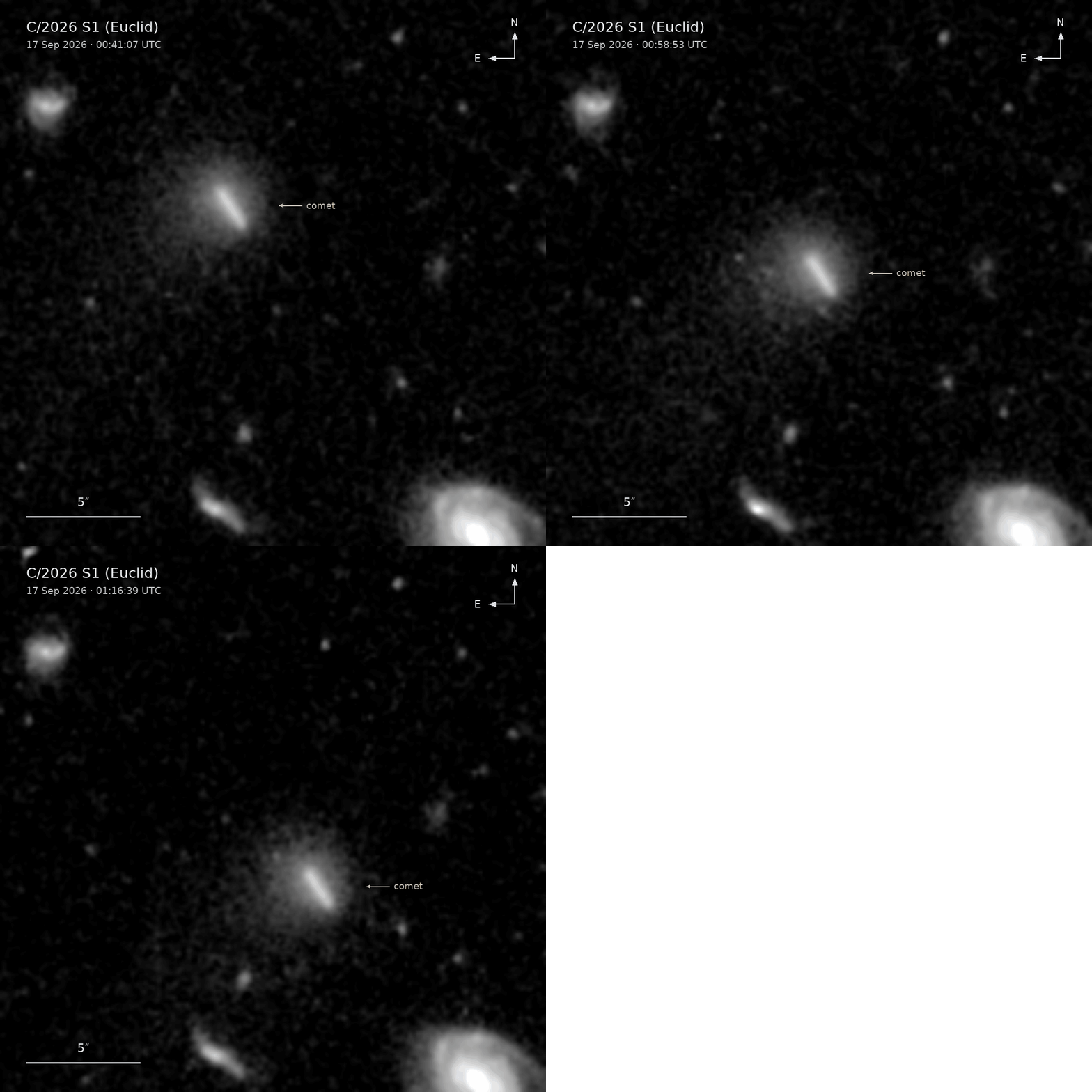
Euclid recorded the comet in 16 exposures across those observations. Pöntinen then examined its appearance more closely and noticed a fuzzy cloud surrounding the central object. Comets develop this cloud, known as a coma, when sunlight heats their icy material and releases gas and dust into space. The combination of movement and a visible coma gave him good reason to suspect a comet.
Long exposures turned the comet into a streak
Euclid keeps its camera pointed steadily at a selected region while it gathers light. That approach allows it to record faint galaxies, but a moving object can travel across the frame before the exposure ends.
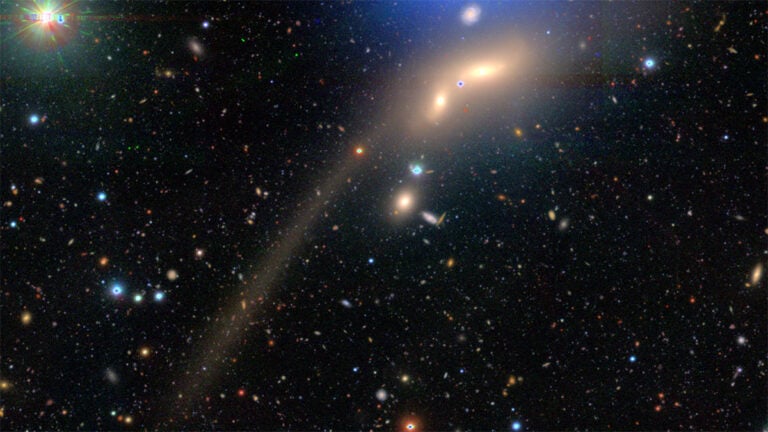
ESA released a sequence showing the comet in three VIS exposures taken on 17 September 2026. The images began at 00:41:07, 00:58:53, and 01:16:39 UTC. Each exposure lasted 560.52 seconds, or just over nine minutes. During that time, the comet shifted against the background of stars and galaxies, leaving an elongated mark in each image.
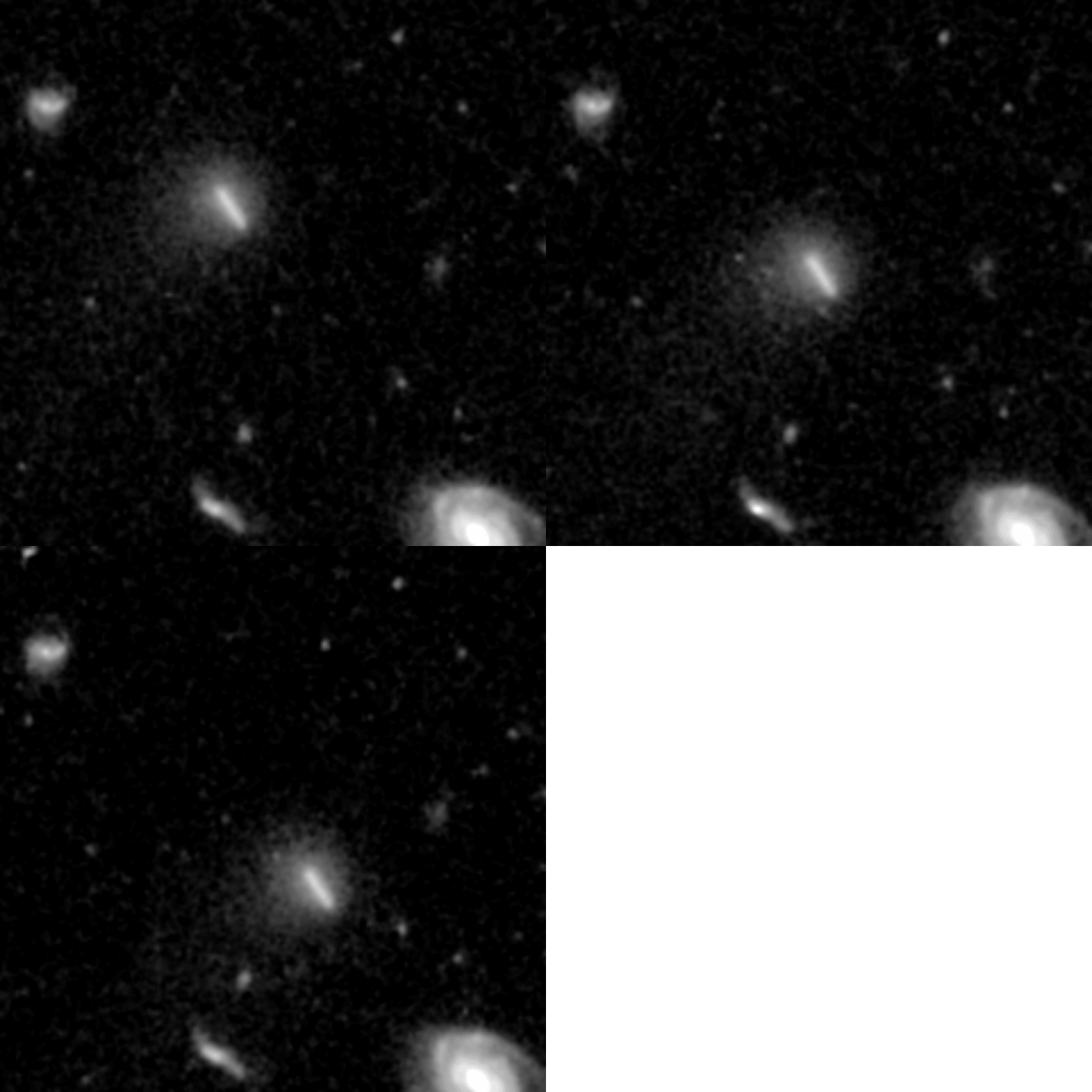
The streak records the comet’s apparent motion, not the shape of its nucleus. The distant galaxies provide a relatively steady background because of their enormous distances. The comet, by comparison, moves noticeably across the field of view during a nine-minute exposure. Its light therefore falls across a line of pixels rather than remaining concentrated in one small area.
ESA also released a composite made from eight shorter VIS exposures, each lasting 89.5 seconds. For this image, the team aligned the frames on the comet before combining them. This kept the comet in roughly the same position while the background shifted between exposures.
Clear skies!
See more from DIYPhotography.net on Google
Add DIYPhotography.net as a trusted source. This makes
our stories more likely to appear in your Google Search results.
 Add as a preferred source on Google

Soumyadeep Mukherjee
Soumyadeep Mukherjee is an award-winning astrophotographer from India. He has a doctorate degree in Linguistics. His work extends to the sub-genres of nightscape, deep sky, solar, lunar and optical phenomenon photography. He is also a photography educator and has conducted numerous workshops. His works have appeared in over 40 books & magazines including Astronomy, BBC Sky at Night, Sky & Telescope among others, and in various websites including National Geographic, NASA, Forbes. He was the first Indian to win “Astronomy Photographer of the Year” award in a major category.

Join the Discussion
DIYP Comment Policy
Be nice, be on-topic, no personal information or flames.