






















Subaru Telescope Captures Three Galaxies: Three Different Stories
May 24, 2026
Soumyadeep Mukherjee
Soumyadeep Mukherjee is an award-winning astrophotographer from India. He has a doctorate degree in Linguistics. His work extends to the sub-genres of nightscape, deep sky, solar, lunar and optical phenomenon photography. He is also a photography educator and has conducted numerous workshops. His works have appeared in over 40 books & magazines including Astronomy, BBC Sky at Night, Sky & Telescope among others, and in various websites including National Geographic, NASA, Forbes. He was the first Indian to win “Astronomy Photographer of the Year” award in a major category.
Share:
Astronomical images compress vast amounts of information into a single frame. A galaxy may appear as a simple patch of light. Still, that light carries evidence of stellar birth, stellar death, gas flows, dust clouds, and interactions that unfolded over millions or even billions of years. Extracting that information requires specialized instruments, dark skies, and long exposures capable of recording structures far fainter than the human eye can see.
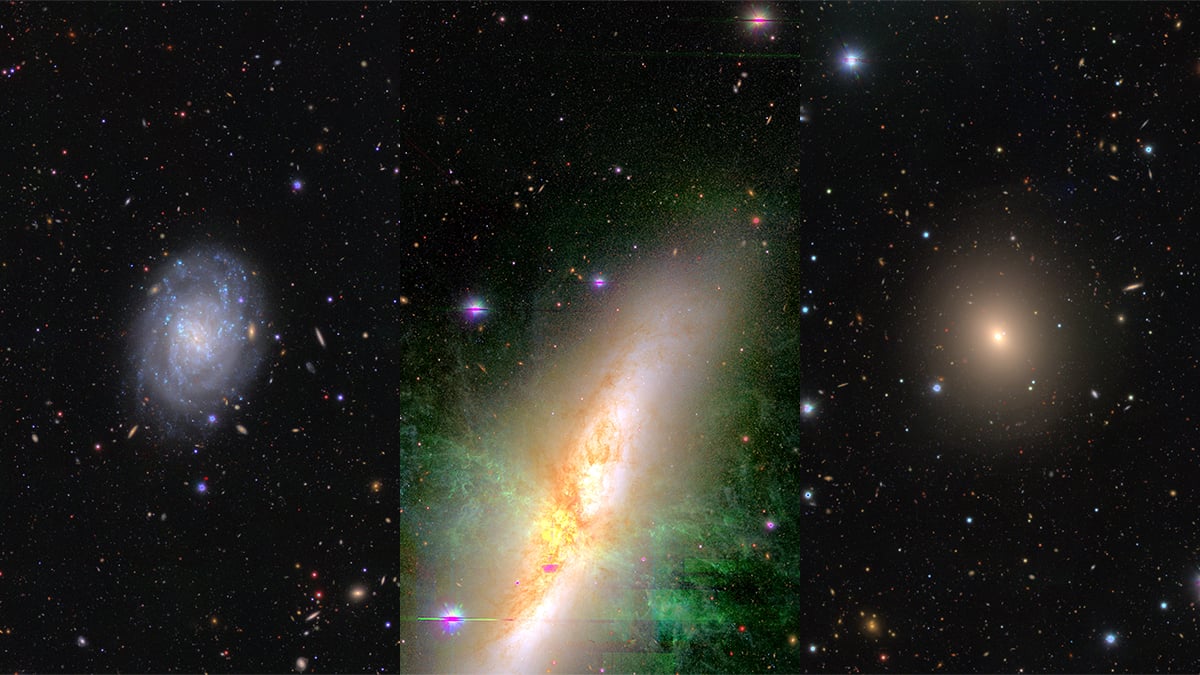
The Subaru Telescope excels at this work. Perched atop Maunakea in Hawaii, the 8.2-meter telescope features a large light-gathering mirror with one of the most capable imaging systems. Its Hyper Suprime-Cam covers a large area of sky. Three recent image releases from Subaru offer an excellent example of this. The targets are NGC 941, NGC 7458, and Messier 82. Each belongs to a different class of galaxy and presents different stories of the universe.
Subaru telescope and Hyper Suprime-Cam
Large telescopes often face a trade-off between detail and coverage. Some instruments record tiny regions of sky at high resolution. Others capture wide areas but sacrifice detail. Hyper Suprime-Cam covers the best of both worlds. The camera contains 116 CCD sensors and covers a field of view of about 1.5 degrees across. For comparison, the full Moon spans roughly half a degree in the sky. A single exposure can encompass a surprisingly large celestial area while preserving fine structure within individual objects.

This feature becomes useful when imaging galaxies. The brightest portions usually occupy only a fraction of their true extent. Dust lanes can stretch far from the center. Faint halos surround many systems. Streams of stars may trace the remains of past encounters with companion galaxies.
Capturing such features requires sensitivity to extremely low light levels. Subaru’s large mirror helps collect that light, while the stable atmosphere above Maunakea helps maintain image sharpness. Together, they allow structures hidden from smaller observations to emerge.

NGC 941: A spiral galaxy rich in raw materialx
Among the three images, NGC 941 appears the most familiar. Located about 55 million light-years away in the constellation Cetus, NGC 941 belongs to the category of intermediate spiral galaxies. It sits between barred and unbarred spirals, displaying characteristics of both groups.
The Subaru image captures dust lanes that weave through the disk and break up the distribution of starlight. These dark features consist of dense clouds of gas and dust. Although they block visible light, they also mark locations where future stars may form.

Blue regions scattered through the spiral arms stand out against the darker background. Their color points to the presence of young, massive stars. Such stars burn through their fuel rapidly. They remain visible for only a short fraction of a galaxy’s lifetime. When astronomers detect significant blue light, they know that stellar birth has taken place relatively recently.
The spiral arms themselves play an important role in that process. Gas drifting through the galaxy encounters these denser regions and becomes compressed. As pressure increases, portions of giant molecular clouds can collapse under gravity and begin producing new stars.

NGC 7458: An aging galaxy with ancient stars
NGC 7458 lacks spiral arms entirely. No dust lanes cut through its center. Bright blue clusters are absent. Located roughly 240 million light-years away, NGC 7458 belongs to the elliptical galaxy family.
The light distribution changes from the center outward. Brightness declines without any obvious interruptions. This pattern shows the motions of the stars themselves. In spiral galaxies, stars orbit within a flattened rotating disk. Elliptical galaxies contain stars moving along a much wider range of paths. The result is a rounded structure rather than an organized spiral pattern.

Color also provides important clues. NGC 7458 displays a noticeably warmer tone than NGC 941. The difference stems largely from age. Massive blue stars exhaust their fuel quickly and disappear long before smaller stars. If star formation slows or stops, the remaining population gradually becomes dominated by older stars.
The galaxy contains little evidence for widespread recent stellar birth. Its light comes primarily from stars that formed billions of years earlier. The image conveys a sense of stability and maturity. Activity has not vanished entirely, but it no longer dominates the appearance of the system.

M82: Pushing gas far beyond the stellar disk
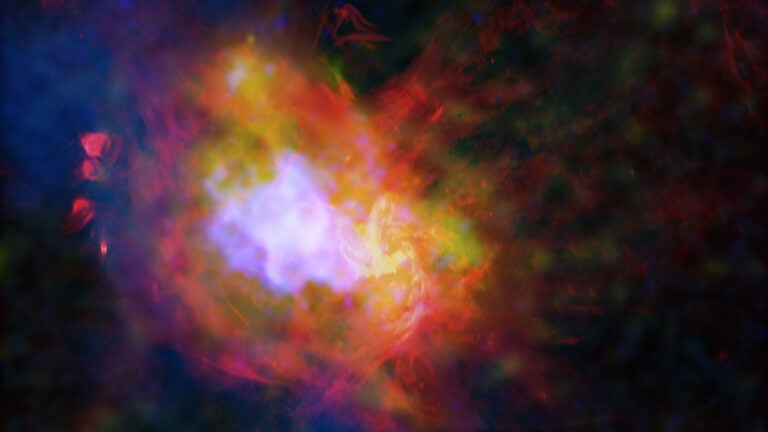
Known widely as the Cigar Galaxy, M82 lies approximately 12 million light-years away in Ursa Major. It has attracted astronomical attention for decades because of its extraordinary level of activity. A bright, elongated disk stretches across the frame. Dark dust lanes slice through the galaxy and create a complex network of obscuring material.

Long filaments rise above and below the galaxy. Some appear narrow and threadlike. Others form broader clouds extending far into the surrounding space. These structures originate in the galaxy’s central regions, where stars form at an unusually high rate. Massive stars release intense stellar winds throughout their lives. Later, many explode as supernovae. Each event injects energy into the surrounding gas.
Astronomers have linked much of this activity to past gravitational interactions with the neighboring galaxy M81. Those encounters disturbed gas within M82 and helped funnel material toward its center. The increased gas supply fueled rapid star formation, which in turn generated the powerful outflows visible today.

Clear skies!
See more from DIYPhotography.net on Google
Add DIYPhotography.net as a trusted source. This makes
our stories more likely to appear in your Google Search results.
 Add as a preferred source on Google

Soumyadeep Mukherjee
Soumyadeep Mukherjee is an award-winning astrophotographer from India. He has a doctorate degree in Linguistics. His work extends to the sub-genres of nightscape, deep sky, solar, lunar and optical phenomenon photography. He is also a photography educator and has conducted numerous workshops. His works have appeared in over 40 books & magazines including Astronomy, BBC Sky at Night, Sky & Telescope among others, and in various websites including National Geographic, NASA, Forbes. He was the first Indian to win “Astronomy Photographer of the Year” award in a major category.


Join the Discussion
DIYP Comment Policy
Be nice, be on-topic, no personal information or flames.