





















Hubble Captures Stunning High-Resolution Image of Messier 82, the Cigar Galaxy
Sep 16, 2025
Soumyadeep Mukherjee
Soumyadeep Mukherjee is an award-winning astrophotographer from India. He has a doctorate degree in Linguistics. His work extends to the sub-genres of nightscape, deep sky, solar, lunar and optical phenomenon photography. He is also a photography educator and has conducted numerous workshops. His works have appeared in over 40 books & magazines including Astronomy, BBC Sky at Night, Sky & Telescope among others, and in various websites including National Geographic, NASA, Forbes. He was the first Indian to win “Astronomy Photographer of the Year” award in a major category.
Share:

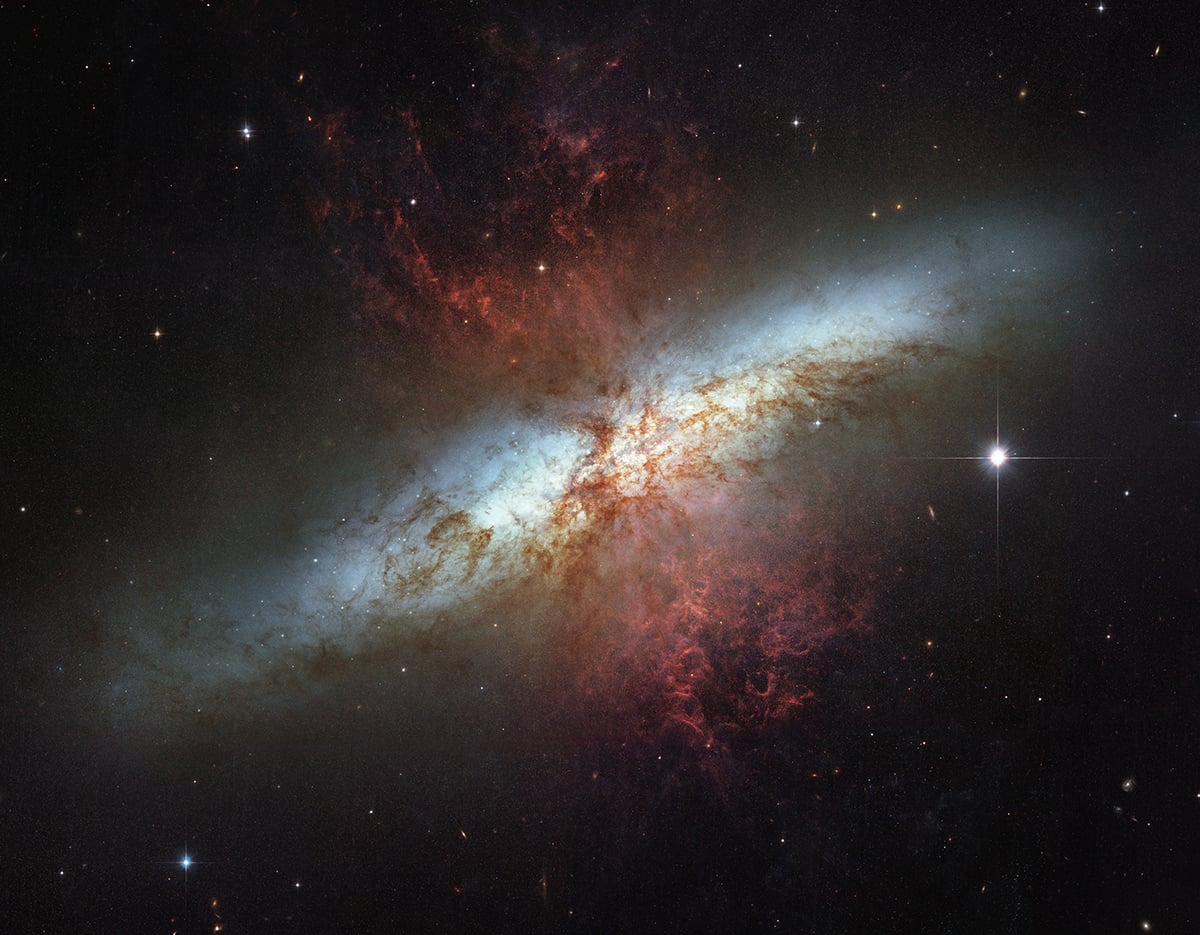
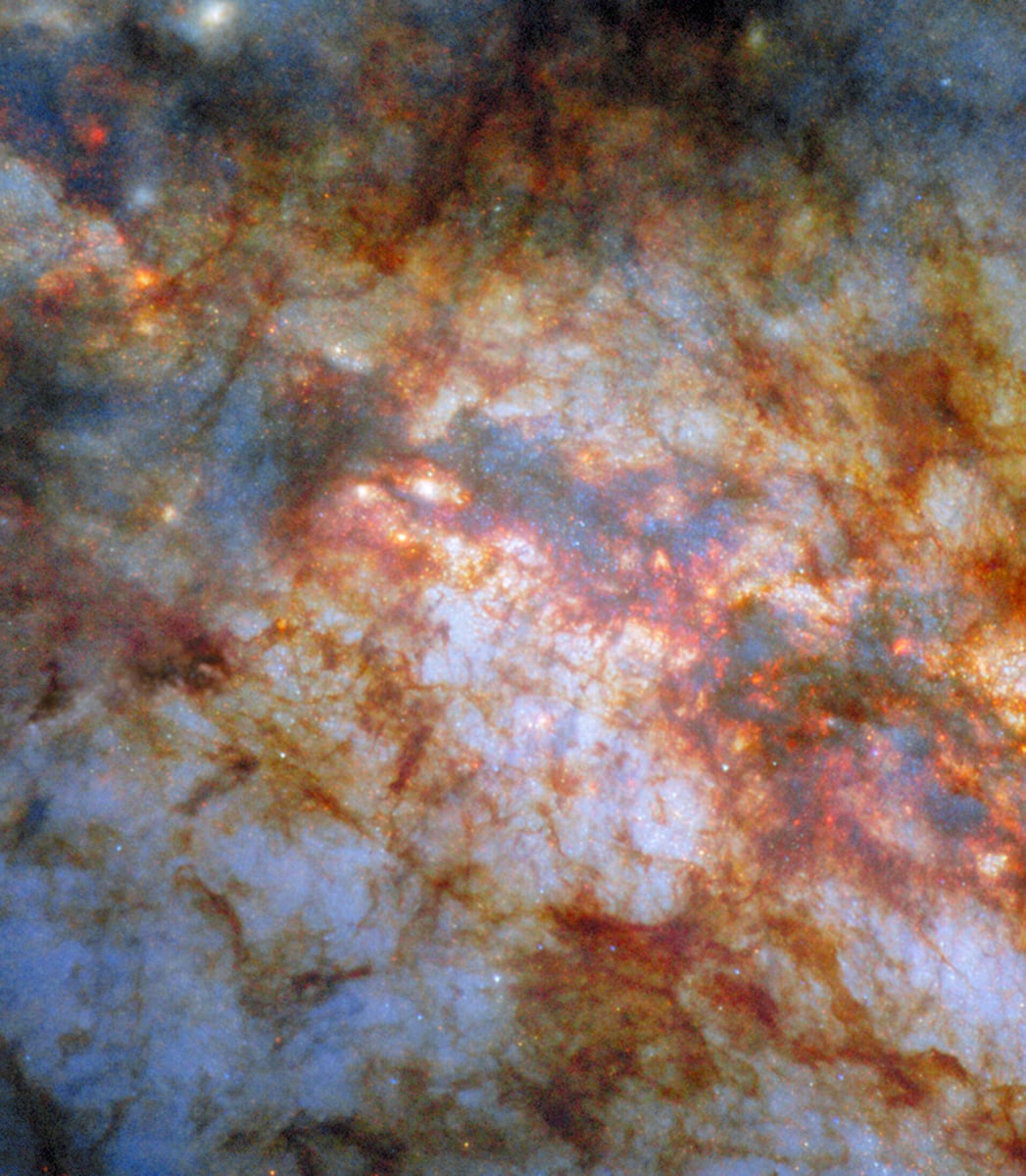
Messier 82, also called the Cigar Galaxy, lies about 12 million light-years away in the constellation Ursa Major. Astronomers classify it as a starburst galaxy, a type known for its extremely high rate of star formation. M82 is five times more luminous than our Milky Way and forms new stars about ten times faster. The new Hubble image focuses on the galaxy’s central region. It offers an unusually detailed view of a system that has long fascinated both astronomers and astrophotographers.
The galaxy earned its nickname because of its elongated shape, which resembles a cigar when viewed through a telescope. While its outline may look simple, the internal activity is complex and violent. Streams of gas, dust, and radiation continuously flow through its core. The result is a dense and dynamic environment where young, massive stars are born in clusters and then quickly begin to shape the galaxy around them.
Hubble’s high-resolution legacy
The image comes from the High Resolution Channel of the Advanced Camera for Surveys (ACS) on the Hubble Space Telescope. This channel had a unique ability to zoom in on very crowded star fields and reveal fine structural details. It was particularly well-suited for studying dense star clusters and galactic cores.
The recently highlighted observation showcases just how sharp the instrument could be. Even in the busy environment of M82’s centre, the image resolves individual stars and clusters. Dust lanes cut across the galaxy’s bright regions, while glowing clouds of ionised gas hint at ongoing star formation and energetic feedback from young stars. These features make the galaxy a textbook case for understanding how starburst activity shapes galactic evolution.

The starburst phenomenon
Starburst galaxies like M82 are rare in the nearby universe. They represent phases in which galaxies use up their gas supply at an accelerated rate. In M82, the central kiloparsec is dominated by intense star formation. Studies suggest that M82 may have undergone gravitational interactions with its neighbour, Messier 81, around 200 million years ago. That close encounter likely disturbed M82’s structure and funnelled gas into its central region.
As a result, massive clusters of stars formed in rapid succession. These stars shine brightly but live short lives. Many end as supernovae within a few million years. The combined energy from winds and explosions drives gas out of the galactic plane in spectacular “superwinds.” These winds enrich the intergalactic medium with heavy elements and also regulate further star formation within the galaxy. In images from other observatories, vast plumes of hot gas can be seen streaming from M82’s disk. The Hubble view focuses on the crowded central zone where this process begins.
A galaxy with astronomical significance
Messier 82 plays an important role in the study of galactic dynamics and evolution. Because it is relatively close to Earth, it serves as a laboratory for testing theories of starburst activity. Observations across the electromagnetic spectrum, from radio waves to X-rays, have revealed the full complexity of its structure.
Infrared data reveal the hidden star formation obscured by thick dust. X-ray telescopes detect the hot outflows generated by stellar winds and supernovae. Radio maps reveal synchrotron emission from charged particles spiralling in magnetic fields. Each wavelength highlights a different part of the system. Together, they form a complete picture of a galaxy in turmoil. The Hubble image adds the crucial visual detail of individual stars and clusters, which helps connect large-scale processes with the small-scale physics of stellar birth.
The Cigar Galaxy will continue to be a key object for astronomers. Its proximity, brightness, and unusual activity ensure that it will be studied with every major observatory. New instruments on Earth and in space will refine our knowledge of its structure. Radio telescopes will map its gas in greater detail, while future X-ray missions may reveal the full impact of its energetic outflows. Webb will continue to study its dust-obscured regions, offering insights into how starbursts operate behind thick curtains of material.
Clear skies!
See more from DIYPhotography.net on Google
Add DIYPhotography.net as a trusted source. This makes
our stories more likely to appear in your Google Search results.
 Add as a preferred source on Google

Soumyadeep Mukherjee
Soumyadeep Mukherjee is an award-winning astrophotographer from India. He has a doctorate degree in Linguistics. His work extends to the sub-genres of nightscape, deep sky, solar, lunar and optical phenomenon photography. He is also a photography educator and has conducted numerous workshops. His works have appeared in over 40 books & magazines including Astronomy, BBC Sky at Night, Sky & Telescope among others, and in various websites including National Geographic, NASA, Forbes. He was the first Indian to win “Astronomy Photographer of the Year” award in a major category.

Join the Discussion
DIYP Comment Policy
Be nice, be on-topic, no personal information or flames.