
























Subaru Telescope Captures a Galaxy Fading 20-Fold in 20 Years
Apr 19, 2026
Soumyadeep Mukherjee
Soumyadeep Mukherjee is an award-winning astrophotographer from India. He has a doctorate degree in Linguistics. His work extends to the sub-genres of nightscape, deep sky, solar, lunar and optical phenomenon photography. He is also a photography educator and has conducted numerous workshops. His works have appeared in over 40 books & magazines including Astronomy, BBC Sky at Night, Sky & Telescope among others, and in various websites including National Geographic, NASA, Forbes. He was the first Indian to win “Astronomy Photographer of the Year” award in a major category.
Share:
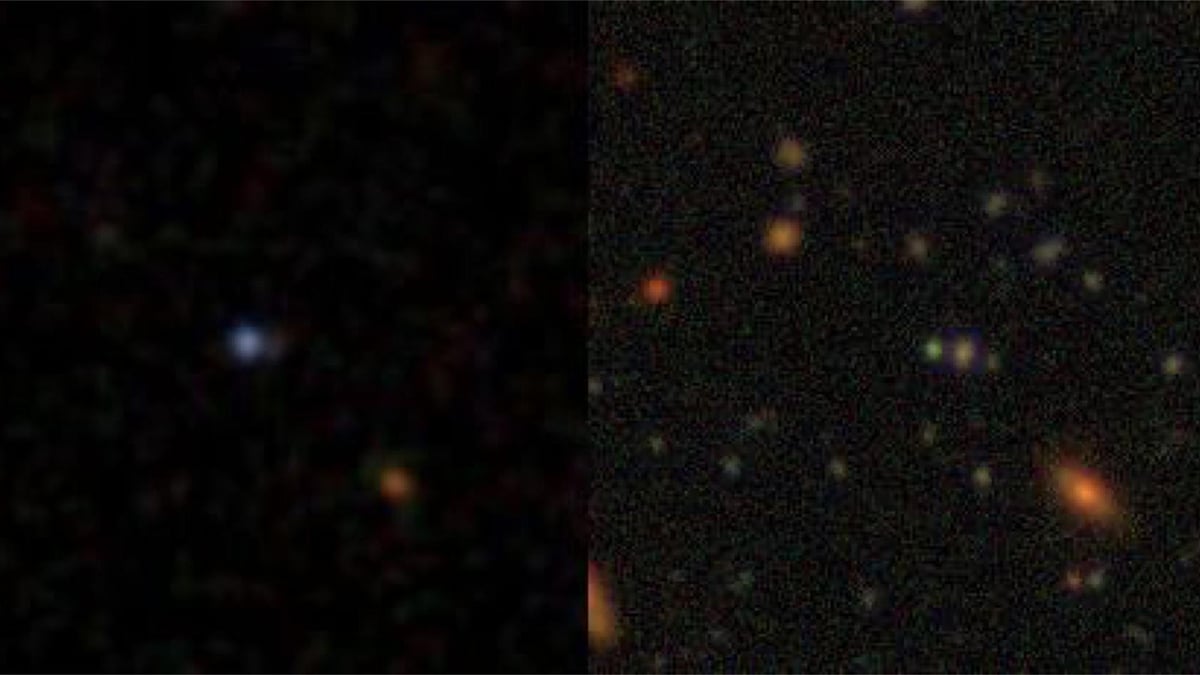
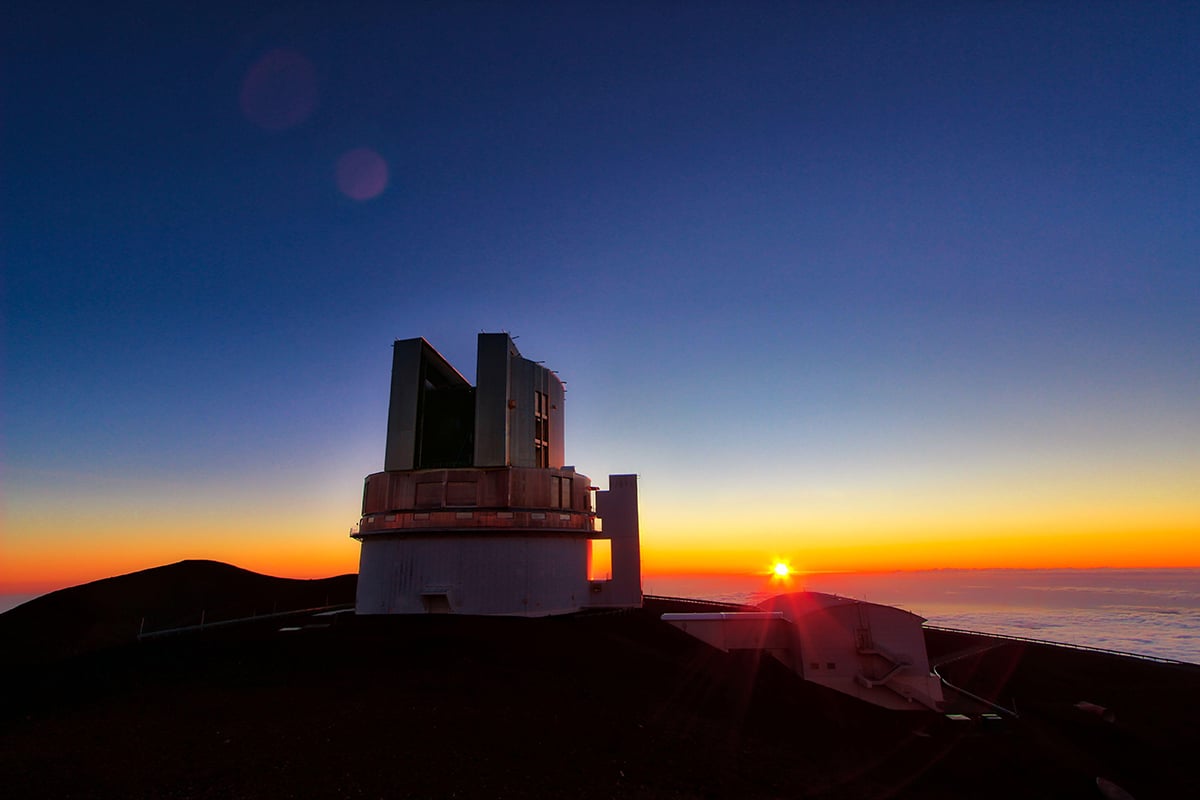
Deep multi-epoch imaging with the Hyper Suprime-Cam instrument on the Subaru Telescope has revealed a striking luminosity transition in the high-redshift active galactic nucleus J0218−0036 at a redshift of about 1.8. Over roughly two decades in the observer’s frame, the optical brightness of the nucleus declined by nearly a factor of twenty. After separating the host galaxy contribution from the nuclear emission, the intrinsic luminosity drop appears closer to a factor of fifty.
Researchers identified this fading by comparing deep Subaru imaging with earlier survey measurements obtained in the year 2002. Because the decline appears consistently across multiple wavelength bands, the observations point to a physical change within the accretion flow itself.
Multi-epoch survey comparisons
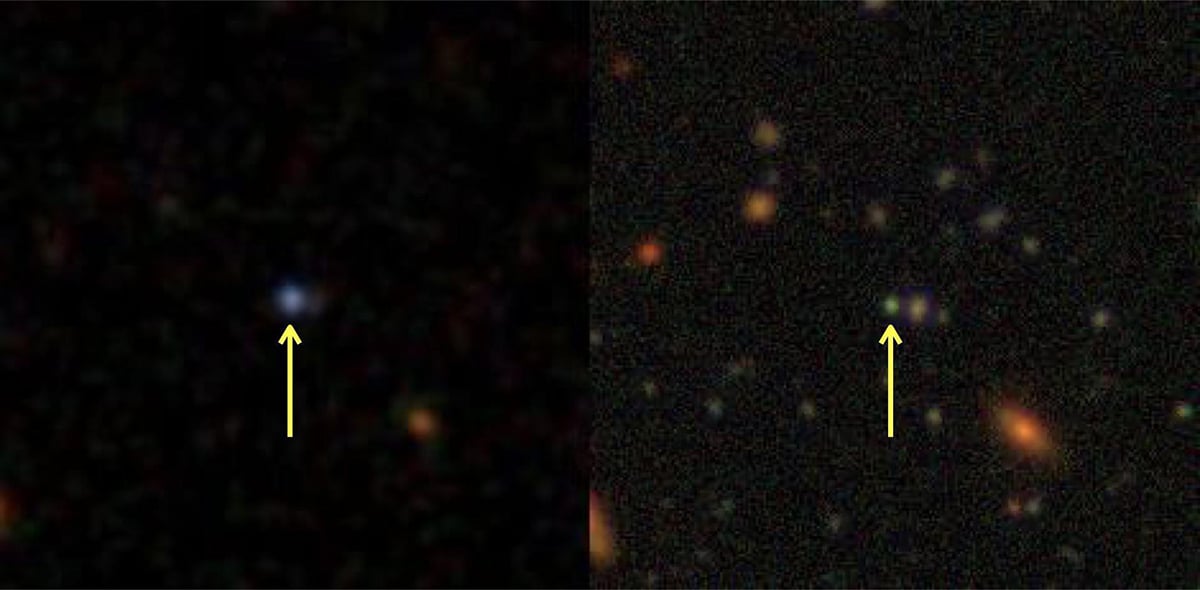
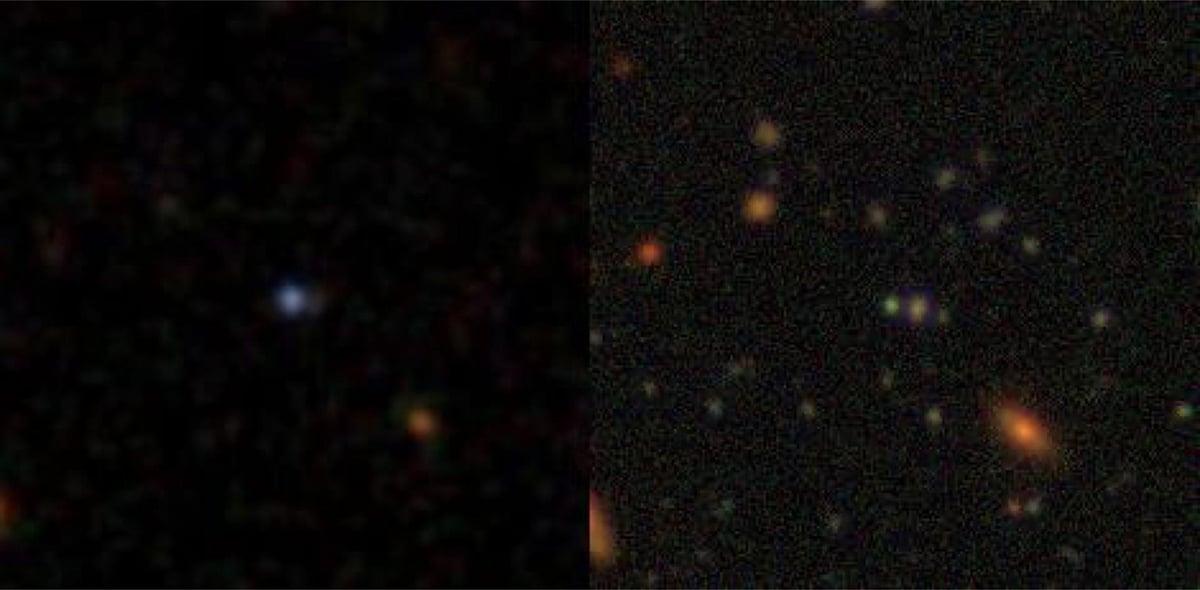
The discovery emerged from comparisons between wide-field survey observations obtained at different epochs. Early optical measurements from the Sloan Digital Sky Survey recorded a bright nucleus in J0218−0036. Later observations with Hyper Suprime-Cam on the Subaru Telescope revealed a much weaker signal from the same source. The difference immediately suggested that a substantial change had taken place in the central engine.
Researchers then examined additional observations obtained with large ground-based telescopes, including the W. M. Keck Observatory and the Gran Telescopio Canarias. These measurements confirmed the fading in both optical and near-infrared wavelengths. Radio and X-ray observations provided further evidence that the energy output from the nucleus had declined significantly.
Historical photographic plate data extended the brightness record even further back in time. These archival measurements showed that the nucleus remained luminous for decades before the recent decline began. Taken together, the multi-epoch dataset demonstrates that the fading represents a genuine physical transition rather than a calibration effect or measurement uncertainty.
Accretion disk emission
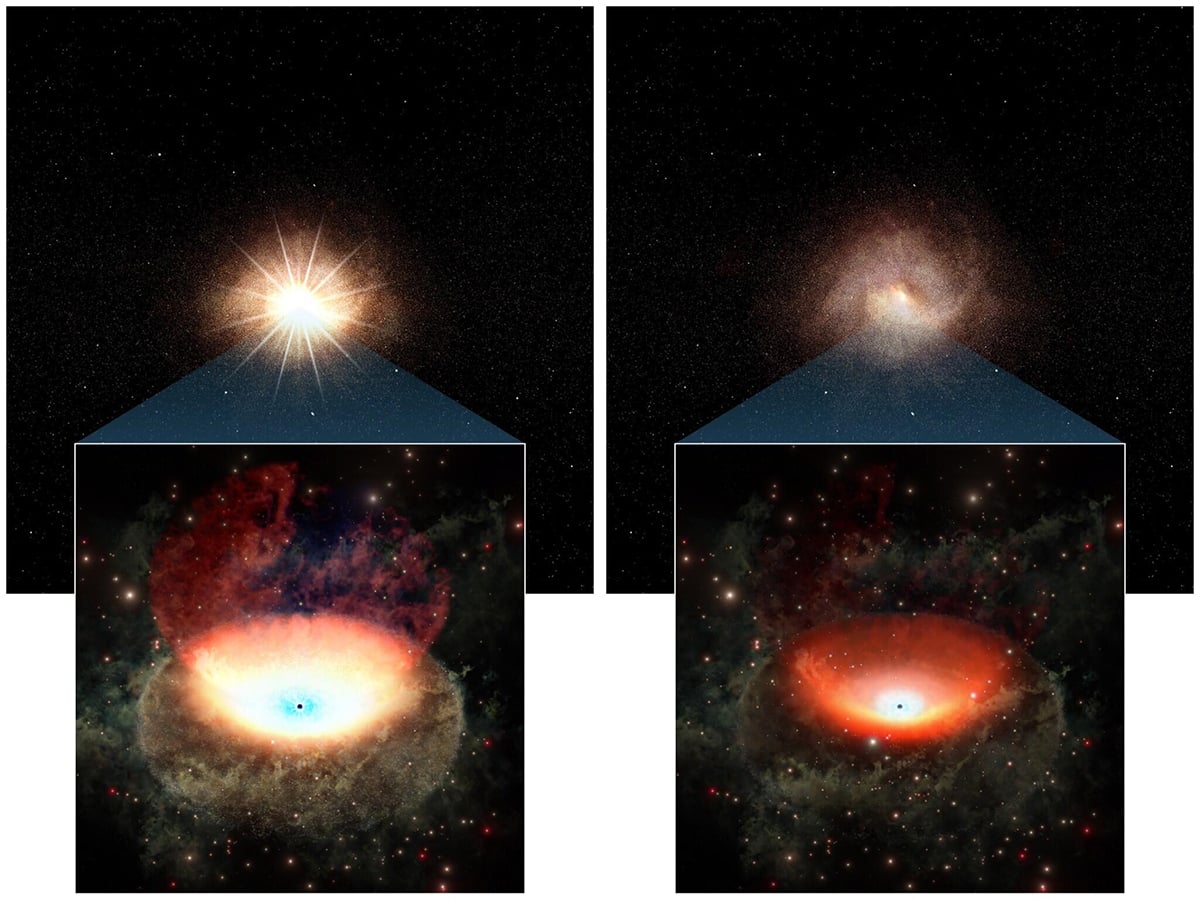
Supermassive black holes reside at the centers of most massive galaxies. These objects become visible when gas begins to fall toward them and forms a rotating accretion disk. Viscous processes inside the disk convert gravitational energy into radiation across a broad range of wavelengths. This radiation produces the luminous central region known as an active galactic nucleus.
The strength of this emission depends on the rate at which gas flows into the disk. When the inflow remains steady, the nucleus maintains a high luminosity. When the inflow weakens, the disk cools and the brightness decreases.
Long-term brightness measurements provide information about changes in the feeding process near the black hole. In the case of J0218−0036, the observed decline indicates that the mass supply reaching the accretion disk decreased rapidly within a relatively short interval.
Evidence for a sharp reduction in the central mass accretion rate
Astronomers first examined whether dust obscuration could explain the fading. Dust clouds sometimes move across the line of sight and reduce the apparent brightness of an active nucleus. However, this explanation does not match the observations in this system.
The decline appears consistently across optical, infrared, radio, and X-ray wavelengths. Dust extinction normally affects shorter wavelengths more strongly than longer ones. Because the fading shows little wavelength dependence, the observations indicate an intrinsic change in the energy output of the accretion disk.
Researchers then compared the measurements with theoretical models of disk evolution. Their analysis shows that the mass accretion rate likely dropped to roughly one-fiftieth of its earlier value. This transition occurred within about seven years in the rest frame of the galaxy.
Subaru Telescope observations
This discovery shows the scientific value of repeated wide-field imaging surveys carried out with instruments such as Hyper Suprime-Cam on the Subaru Telescope. These surveys allow astronomers to compare observations obtained years or decades apart across large regions of the sky. As a result, researchers can detect slow changes in distant objects that would otherwise remain unnoticed.
In the present study, the combination of multi-epoch optical measurements with infrared, radio, and X-ray observations made it possible to separate emission from the host galaxy and the active nucleus with improved accuracy. The analysis confirmed that the fading originated primarily within the nucleus itself rather than in the surrounding galaxy.
Future survey programs will extend this capability further. New observations will monitor millions of galaxies with increasing sensitivity and temporal coverage. These datasets will help astronomers identify additional systems undergoing rapid transitions in nuclear activity.
Clear skies!
See more from DIYPhotography.net on Google
Add DIYPhotography.net as a trusted source. This makes
our stories more likely to appear in your Google Search results.
 Add as a preferred source on Google

Soumyadeep Mukherjee
Soumyadeep Mukherjee is an award-winning astrophotographer from India. He has a doctorate degree in Linguistics. His work extends to the sub-genres of nightscape, deep sky, solar, lunar and optical phenomenon photography. He is also a photography educator and has conducted numerous workshops. His works have appeared in over 40 books & magazines including Astronomy, BBC Sky at Night, Sky & Telescope among others, and in various websites including National Geographic, NASA, Forbes. He was the first Indian to win “Astronomy Photographer of the Year” award in a major category.
Join the Discussion
DIYP Comment Policy
Be nice, be on-topic, no personal information or flames.