









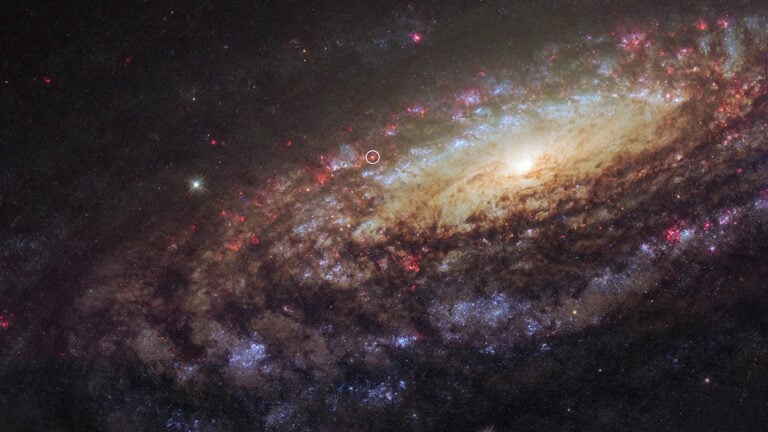














Very Large Telescope Captures a Close-up of the Triangulum Galaxy
Mar 23, 2026
Soumyadeep Mukherjee
Soumyadeep Mukherjee is an award-winning astrophotographer from India. He has a doctorate degree in Linguistics. His work extends to the sub-genres of nightscape, deep sky, solar, lunar and optical phenomenon photography. He is also a photography educator and has conducted numerous workshops. His works have appeared in over 40 books & magazines including Astronomy, BBC Sky at Night, Sky & Telescope among others, and in various websites including National Geographic, NASA, Forbes. He was the first Indian to win “Astronomy Photographer of the Year” award in a major category.
Share:
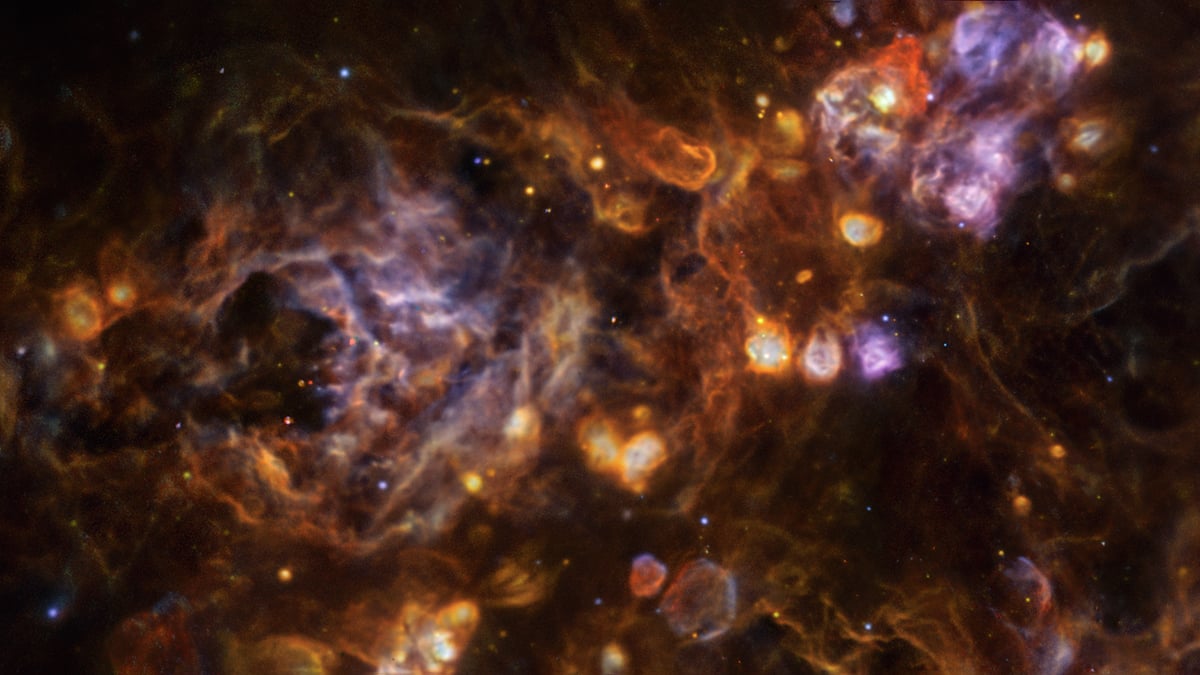
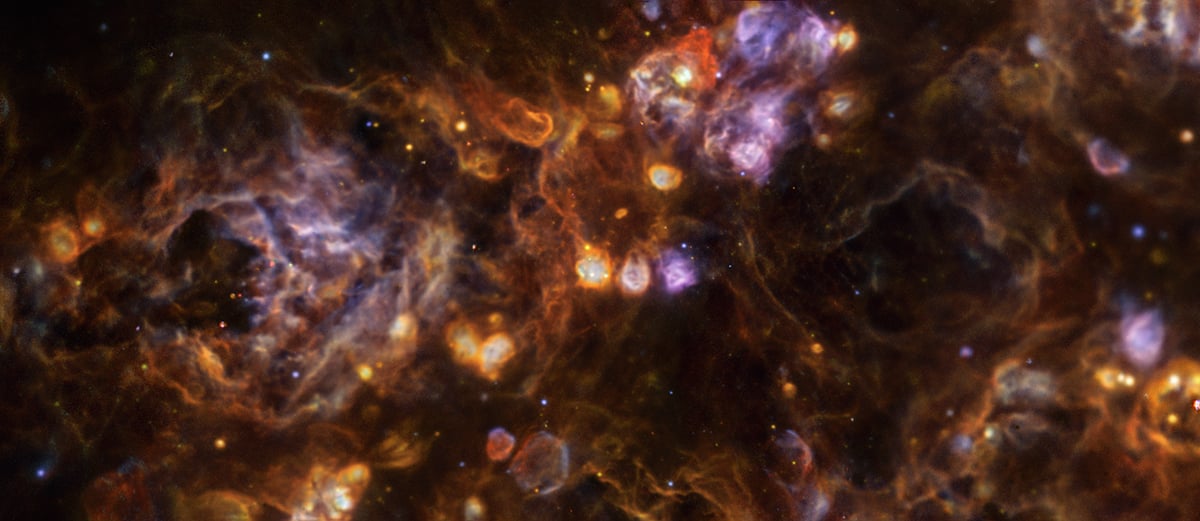
A new spectroscopic view of the nearby spiral galaxy Messier 33 (Triangulum Galaxy) shows how modern integral-field instruments transform galaxy imaging into quantitative physical mapping. Using the Multi-Unit Spectroscopic Explorer on the Very Large Telescope, operated by the European Southern Observatory, astronomers produced a spatially resolved emission-line dataset that traces ionized gas across one of the closest spiral galaxies beyond the Milky Way. The observation forms part of a programme led by Anna Feltre at INAF–Arcetri that investigates how massive stars modify their surrounding interstellar environment.
Unlike conventional imaging surveys, this dataset records spectra at every position across the field of view. As a result, it allows astronomers to map hydrogen, oxygen, and sulphur emission simultaneously. These measurements reveal the structure of the ionised interstellar medium and its response to stellar radiation across the galactic disk. Because Messier 33 lies only about three million light-years away, the observations resolve individual star-forming regions with great clarity.
Messier 33: A benchmark spiral galaxy
Messier 33 occupies a key position within the Local Group of galaxies. It is smaller than the Milky Way and the Andromeda Galaxy, yet it remains one of the most actively studied nearby spirals. Astronomers often select it as a laboratory for testing models of star formation and gas dynamics because its proximity allows them to examine structures that remain unresolved elsewhere.
The galaxy appears nearly face-on from Earth. This geometry simplifies the interpretation of observations. Researchers can trace spiral arms and star-forming complexes without severe projection effects. As a result, they can measure how ionised gas distributes itself across the disk with relatively small uncertainties.
Moreover, Messier 33 hosts a large population of bright H II regions. These regions form when ultraviolet radiation from young massive stars ionises surrounding hydrogen clouds. Their emission marks locations where star formation occurred recently. By mapping these regions across the disk, astronomers reconstruct how stellar activity spreads through the galaxy over time.
Another advantage lies in the galaxy’s moderate mass. Messier 33 lacks the extremely dense central bulge seen in many large spirals. Consequently, its structure reflects disk-driven star formation more directly. Researchers therefore use it as a reference system when comparing star-formation processes across galaxies of different sizes.
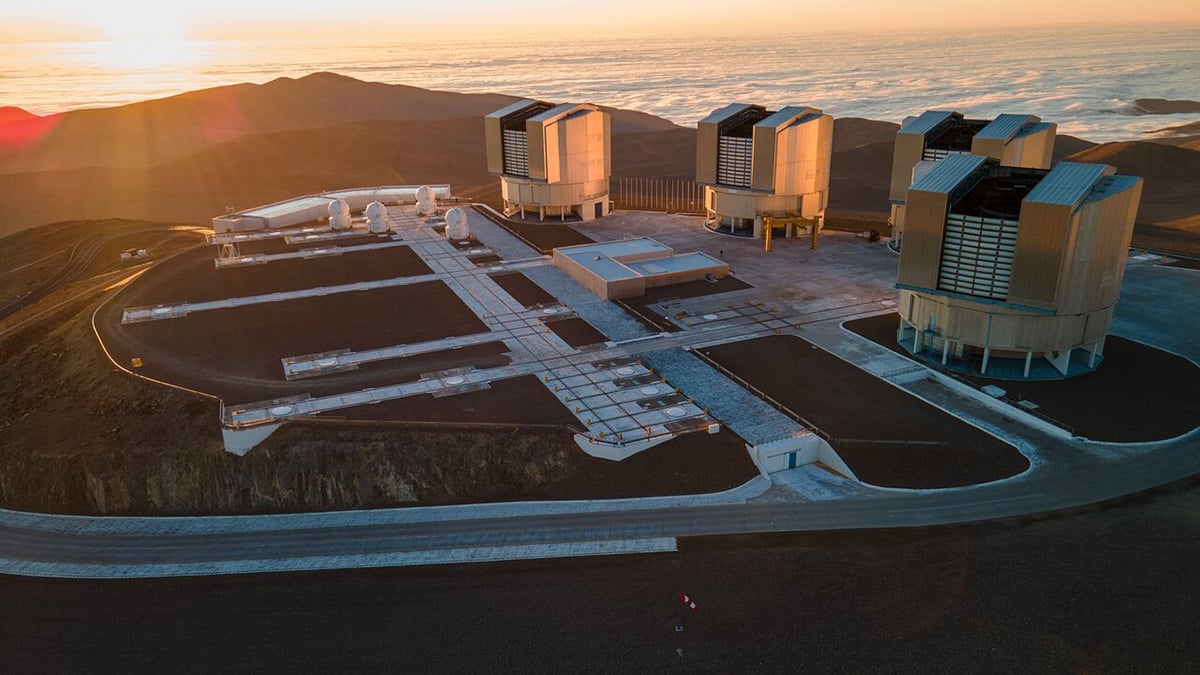
Observations with MUSE at Paranal Observatory
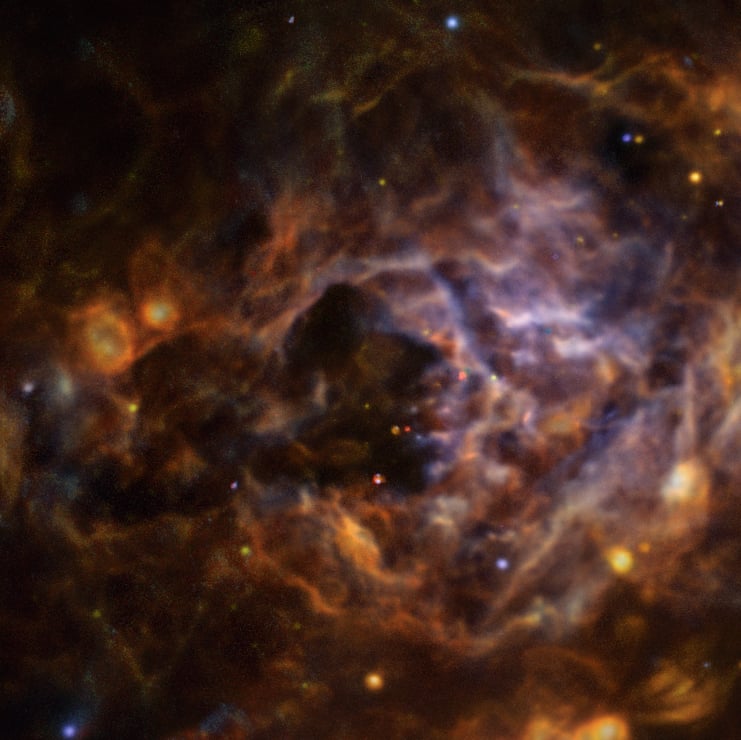
The observations were obtained at Paranal Observatory, one of the world’s leading sites for optical astronomy. The observatory stands in the Atacama Desert at high altitude under exceptionally dry conditions. These conditions reduce atmospheric absorption and improve image stability. As a result, astronomers can perform high-precision spectroscopic measurements across wide wavelength ranges.
MUSE operates as an integral-field spectrograph rather than a traditional camera. Instead of recording a single brightness value per pixel, it divides incoming light into thousands of spectral channels. Each spatial element becomes a complete spectrum. Researchers can later reconstruct emission-line maps for individual chemical species across the observed region.
This technique produces what astronomers call a spectral cube. Two axes describe position on the sky, while the third axis represents wavelength. Scientists then extract physical information from this cube by isolating emission lines from specific ions. They can also measure velocity shifts caused by gas motion along the line of sight.
Emission-line mapping of ionised gas across the galactic disk
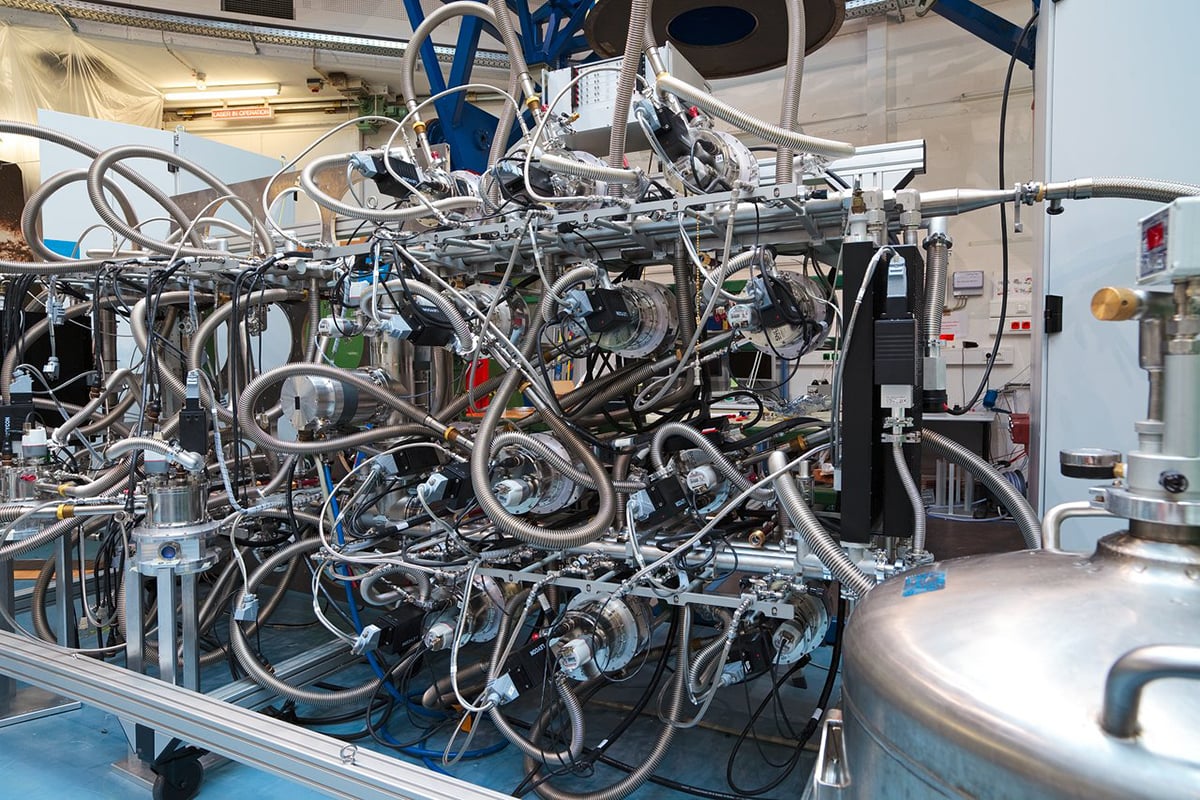
The released dataset highlights emissions from hydrogen, oxygen, and sulphur. These emission lines originate in ionised regions surrounding young stars. Their spatial distribution traces where stellar radiation interacts most strongly with interstellar gas.
Hydrogen emission identifies classical H II regions. These regions form when massive stars produce intense ultraviolet radiation that strips electrons from surrounding hydrogen atoms. When those electrons recombine with protons, the gas emits characteristic spectral lines. Consequently, hydrogen emission marks recent star-formation activity with high reliability.
Oxygen emission reveals regions exposed to stronger radiation fields. Ionised oxygen often appears near clusters of hot stars whose radiation modifies the surrounding gas more aggressively. Mapping this emission helps researchers identify energetic star-forming complexes.
Sulphur emission traces zones where shocks or density variations influence the interstellar medium. Such shocks may arise from stellar winds or earlier supernova activity. By mapping sulphur alongside hydrogen and oxygen, astronomers reconstruct the physical state of gas across different environments within the disk.
Tracing the structure of the interstellar medium
The interstellar medium defines the environment in which stars form and evolve. It consists mainly of hydrogen gas mixed with dust and trace heavy elements. Although its density remains extremely low compared with terrestrial standards, it still shapes galactic evolution through long-term interactions with stellar radiation and winds.
The new spectroscopic mapping of Messier 33 reveals filamentary structures extending across large sections of the disk. These filaments trace the boundaries between ionised and neutral gas regions. Their shapes reflect the cumulative influence of stellar winds and radiation pressure over millions of years.
Young stellar clusters often appear near the centres of ionised cavities within the gas distribution. These cavities form when stellar radiation clears surrounding material. As the cavities expand, they compress neighbouring gas clouds. This compression may trigger further star formation nearby. Thus, the interstellar medium evolves through a sequence of feedback cycles.
By observing these structures across a nearby spiral galaxy, astronomers obtain evidence of how stellar populations regulate their environments. This regulation influences both the efficiency and the spatial distribution of star formation across the disk.
Clear skies!
See more from DIYPhotography.net on Google
Add DIYPhotography.net as a trusted source. This makes
our stories more likely to appear in your Google Search results.
 Add as a preferred source on Google

Soumyadeep Mukherjee
Soumyadeep Mukherjee is an award-winning astrophotographer from India. He has a doctorate degree in Linguistics. His work extends to the sub-genres of nightscape, deep sky, solar, lunar and optical phenomenon photography. He is also a photography educator and has conducted numerous workshops. His works have appeared in over 40 books & magazines including Astronomy, BBC Sky at Night, Sky & Telescope among others, and in various websites including National Geographic, NASA, Forbes. He was the first Indian to win “Astronomy Photographer of the Year” award in a major category.
Related Posts
 Very Large Telescope Captures the Clearest Image Ever of Betelgeuse’s Companion
 Very Large Telescope Captures 44 Nysa: A Strange Three-Lobed Asteroid
 ESO Astronomer captures Extremely Large Telescope against Sun and Moon over 4 years
 James Webb telescope captures a distant galaxy just like the Milky Way
Join the Discussion
DIYP Comment Policy
Be nice, be on-topic, no personal information or flames.
One response to “Very Large Telescope Captures a Close-up of the Triangulum Galaxy”
These photographs, and others similar to them, leave me speechless. I have a hard time even imagining the vastness of the galaxies, sometimes a cluster of galaxies. What fits on my small laptop screen spans probably millions of miles, perhaps even light-years. They also help me realize that our earth is not even like a grain of sand in the ocean. What a humbling experience. For me, at least. Phenomenal.