





















Two Telescopes, One Story: Hubble and JWST Photographs a Star Cluster Duo
Jul 9, 2025
Soumyadeep Mukherjee
Soumyadeep Mukherjee is an award-winning astrophotographer from India. He has a doctorate degree in Linguistics. His work extends to the sub-genres of nightscape, deep sky, solar, lunar and optical phenomenon photography. He is also a photography educator and has conducted numerous workshops. His works have appeared in over 40 books & magazines including Astronomy, BBC Sky at Night, Sky & Telescope among others, and in various websites including National Geographic, NASA, Forbes. He was the first Indian to win “Astronomy Photographer of the Year” award in a major category.
Share:

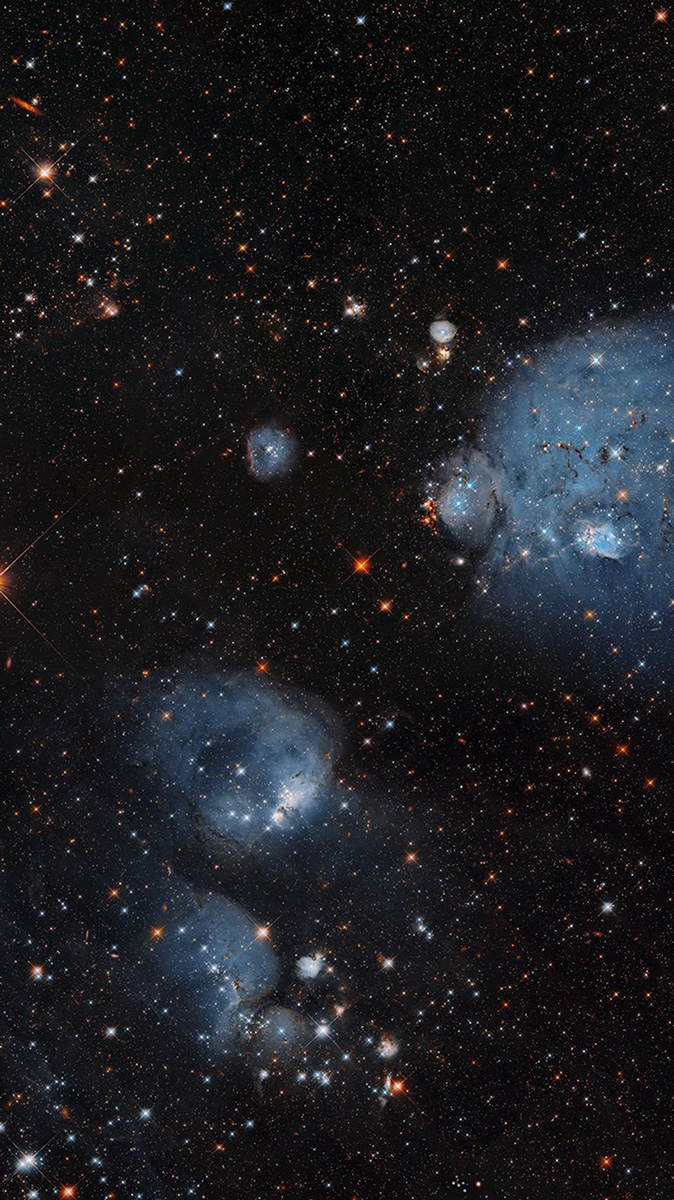
NASA has released a breathtaking new image. It shows two young star clusters in a nearby galaxy. The image is a joint effort by two space telescopes, Hubble and JWST. Each telescope captures the region in a different light. Together, they reveal the two “faces” of a stellar nursery. This mosaic gives us one of the most detailed views of star formation outside the Milky Way. The targets are two open clusters named NGC 460 and NGC 456. These clusters lie in the Small Magellanic Cloud (SMC). The SMC is a dwarf satellite galaxy of the Milky Way. It is about 200,000 light-years away from Earth. The region lies in the southern constellation Tucana.
What did Hubble see?
The Hubble Space Telescope looked at the region in visible light. This light reveals glowing gas clouds around young stars. These clouds are mainly hydrogen. Hubble captured ionized hydrogen glowing red in the image. This shows how energetic radiation from young stars excites nearby gas. Hubble also reveals dramatic “bubbles” and “filaments.” These shapes come from stellar winds and radiation. The powerful energy of young stars carves the surrounding gas into complex forms. In the image, you can see arcs, loops, and cavities. These are signs of intense star formation and feedback. Some stars are very hot and massive. These are known as O-type stars. They shine bright blue in Hubble’s image. These giants live short lives and explode as supernovae. Their intense radiation further sculpts the region.
What did JWST see?
The James Webb Space Telescope observed the same region in infrared light. Infrared light passes through dust clouds that block visible light. So, JWST sees much more deeply into the region. It reveals stars hidden behind thick dust. JWST’s image shows warm dust glowing in orange and red. It also reveals cooler gas structures not visible to Hubble. We see fine filaments of dust, new stars forming, and galaxies in the background. Some of these galaxies lie far beyond the SMC. One striking detail is the clarity of dust lanes and cavities. JWST’s resolution in the infrared is extraordinary. It reveals delicate structures never seen before in this region. We can trace the flow of gas and dust shaped by star formation.
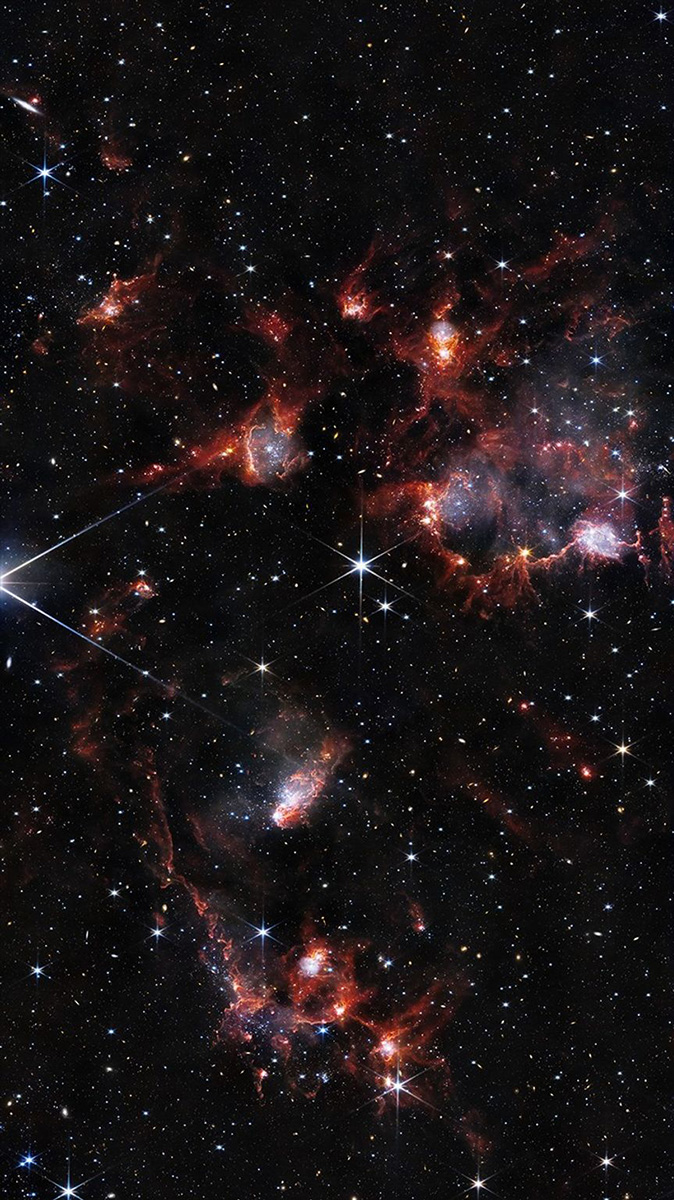
Why this region?
NGC 456 and NGC 460 are very young clusters. Their stars are only 1 to 10 million years old. That is extremely young on cosmic timescales. The Sun, by comparison, is 4.6 billion years old. The clusters lie in an area rich in gas and dust. This makes it a prime site for observing how stars form and grow. These clusters also host some of the rarest types of stars, O-type stars. Only about 20,000 of these exist in the entire Milky Way. But this single image captures many of them. The SMC is also a special kind of galaxy. It has fewer heavy elements than the Milky Way. Astronomers call it “metal-poor.” This means it lacks elements like carbon, oxygen, and iron. These metals form in older stars and supernovae. Because the SMC is metal-poor, it resembles the conditions of the early universe.
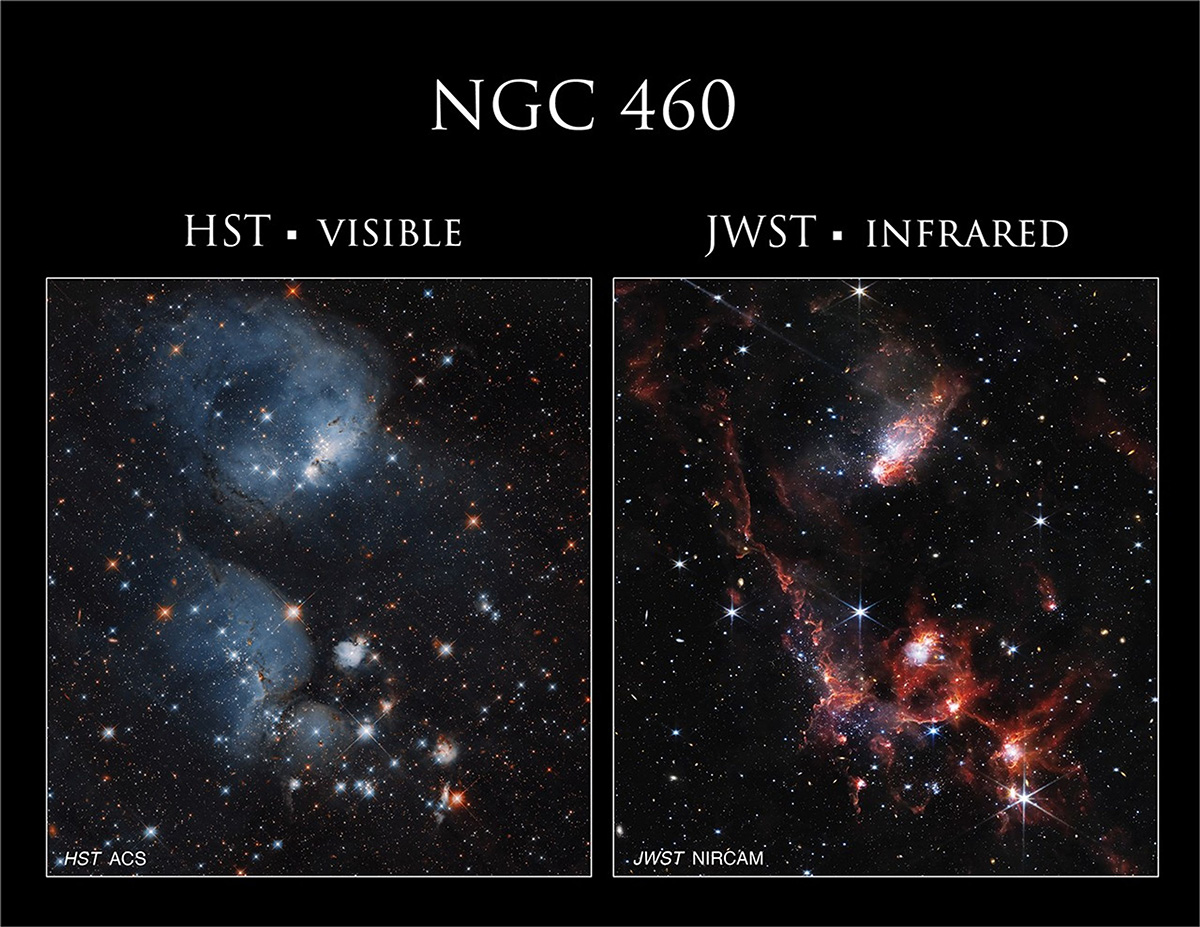
A 527-megapixel mosaic
This new image is massive in detail. It is a mosaic made of 12 overlapping tiles. Together, they create a 527-megapixel masterpiece. The field of view spans about 320 light-years across. NASA has released this mosaic for the public and scientists. You can zoom in and explore countless stars, gas filaments, and even distant galaxies. It’s a visual feast and a scientific goldmine.
You can download the high-resolution file from the official NASA website. The combined data weighs over 40 MB. It’s ideal for researchers studying gas dynamics, star birth, and galactic evolution.
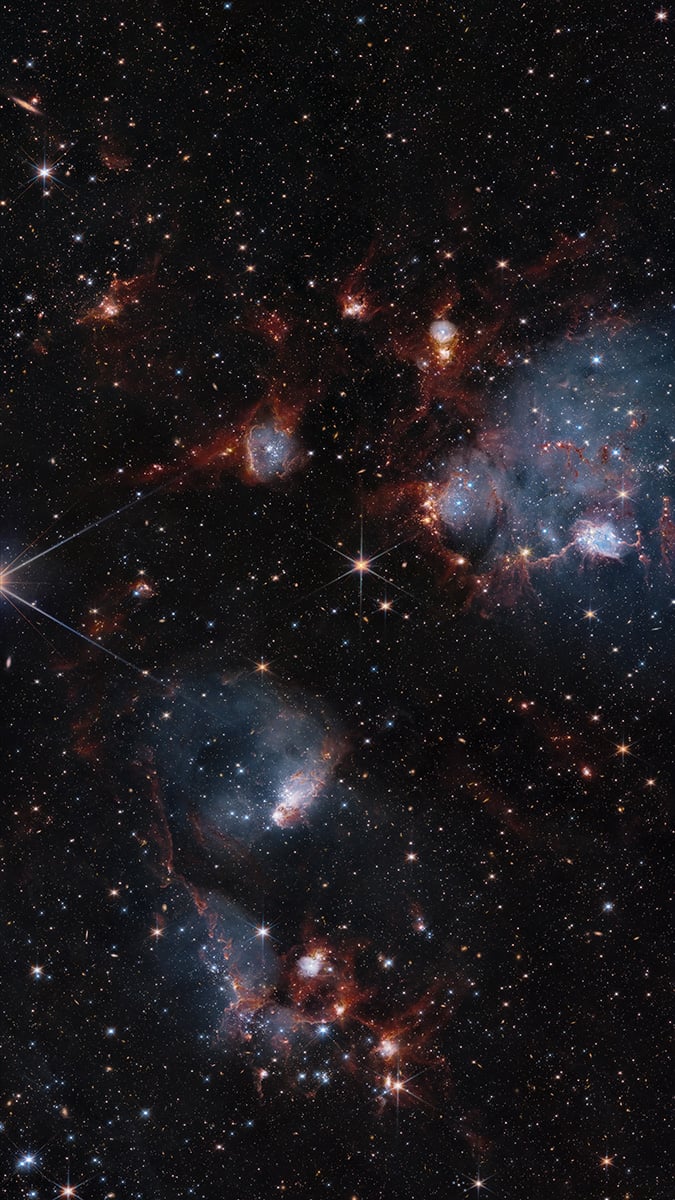
A collaborative effort
This observation is a testament to the power of collaboration. Hubble has been in orbit since 1990. JWST launched in 2021. Together, they represent the best of two generations of space telescopes. Hubble gives us high-resolution visible light images. JWST opens up the dusty, infrared universe. By combining their strengths, we can explore the cosmos in unprecedented detail. NASA’s science team carefully planned this observation. They used the Hubble Advanced Camera for Surveys (ACS). JWST used its Near-Infrared Camera (NIRCam). The data was then processed and stitched together into one seamless view.
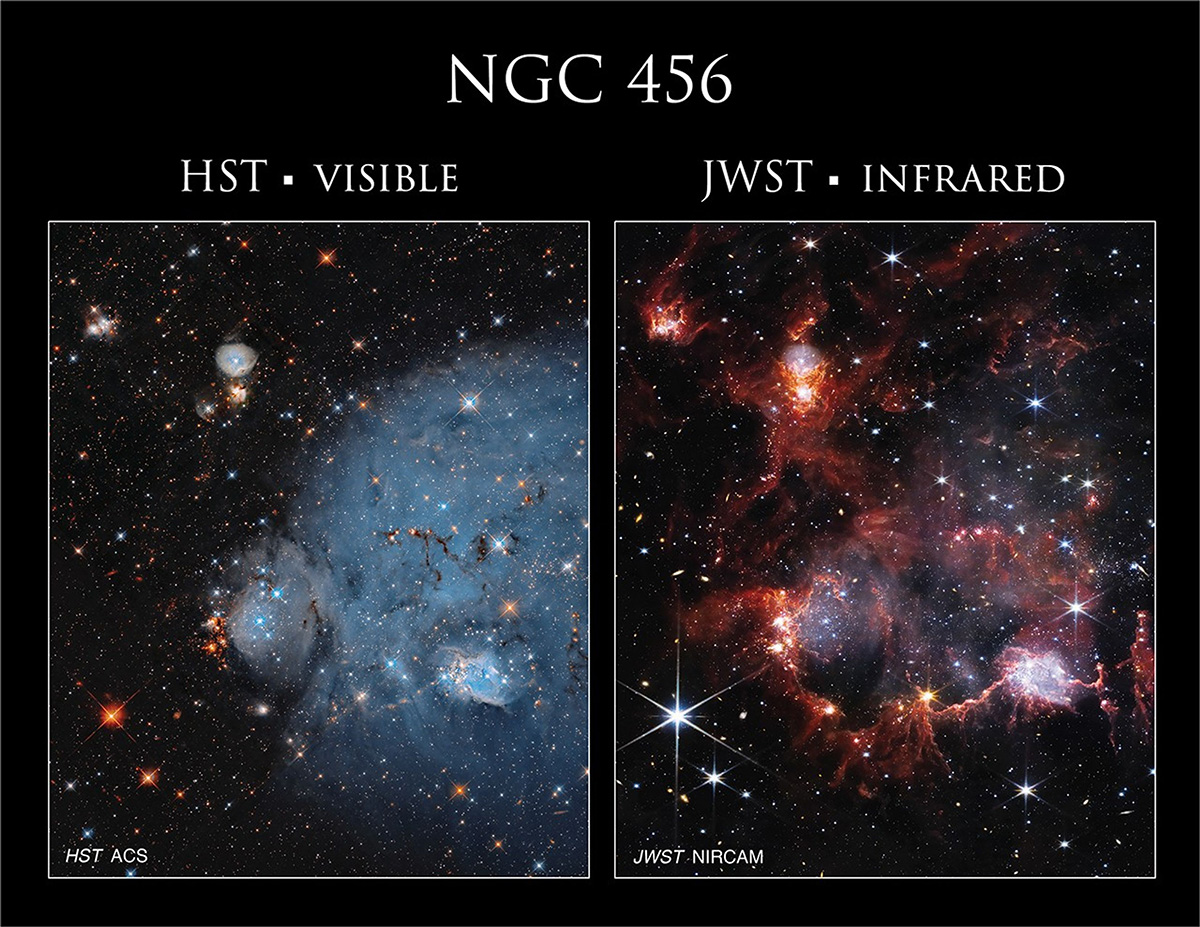
From hot stars to dusty filaments, this mosaic reveals the full lifecycle of stars. It shows birth, feedback, and cosmic shaping in action. Hubble and JWST will continue to work together. They will explore more such regions in the future. With each new view, we move closer to understanding how stars and galaxies evolve.
Clear skies
See more from DIYPhotography.net on Google
Add DIYPhotography.net as a trusted source. This makes
our stories more likely to appear in your Google Search results.
 Add as a preferred source on Google

Soumyadeep Mukherjee
Soumyadeep Mukherjee is an award-winning astrophotographer from India. He has a doctorate degree in Linguistics. His work extends to the sub-genres of nightscape, deep sky, solar, lunar and optical phenomenon photography. He is also a photography educator and has conducted numerous workshops. His works have appeared in over 40 books & magazines including Astronomy, BBC Sky at Night, Sky & Telescope among others, and in various websites including National Geographic, NASA, Forbes. He was the first Indian to win “Astronomy Photographer of the Year” award in a major category.

Join the Discussion
DIYP Comment Policy
Be nice, be on-topic, no personal information or flames.