





















Teleios: The Perfect Supernova Remnant Photographed
May 27, 2025
Soumyadeep Mukherjee
Soumyadeep Mukherjee is an award-winning astrophotographer from India. He has a doctorate degree in Linguistics. His work extends to the sub-genres of nightscape, deep sky, solar, lunar and optical phenomenon photography. He is also a photography educator and has conducted numerous workshops. His works have appeared in over 40 books & magazines including Astronomy, BBC Sky at Night, Sky & Telescope among others, and in various websites including National Geographic, NASA, Forbes. He was the first Indian to win “Astronomy Photographer of the Year” award in a major category.
Share:

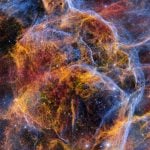
In the vast expanse of our galaxy, a recent discovery has captivated astronomers worldwide. A supernova remnant, designated G305.4–2.2 and affectionately nicknamed “Teleios” (Greek for “perfect”), has been identified due to its remarkable near-perfect circular symmetry. This discovery offers a unique glimpse into the aftermath of stellar explosions and the conditions of the interstellar medium.
Discovery and observation
The Australian Square Kilometre Array Pathfinder (ASKAP), as part of the Evolutionary Map of the Universe (EMU) survey, detected Teleios through radio-continuum imaging. With an angular size of approximately 1320″ × 1260″, Teleios stands out as one of the most symmetrical supernova remnants observed in our galaxy. Notably, it is visible exclusively in radio wavelengths, with no corresponding detections in X-ray, optical, or infrared spectra. This singular detection challenges conventional understanding of supernova remnants, which are typically observed across multiple wavelengths.

Physical characteristics
Symmetry: Teleios exhibits an almost perfect circular shape, suggesting an expansion into a uniform interstellar medium.
Surface Brightness: It possesses one of the lowest surface brightness levels among known Galactic supernova remnants, indicating a relatively faint emission in radio frequencies.
Spectral Index: The remnant has a steep spectral index of α = -0.6 ± 0.3, consistent with synchrotron emission from accelerated electrons.
Distance and Size: Estimates place Teleios at either ~2.2 kiloparsecs (kpc) or ~7.7 kpc away, corresponding to physical diameters of approximately 14 parsecs (pc) and 48 pc, respectively.
Age: Depending on its distance, the remnant’s age could range from under 1,000 years (if closer) to over 10,000 years (if farther).

Challenges in classification
Determining the exact type of supernova that led to Teleios remains complex. While its symmetry suggests a Type Ia supernova, characterized by the thermonuclear explosion of a white dwarf in a binary system, the absence of expected X-ray emissions complicates this classification. An alternative hypothesis considers a Type Iax supernova, a less energetic variant that may leave behind a surviving white dwarf. However, this scenario would place Teleios at a much closer distance of less than 1 kpc, conflicting with other observational data.
Implications for Astrophysics
The discovery of Teleios provides valuable insights into the dynamics of supernova remnants and their interactions with the interstellar medium. Its near-perfect symmetry implies an expansion into a relatively undisturbed environment, offering a rare opportunity to study the intrinsic properties of supernova explosions without significant external influences. Furthermore, the detection of such a faint remnant underscores the capabilities of modern radio telescopes like ASKAP in uncovering previously hidden structures in our galaxy.

To unravel the mysteries surrounding Teleios, further observations across multiple wavelengths are essential. High-resolution studies in X-ray, optical, and infrared spectra could provide additional data on its composition, energy output, and potential central compact object. Moreover, detailed modeling of its expansion and interaction with the surrounding medium may shed light on the conditions that led to its exceptional symmetry. Its discovery not only challenges existing paradigms but also opens new avenues for research into the life cycles of stars and the evolution of supernova remnants. As telescopic technologies progress, we can anticipate uncovering more such enigmatic structures, each contributing to our understanding of the cosmos.
Clear skies!
See more from DIYPhotography.net on Google
Add DIYPhotography.net as a trusted source. This makes
our stories more likely to appear in your Google Search results.
 Add as a preferred source on Google

Soumyadeep Mukherjee
Soumyadeep Mukherjee is an award-winning astrophotographer from India. He has a doctorate degree in Linguistics. His work extends to the sub-genres of nightscape, deep sky, solar, lunar and optical phenomenon photography. He is also a photography educator and has conducted numerous workshops. His works have appeared in over 40 books & magazines including Astronomy, BBC Sky at Night, Sky & Telescope among others, and in various websites including National Geographic, NASA, Forbes. He was the first Indian to win “Astronomy Photographer of the Year” award in a major category.



Join the Discussion
DIYP Comment Policy
Be nice, be on-topic, no personal information or flames.