





















James Webb Captures Thousands of Young Stars “Brewing” in Space
Oct 23, 2026
Soumyadeep Mukherjee
Soumyadeep Mukherjee is an award-winning astrophotographer from India. He has a doctorate degree in Linguistics. His work extends to the sub-genres of nightscape, deep sky, solar, lunar and optical phenomenon photography. He is also a photography educator and has conducted numerous workshops. His works have appeared in over 40 books & magazines including Astronomy, BBC Sky at Night, Sky & Telescope among others, and in various websites including National Geographic, NASA, Forbes. He was the first Indian to win “Astronomy Photographer of the Year” award in a major category.
Share:
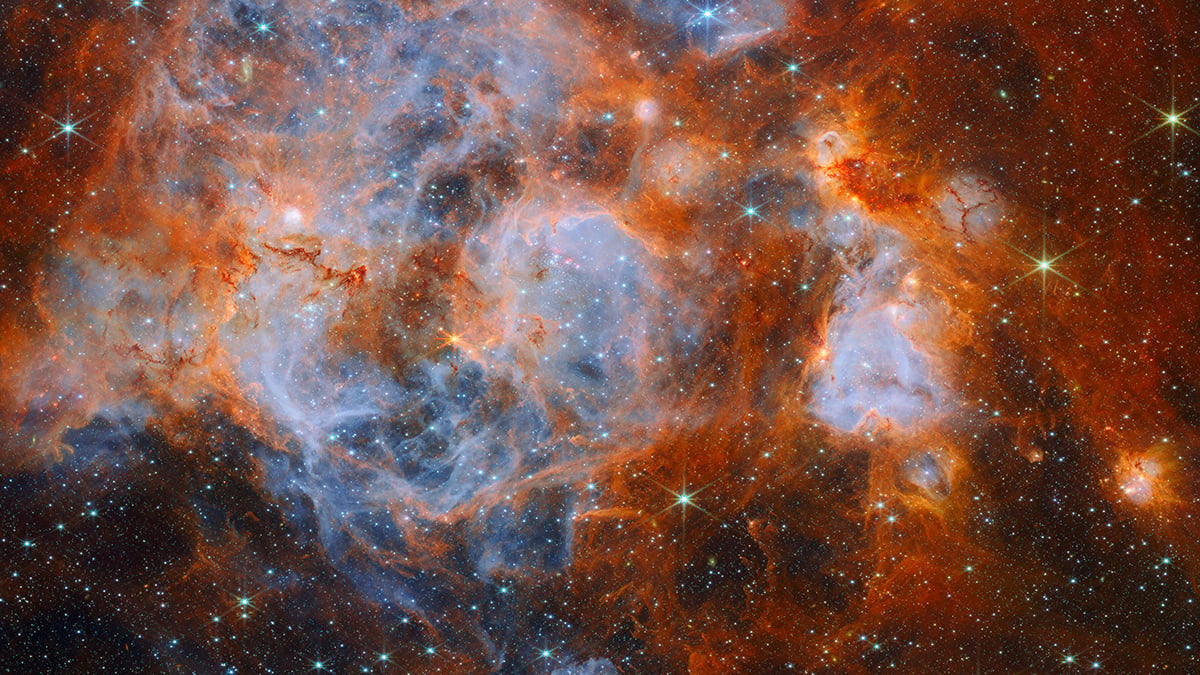
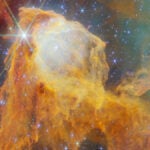
The James Webb Space Telescope has captured a detailed view of N159, a star-forming region in a neighboring galaxy. The image shows glowing gas, thick clouds of dust, and dark filaments that contain some of the region’s youngest stars. It spans about 230 light-years across the Large Magellanic Cloud, a satellite galaxy of the Milky Way.
N159 lies roughly 161,000 light-years from Earth. Astronomers estimate its age at less than three million years, making it one of the younger star-forming regions in the Large Magellanic Cloud. Its stars have begun to change the clouds around them, but dense pockets of gas still hide objects in their earliest stages of development.
N159: A turbulent stellar nursery
N159 belongs to a class of objects known as H II regions. These clouds contain hydrogen gas that massive, hot stars have ionized with their ultraviolet radiation. The radiation strips electrons from hydrogen atoms, and the resulting gas emits light. This process gives the nebula much of its bright appearance.
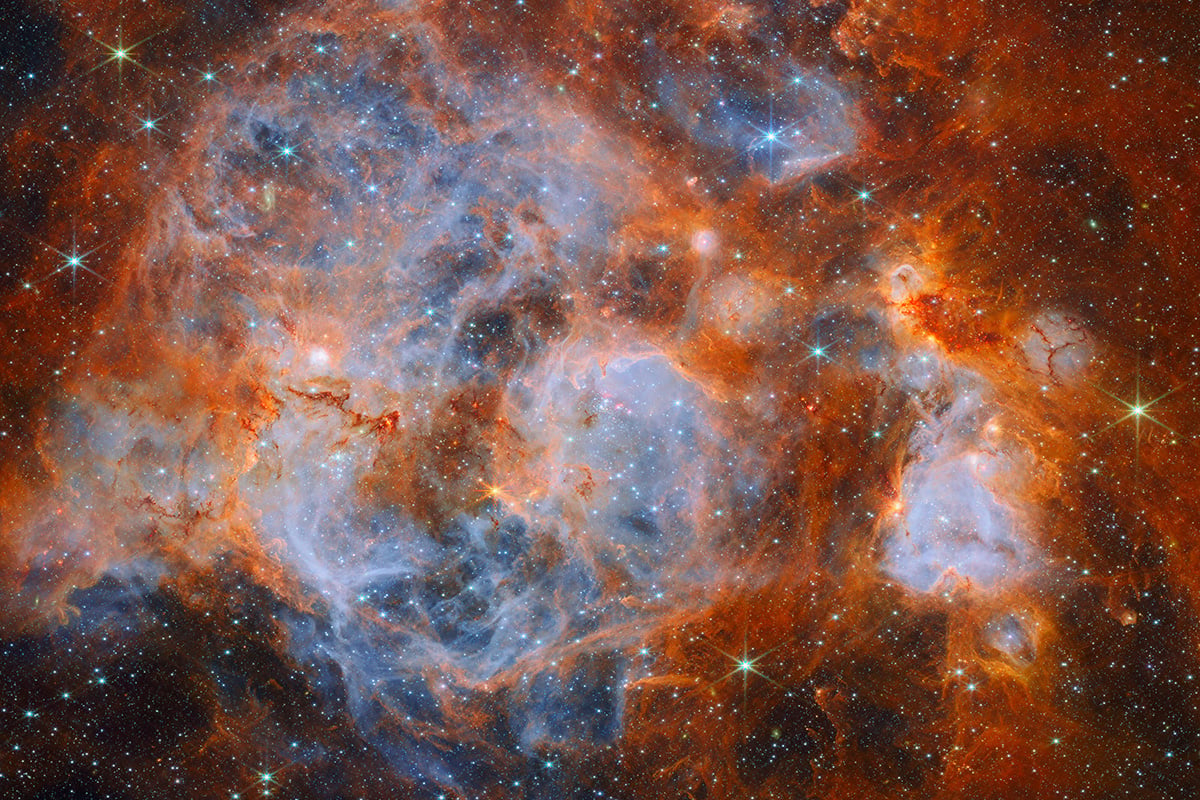
The story begins inside cold molecular clouds. Gravity draws gas together, creating increasingly dense clumps. As material falls towards a developing star, the central region grows hotter and denser. Once the core reaches the right conditions, nuclear fusion begins. The star then starts producing its own energy.
Massive stars quickly become powerful sources of radiation. They also release stellar winds, streams of charged particles that push against the surrounding gas. These forces carve cavities into the cloud and compress material along their edges. JWST’s image captures the results of this interaction across N159.
The pale blue areas mark regions where energetic radiation has ionised hydrogen. Dense ridges surround some of these cavities, while thicker clouds remain elsewhere. The contrast shows how unevenly the stars affect their environment. Some areas have lost much of their surrounding material, while others remain embedded in dense gas.
The orange clouds and dark red filaments
The colors in James Webb’s image represent different wavelengths of infrared light. Scientists assign visible colors to the observations so they can distinguish the materials within the nebula.
The thick orange clouds trace emission from polycyclic aromatic hydrocarbons, commonly called PAHs. These carbon-based molecules occur in interstellar material and emit infrared light when nearby radiation excites them. Their glow outlines parts of the dusty cloud surrounding the ionized gas.
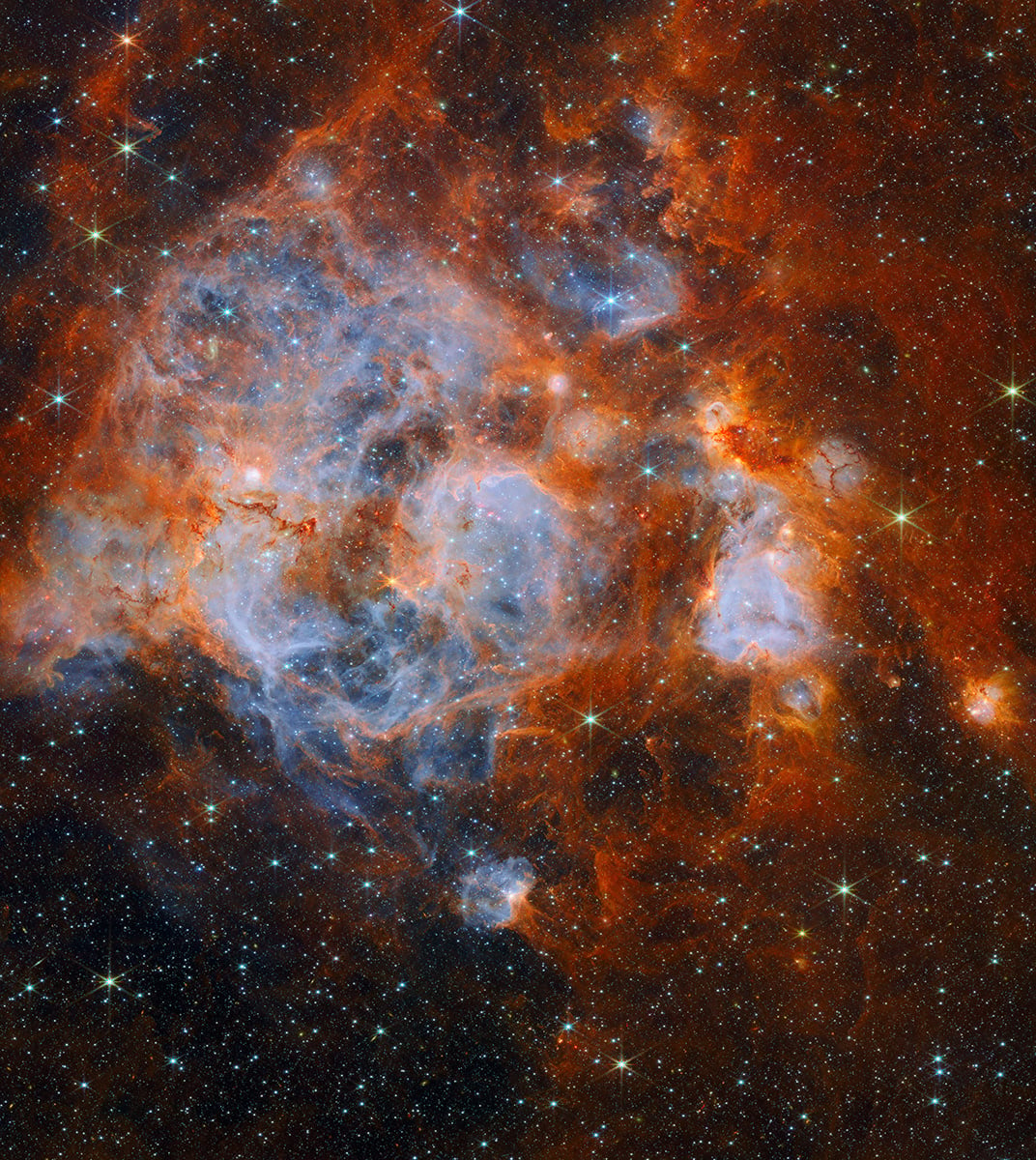
The pale blue regions trace ionized hydrogen. Hot, young stars provide the ultraviolet radiation that energizes this gas. Their influence creates the cavities and bright areas that dominate parts of the image. The boundaries between blue gas and orange clouds help reveal where the radiation meets denser material.
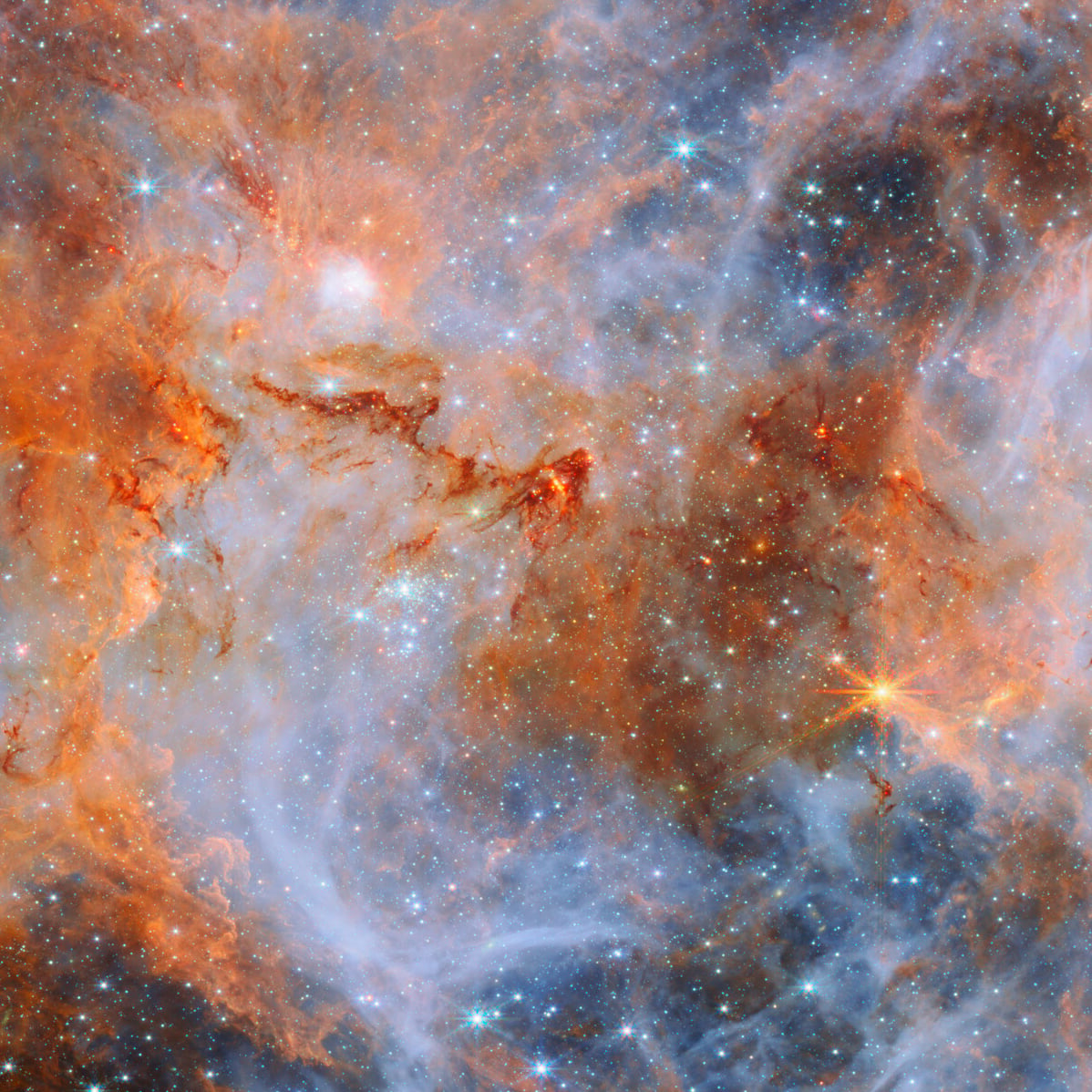
Dark red filaments cross the central region, particularly above the blue cavity on the right. These structures contain cool molecular hydrogen. They form some of the densest parts of N159 and help shield young stars from harsh radiation and stellar winds.
The Papillon Nebula and stars at different stages
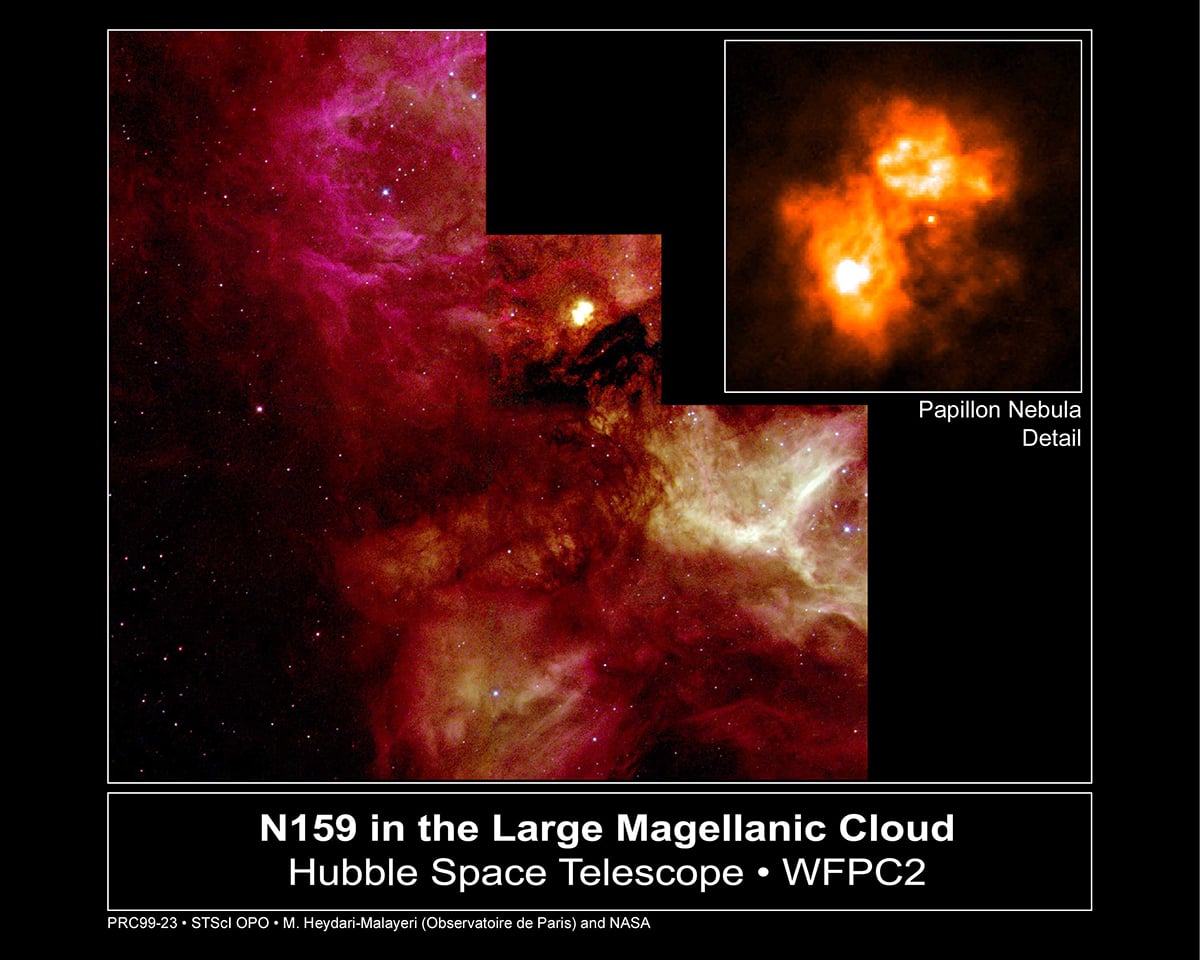
A bright, compact feature gets our attention on the left side of the image. Astronomers call it the Papillon Nebula, using the French word for butterfly. This small region of ionized hydrogen is associated with the formation of massive stars.
The Hubble Space Telescope resolved the Papillon Nebula in 1999. Hubble revealed its unusual structure within N159, giving astronomers an early look at this compact region. The new JWST image places it within a broader view of the surrounding gas and dust.
The new observations examine stars at different stages of evolution across N159. Researchers detected extremely faint stars with less than one-tenth the mass of the Sun. They also distinguished more evolved stars from young stellar objects still wrapped in the material from which they formed.
This range of objects makes N159 particularly useful for studying stellar evolution. Astronomers can compare young stars that remain embedded in dense clouds with older objects that have already affected their surroundings. The same image also shows the gas that links these stages together.
Clear skies!
See more from DIYPhotography.net on Google
Add DIYPhotography.net as a trusted source. This makes
our stories more likely to appear in your Google Search results.
 Add as a preferred source on Google

Soumyadeep Mukherjee
Soumyadeep Mukherjee is an award-winning astrophotographer from India. He has a doctorate degree in Linguistics. His work extends to the sub-genres of nightscape, deep sky, solar, lunar and optical phenomenon photography. He is also a photography educator and has conducted numerous workshops. His works have appeared in over 40 books & magazines including Astronomy, BBC Sky at Night, Sky & Telescope among others, and in various websites including National Geographic, NASA, Forbes. He was the first Indian to win “Astronomy Photographer of the Year” award in a major category.
Join the Discussion
DIYP Comment Policy
Be nice, be on-topic, no personal information or flames.