























James Webb Reveals Young Stars in Orion Molecular Cloud
Jun 14, 2026
Soumyadeep Mukherjee
Soumyadeep Mukherjee is an award-winning astrophotographer from India. He has a doctorate degree in Linguistics. His work extends to the sub-genres of nightscape, deep sky, solar, lunar and optical phenomenon photography. He is also a photography educator and has conducted numerous workshops. His works have appeared in over 40 books & magazines including Astronomy, BBC Sky at Night, Sky & Telescope among others, and in various websites including National Geographic, NASA, Forbes. He was the first Indian to win “Astronomy Photographer of the Year” award in a major category.
Share:
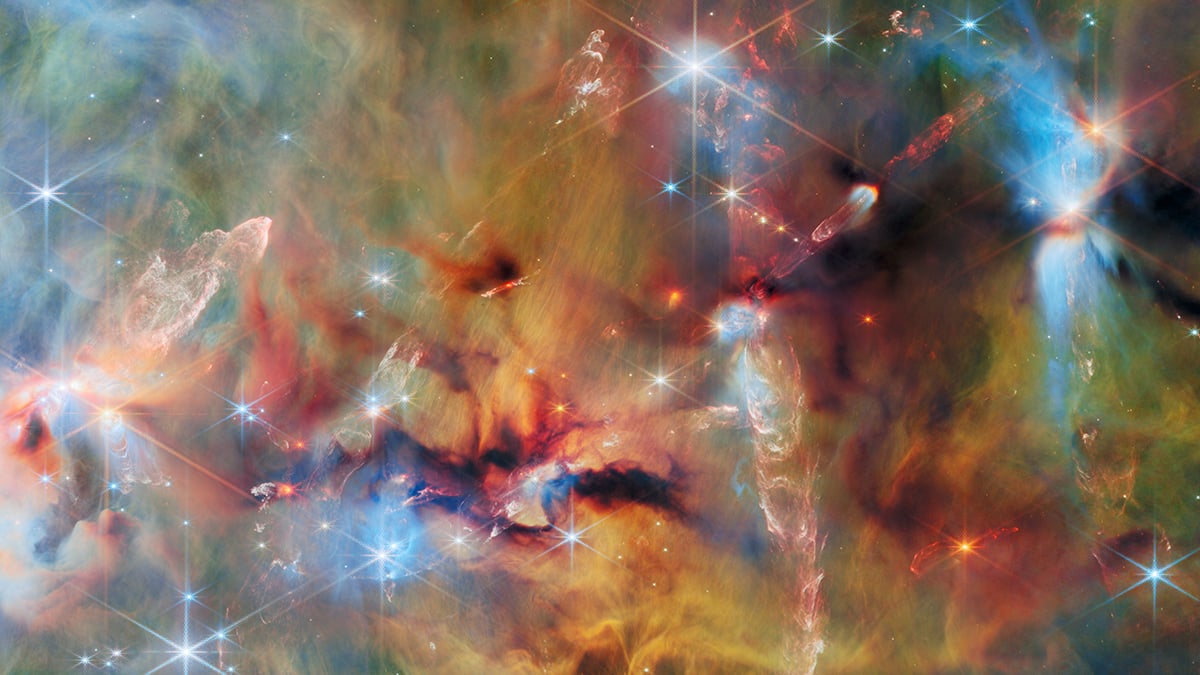
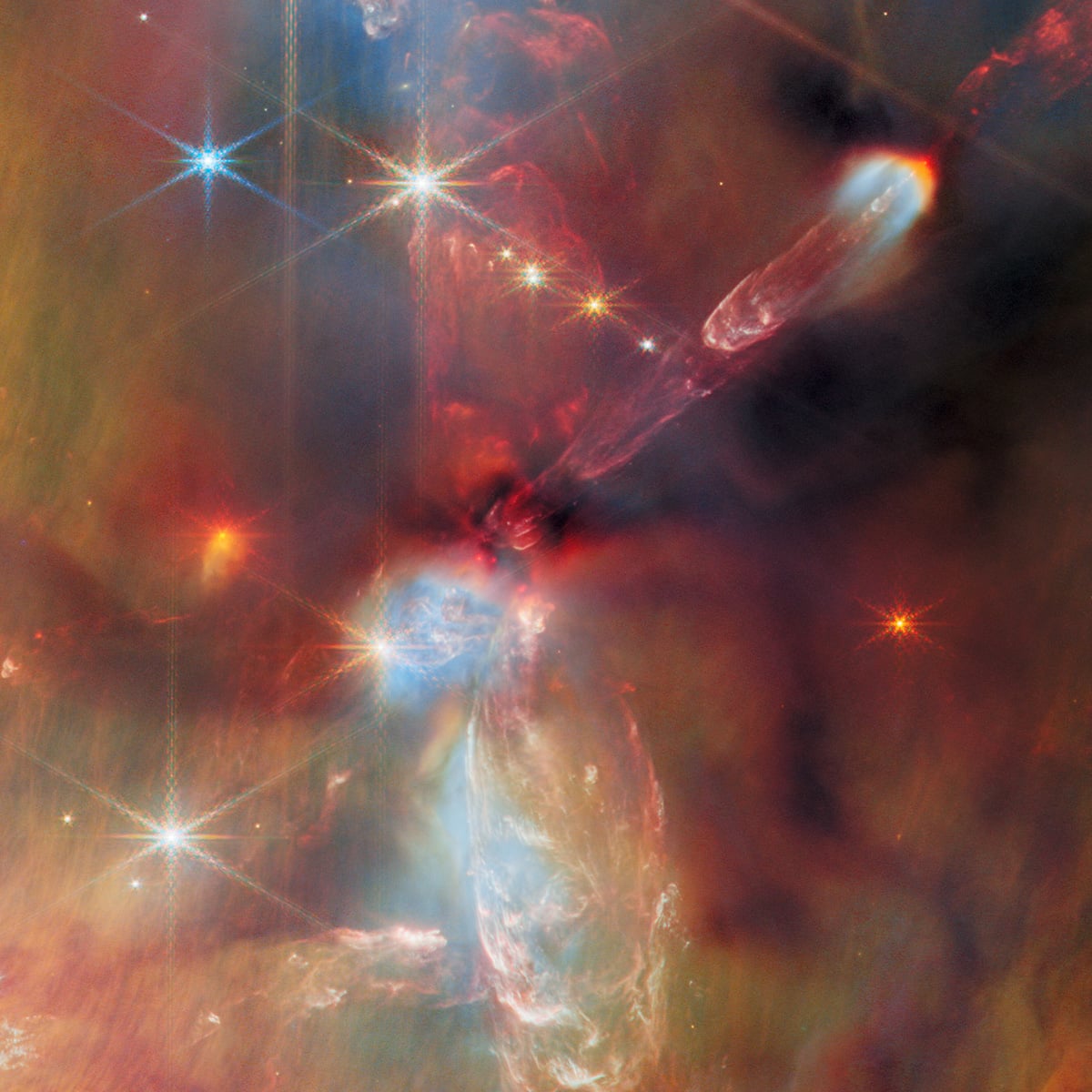
The James Webb Space Telescope has released a new infrared view of the Orion Molecular Cloud Complex, offering an unusually detailed look into one of the nearest active stellar nurseries in the Milky Way. The observation focuses on OMC-2, a dense filamentary region located within the larger Orion A molecular cloud, roughly 1,300 light-years from Earth.
Using its Near-Infrared Camera, JWST traced embedded protostars, dusty filaments, ionized cavities, and energetic outflows across a crowded star-forming environment that optical telescopes cannot fully penetrate. The image captures a region where gravity, turbulence, radiation, and magnetic activity interact continuously. Dense molecular gas collapses into stellar embryos, while young stars inject energy back into the cloud through jets and stellar winds.
A dense region hidden behind the Orion Nebula
The Orion Nebula dominates most photographs of the Orion constellation. It appears bright even through amateur telescopes and has become one of the most studied nebulae in astronomy. However, the glowing nebula visible from Earth represents only the illuminated surface of a much larger cloud complex.
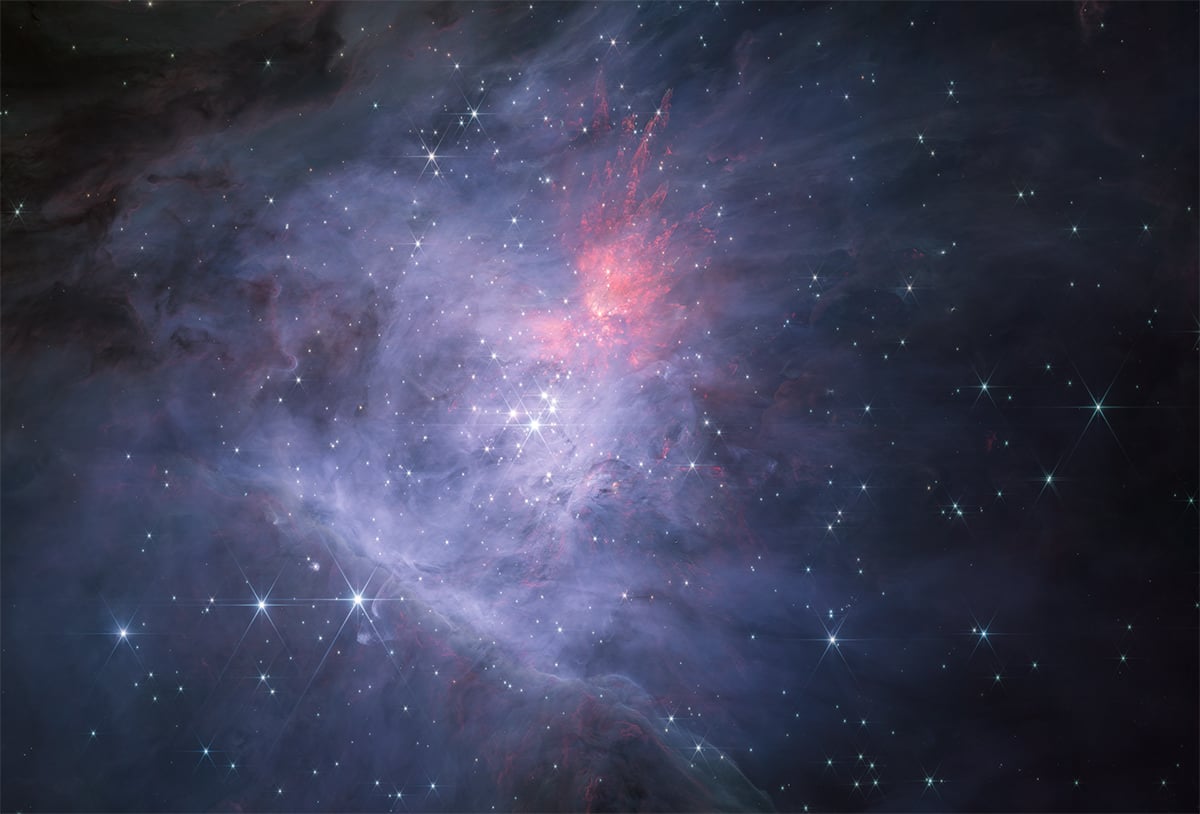
Behind the bright emission region lies Orion A, a giant molecular cloud filled with cold gas, dust, and young stellar systems. OMC-2 forms part of this larger structure. Astronomers classify it as an active star-forming filament, where dense pockets of material continue to collapse under gravity.
Unlike the bright Orion Nebula, OMC-2 remains heavily obscured at visible wavelengths. Thick dust grains absorb and scatter optical light across much of the region. Consequently, earlier observations could reveal only fragments of the activity inside the cloud. Infrared astronomy with space telescopes like Spitzer detected embedded sources hidden inside Orion’s dusty structure, while radio facilities mapped cold molecular gas in greater detail.
Protostars emerge inside thick dust clouds
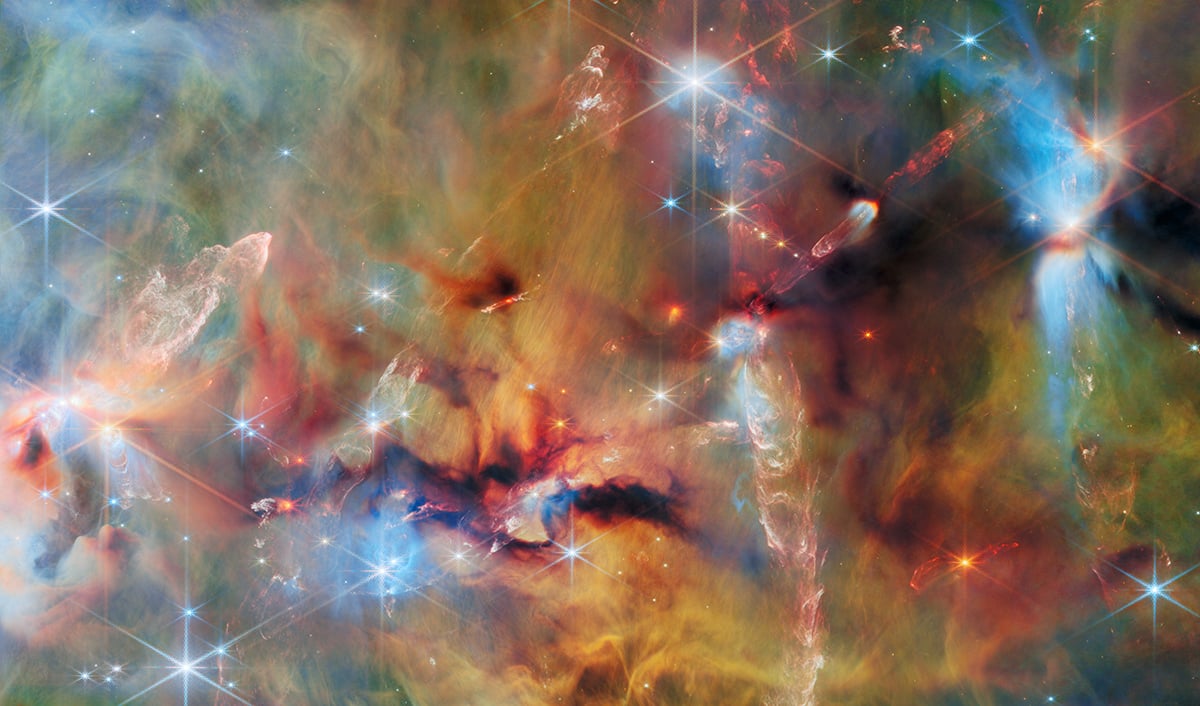
Many of the objects visible in the JWST image remain extremely young by stellar standards. Several likely belong to the protostellar phase, during which a forming star still gathers material from its surrounding cloud. Protostars form when dense molecular cores collapse under their own gravity. As gas falls inward, rotational motion increases and creates an accretion disk around the growing object. Friction inside the disk heats the material, producing strong infrared emission long before stable nuclear fusion begins.
This early phase remains difficult to observe in visible light because thick dust cocoons surround the forming stars. Infrared wavelengths pass through much of that dust, allowing JWST to detect deeply embedded sources across the OMC-2 region.
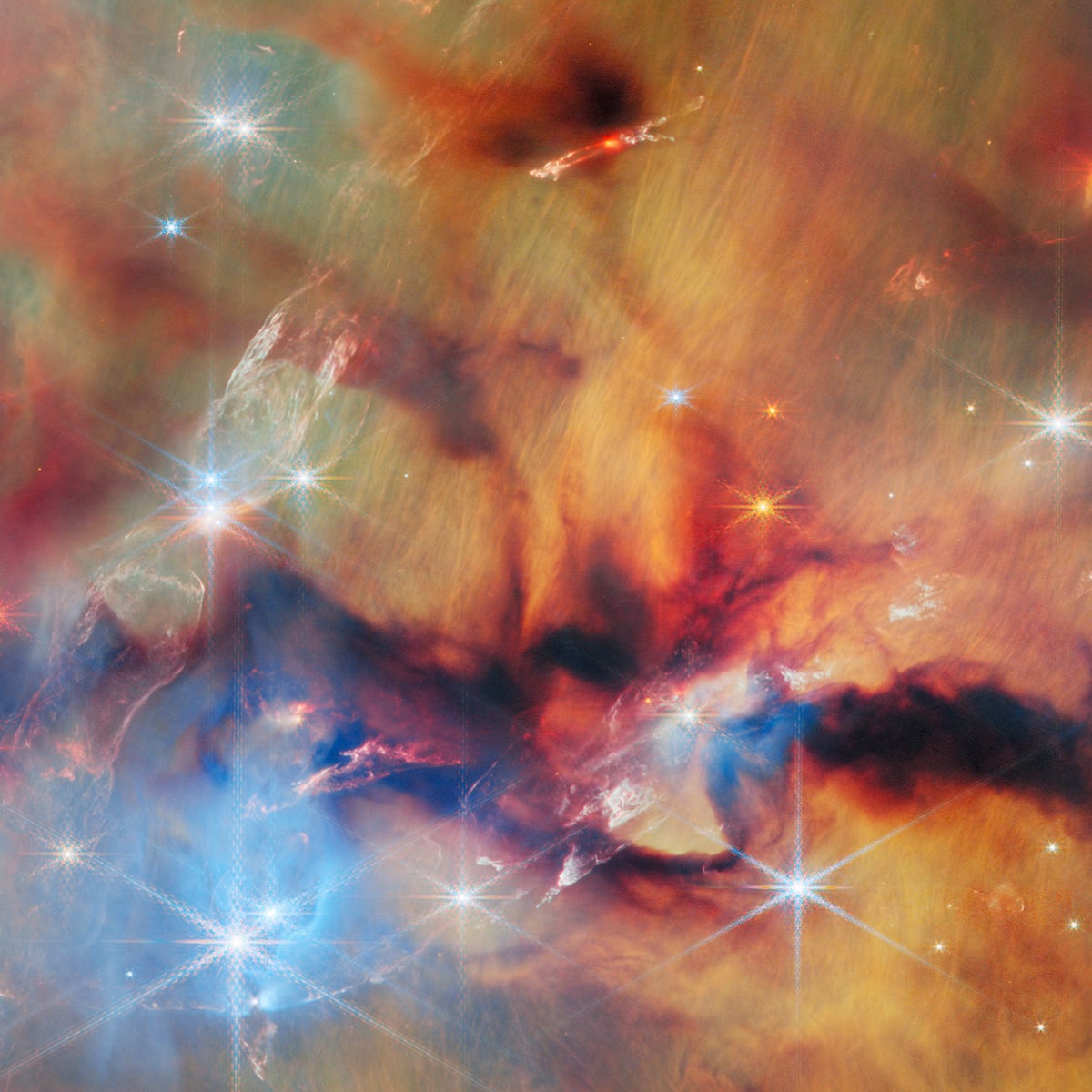
Some of the youngest objects appear as faint reddish points buried inside dark filaments. Others illuminate surrounding cavities where radiation and stellar winds have begun clearing nearby material. Several systems also display elongated structures associated with outflows.
These outflows represent one of the most important signatures of early stellar evolution. As material spirals inward through the accretion disk, magnetic fields channel part of the gas away from the protostar’s poles at high velocity. The resulting jets can extend across large distances and interact violently with the surrounding cloud.
At the same time, the image highlights how crowded stellar nurseries become. Stars rarely form alone inside giant molecular clouds. Instead, clusters of young systems emerge together inside dense filaments. Their radiation, winds, and outflows continuously reshape the surrounding environment.
Dust filaments control the evolution of the cloud
Dust mainly dominates the visual structure of the new JWST observation. Thick filaments twist across the frame and divide the cloud into dense and diffuse regions. Although these structures appear dark in some wavelengths, they contain the raw material needed for future generations of stars.
Interstellar dust consists mainly of microscopic grains composed of silicates, carbon compounds, and ices. Mixed with molecular hydrogen gas, these grains cool the cloud and help gravitational collapse proceed more efficiently.
The densest filaments inside OMC-2 contain large concentrations of molecular gas. Over time, turbulence and gravity fragment these structures into smaller cores. Some cores eventually collapse into protostars, while others remain stable for long periods.
The contrast between dark dust lanes and glowing cavities also exposes the dynamic nature of the environment. Young stars inject energy into the cloud through ultraviolet radiation, stellar winds, and outflows. Those processes heat the surrounding dust and create expanding cavities inside the molecular gas. In several locations, JWST detected bright arcs and shell-like structures surrounding embedded stars. These features likely formed as stellar radiation pushed against nearby material over time.
Dust also plays a major role in planetary system formation. Circumstellar disks around young stars contain the same grains visible throughout the cloud. Inside those disks, particles collide and gradually form larger bodies. Over millions of years, that process may produce planets, moons, and asteroid systems.
Clear skies!
See more from DIYPhotography.net on Google
Add DIYPhotography.net as a trusted source. This makes
our stories more likely to appear in your Google Search results.
 Add as a preferred source on Google

Soumyadeep Mukherjee
Soumyadeep Mukherjee is an award-winning astrophotographer from India. He has a doctorate degree in Linguistics. His work extends to the sub-genres of nightscape, deep sky, solar, lunar and optical phenomenon photography. He is also a photography educator and has conducted numerous workshops. His works have appeared in over 40 books & magazines including Astronomy, BBC Sky at Night, Sky & Telescope among others, and in various websites including National Geographic, NASA, Forbes. He was the first Indian to win “Astronomy Photographer of the Year” award in a major category.
Join the Discussion
DIYP Comment Policy
Be nice, be on-topic, no personal information or flames.