
























Hubble Observes a Massive Stellar Jet: Herbig-Haro 80/81
Jan 12, 2026
Soumyadeep Mukherjee
Soumyadeep Mukherjee is an award-winning astrophotographer from India. He has a doctorate degree in Linguistics. His work extends to the sub-genres of nightscape, deep sky, solar, lunar and optical phenomenon photography. He is also a photography educator and has conducted numerous workshops. His works have appeared in over 40 books & magazines including Astronomy, BBC Sky at Night, Sky & Telescope among others, and in various websites including National Geographic, NASA, Forbes. He was the first Indian to win “Astronomy Photographer of the Year” award in a major category.
Share:
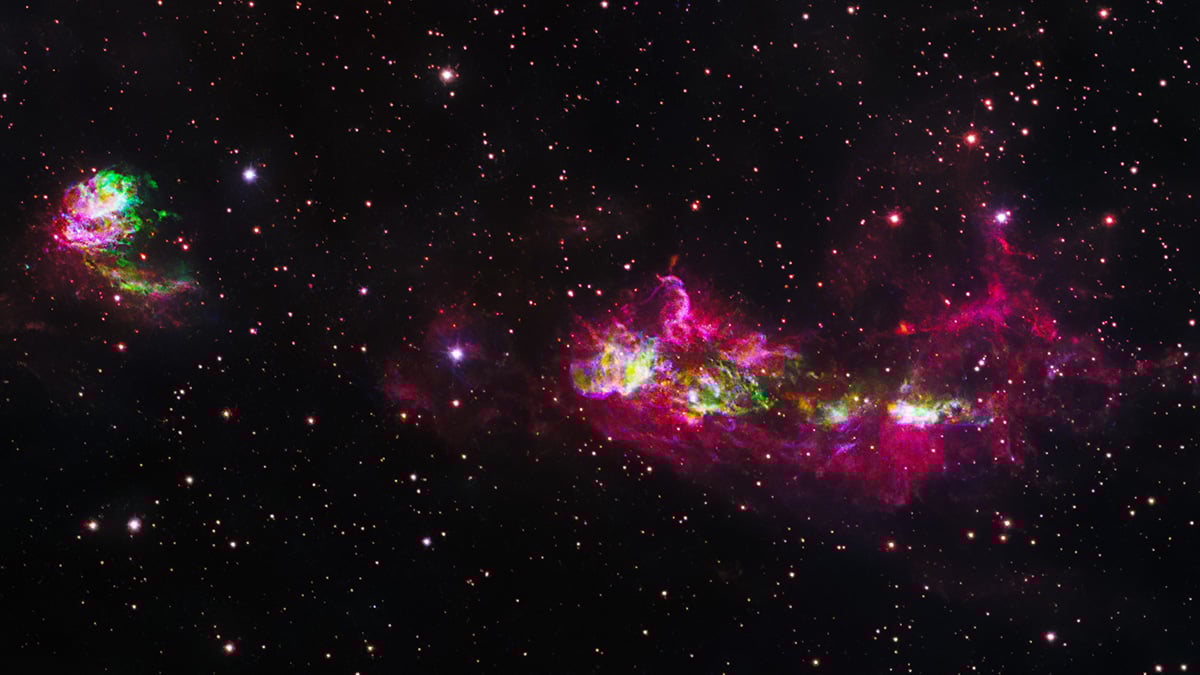
High-resolution imaging from the Hubble Space Telescope has revealed one of the most extreme protostellar outflow systems known in the Milky Way. In a dense star-forming region toward the constellation Sagittarius, a massive young star is driving supersonic jets of ionized gas into surrounding interstellar material. These jets generate strong shock fronts that heat the gas and cause it to radiate intensely at optical wavelengths. Hubble’s latest observations resolve this interaction with exceptional clarity and scale.
The target of this study is the Herbig–Haro complex known as HH 80 and HH 81. These luminous structures trace the impact zones where fast-moving stellar jets collide with slower gas expelled during earlier stages of star formation. While Herbig–Haro objects are common in star-forming regions, this system stands apart. Its size, velocity, and energy output exceed those of any previously observed protostellar jet. According to NASA, the outflow extends for roughly 32 light-years, making it the largest known jet driven by a forming star.
The galactic environment: HH 80/81
The HH 80/81 system lies approximately 5,500 light-years from Earth, embedded within a crowded region of the Milky Way rich in gas and dust. This part of Sagittarius hosts several active stellar nurseries, where dense molecular clouds continue to collapse and fragment into new stars. Such environments supply the raw material needed for star formation but also obscure these processes from view at visible wavelengths.
Despite this complexity, HH 80 and HH 81 stand out because their shocks are energetic enough to ionize gas and produce strong optical emission. Hubble’s sensitivity allows astronomers to isolate this emission and separate it from the surrounding background.
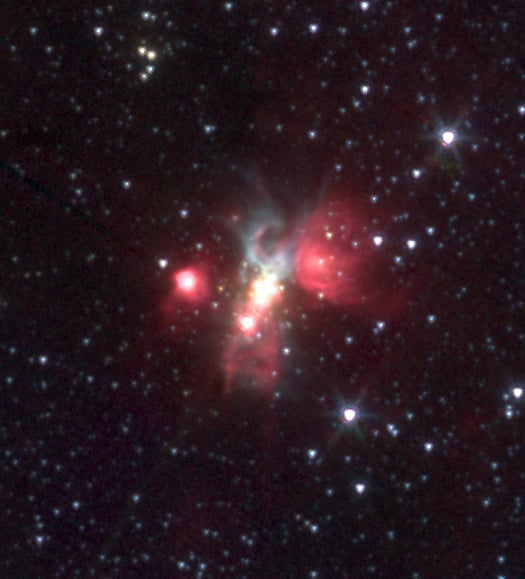
At the center of the outflow sits the massive protostar IRAS 18162-2048. Infrared and radio observations show that this object is still accreting material. Estimates place its mass at roughly 20 times that of the Sun. This immediately makes the system unusual. Most Herbig–Haro jets originate from low-mass protostars. In contrast, this jet is powered by a star that will eventually evolve into a high-mass, short-lived stellar object.
How the jet forms and propagates
Star formation begins when gravity pulls gas inward toward a dense core. As material falls in, conservation of angular momentum causes it to form a rotating disk around the protostar. However, not all infalling gas reaches the stellar surface. Strong magnetic fields thread the disk and the star, redirecting part of the material along the system’s rotational axis.
This process produces jets that accelerate gas away from the protostar at extreme velocities. In the case of IRAS 18162-2048, those velocities exceed 1,000 kilometers per second. Measurements confirm that this is the fastest protostellar jet observed at both optical and radio wavelengths.
As the jet propagates outward, it does not move through space. Instead, it encounters gas ejected during earlier phases of the star’s growth. When the fast jet collides with this slower material, shock waves form. These shocks compress and heat the gas, ionizing atoms and triggering emission across multiple wavelengths.

HH 80 and HH 81 shine intensely
The brightness of HH 80 and HH 81 arises from shock excitation rather than direct illumination. When gas passes through a shock front, its temperature increases sharply. Atoms collide more frequently, and electrons move to higher energy states. As the gas cools, electrons fall back to lower levels and emit light at characteristic wavelengths.
Hubble’s observations isolate emission from hydrogen, oxygen, and sulfur. Each element traces a different physical condition within the shock. Hydrogen outlines the overall jet structure. Oxygen highlights high-energy regions where shock speeds peak. Sulfur reveals cooling zones behind the shock front.
Together, these emissions produce the complex filamentary appearance seen in the image. Fine arcs and knots indicate regions where energy transfer is actively reshaping the surrounding medium. NASA reports that HH 80 and HH 81 rank among the brightest Herbig–Haro objects ever observed. Their intensity allows astronomers to study shock physics in detail and test models of jet-driven feedback.

A unique laboratory for massive star formation
Jets play a critical role in star formation. They remove excess angular momentum from the system, allowing material to continue falling onto the star. Without this process, accretion would stall. Jets also inject energy and momentum into the surrounding cloud, altering its structure and evolution.
In low-mass stars, this mechanism is well studied. In massive stars, it remains poorly understood. Strong radiation pressure and intense stellar winds complicate the process. For years, astronomers have debated whether massive stars can sustain well-collimated jets.
HH 80/81 provides a clear answer. The observations indicate that massive protostars can indeed launch narrow, stable jets over extremely long distances. Moreover, the energy carried by these jets rivals that of small supernova remnants, even though the star has not yet reached maturity.

Hubble’s role in revealing long-term evolution
The data used in this study come from Hubble’s Wide Field Camera 3, an instrument designed for high-resolution imaging across visible and ultraviolet wavelengths. Its sensitivity allows astronomers to resolve fine structural details within the jet that would otherwise remain hidden.
Importantly, HH 80 and HH 81 have been observed for decades. By comparing older images with the latest data, researchers can measure how individual knots of gas move over time. These proper motion studies confirm the extreme velocities involved and show how shock fronts evolve as the jet interacts with its environment.

This long temporal baseline is one of Hubble’s greatest strengths. Few observatories can provide such continuity. Even as newer telescopes come online, Hubble remains unmatched for tracking slow but significant changes in nearby astrophysical systems.
Clear skies!
See more from DIYPhotography.net on Google
Add DIYPhotography.net as a trusted source. This makes
our stories more likely to appear in your Google Search results.
 Add as a preferred source on Google

Soumyadeep Mukherjee
Soumyadeep Mukherjee is an award-winning astrophotographer from India. He has a doctorate degree in Linguistics. His work extends to the sub-genres of nightscape, deep sky, solar, lunar and optical phenomenon photography. He is also a photography educator and has conducted numerous workshops. His works have appeared in over 40 books & magazines including Astronomy, BBC Sky at Night, Sky & Telescope among others, and in various websites including National Geographic, NASA, Forbes. He was the first Indian to win “Astronomy Photographer of the Year” award in a major category.



Join the Discussion
DIYP Comment Policy
Be nice, be on-topic, no personal information or flames.