


























GLEAM-X Reveals the Milky Way in the Largest Radio Map Ever
Oct 30, 2025
Soumyadeep Mukherjee
Soumyadeep Mukherjee is an award-winning astrophotographer from India. He has a doctorate degree in Linguistics. His work extends to the sub-genres of nightscape, deep sky, solar, lunar and optical phenomenon photography. He is also a photography educator and has conducted numerous workshops. His works have appeared in over 40 books & magazines including Astronomy, BBC Sky at Night, Sky & Telescope among others, and in various websites including National Geographic, NASA, Forbes. He was the first Indian to win “Astronomy Photographer of the Year” award in a major category.
Share:

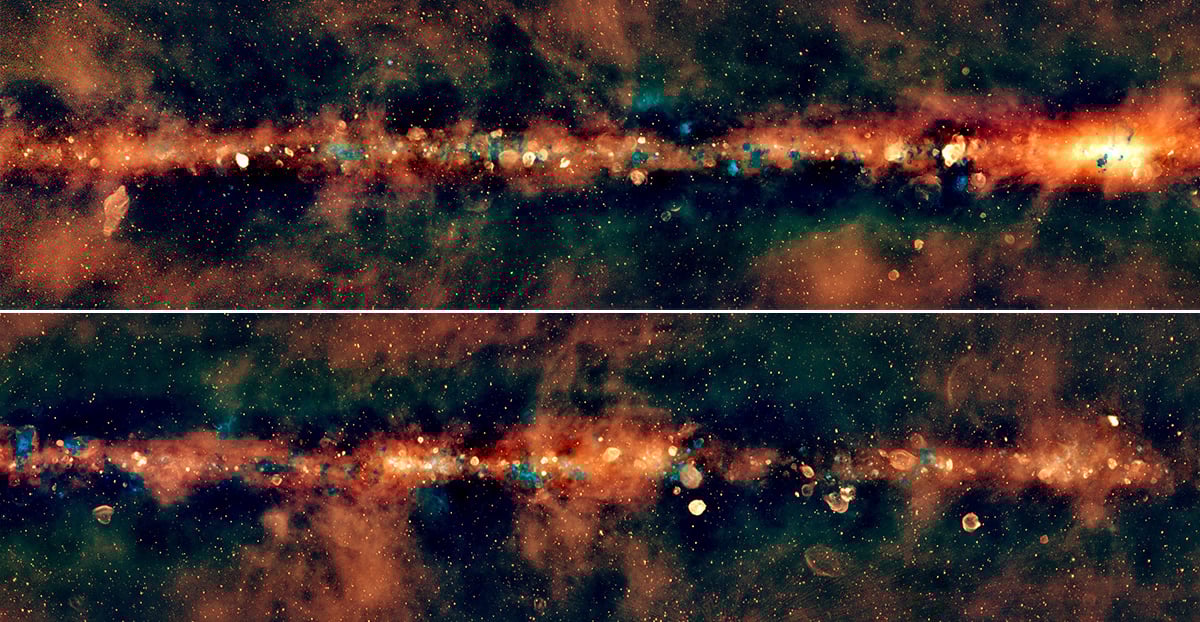
A breathtaking new map of our Galaxy has just been unveiled by Australian astronomers. It’s called GLEAM-X, and it captures the Milky Way in low-frequency radio light like never before. The image spans the southern sky, revealing tens of thousands of previously hidden cosmic objects, ranging from dying stars to distant galaxies.
The project was led by the International Centre for Radio Astronomy Research (ICRAR), using the Murchison Widefield Array (MWA) in Western Australia. This telescope listens to the Universe in radio frequencies far below what human eyes can see. The result is the most detailed radio image ever made of the Milky Way’s southern plane.
Seeing the galaxy in a new light
When we look up on a clear night, we see the Milky Way as a pale band of light. But that’s only a small part of the story. The visible light we see conceals enormous amounts of activity, including explosions, magnetic fields, and clouds of gas that emit radiation in radio waves.
Radio telescopes like the MWA can tune into those long wavelengths and pick up signals from some of the most energetic processes in the Galaxy. These waves come from supernova remnants, star-forming regions, and pulsars, the ultra-dense leftovers of massive stars that spin rapidly and emit beams of radio energy.
GLEAM-X, short for GaLactic and Extragalactic All-sky MWA-eXtended, takes this view to an entirely new level. It follows the earlier GLEAM survey but goes much deeper. The new image has twice the resolution, ten times the sensitivity, and double the sky coverage of its predecessor. It’s the most comprehensive low-frequency radio view of our Galaxy ever assembled.

A massive undertaking
Creating this image was no small task. Astronomers collected data from 113 nights of observation between 2018 and 2020. Each observation covered a wide portion of the sky at frequencies between 72 and 231 MHz, about the same range used by FM radio stations.
The Murchison Widefield Array, located on Wajarri Yamaji Country in Western Australia, is an ideal instrument for such work. Its 4,096 spider-like antennas are spread across several kilometres of desert, far from human radio interference. The array can image huge areas of the sky at once, making it perfect for wide surveys like GLEAM-X.
Processing the data was also a colossal effort. The team used around one million hours of computing time to clean, calibrate, and combine all the observations into a single seamless map. Every pixel in the image represents a real radio source somewhere in the Milky Way.

What the image shows
The GLEAM-X map looks like a tapestry of glowing clouds and colourful threads. Red shades represent the lowest frequencies, while blue corresponds to the highest. The combination produces a false-colour view that highlights the different types of radiation across the sky.
Within the image, astronomers identified around 98,000 distinct radio sources. These include everything from tiny planetary nebulae to enormous supernova remnants. Some regions show the remains of stars that exploded thousands of years ago, their shockwaves still rippling through space. Others reveal bright knots where new stars are forming inside dense gas clouds.
One of the remarkable aspects of this map is how it exposes structures that were invisible before. Low-frequency radio waves can travel through the dust that blocks optical light, allowing astronomers to see deep into the Galactic Plane. Many large, faint objects that were missed by earlier surveys now stand out clearly in the new data.
Discovering the hidden Milky Way
The Milky Way’s southern plane has always been a challenging region to study. It’s crowded, dusty, and full of overlapping sources. But that’s also what makes it fascinating. GLEAM-X helps astronomers peel back the layers and understand how the Galaxy is built.
For example, the survey is helping scientists identify previously unknown supernova remnants. These are the expanding shells of gas left behind after massive stars explode. They glow strongly at low frequencies, making them easier to detect in radio than in optical light. Each remnant adds a piece to the puzzle of how stars enrich the Galaxy with heavier elements.
The image also captures numerous pulsars, spinning neutron stars that flash beams of radio energy toward Earth. These objects serve as precise cosmic clocks. Mapping them in such detail helps refine models of the Milky Way’s structure and magnetic field. Beyond the Galaxy, the survey picks up distant radio galaxies far behind the Milky Way’s glow. Their inclusion makes GLEAM-X both a Galactic and extragalactic treasure trove.

A milestone for radio astronomy
The GLEAM-X project demonstrates just how powerful modern low-frequency instruments have become. Compared to its earlier version, this survey reaches deeper and resolves smaller features. The precision of the calibration also allows astronomers to study subtle differences in radio colour, which in turn reveal the physics of the sources.
This achievement goes beyond producing a stunning picture. It’s a vital scientific dataset that will serve as a reference for years. Researchers can now cross-match the GLEAM-X catalog with observations at other wavelengths, from infrared and optical to X-ray, to understand how different processes connect across the electromagnetic spectrum.
While GLEAM-X is impressive, it’s a preview of what’s on the horizon. The Square Kilometre Array (SKA), now under construction in Australia and South Africa, will operate at similar frequencies but with far greater sensitivity. It will see even finer details in the Galaxy’s structure and detect fainter, more distant sources.
Clear skies!
See more from DIYPhotography.net on Google
Add DIYPhotography.net as a trusted source. This makes
our stories more likely to appear in your Google Search results.
 Add as a preferred source on Google

Soumyadeep Mukherjee
Soumyadeep Mukherjee is an award-winning astrophotographer from India. He has a doctorate degree in Linguistics. His work extends to the sub-genres of nightscape, deep sky, solar, lunar and optical phenomenon photography. He is also a photography educator and has conducted numerous workshops. His works have appeared in over 40 books & magazines including Astronomy, BBC Sky at Night, Sky & Telescope among others, and in various websites including National Geographic, NASA, Forbes. He was the first Indian to win “Astronomy Photographer of the Year” award in a major category.


Join the Discussion
DIYP Comment Policy
Be nice, be on-topic, no personal information or flames.