

























Hubble’s Portrait of the “Lost Galaxy” NGC 4535: A Busy Stellar Neighborhood
Nov 17, 2025
Soumyadeep Mukherjee
Soumyadeep Mukherjee is an award-winning astrophotographer from India. He has a doctorate degree in Linguistics. His work extends to the sub-genres of nightscape, deep sky, solar, lunar and optical phenomenon photography. He is also a photography educator and has conducted numerous workshops. His works have appeared in over 40 books & magazines including Astronomy, BBC Sky at Night, Sky & Telescope among others, and in various websites including National Geographic, NASA, Forbes. He was the first Indian to win “Astronomy Photographer of the Year” award in a major category.
Share:

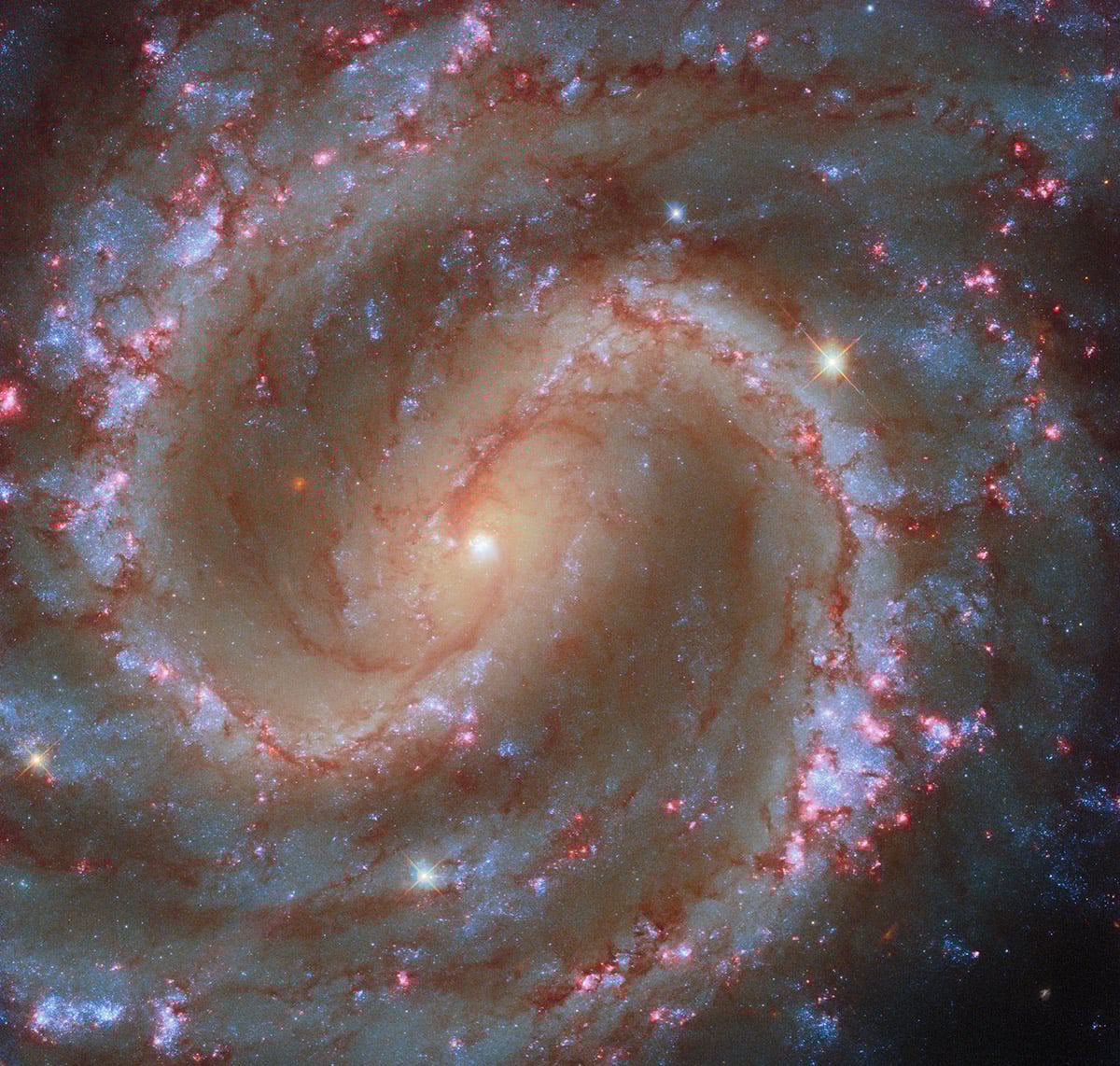
NGC 4535 has carried the nickname “Lost Galaxy” for decades. Amateur observers gave it that name because the galaxy looks faint and soft through small backyard telescopes. It hides in the Virgo Cluster and often appears as a pale blur under imperfect skies. Hubble’s new image changes that impression. It reveals a bright and structured spiral filled with young stars, glowing clouds, and a central bar that shapes the galaxy’s motion.
A galaxy that no longer looks lost
NGC 4535 sits about fifty million light-years away in Virgo. From Earth, it is large enough to detect through small telescopes, but its surface brightness is low. Many amateur astronomers see only a faint patch of light. Its spiral arms rarely show up clearly. That faintness inspired the “Lost Galaxy” label.
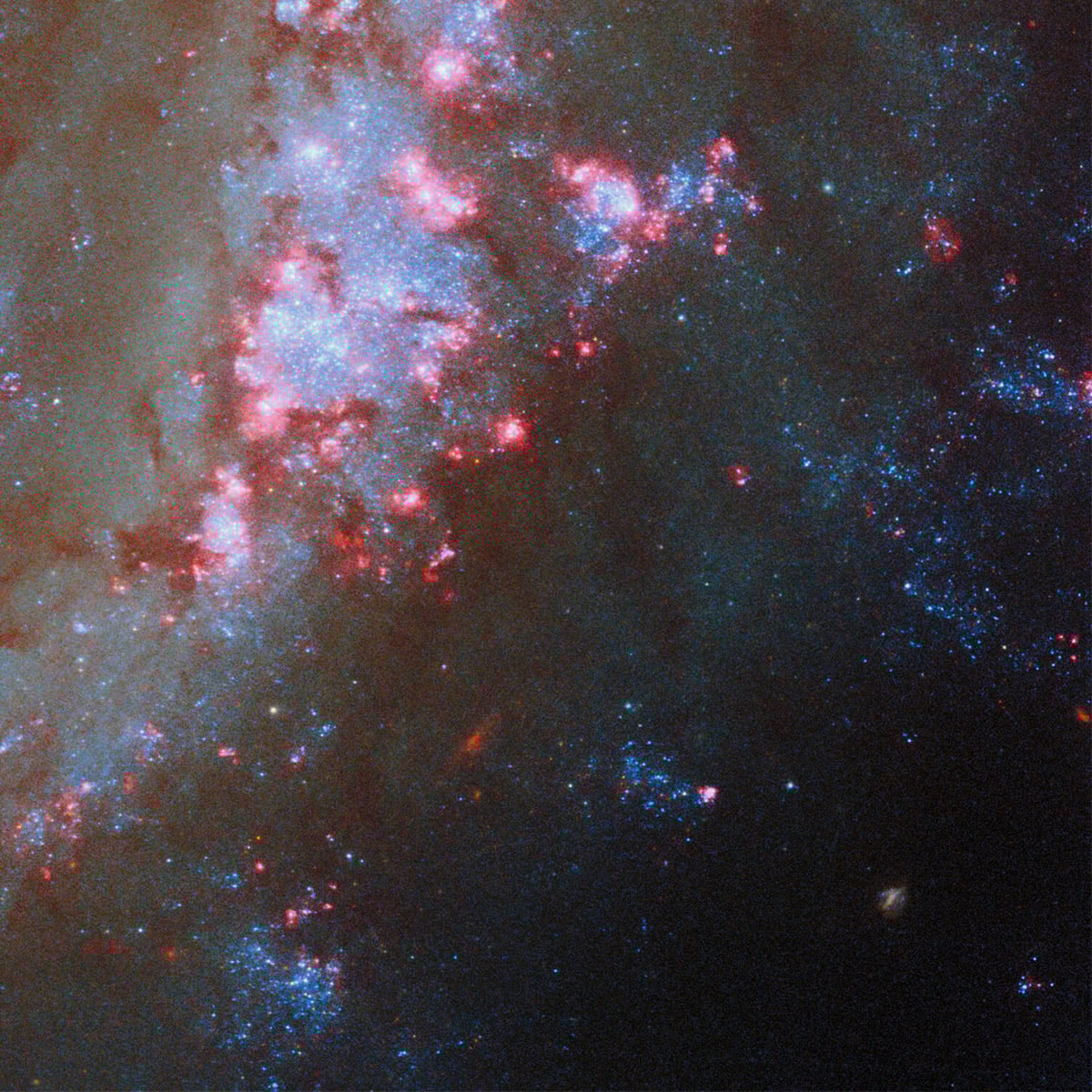
Hubble does not struggle with the same limitations. Its 2.4-meter mirror and position above Earth’s atmosphere remove most of the blurring that affects ground images. When Hubble observes a galaxy like NGC 4535, fine structure appears in the image. Dust lanes trace smooth arcs. Blue clusters stand out along the spiral arms. Red regions reveal clouds heated by young stars. Every part of the galaxy becomes easier to interpret.
The colours in the galaxy
Hubble does not take colour photographs. Instead, it uses filters that capture light from specific wavelengths. Scientists combine these exposures into a colour image that highlights real physical features.
- The bright blue patches are young star clusters. These clusters contain hot, massive stars that shine strongly in blue and ultraviolet light. Their brightness makes them stand out even at large distances.
- The soft pink regions represent H II regions. These are clouds of hydrogen gas ionised by strong ultraviolet radiation from young stars. When the ionised gas recombines, it emits light in a characteristic red tone, especially in the H-alpha line. Hubble captured this image using a filter centered near 657 nanometers, which isolates emission from hydrogen and nitrogen.
- The yellowish glow near the central bar contains older stars. These stars have cooled and aged and no longer emit strong ultraviolet light. Their presence marks the settled core of the galaxy.
These colours give a detailed map of stellar activity. They show where stars form, where they have matured, and where the gas that fuels future star formation resides.

The rich network of young star clusters
One of the strongest features of this Hubble image is the number of compact star clusters. They line the spiral arms like bright beads. Each cluster contains thousands of stars. Many of these stars are hot and massive. They live fast and die early, often exploding as supernovae within a few million years.
These clusters help astronomers understand how star formation works on local scales. By identifying clusters of different ages, researchers can track how long star-forming regions remain active. They can also study how feedback from young stars shapes nearby gas. In many galaxies, star clusters and H II regions appear together, but Hubble’s resolution makes it easier to separate them and analyse each environment.
NGC 4535 offers an example of this relationship. The blue clusters often sit inside or next to red ionised clouds. This pattern reveals a typical cycle: gas collapses to form young stars; those stars light up and ionise the surrounding material; then radiation and winds clear out the region. This cycle repeats along the arms, producing a series of bright patches that trace the path of star formation around the galaxy.
A larger scientific effort
The new image is not a one-off observation. It forms part of a broader program called PHANGS, short for Physics at High Angular resolution in Nearby GalaxieS. PHANGS uses Hubble and several other observatories to study nearby spiral galaxies. The goal is to connect different stages of the star-formation process.
Hubble’s role is to identify young clusters and compact structures with fine detail. Other telescopes, such as ALMA, supply maps of cold gas, the raw fuel for star formation. Infrared telescopes show warm dust and embedded stars that optical images may miss. By linking all these datasets, scientists can follow gas clouds from their earliest phases to their final stages.

NGC 4535 is ideal for this work. Its structure is well-defined, and it lies close enough for Hubble to resolve star clusters at useful scales. The galaxy also belongs to the Virgo Cluster, which provides context for how galaxies behave within larger systems. The shape and distribution of the galaxy help astronomers understand how barred spirals evolve. While NGC 4535 may not look special from the ground, Hubble’s view makes its internal structure clear and scientifically valuable.
Clear skies!
See more from DIYPhotography.net on Google
Add DIYPhotography.net as a trusted source. This makes
our stories more likely to appear in your Google Search results.
 Add as a preferred source on Google

Soumyadeep Mukherjee
Soumyadeep Mukherjee is an award-winning astrophotographer from India. He has a doctorate degree in Linguistics. His work extends to the sub-genres of nightscape, deep sky, solar, lunar and optical phenomenon photography. He is also a photography educator and has conducted numerous workshops. His works have appeared in over 40 books & magazines including Astronomy, BBC Sky at Night, Sky & Telescope among others, and in various websites including National Geographic, NASA, Forbes. He was the first Indian to win “Astronomy Photographer of the Year” award in a major category.


Join the Discussion
DIYP Comment Policy
Be nice, be on-topic, no personal information or flames.