
























Six telescopes in one: Askar V Modular Telescope
Jun 9, 2025
Soumyadeep Mukherjee
Soumyadeep Mukherjee is an award-winning astrophotographer from India. He has a doctorate degree in Linguistics. His work extends to the sub-genres of nightscape, deep sky, solar, lunar and optical phenomenon photography. He is also a photography educator and has conducted numerous workshops. His works have appeared in over 40 books & magazines including Astronomy, BBC Sky at Night, Sky & Telescope among others, and in various websites including National Geographic, NASA, Forbes. He was the first Indian to win “Astronomy Photographer of the Year” award in a major category.
Share:

Astronomy has entered a golden age of design. It blends art, science, and precision. The Askar V refractor telescope stands at the frontier of that innovation. It offers flexibility, quality, and ease of use. All packed in a sleek, portable tube.
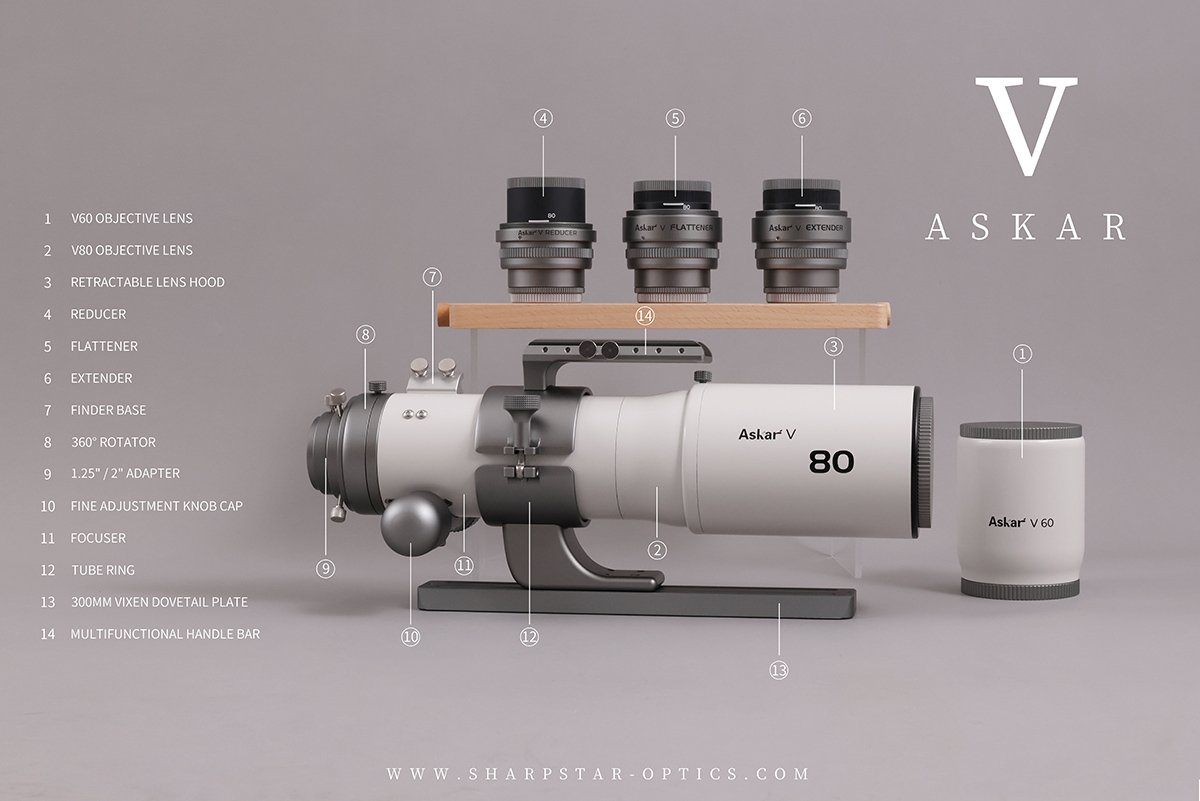
A two‑lens system in one tube
The Askar V includes two objective lenses in a single package:
- A 60 mm triplet APO lens (air-spaced, two ED glasses).
- An 80 mm triplet APO lens (also with two ED glasses).
These lenses screw on quickly. They create six main focal settings when used with accessories (reducer, flattener, extender). They allow you to switch between wide views and detailed shots quickly. Later, we’ll map the focal values. Each lens is a triplet apochromat. Each uses two ED glasses. This design lowers chromatic aberration dramatically. It enhances sharpness and color clarity. You get crisp stars and clean nebula edges.
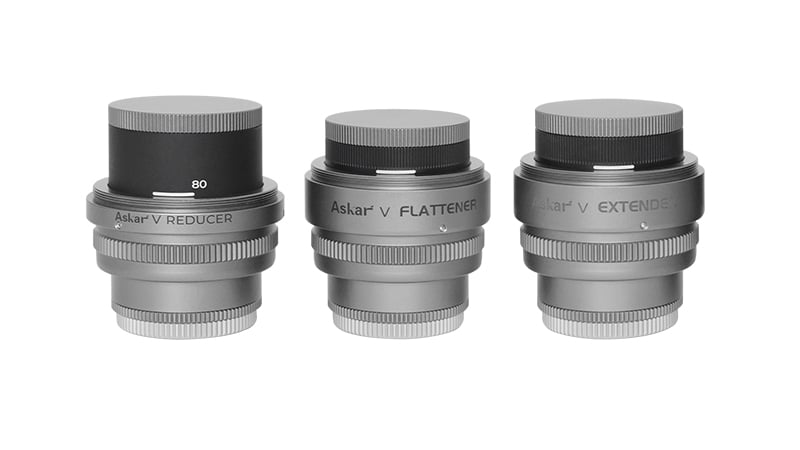
Accessory trio: Reducer, Flattener, Extender
The Askar V includes three optical accessories:
V Reducer
- With 60 mm lens: 270 mm focal length, f/4.5.
- With 80 mm lens: 384 mm focal length, f/4.8.
It brightens the view, shortens exposures, and expands the field, ideal for galaxy clusters and nebulae.
V Flattener
- With 60 mm lens: still 360 mm at f/6.
- With 80 mm lens: 495 mm at f/6.18.
It flattens field curvature and sharpens stars across the full image. It’s a must for full-frame sensors.
V Extender
- With 60 mm lens: 446 mm at f/7.43.
- With 80 mm lens: 600 mm at f/7.5.
It boosts reach. It enhances details in planetary and planetary nebula captures.
Each accessory carries M48/M54 adapters and a standard 55 mm backfocus. They rotate a scale to match the lens size.
Six imaging modes in one setup
Thanks to dual lenses and accessories, Askar V acts as six distinct telescopes:
| Lens | Native | Reducer | Flattener | Extender |
| 60mm | 360 mm f/6 | 270 mm f/4.5 | 360 mm f/6 | 446 mm f/7.43 |
| 80mm | 500 mm f/6.25 | 384 mm f/4.8 | 495 mm f/6.18 | 600 mm f/7.5 |
This range covers wide-field, mid-range, and tight targets with a single device.
Key specifications
V60 Mode (60 mm lens)
- Aperture: 60 mm, triplet APO w/ 2 ED glasses
- Focal length: 360 mm, f/6 native
- Backfocus: 150 mm to 2″ adapter
- Tube length: 318.5 mm (without accessories)
- Weight: 2.8 kg incl. rings & dovetail
- Rear adapters: 2″, 1.25″
V80 Mode (80 mm lens)
- Aperture: 80 mm, triplet APO w/ 2 ED glasses
- Focal length: 500 mm, f/6.25 native
- Backfocus: 139.7 mm to 2″ adapter
- Tube length: 411 mm (retracted), 479 mm (extended)
- Weight: 3.4 kg incl. rings & dovetail
- Rear adapters: 2″, 1.25″
Accessory Weights
- Reducer: 0.44 kg
- Flattener: 0.48 kg
- Extender: 0.46 kg
Who should get it?
- Beginners: Get multiple setups in a single purchase.
- Intermediate and advanced users: One carryable tube can handle many targets.
- Casual star gazers: Visual modes are ready with just eyepieces.
- Astrophotographers: This is a cost-effective all-in-one astro kit.
Price and availability
The Askar V modular telescope is available via the official website for $1,865.
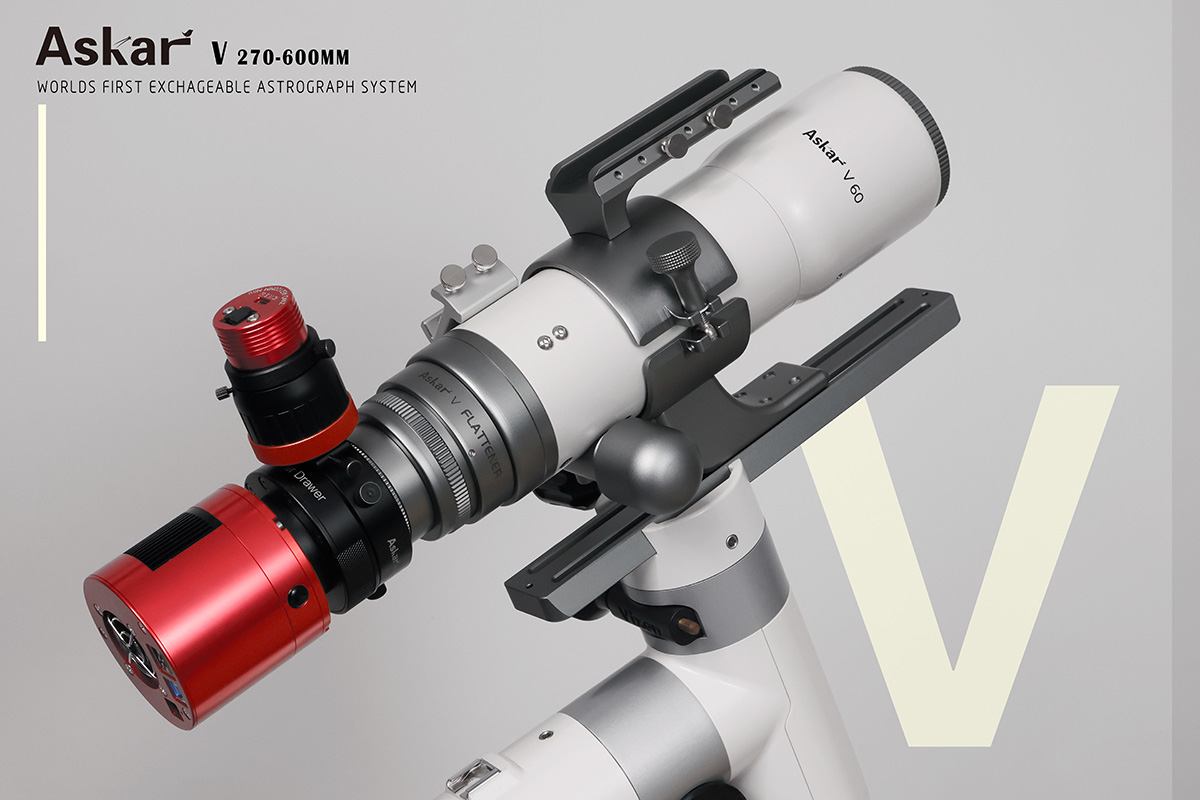
The Askar V blends optics, mechanics, and elegance. It meets the needs of many users. Askar V offers six optical paths and flexible use in one compact package. It lets you chase wide fields one night, switch to planetary detail the next. And it looks sharp doing it. If your goal is versatility, clarity, and portability, Askar V delivers. It stands out as a modern, well-balanced refractor. The telescope suits beginners and veterans alike. It is a true six‑in‑one refractor.
Clear skies!
See more from DIYPhotography.net on Google
Add DIYPhotography.net as a trusted source. This makes
our stories more likely to appear in your Google Search results.
 Add as a preferred source on Google

Soumyadeep Mukherjee
Soumyadeep Mukherjee is an award-winning astrophotographer from India. He has a doctorate degree in Linguistics. His work extends to the sub-genres of nightscape, deep sky, solar, lunar and optical phenomenon photography. He is also a photography educator and has conducted numerous workshops. His works have appeared in over 40 books & magazines including Astronomy, BBC Sky at Night, Sky & Telescope among others, and in various websites including National Geographic, NASA, Forbes. He was the first Indian to win “Astronomy Photographer of the Year” award in a major category.



Join the Discussion
DIYP Comment Policy
Be nice, be on-topic, no personal information or flames.