























Hubble Photographs a Faint Dwarf Irregular Galaxy ESO 490-017
May 28, 2026
Soumyadeep Mukherjee
Soumyadeep Mukherjee is an award-winning astrophotographer from India. He has a doctorate degree in Linguistics. His work extends to the sub-genres of nightscape, deep sky, solar, lunar and optical phenomenon photography. He is also a photography educator and has conducted numerous workshops. His works have appeared in over 40 books & magazines including Astronomy, BBC Sky at Night, Sky & Telescope among others, and in various websites including National Geographic, NASA, Forbes. He was the first Indian to win “Astronomy Photographer of the Year” award in a major category.
Share:
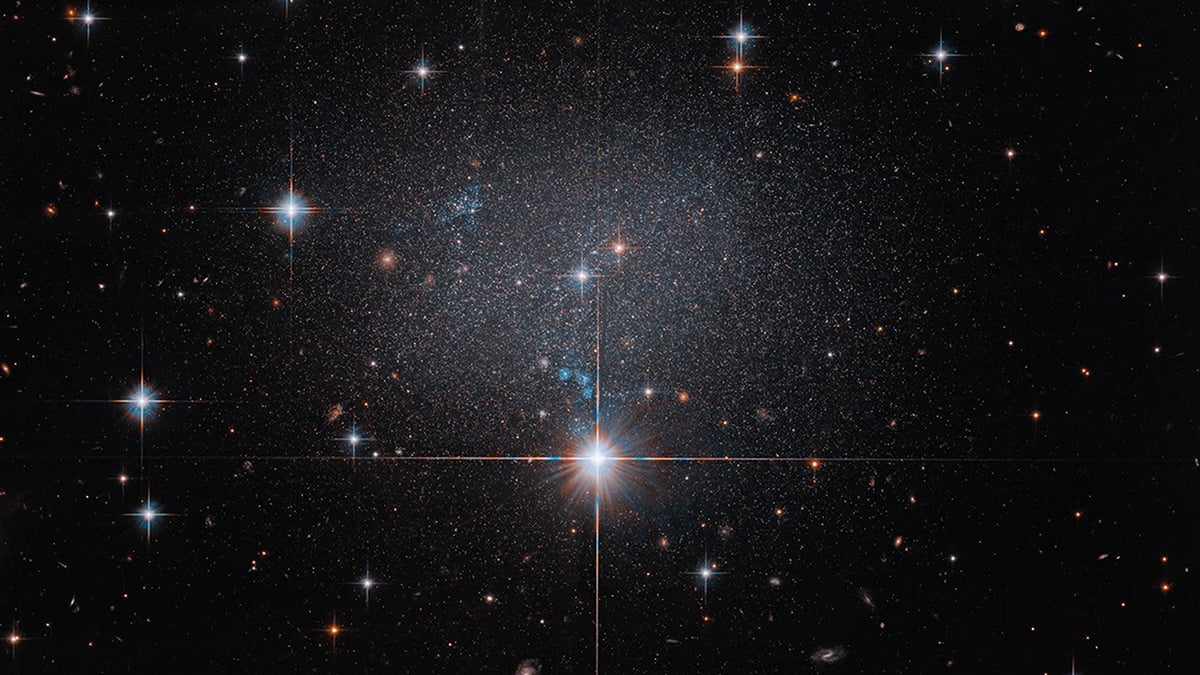
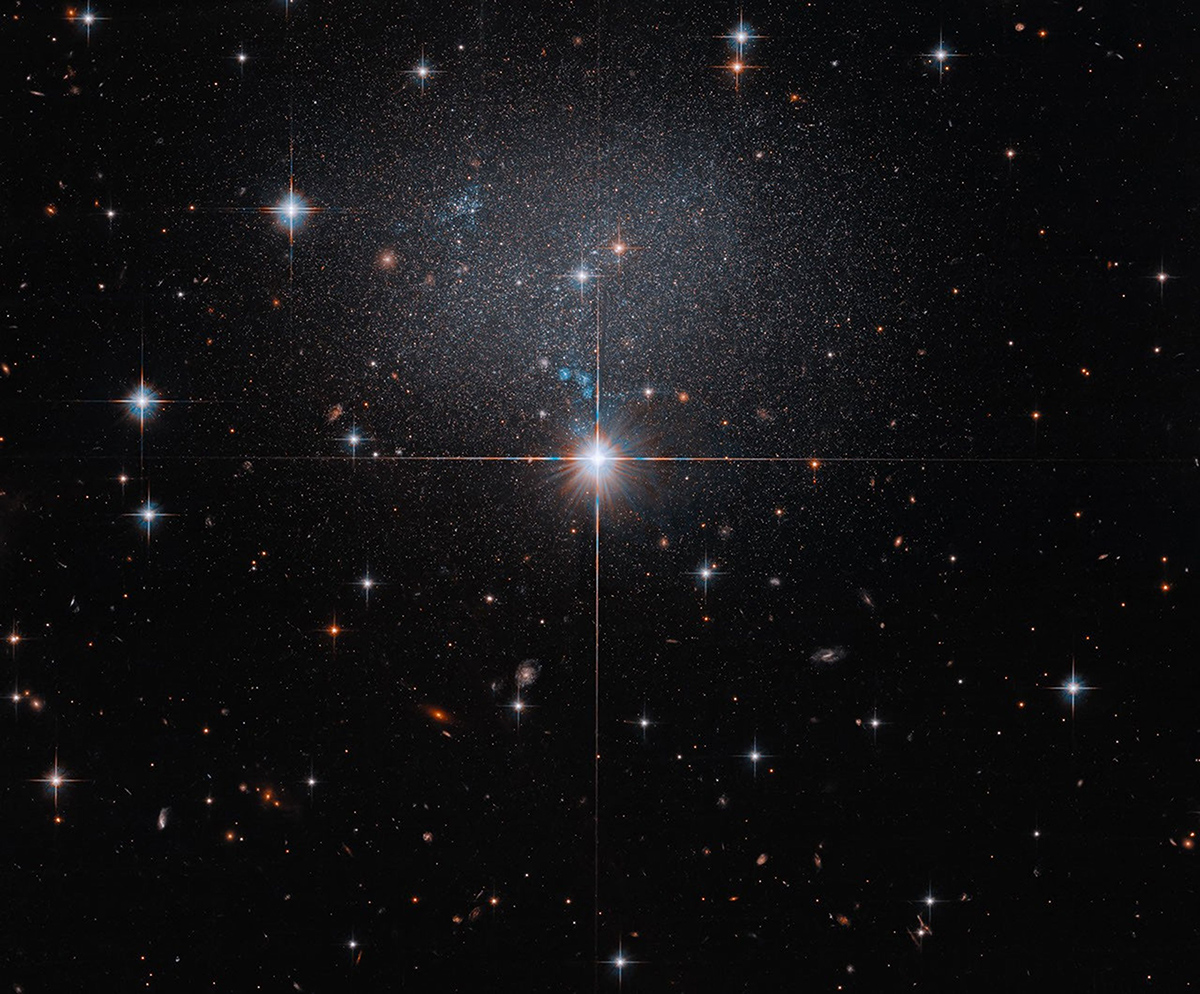
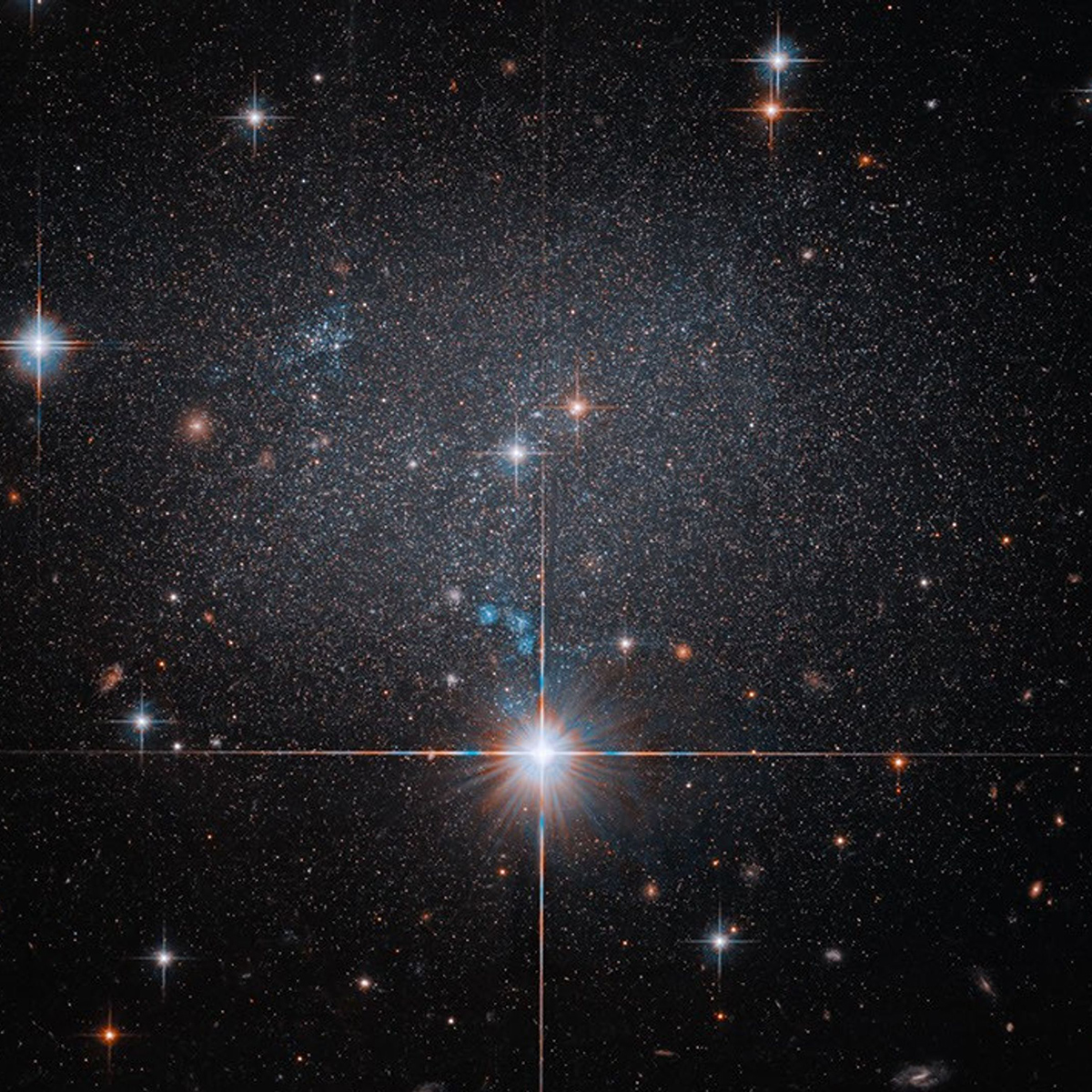
In a recent observation, the Hubble Space Telescope has captured ESO 490-017, a faint dwarf irregular galaxy located nearly 23 million light-years away in the constellation Canis Major. NASA recently released the observation as part of an ongoing effort to study nearby galaxies and refine distance measurements across the local universe. The galaxy appears diffuse and structurally disordered. Hubble resolved individual stellar populations across the galaxy, allowing astronomers to examine its composition, star formation history, and distance with high precision.
ESO 490-017 spans approximately 12,000 light-years, making it significantly smaller than large spiral systems, such as the Milky Way. Unlike spiral galaxies, however, this object lacks an organized structure, a central bulge, or a stable disk. Its stars appear unevenly distributed across a patchy and irregular field. This fragmented appearance shows the physical conditions inside low-mass galaxies, where weaker gravity allows turbulence and stellar feedback to reshape the system over time.
ESO 490-017: A diffuse galaxy with low surface brightness
One of the most striking aspects of ESO 490-017 is its extremely faint appearance. The galaxy barely separates itself from the surrounding background sky. Instead of forming a bright and concentrated structure, the galaxy appears as a loose scattering of stars distributed unevenly across space.
This appearance results from the galaxy’s very low surface brightness. Although ESO 490-017 contains millions of stars, those stars are spread across a broad area rather than concentrated into dense regions. Consequently, the galaxy emits relatively little light per unit area, making it difficult to detect and study from Earth.
Many dwarf galaxies share similar characteristics. Their low mass prevents gravity from compressing stars and gas into stable large-scale structures. As a result, these systems often appear irregular, fragmented, and diffuse. In some cases, astronomers discover faint dwarf galaxies only after conducting deep imaging surveys with sensitive instruments.
Dwarf Irregular Galaxies: Clues about early galactic evolution
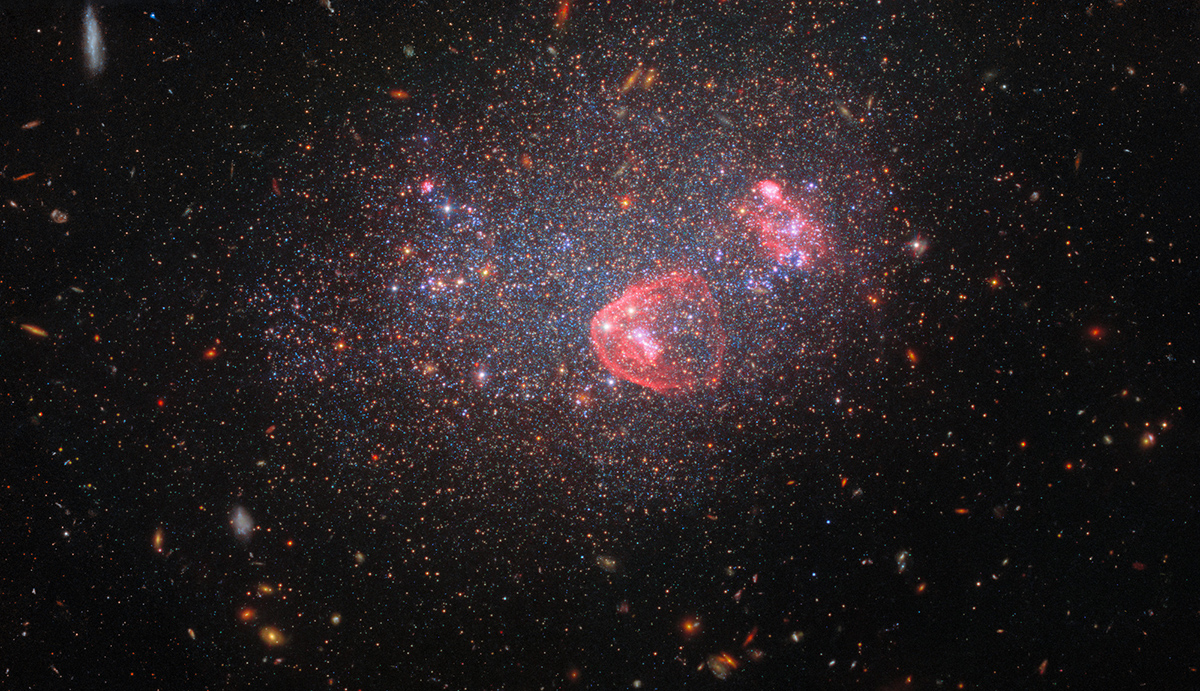
Although dwarf irregular galaxies appear visually simple, astronomers consider them extremely important for understanding cosmic evolution. These galaxies contain fewer stars, less mass, and lower concentrations of heavy elements than large spiral galaxies. Because of those conditions, they preserve environments that resemble earlier stages of galactic evolution.
Astronomers refer to all elements heavier than hydrogen and helium as metals. Massive stars create those heavier elements through nuclear fusion and later distribute them into space during supernova explosions. Over billions of years, repeated generations of star formation gradually enrich galaxies with heavier material.
Large galaxies such as the Milky Way have undergone extensive chemical evolution across cosmic time. Dwarf irregular galaxies, however, often remain less chemically enriched. Consequently, astronomers use them to study physical conditions similar to those present in the early universe.
ESO 490-017 offers a useful example of this process. Its irregular structure and scattered star-forming regions reflect the unstable conditions commonly found inside low-mass systems. Since the galaxy possesses weaker gravity, energetic processes such as stellar winds and supernova explosions can disrupt large portions of the galaxy quite easily.
Using red giant stars to calculate the galaxy’s distance
The recent Hubble observation also collected scientific data needed for distance measurements. Determining galactic distances remains one of astronomy’s most important challenges because many larger cosmological calculations depend on accurate distance estimates.
Astronomers cannot measure these distances directly. They rely on indirect techniques involving objects with known physical properties. In ESO 490-017, researchers focused on red giant stars using a method called the Tip of the Red Giant Branch technique, commonly abbreviated as TRGB.
Red giant stars represent a late stage in stellar evolution. After exhausting hydrogen fuel in their cores, stars expand significantly and become much brighter. Near the end of this phase, red giant stars reach a predictable peak luminosity before undergoing additional internal changes.
Astronomers use that predictable brightness as a standard reference point. By comparing the stars’ intrinsic brightness with their observed brightness from Earth, scientists can determine how far away the galaxy lies.
Clear skies!
See more from DIYPhotography.net on Google
Add DIYPhotography.net as a trusted source. This makes
our stories more likely to appear in your Google Search results.
 Add as a preferred source on Google

Soumyadeep Mukherjee
Soumyadeep Mukherjee is an award-winning astrophotographer from India. He has a doctorate degree in Linguistics. His work extends to the sub-genres of nightscape, deep sky, solar, lunar and optical phenomenon photography. He is also a photography educator and has conducted numerous workshops. His works have appeared in over 40 books & magazines including Astronomy, BBC Sky at Night, Sky & Telescope among others, and in various websites including National Geographic, NASA, Forbes. He was the first Indian to win “Astronomy Photographer of the Year” award in a major category.


Join the Discussion
DIYP Comment Policy
Be nice, be on-topic, no personal information or flames.