



















Cosmic Ballet of ARP 269: JWST Photographs Two Dancing Dwarf Galaxies
Dec 3, 2025
Soumyadeep Mukherjee
Soumyadeep Mukherjee is an award-winning astrophotographer from India. He has a doctorate degree in Linguistics. His work extends to the sub-genres of nightscape, deep sky, solar, lunar and optical phenomenon photography. He is also a photography educator and has conducted numerous workshops. His works have appeared in over 40 books & magazines including Astronomy, BBC Sky at Night, Sky & Telescope among others, and in various websites including National Geographic, NASA, Forbes. He was the first Indian to win “Astronomy Photographer of the Year” award in a major category.
Share:
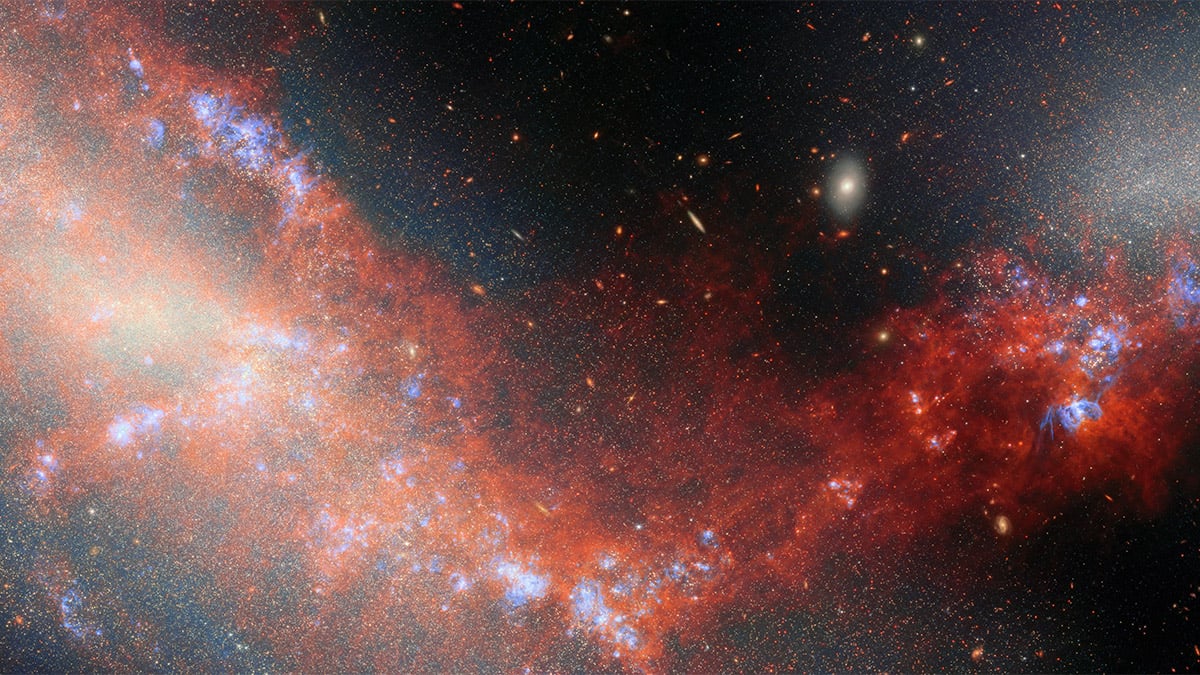
The James Webb Space Telescope has released its December 2025 Picture of the Month. The target was a pair of nearby dwarf galaxies, NGC 4490 and NGC 4485, captured in a way that no earlier telescope could manage. JWST revealed a fully resolved view of the system known as Arp 269, complete with a red, glowing tidal bridge and sharp detail across both galaxies.
The two galaxies are located approximately 24 million light-years away. They are small by galactic standards and would not attract much public attention on their own. Together, however, they form one of the closest and clearest examples of a dwarf-dwarf interaction. JWST’s infrared sensitivity exposes warm dust, star-forming knots, and individual stellar populations that earlier telescopes only hinted at. For astronomers, this image is not just visually striking. It is a dataset that traces the flow of gas, the timing of star formation, and the structural effects of gravitational encounters.
A pair with an unusual history
Arp 269 has been familiar to astronomers for decades. NGC 4490, the larger galaxy, is known as the “Cocoon Galaxy” due to its thick, warped envelope of dust that surrounds it. NGC 4485 is smaller and irregular, its structure disturbed by gravitational tides. Observations with ground-based telescopes and Hubble confirmed that the two galaxies interacted in the past, but their internal structure remained obscured. Dust blocked key regions, and the faint bridge between them was only visible as a diffuse blur.
The distance of roughly 7.4 megaparsecs makes this system close enough for high-resolution study, but until JWST, no telescope could reach deep into the dust lanes. Its NIRCam instrument resolves individual stars even in heavily obscured regions, and MIRI highlights warm dust and organic molecules that glow in the mid-infrared. This combination produces a layered view of the system: stars, ionised gas, dust, shocked regions, and tidal debris.

A bridge lit by dust and young stars
In JWST’s new image, NGC 4490 occupies the left half of the frame with sprawling, distorted arms. NGC 4485 sits at the upper right. The most striking feature lies between them, a red bridge that curves across tens of thousands of light-years. MIRI reveals this bridge as a mix of warm dust, complex hydrocarbons, and dense gas. These materials emit strongly in the mid-infrared, giving the structure its deep red glow.
Embedded across the bridge are clusters of bright points. These are star-forming regions populated by young, massive stars. Their radiation carves cavities in the surrounding gas and lights the areas in blue-white tones in NIRCam wavelengths. In earlier observations, these regions merged into a faint haze. JWST resolves them into individual clusters and, in some areas, into individual stars.
This level of detail allows astronomers to trace how material moved between the galaxies. Streamers of gas extend from NGC 4485 toward NGC 4490, and dust lanes curve in patterns consistent with a gravitational encounter that took place several hundred million years ago.

Reconstructing the interaction through stellar populations
To understand the sequence of events, researchers built color-magnitude diagrams (CMDs) from the JWST data. CMDs sort stars by brightness and color and reveal their ages. In Arp 269, the diagrams show a wide range of ages within both galaxies and the bridge. Some stars are older than a billion years. Many belong to intermediate-age populations. But the interaction triggered two major surges in star formation.
The first surge occurred around 200 million years ago when the galaxies made a close pass. The gravitational pull disturbed the gas in both galaxies and stripped material from NGC 4485. This gas moved toward NGC 4490 and created turbulent pockets that collapsed into new stars. Many of the young clusters visible today trace back to this encounter.
A second burst began about 30 million years ago. By then, the stripped gas had mixed with the gas reservoir inside NGC 4490. The combined material cooled, compressed, and produced another round of cluster formation. JWST’s resolution highlights this younger generation along the bridge and within the distorted spiral structure of NGC 4490.
Researchers also identified metallicity differences between stars in the bridge and stars in the main bodies of the galaxies. Metal-poor stars in the bridge match the expected composition of gas originally from the smaller galaxy. This supports the view that the interaction distorted the pair and it redistributed their material.
Inside the FEAST program
The new image is part of the FEAST program: “Feedback in Emerging extrAgalactic Star clusTers.” This initiative uses JWST to investigate how young star clusters form, survive, and influence their host galaxies. Arp 269 is a central target because it contains clusters at multiple evolutionary stages, from newly formed groups to older, more stable populations.
The program focuses on feedback, the energy and momentum released by young stars through winds, radiation, and supernovae. These forces can compress nearby gas, trigger more star formation, or disrupt clouds and halt future growth. Arp 269’s bridge, with its mix of young clusters and dusty filaments, provides a clean environment to measure these effects.
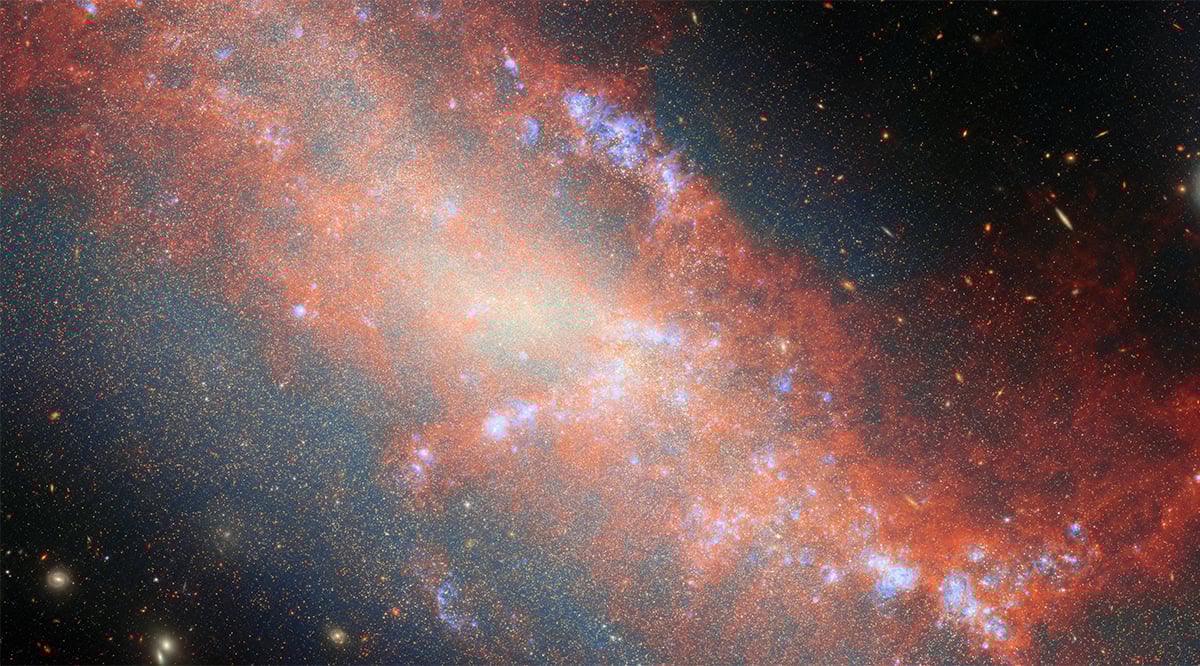
Researchers will compare the bridge clusters with those inside NGC 4490 and NGC 4485. This helps determine how tidal environments shape cluster survival. It also reveals whether clusters formed in low-metallicity tidal debris evolve differently from clusters inside galaxy disks.
Arp 269 is still evolving. Models suggest that the two galaxies will eventually merge into a single system. This will not happen quickly. The process may take a few hundred million years, but JWST’s data provide a baseline for tracking the system’s long-term evolution.

Clear skies!
See more from DIYPhotography.net on Google
Add DIYPhotography.net as a trusted source. This makes
our stories more likely to appear in your Google Search results.
 Add as a preferred source on Google

Soumyadeep Mukherjee
Soumyadeep Mukherjee is an award-winning astrophotographer from India. He has a doctorate degree in Linguistics. His work extends to the sub-genres of nightscape, deep sky, solar, lunar and optical phenomenon photography. He is also a photography educator and has conducted numerous workshops. His works have appeared in over 40 books & magazines including Astronomy, BBC Sky at Night, Sky & Telescope among others, and in various websites including National Geographic, NASA, Forbes. He was the first Indian to win “Astronomy Photographer of the Year” award in a major category.


Join the Discussion
DIYP Comment Policy
Be nice, be on-topic, no personal information or flames.