























JWST’s New Image Unveils the “Heart of the Butterfly”
Aug 27, 2025
Soumyadeep Mukherjee
Soumyadeep Mukherjee is an award-winning astrophotographer from India. He has a doctorate degree in Linguistics. His work extends to the sub-genres of nightscape, deep sky, solar, lunar and optical phenomenon photography. He is also a photography educator and has conducted numerous workshops. His works have appeared in over 40 books & magazines including Astronomy, BBC Sky at Night, Sky & Telescope among others, and in various websites including National Geographic, NASA, Forbes. He was the first Indian to win “Astronomy Photographer of the Year” award in a major category.
Share:
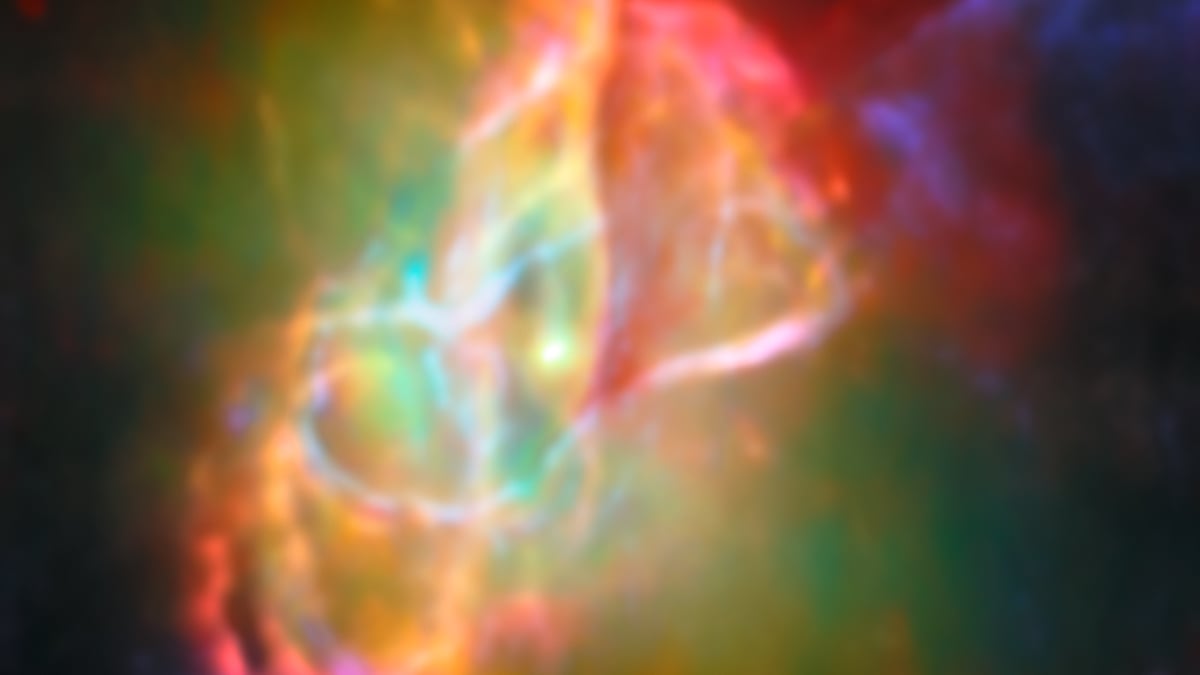
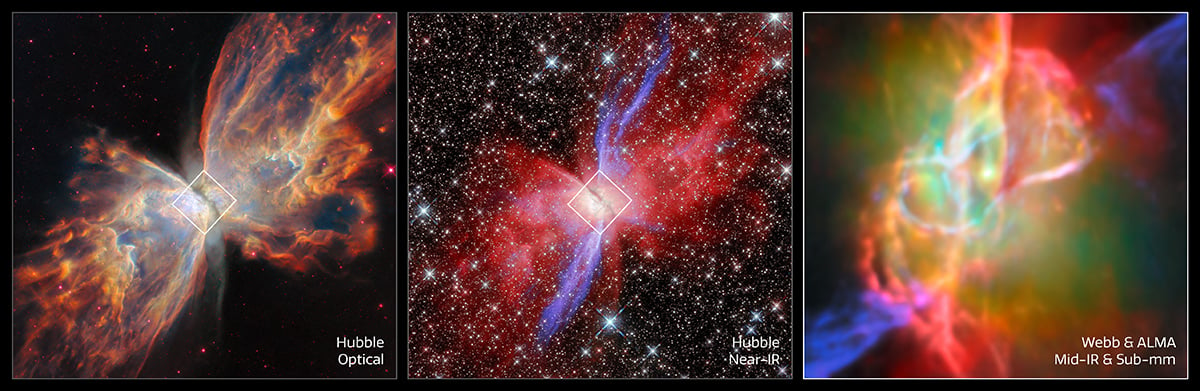
The James Webb Space Telescope (JWST) has delivered its sharpest view of one of the most striking planetary nebulae in our galaxy, the Butterfly Nebula (NGC 6302). Located approximately 3,400 light-years away in the constellation Scorpius, this object has long fascinated astronomers due to its dramatic, wing-like shape. Earlier telescopes had revealed glowing lobes of gas and dust streaming away from the nebula’s center, but the heart of this cosmic structure remained hidden. Now, JWST’s Mid-Infrared Instrument (MIRI) has pierced the obscuring dust and revealed details that were previously out of reach.
The dusty torus that shapes the wings
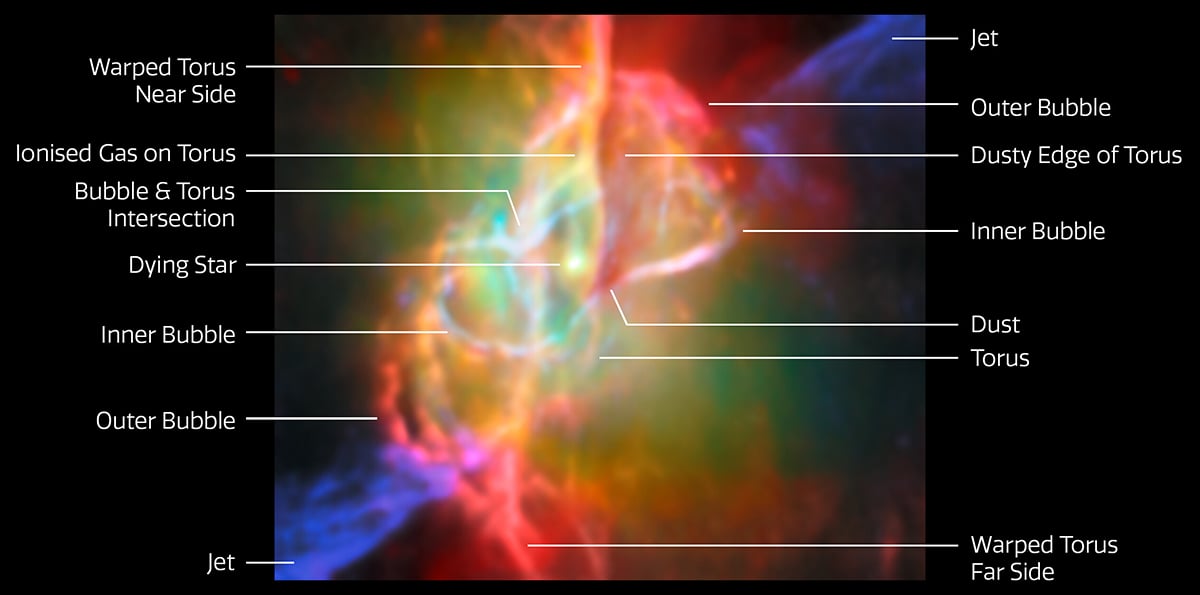
The iconic butterfly shape of NGC 6302 does not come from mere symmetry. JWST’s images show that the gas ejected by the star does not escape evenly in all directions. A thick, doughnut-shaped band of dust, known as a torus, surrounds the central star. This structure blocks the flow of material along the equatorial plane, forcing gas to escape more freely along the poles. The result is two vast, curved lobes that give the nebula its distinctive form.
JWST’s data reveal the composition of this dust in remarkable detail. The torus contains crystalline silicates, including structures similar to quartz. These crystals appear alongside irregular, amorphous grains. Some of the dust particles are surprisingly large, measuring up to a millionth of a meter across, which is considerable by cosmic standards. Such grains are thought to play an important role in seeding new planetary systems when they are recycled into future generations of stars.

A laboratory of complex chemistry
JWST’s MIRI instrument carries an integral field spectrograph that allows astronomers to record the chemical fingerprints of different regions across the nebula. By separating light into its component wavelengths, scientists can identify the atoms, ions, and molecules present. In the case of the Butterfly Nebula, MIRI detected almost 200 distinct spectral lines.
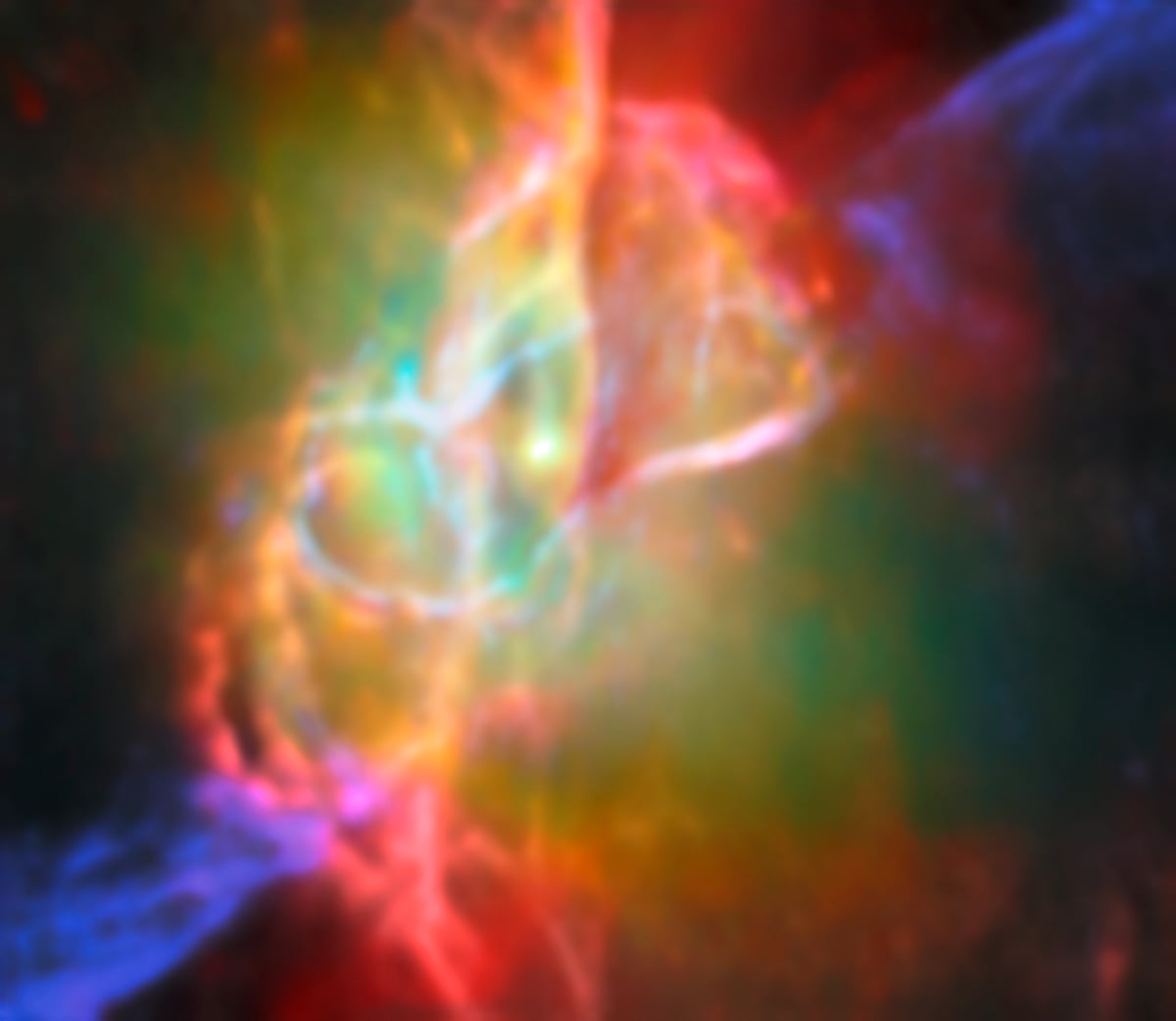
These data reveal a layered structure of different chemical species. High-energy ions are concentrated closer to the star, where radiation is most intense. Further out, cooler regions harbor molecules that would not survive in harsher conditions. This stratification creates a rich tapestry of environments within a relatively small region of space.
One of the most surprising results was the detection of polycyclic aromatic hydrocarbons (PAHs). These are carbon-based molecules often associated with soot. They are typically found in environments with abundant carbon, yet the Butterfly Nebula is known to be oxygen-rich. The discovery of PAHs here suggests that unexpected chemical reactions are taking place. Researchers propose that the molecules may form when stellar winds break through surrounding shells of gas, triggering shocks and rapid cooling that allow carbon chains to assemble.

The fleeting stage of a planetary nebula
Planetary nebulae like NGC 6302 represent a brief but important stage in the life cycle of stars with masses similar to the Sun. After exhausting nuclear fuel in their cores, such stars swell into red giants and begin shedding their outer layers. When the core contracts and heats up, it produces ultraviolet radiation that illuminates the expelled material, creating glowing clouds of gas and dust.
This phase lasts only about 10,000 to 20,000 years, a short span compared with the billions of years these stars spend on the main sequence. For the Butterfly Nebula, this means the striking wings we see today will not endure. Over time, the material will disperse into the interstellar medium, enriching it with heavy elements and dust grains that may later form new stars and planets.
A preview of the Sun’s distant future
Although the Butterfly Nebula is far away, it offers a glimpse into the eventual fate of our own Solar System. In about five billion years, the Sun will run out of hydrogen fuel and begin a similar transformation. It will swell into a red giant, shed its outer layers, and leave behind a hot core that contracts into a white dwarf. The ejected material may form a nebula resembling NGC 6302, though the precise shape will depend on factors such as rotation, magnetic fields, and possible interactions with planets.
Clear skies!
See more from DIYPhotography.net on Google
Add DIYPhotography.net as a trusted source. This makes
our stories more likely to appear in your Google Search results.
 Add as a preferred source on Google

Soumyadeep Mukherjee
Soumyadeep Mukherjee is an award-winning astrophotographer from India. He has a doctorate degree in Linguistics. His work extends to the sub-genres of nightscape, deep sky, solar, lunar and optical phenomenon photography. He is also a photography educator and has conducted numerous workshops. His works have appeared in over 40 books & magazines including Astronomy, BBC Sky at Night, Sky & Telescope among others, and in various websites including National Geographic, NASA, Forbes. He was the first Indian to win “Astronomy Photographer of the Year” award in a major category.



Join the Discussion
DIYP Comment Policy
Be nice, be on-topic, no personal information or flames.