

























DKIST Captures the Sharpest Ever View of a Solar Flare
Aug 25, 2025
Soumyadeep Mukherjee
Soumyadeep Mukherjee is an award-winning astrophotographer from India. He has a doctorate degree in Linguistics. His work extends to the sub-genres of nightscape, deep sky, solar, lunar and optical phenomenon photography. He is also a photography educator and has conducted numerous workshops. His works have appeared in over 40 books & magazines including Astronomy, BBC Sky at Night, Sky & Telescope among others, and in various websites including National Geographic, NASA, Forbes. He was the first Indian to win “Astronomy Photographer of the Year” award in a major category.
Share:
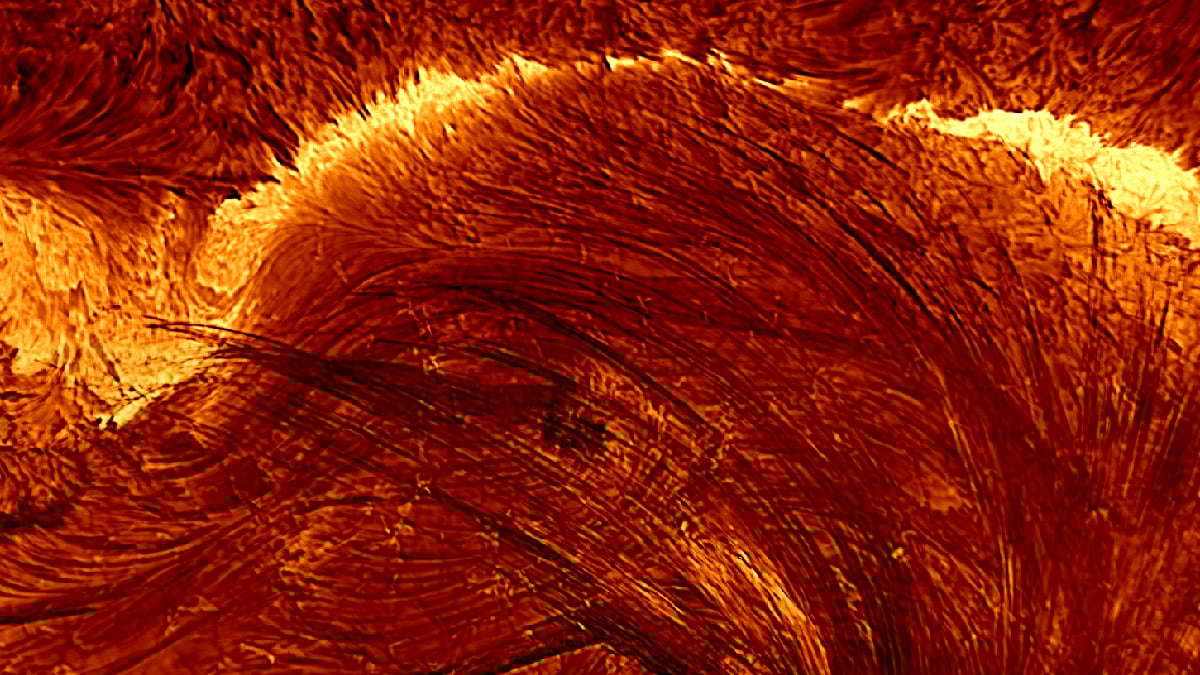
On 8 August 2024, astronomers pointed the Daniel K. Inouye Solar Telescope (DKIST) toward an eruptive event on the Sun. The four-metre telescope, located on the summit of Haleakalā in Maui, had been waiting for such an opportunity. When an X1.3-class solar flare broke out, DKIST caught the sharpest view of it. The images that followed set a new benchmark in solar physics. They revealed coronal loops so fine that their scale pushed against the theoretical limits of solar structure. It was the first time that scientists could measure such delicate features with direct imaging.
A telescope designed for fine detail
DKIST is the world’s largest solar telescope. Operated by the National Science Foundation’s National Solar Observatory, it began its first science observations in 2022. The telescope was designed to study the Sun at the highest possible resolution in visible and infrared light. Its four-metre aperture collects more light than any previous solar instrument, allowing sharp imaging down to scales of about 20 kilometres on the solar surface. For comparison, one kilometre on the Sun’s disk spans about 725 kilometres in real distance, as seen from Earth. Achieving 20-kilometre resolution means separating features thousands of times smaller than the apparent diameter of the Sun.
The telescope uses an off-axis optical design that reduces scattered light and thermal distortion. Its adaptive optics system corrects the blur caused by Earth’s atmosphere in real time. Without those corrections, even a large telescope would see the Sun through a constantly shifting veil. With adaptive optics, DKIST can approach its diffraction limit and deliver the crisp detail promised by its design. The instrument package includes the Visible Broadband Imager, which records high-cadence frames in several filters, including H-alpha at 656.28 nanometres. That wavelength is critical for watching flares and chromospheric dynamics.

The flare and its loops
The August 2024 flare was classified as X1.3, meaning it was among the strongest categories of solar flares. Such flares release vast amounts of energy and often produce bright post-flare arcades. These arcades are a series of coronal loops shaped by magnetic reconnection high above the surface. DKIST captured the arcade during the decay phase, when the hot plasma cooled and the loops became visible in H-alpha.
The images showed dark strands arcing across the bright background. By examining the sharpest frames, researchers could resolve the loops into individual strands. Measurements revealed an average loop width of about 48.2 kilometres. Some strands measured only 21 kilometres across, the narrowest ever recorded in coronal loops. The distribution of widths clustered tightly around 43 kilometres, suggesting the telescope was reaching the intrinsic scale of the structures. These were not artefacts of the optics. They were real features of the solar magnetic field.

Space weather implications
Solar flares and their associated coronal mass ejections are the drivers of space weather. They can release streams of charged particles that disturb satellites, disrupt radio communication, and induce currents in power grids. By resolving the fine structure of flare loops, DKIST offers new input for forecasting models. Knowing the scale of magnetic strands allows better representation of how flares evolve in simulations. Those models feed into prediction tools used by agencies that monitor space weather. The ultimate goal is to forecast flares and their impacts with greater accuracy and lead time. DKIST cannot predict a flare before it happens, but it can show the physics behind flare development more clearly than any other telescope. That knowledge, in turn, strengthens the predictive framework.

Future observations will expand the sample of flares studied with DKIST. The aim is to determine whether the 21- to 48-kilometre width range is common or whether it varies with flare strength and location. Larger datasets will also help determine how loop widths evolve within a single flare. These statistics will be critical for refining theoretical models. The Sun is our nearest star and the driver of space weather. Understanding it in detail is essential for both fundamental science and practical safety. The Inouye Solar Telescope has begun to provide that detail.
Clear skies!
See more from DIYPhotography.net on Google
Add DIYPhotography.net as a trusted source. This makes
our stories more likely to appear in your Google Search results.
 Add as a preferred source on Google

Soumyadeep Mukherjee
Soumyadeep Mukherjee is an award-winning astrophotographer from India. He has a doctorate degree in Linguistics. His work extends to the sub-genres of nightscape, deep sky, solar, lunar and optical phenomenon photography. He is also a photography educator and has conducted numerous workshops. His works have appeared in over 40 books & magazines including Astronomy, BBC Sky at Night, Sky & Telescope among others, and in various websites including National Geographic, NASA, Forbes. He was the first Indian to win “Astronomy Photographer of the Year” award in a major category.



Join the Discussion
DIYP Comment Policy
Be nice, be on-topic, no personal information or flames.
2 responses to “DKIST Captures the Sharpest Ever View of a Solar Flare”
I realise you gotta pay your bills, but the intrusive videos that pop-out from the side all the time are really putting me off visiting this site.
This is so incredibly gorgeous.