





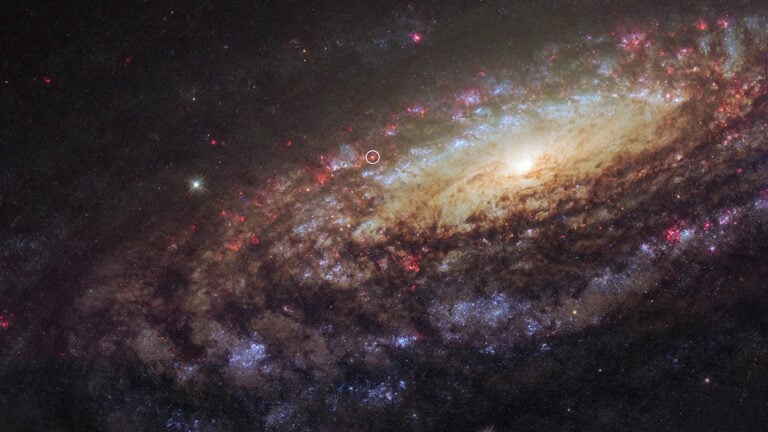














Surya: NASA and IBM’s new AI Model for Predicting Space Weather
Aug 20, 2025
Soumyadeep Mukherjee
Soumyadeep Mukherjee is an award-winning astrophotographer from India. He has a doctorate degree in Linguistics. His work extends to the sub-genres of nightscape, deep sky, solar, lunar and optical phenomenon photography. He is also a photography educator and has conducted numerous workshops. His works have appeared in over 40 books & magazines including Astronomy, BBC Sky at Night, Sky & Telescope among others, and in various websites including National Geographic, NASA, Forbes. He was the first Indian to win “Astronomy Photographer of the Year” award in a major category.
Share:

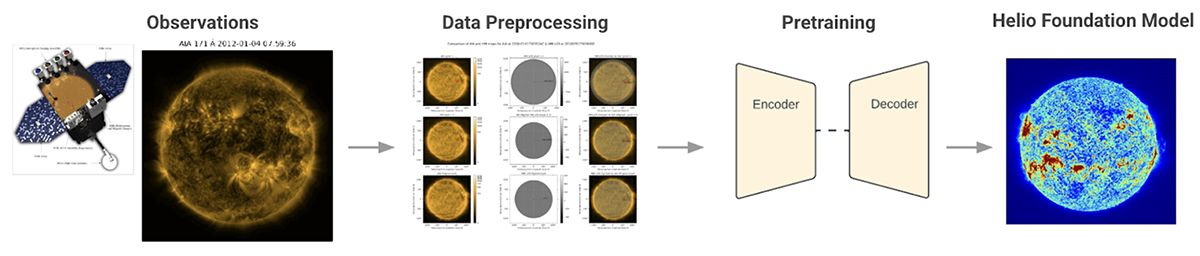
When scientists talk about the Sun, they often call it “active” or “quiet.” Those words might sound gentle, but they hide a reality that can shake life on Earth. A solar flare can release as much energy as billions of nuclear bombs. A coronal mass ejection can send charged particles racing toward our planet, disrupting satellites, GPS signals, and power grids. Predicting these events has always been a challenge. Now, NASA believes it has a new tool to help: a powerful artificial intelligence model named “Surya“. Surya takes its name from the Sanskrit word for the Sun. It is the first heliophysics foundation model developed under NASA’s AI for Science initiative. In partnership with IBM and several research institutions, NASA has trained Surya on nearly a decade of high-resolution solar observations. The goal is straightforward: make better forecasts of solar activity and space weather.
Importance of space weather
Most people don’t notice space weather unless a powerful storm creates auroras visible far from the poles. But for engineers and operators of critical systems, it is always on their minds. The strongest storms can degrade GPS accuracy, interfere with aviation communications, and push satellites out of position by heating and expanding Earth’s atmosphere. Power companies also keep an eye on the Sun because geomagnetic storms can drive unwanted currents through transmission lines, sometimes tripping entire grids. That’s why forecasters work hard to understand the Sun. They use both observations and physics-based simulations to track sunspots, magnetic activity, and solar eruptions. However, predicting the exact timing and strength of solar flares has remained a challenge. Often, the warning comes too late to take preventive measures. NASA believes Surya can help change that.
Built on the Solar Dynamics Observatory
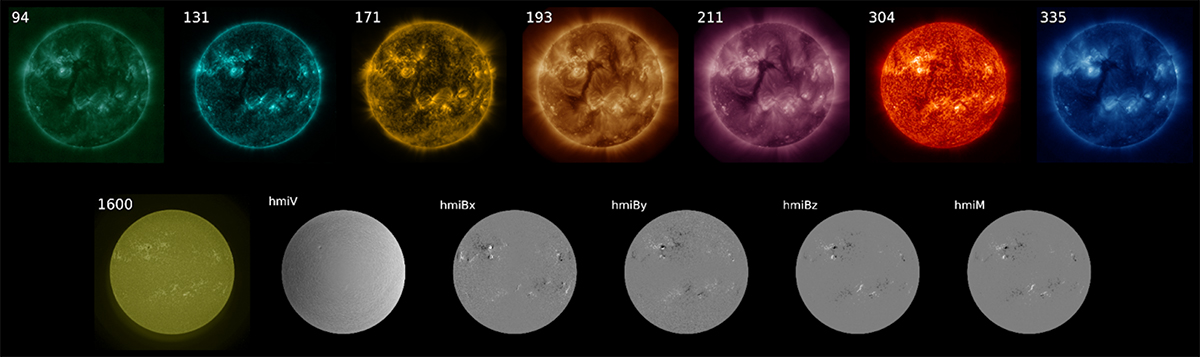
The foundation of Surya is data. For training material, the team turned to the Solar Dynamics Observatory (SDO), a spacecraft launched in 2010 that has watched the Sun almost nonstop ever since. SDO’s cameras capture an image every 12 seconds across multiple wavelengths of ultraviolet and extreme ultraviolet light. It also measures the Sun’s magnetic fields, which often hold the clues to future activity. This uninterrupted record of solar behavior has few equals in space science. Over nine years, SDO has documented the rise and fall of sunspot cycles, countless flares, and several major coronal mass ejections. All of it provides exactly the kind of comprehensive, well-calibrated dataset that a model like Surya needs. By learning from this enormous archive, Surya can recognize the subtle signs that precede solar events.
What the model can do
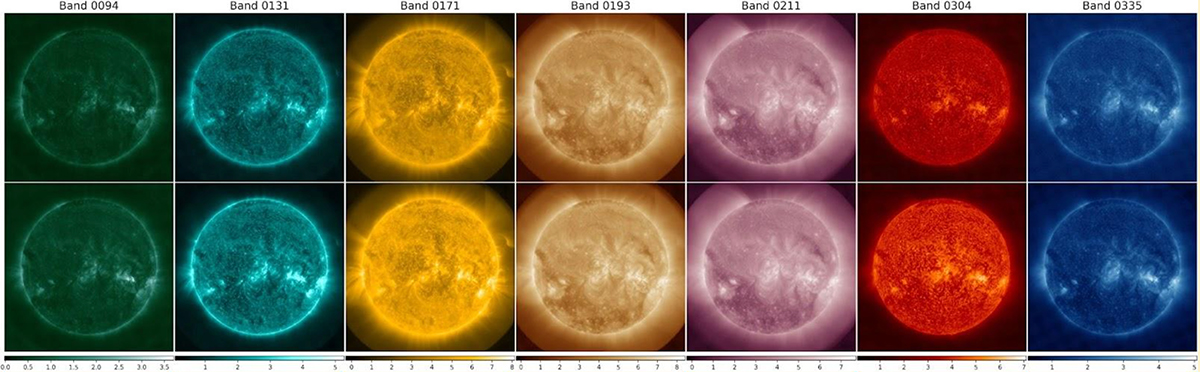
So what does Surya produce? Its most eye-catching feature is a visual forecast of solar flares up to two hours in advance. Instead of only issuing a probability, the model generates images that show how an active region might evolve and where a flare is likely to erupt. This visual output makes it easier for human experts to judge the forecast and compare it to their observations. In early tests, Surya’s flare forecasts performed better than previous methods, improving benchmark accuracy by about 16 percent. That may not sound dramatic at first glance, but in forecasting, especially in such a complex field, it is a meaningful gain. An extra hour or two of warning can be crucial for preparing satellites, rerouting flights, or adjusting communications systems.
Beyond flare forecasting, Surya has shown promise in several other tasks. It can estimate solar wind speed several days ahead, predict the emergence of new active regions, and model the Sun’s ultraviolet output across a wide range of wavelengths. Each of these abilities ties into real-world applications. Solar wind, for instance, affects the drag on satellites in low Earth orbit, while ultraviolet emissions influence the ionosphere, which affects radio signals. NASA has already demonstrated the model by replaying the famous 2015 St. Patrick’s Day storm, one of the largest of the past decade. Surya was able to reproduce the chain of solar activity leading up to the event, suggesting that its training has captured more than surface appearances.
Open science at work
One of the most significant parts of Surya’s story is how it has been released. NASA and IBM have made the model openly available on HuggingFace, a platform widely used by AI researchers, and shared its code on GitHub. They have also introduced SuryaBench, a dataset and benchmarking suite that allows researchers to test the model on multiple forecasting tasks.
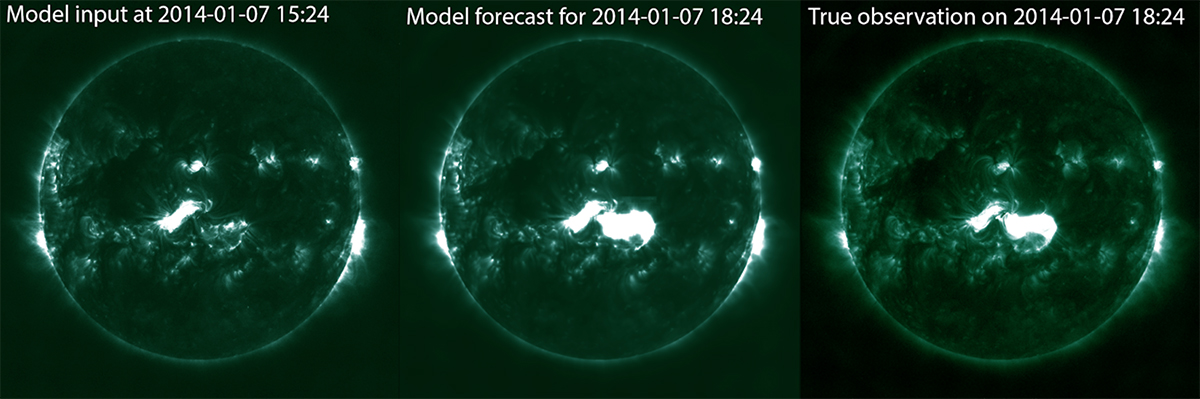
The release of Surya comes at a critical time. The Sun is at the peak of its 11-year activity cycle, which means stronger flares and more frequent eruptions in the next few years. Having a model that can see two hours into the future and generate reliable visual forecasts could make a real difference.
Clear skies!
See more from DIYPhotography.net on Google
Add DIYPhotography.net as a trusted source. This makes
our stories more likely to appear in your Google Search results.
 Add as a preferred source on Google

Soumyadeep Mukherjee
Soumyadeep Mukherjee is an award-winning astrophotographer from India. He has a doctorate degree in Linguistics. His work extends to the sub-genres of nightscape, deep sky, solar, lunar and optical phenomenon photography. He is also a photography educator and has conducted numerous workshops. His works have appeared in over 40 books & magazines including Astronomy, BBC Sky at Night, Sky & Telescope among others, and in various websites including National Geographic, NASA, Forbes. He was the first Indian to win “Astronomy Photographer of the Year” award in a major category.



Join the Discussion
DIYP Comment Policy
Be nice, be on-topic, no personal information or flames.