





















Fury in February: NASA Captures Consecutive Massive Solar Flares
Feb 5, 2026
Soumyadeep Mukherjee
Soumyadeep Mukherjee is an award-winning astrophotographer from India. He has a doctorate degree in Linguistics. His work extends to the sub-genres of nightscape, deep sky, solar, lunar and optical phenomenon photography. He is also a photography educator and has conducted numerous workshops. His works have appeared in over 40 books & magazines including Astronomy, BBC Sky at Night, Sky & Telescope among others, and in various websites including National Geographic, NASA, Forbes. He was the first Indian to win “Astronomy Photographer of the Year” award in a major category.
Share:

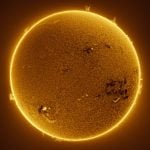
In early February 2026, the Sun entered a short but intense phase of eruptive activity driven by rapid magnetic restructuring in a newly formed active region. Space-based solar observatories recorded a sequence of high-energy flares over several consecutive days, including multiple X-class events. These eruptions originated from Active Region 4366, a large and magnetically complex sunspot group that developed quickly as it rotated onto the Earth-facing side of the solar disk.
Solar flares occur when stressed magnetic field lines in the Sun’s atmosphere reconnect and release stored energy. That energy escapes as electromagnetic radiation across a wide range of wavelengths, including X-rays and extreme ultraviolet light. The February events stood out for their strength and also for their frequency. Within a narrow window, AR 4366 produced several major flares, including one of the strongest recorded so far during Solar Cycle 25.
Active Region 4366 and the rapid rise of a solar powerhouse
Everything began with the emergence of Active Region 4366. As this sunspot group formed, it expanded rapidly and developed a highly complex magnetic structure. Solar physicists classified it as a beta-gamma-delta region, a designation reserved for sunspots with deeply entangled magnetic fields. Regions with this configuration often act as efficient flare producers because they store large amounts of magnetic energy in unstable arrangements.
As AR 4366 grew, it also became one of the most prominent features on the Sun’s visible surface. Its location near the central solar disk increased the likelihood that any eruptions would direct radiation toward Earth. Within days, the region began releasing energy in repeated bursts.
Between February 1 and February 2 alone, the region generated dozens of flares. Most fell into the M-class category, which represents moderate solar eruptions. However, four of these events crossed into the X-class, the highest category on the flare scale. Among them was an exceptionally strong X8.1 flare, which dominated the sequence and marked the peak of this activity cycle.
This rapid succession of powerful eruptions revealed how efficiently AR 4366 converted magnetic stress into explosive energy. Instead of producing a single major flare and then stabilizing, the region continued to reorganize its magnetic fields and release energy repeatedly. Each reconnection event reshaped the surrounding plasma environment and set the stage for the next eruption.

A cluster of major flares in just four days
The first X-class flare appeared on February 1, registering as an X1.0 event. Later the same day, the region unleashed the much stronger X8.1 flare. Solar observatories recorded intense X-ray output and bright emission across multiple wavelengths as hot plasma surged through the Sun’s upper atmosphere.
Soon after, two additional X-class flares followed on February 2, rated X2.8 and X1.6. Rather than fading after these eruptions, AR 4366 remained unstable. On February 3, it produced yet another X-class flare, confirming that the region had not yet exhausted its stored magnetic energy. The sequence continued on February 4 with an X4.2 flare, one of the strongest of the entire episode. By this point, AR 4366 had firmly established itself as one of the most flare-productive regions of Solar Cycle 25.
To understand the scale of these events, it helps to consider how flare classes work. Scientists rank flares as A, B, C, M, or X, based on peak X-ray brightness measured near Earth. Each step up represents a tenfold increase in energy output. Within the X-class, the numerical value indicates relative strength. An X8 flare, therefore, releases roughly eight times more energy than an X1 flare. This makes the X8.1 eruption particularly significant. While strong flares are not unusual near solar maximum, the clustering of multiple X-class events within such a short period remains noteworthy.

Immediate effects on Earth’s space environment
When powerful flares erupt, their X-ray and ultraviolet radiation reach Earth in about eight minutes. Upon arrival, this energy alters the ionosphere, the electrically charged layer of Earth’s upper atmosphere. Increased ionization changes how radio waves propagate, which can disrupt communication systems that rely on ionospheric reflection.
During the strongest February flares, operators reported shortwave radio blackouts across parts of the sunlit side of Earth, particularly over the South Pacific region. Aviation and maritime services that depend on high-frequency radio experienced brief interruptions. Amateur radio users also noted sudden signal loss. Navigation systems felt the effects as well. Rapid changes in ionospheric density can degrade GPS accuracy and introduce timing errors. Although these disruptions were temporary, they highlighted how quickly solar activity can influence modern technology.

Satellite operators monitored conditions closely. High-energy radiation increases the risk of electronic anomalies aboard spacecraft, while enhanced atmospheric drag can subtly alter satellite orbits. At the same time, space agencies evaluated radiation levels for crews aboard orbital platforms, although the February events did not reach thresholds that posed significant danger to astronauts.
The anticipated CME from the X8.1 flare produced only modest geomagnetic effects. Forecasts suggested a minor geomagnetic storm, which can intensify auroras and cause small fluctuations in power grid currents at high latitudes. Observers in polar regions reported brighter auroral displays, but impacts elsewhere remained limited.

How scientists monitor and forecast solar eruptions
Behind every space weather alert lies a global network of observatories and monitoring systems. Instruments aboard spacecraft such as the Solar Dynamics Observatory continuously image the Sun in multiple wavelengths, revealing changes in temperature, density, and magnetic structure. At the same time, geostationary satellites measure X-ray flux to classify flares in real time.
Ground-based observatories complement these efforts by tracking sunspot evolution and magnetic field strength. These data streams feed into forecasting models operated by space weather centers. Analysts use them to assess flare probabilities, estimate CME trajectories, and predict geomagnetic impacts.
During the February episode, forecasters issued regular updates as AR 4366 evolved. Each new flare prompted fresh assessments of radiation levels and CME potential. This constant flow of information allowed satellite operators, communication providers, and power utilities to stay informed and prepare for possible disruptions.
Although scientists cannot yet predict the exact timing of individual flares, they can identify regions with elevated risk. Active Region 4366 remained under close watch throughout its transit across the solar disk because its magnetic structure continued to signal flare potential.
Clear skies!
See more from DIYPhotography.net on Google
Add DIYPhotography.net as a trusted source. This makes
our stories more likely to appear in your Google Search results.
 Add as a preferred source on Google

Soumyadeep Mukherjee
Soumyadeep Mukherjee is an award-winning astrophotographer from India. He has a doctorate degree in Linguistics. His work extends to the sub-genres of nightscape, deep sky, solar, lunar and optical phenomenon photography. He is also a photography educator and has conducted numerous workshops. His works have appeared in over 40 books & magazines including Astronomy, BBC Sky at Night, Sky & Telescope among others, and in various websites including National Geographic, NASA, Forbes. He was the first Indian to win “Astronomy Photographer of the Year” award in a major category.

Join the Discussion
DIYP Comment Policy
Be nice, be on-topic, no personal information or flames.