




















X-Ray Images of 3I/ATLAS: XRISM and XMM-Newton Captures Interstellar Comet
Dec 18, 2025
Soumyadeep Mukherjee
Soumyadeep Mukherjee is an award-winning astrophotographer from India. He has a doctorate degree in Linguistics. His work extends to the sub-genres of nightscape, deep sky, solar, lunar and optical phenomenon photography. He is also a photography educator and has conducted numerous workshops. His works have appeared in over 40 books & magazines including Astronomy, BBC Sky at Night, Sky & Telescope among others, and in various websites including National Geographic, NASA, Forbes. He was the first Indian to win “Astronomy Photographer of the Year” award in a major category.
Share:

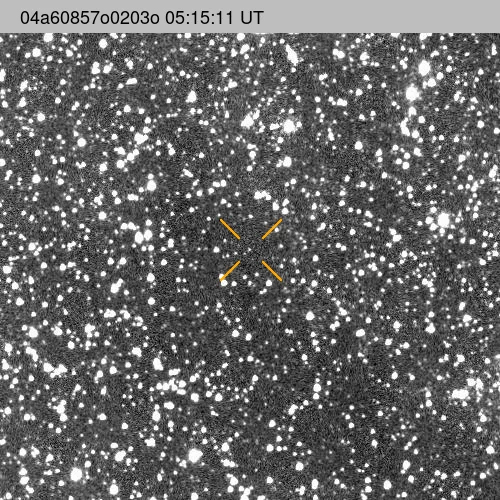
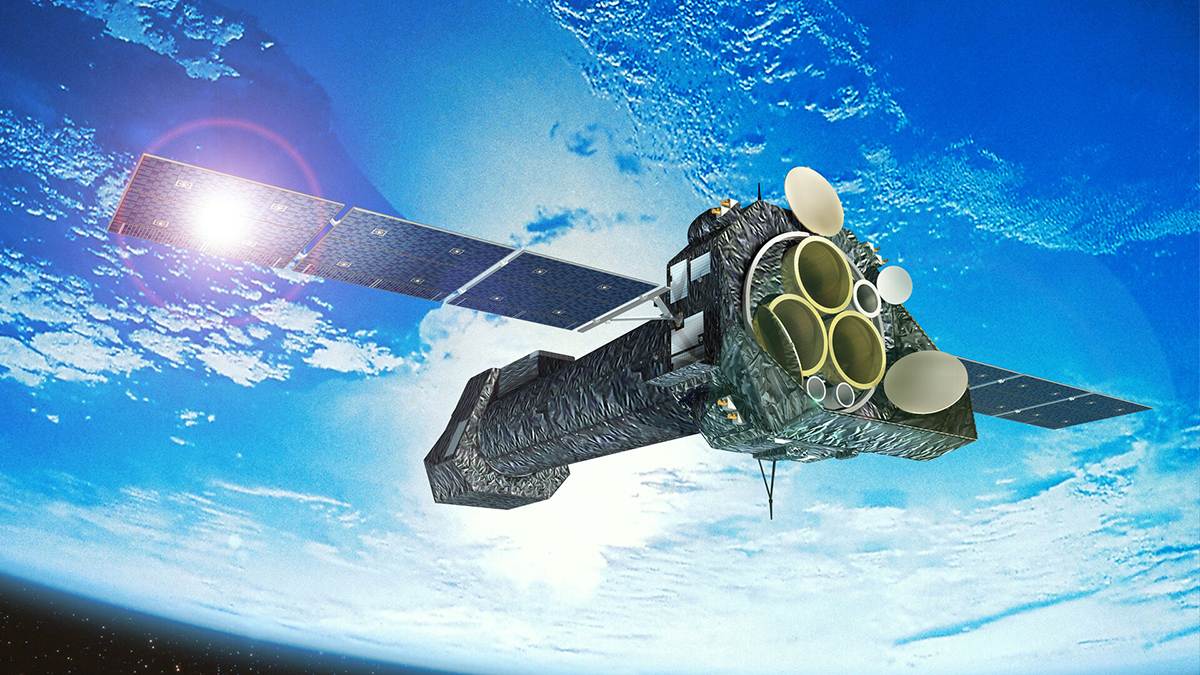
Interstellar comet 3I/ATLAS passed through the inner solar system only briefly. During its passage in December 2025, astronomers used two X-ray observatories to study it in an entirely new way. ESA’s XMM-Newton and the XRISM mission both detected soft X-ray emission from the comet’s coma. These detections mark the first confirmed X-ray observations of an interstellar comet. They extend comet science beyond the solar system for the first time.
X-ray emission from comets is a well-known phenomenon. However, until now, it had only been observed in objects formed around the Sun. The detection from 3I/ATLAS shows that the same physical processes operate in material formed around other stars.
An interstellar origin
Astronomers discovered 3I/ATLAS on 1 July 2025 using the ATLAS survey system in Chile. From the first orbital solutions, its origin was clear. The comet follows a strongly hyperbolic trajectory. Its inbound velocity exceeds what the Sun can gravitationally bind. These parameters confirm an interstellar origin.
Only two such objects had been confirmed before. 1I/ʻOumuamua in 2017 showed no obvious cometary activity. 2I/Borisov in 2019 behaved like a typical comet. 3I/ATLAS belongs to the second category. As it approached the Sun, its icy nucleus released gas and dust. A coma developed and expanded rapidly.
That activity made 3I/ATLAS especially valuable. Gas in the coma provides a large interaction surface with the solar wind. This interaction is essential for producing X-rays.
Why comets emit X-Rays
Comets do not emit X-rays thermally. The temperatures are far too low. Instead, X-ray emission comes from charge exchange interactions between the solar wind and neutral atoms in the coma. The solar wind contains highly charged ions, such as oxygen and carbon ions stripped of many electrons. When these ions collide with neutral gas molecules released by the comet, they capture electrons. The ions then relax to lower energy states. In doing so, they emit photons in the X-ray band.
This mechanism has been observed in dozens of comets in the solar system since the 1990s. It produces soft X-ray emission, typically below 1 keV. The brightness and spatial structure depend on both the solar wind conditions and the density of the cometary gas. Until 3I/ATLAS, this process had never been confirmed in an interstellar object.
XRISM provides the first X-Ray image of an interstellar comet
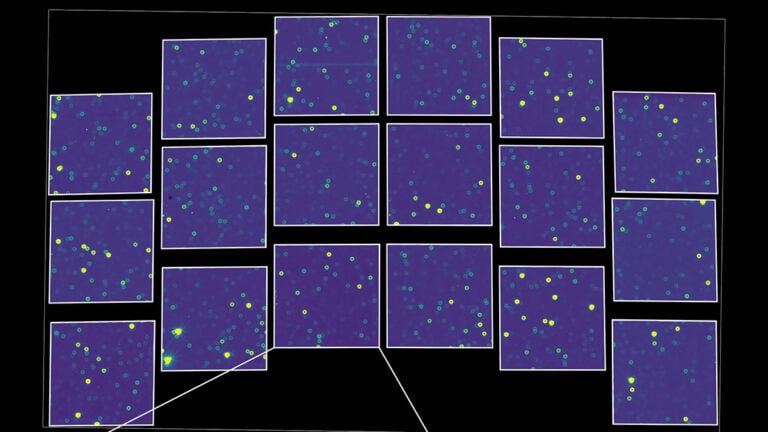
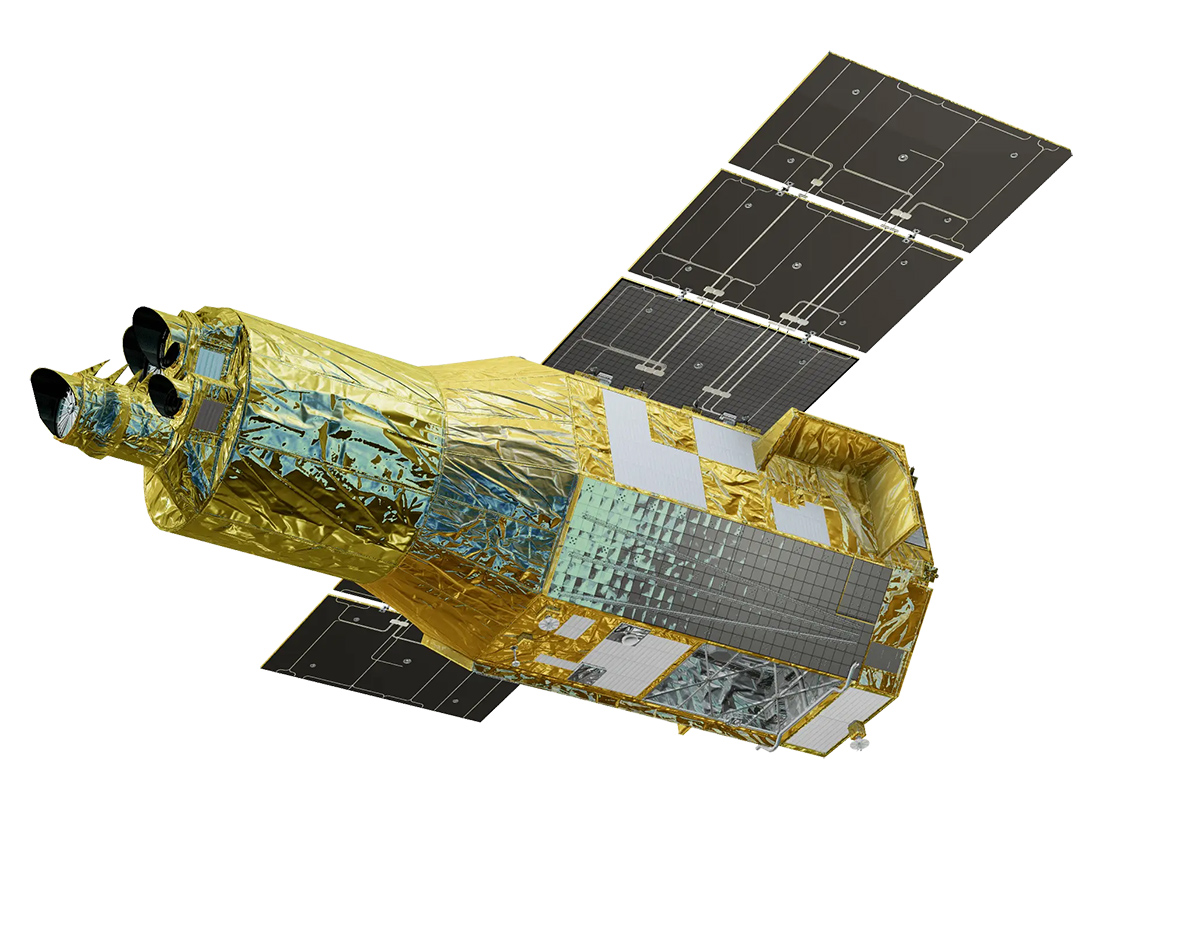
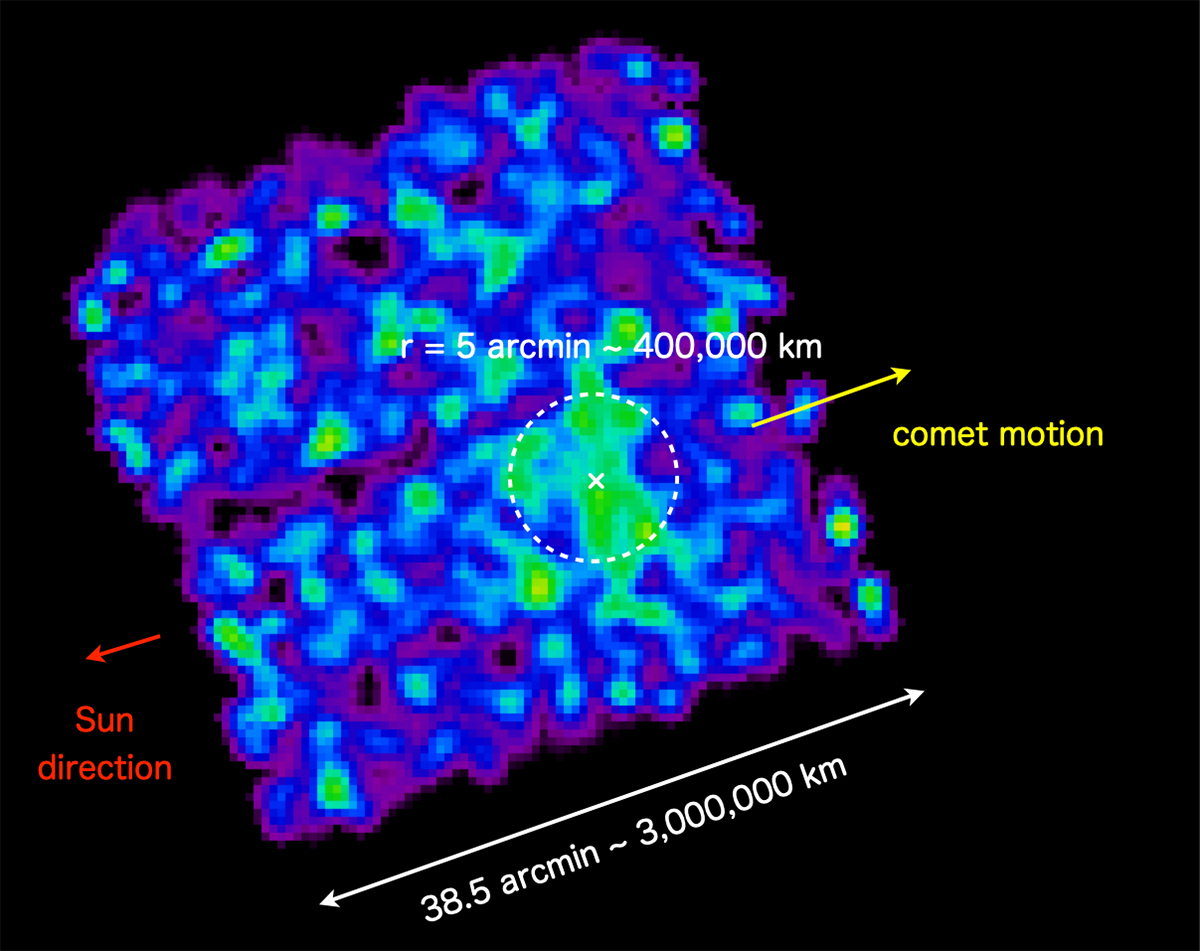
Shortly before XMM-Newton observed the comet, the XRISM mission had targeted 3I/ATLAS. XRISM observed the comet between 26 and 28 November 2025. Its instruments captured the first X-ray image ever obtained of an interstellar comet.
The XRISM data showed a broad halo of X-ray emission extending hundreds of thousands of kilometres from the nucleus. The image confirmed that the emission was not localized. Instead, it filled a large interaction region between the solar wind and the coma.
XRISM also provides high-quality spectral information. These spectra help identify which ions dominate the emission. Oxygen and carbon ions play a major role, as expected. The results align well with models developed from observations of comets in the solar system.
XMM-Newton detects extended X-Ray emission
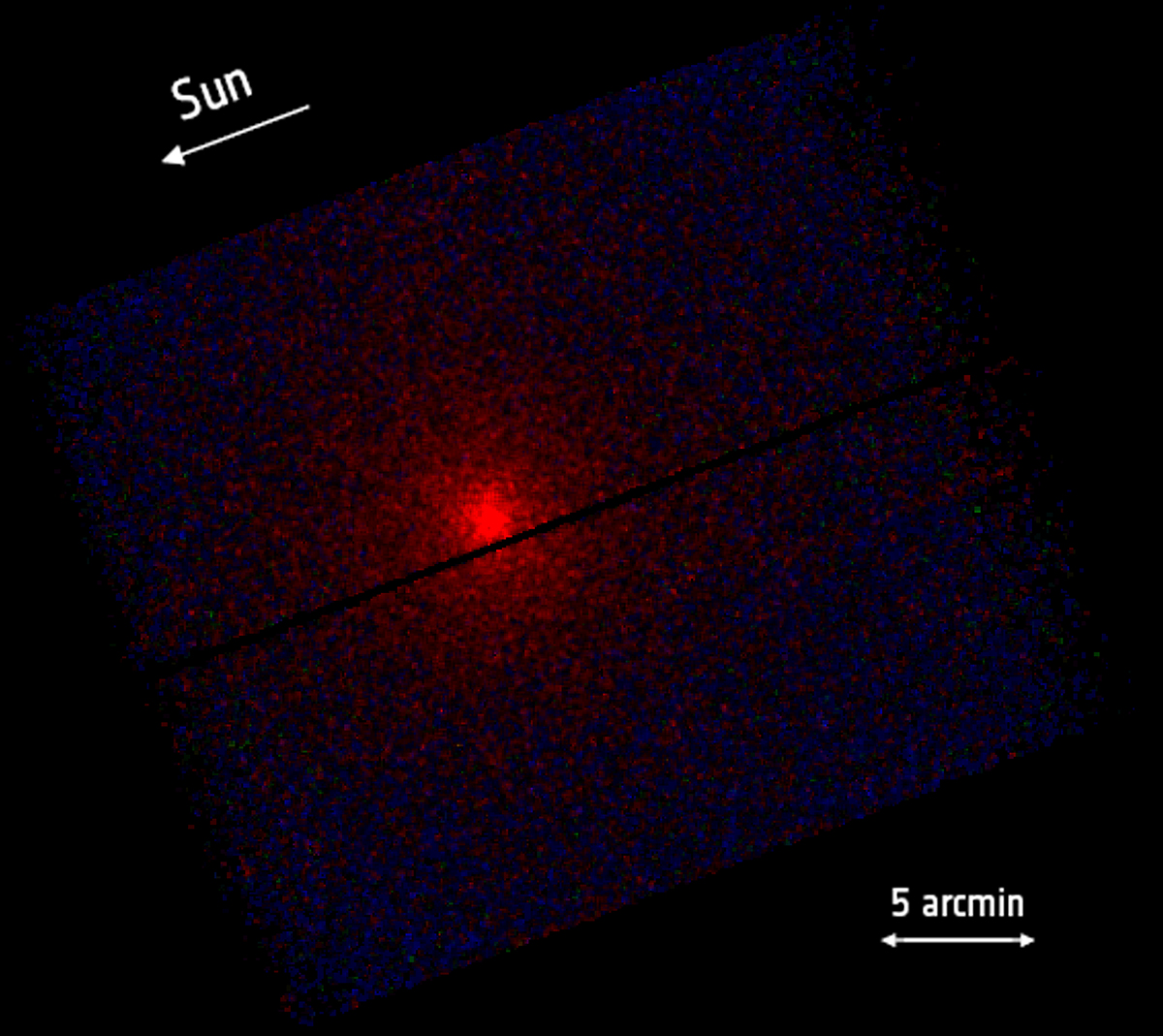
ESA’s XMM-Newton observatory observed 3I/ATLAS in early December 2025. The spacecraft tracked the comet for almost 20 hours. At the time, the comet lay at a distance of roughly 280 million kilometres. The observations revealed a clear detection of diffuse X-ray emission surrounding the nucleus. The emission extended well beyond the visible coma. It traced the region where solar wind ions interacted with neutral gas flowing outward from the comet.
The X-ray brightness varied across the coma. This variation reflects changes in gas density and the structure of the solar wind. Such patterns are familiar from studies of solar system comets. Seeing them in an interstellar comet was a key confirmation. XMM-Newton’s sensitivity allowed astronomers to detect low-energy photons that are difficult to observe from Earth. These data help constrain the amount of hydrogen and other light elements present in the coma.
Together, XRISM and XMM-Newton offer complementary perspectives. One provides detailed imaging while the other delivers high sensitivity across a wider field. The agreement between the two strengthens confidence in the interpretation.
What X-Rays reveal about an interstellar comet
X-ray observations offer insights that other wavelengths cannot easily provide. Optical telescopes detect dust and some gas species. Infrared instruments trace molecules like water and carbon dioxide. X-rays probe the interaction physics directly. In the case of 3I/ATLAS, the X-ray data confirm that its coma contains sufficient neutral gas to sustain strong charge exchange emission. This finding implies active outgassing similar to that of typical solar system comets.
X-rays also help trace elements like hydrogen and nitrogen, which are difficult to observe otherwise. These elements are important for understanding the chemical inventory of the comet. They may offer clues about the environment in which it formed.
The overall similarity between 3I/ATLAS and solar system comets suggests that comet formation processes may be broadly similar across planetary systems. Differences, if present, are likely subtle. Detailed analysis of the spectra may reveal them.
Further reading
Right from the discovery of the interstellar comet 3I/ATLAS, DIYP has published several articles on its photographs and features. Here is the list of articles:
- A New Visitor from the Stars: Comet 3I/ATLAS
- Gemini North Photographs the Interstellar Comet 3I/ATLAS
- Hubble’s Sharpest Portrait of a Visitor from the Stars: Comet 3I/ATLAS
- JWST Reveals the Secrets of Interstellar Comet 3I/ATLAS in New Images
- SPHEREx Maps the Carbon Dioxide Breath of Interstellar Comet 3I/ATLAS
- Gemini South Photographs Anti-Solar Tail of 3I/ATLAS
- Interstellar Comet 3I/ATLAS: Gemini South Images Reveal a Growing Tail
- Interstellar Comet 3I/ATLAS through Many Eyes: All Images so Far
- A Faint Smudge from Mars: Did Perseverance Really Capture Interstellar Comet 3I/ATLAS?
- ESA’s Mars Orbiter Capture “Closest Yet” View of Interstellar Comet 3I/ATLAS
- Comet 3I/ATLAS Returns: Astronomer Photographs it after Perihelion
- Tianwen-1’s Surprise Close-Up: China’s Mars Orbiter Images Interstellar Comet 3I/ATLAS
- Interstellar Comet 3I/ATLAS Returns to View with a Growing Ion Tail
- NASA Shares Eight New Images of Interstellar Comet 3I/ATLAS
- Hubble Space Telescope Revisits Interstellar Comet 3I/ATLAS
- ESA’s JUICE captures a detailed image of Interstellar Comet 3I/ATLAS
Clear skies!
See more from DIYPhotography.net on Google
Add DIYPhotography.net as a trusted source. This makes
our stories more likely to appear in your Google Search results.
 Add as a preferred source on Google

Soumyadeep Mukherjee
Soumyadeep Mukherjee is an award-winning astrophotographer from India. He has a doctorate degree in Linguistics. His work extends to the sub-genres of nightscape, deep sky, solar, lunar and optical phenomenon photography. He is also a photography educator and has conducted numerous workshops. His works have appeared in over 40 books & magazines including Astronomy, BBC Sky at Night, Sky & Telescope among others, and in various websites including National Geographic, NASA, Forbes. He was the first Indian to win “Astronomy Photographer of the Year” award in a major category.


Join the Discussion
DIYP Comment Policy
Be nice, be on-topic, no personal information or flames.