






















The “Missing Matter”: XMM-Newton Photographed Universe’s Hidden Mass
Jun 30, 2025
Soumyadeep Mukherjee
Soumyadeep Mukherjee is an award-winning astrophotographer from India. He has a doctorate degree in Linguistics. His work extends to the sub-genres of nightscape, deep sky, solar, lunar and optical phenomenon photography. He is also a photography educator and has conducted numerous workshops. His works have appeared in over 40 books & magazines including Astronomy, BBC Sky at Night, Sky & Telescope among others, and in various websites including National Geographic, NASA, Forbes. He was the first Indian to win “Astronomy Photographer of the Year” award in a major category.
Share:
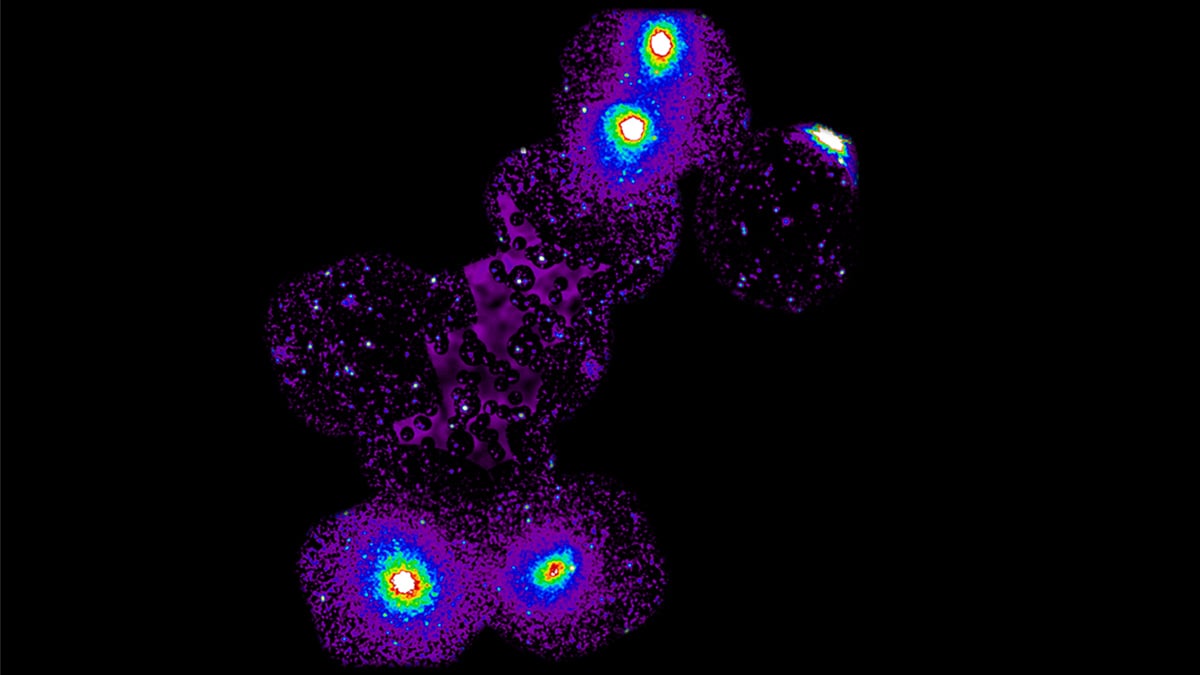
For decades, scientists had a puzzle on their hands. Their models said that the Universe should contain a certain amount of normal, or “baryonic,” matter. But when astronomers added up all the gas, dust, and stars they could see, a big chunk of that matter was missing. A breakthrough, thanks to ESA’s XMM-Newton and JAXA’s Suzaku X-ray space telescopes, has finally provided an answer. The mystery matter was hiding in vast, hot threads of gas that stretch across the Universe. This exciting discovery was published by the European Space Agency (ESA) in June 2025.
What is “missing” matter?
Scientists divide the Universe’s contents into three major types:
- Dark energy – about 68%
- Dark matter – about 27%
- Baryonic matter – about 5%
Baryonic matter is everything we’re made of. Stars, planets, oceans, animals, and even our own bodies. But here’s the twist: when astronomers looked at the sky, they could only account for about two-thirds of that 5%. Roughly one-third of all baryonic matter was missing. Cosmologists believed it was hiding somewhere in the vast spaces between galaxies. But they had little proof.

The theory: The cosmic web
Over the years, simulations showed that the Universe is not smooth. Matter doesn’t spread out evenly. Instead, it forms a kind of “cosmic web.” This web has:
- Nodes – giant galaxy clusters.
- Filaments – long, thin threads of hot gas connecting clusters.
- Voids – empty regions with very little matter.
The missing matter was thought to be hiding in the filaments, specifically in what’s called the Warm–Hot Intergalactic Medium (WHIM). But detecting this hot, thin gas was incredibly difficult.

The tools: XMM-Newton and Suzaku
ESA’s XMM-Newton is one of the most powerful X-ray telescopes ever launched. It has been observing the Universe since 1999. It can detect faint X-rays from distant sources, including gas in galaxy clusters. JAXA’s Suzaku mission was another X-ray observatory, launched by Japan in 2005. It operated until 2015. Suzaku had excellent sensitivity to hot, diffuse X-ray emissions. Together, these two telescopes became the perfect duo to hunt for the hidden matter.
A 23-million-light-year filament
Astronomers aimed their instruments at a region called the Shapley Supercluster. This is one of the largest cosmic structures in the local Universe. It contains many galaxy clusters packed close together. Within this supercluster, scientists focused on a specific part that linked four massive galaxy clusters. They believed this region might contain a dense filament of hot gas.

The telescopes found exactly what the models predicted—a 23-million-light-year-long filament of hot gas. This filament connects the four galaxy clusters. The gas inside it is more than 10 million degrees Kelvin. That’s millions of degrees hotter than the surface of the Sun. According to ESA, the gas in this filament has a mass ten times larger than the Milky Way galaxy. The discovery was the clearest, most direct observation of this kind of cosmic filament to date.
Detecting such a faint structure required precision. Suzaku provided wide-field coverage and sensitivity to faint X-rays. It mapped the overall shape and glow of the filament. XMM-Newton then zoomed in. It helped astronomers remove bright X-ray sources from the image. These included active black holes, neutron stars, and other point sources. Once those were filtered out, what remained was the soft, faint glow of the hot intergalactic gas. The observations matched perfectly with theoretical predictions.

The Universe is full of mysteries. Some are vast and dark, like black holes or dark matter. Others are right under our noses, or floating between galaxies. By looking deeper into the cosmos, astronomers have shown that even missing things can leave behind a glowing trail. The models were right. The matter was never truly missing. It was hiding in the threads of the cosmic web, just waiting to be found.
Clear skies!
See more from DIYPhotography.net on Google
Add DIYPhotography.net as a trusted source. This makes
our stories more likely to appear in your Google Search results.
 Add as a preferred source on Google

Soumyadeep Mukherjee
Soumyadeep Mukherjee is an award-winning astrophotographer from India. He has a doctorate degree in Linguistics. His work extends to the sub-genres of nightscape, deep sky, solar, lunar and optical phenomenon photography. He is also a photography educator and has conducted numerous workshops. His works have appeared in over 40 books & magazines including Astronomy, BBC Sky at Night, Sky & Telescope among others, and in various websites including National Geographic, NASA, Forbes. He was the first Indian to win “Astronomy Photographer of the Year” award in a major category.
Related Posts
 X-Ray Images of 3I/ATLAS: XRISM and XMM-Newton Captures Interstellar Comet
 Award-winning photographer has exhibition with Helmut Newton censored for her same sex imagery
 ALMA photographs Hidden Structures in the Universe’s First Galaxies
 Largest Radio Map Ever: LOFAR Sky Survey Reveals the Hidden Universe
Join the Discussion
DIYP Comment Policy
Be nice, be on-topic, no personal information or flames.