






















Gemini South Photographs Anti-Solar Tail of 3I/ATLAS
Sep 2, 2025
Soumyadeep Mukherjee
Soumyadeep Mukherjee is an award-winning astrophotographer from India. He has a doctorate degree in Linguistics. His work extends to the sub-genres of nightscape, deep sky, solar, lunar and optical phenomenon photography. He is also a photography educator and has conducted numerous workshops. His works have appeared in over 40 books & magazines including Astronomy, BBC Sky at Night, Sky & Telescope among others, and in various websites including National Geographic, NASA, Forbes. He was the first Indian to win “Astronomy Photographer of the Year” award in a major category.
Share:

On July 1, 2025, the ATLAS survey in Chile spotted a faint, fast-moving object in the night sky. Within a day, analysts recognized its path as hyperbolic. That told astronomers it came from beyond our solar system. The object soon received a formal name: 3I/ATLAS, the third interstellar visitor ever confirmed. The discovery triggered a global observing campaign. Teams pointed the largest ground and space telescopes at the target. They wanted to learn how an ice-rich body from another star system behaves. Early images showed a compact coma and little structure. That changed in late August. A new feature appeared that confirmed rising activity: an anti-solar tail.
From discovery to detailed portraits
ATLAS and other survey archives traced the object back to mid-June. Those “pre-discovery” detections helped refine the orbit. The interstellar path means the object will not return. It will sweep around the Sun once and head back to deep space. NASA’s first public note put the comet about 420 million miles away at discovery. It also showed a simple diagram of the incoming trajectory.
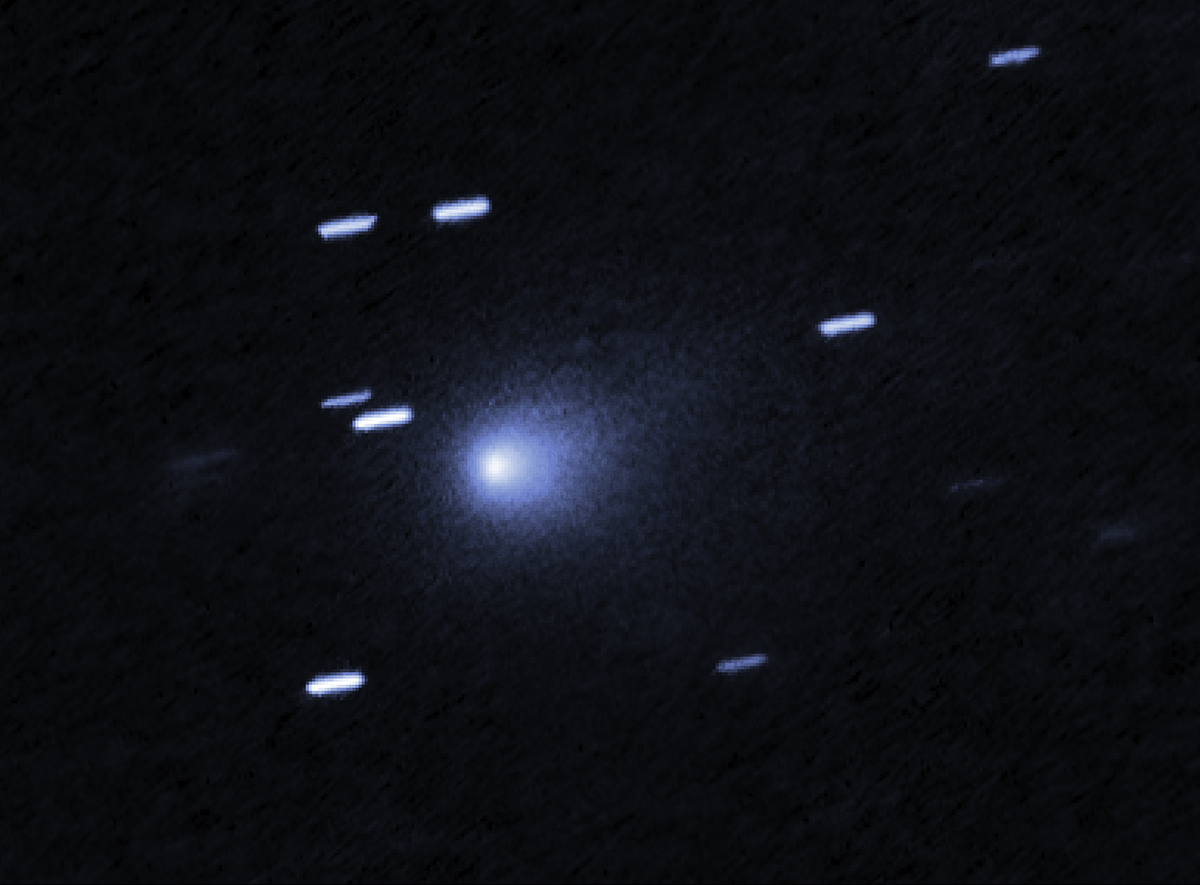
Within two weeks, the International Gemini Observatory offered a closer look. Gemini North on Maunakea imaged 3I/ATLAS with the GMOS instrument. The processed frames showed a bead-like trail. That pattern came from tracking the moving target through different filters. The images revealed a tight coma but no obvious tail. The view suggested a still-gentle level of activity at a large distance from the Sun.
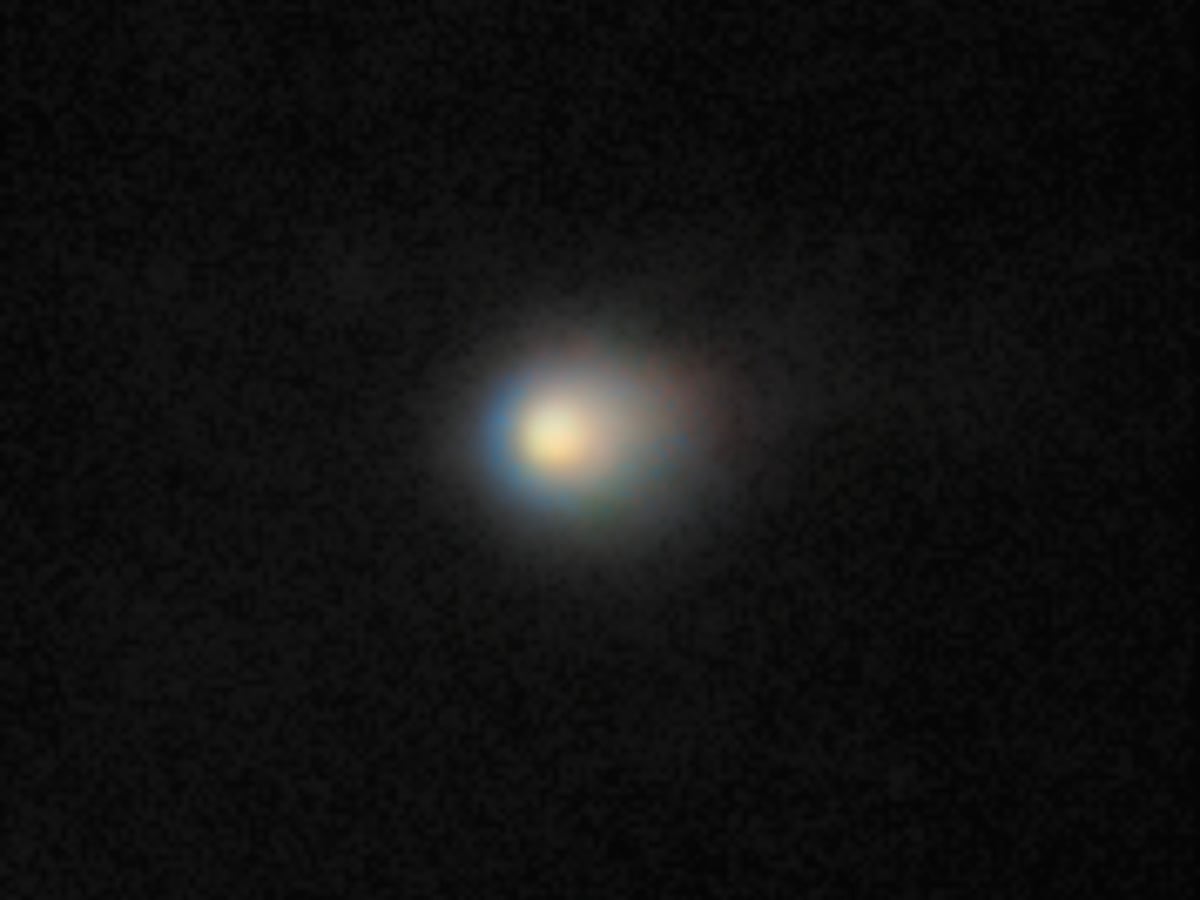
Hubble joined in soon after. On July 21, it captured the sharpest early image from space. The team constrained the nucleus to be about 5.6 kilometers across. It could be as small as a few hundred meters. Hubble also recorded a dust plume and a soft dust tail. That view reinforced the idea that sunlight was already warming surface ices.
What is an “anti-solar tail”
Comets often grow two distinct tails. Gas ions stream straight away from the Sun under the solar wind. Dust grains lag in curved fans under solar radiation pressure and orbital motion. “Anti-solar” simply means the tail points directly away from the Sun. Seeing such a tail tells you the comet is actively shedding material. It also tells you which direction sunlight and the solar wind are pushing its gases and grains.
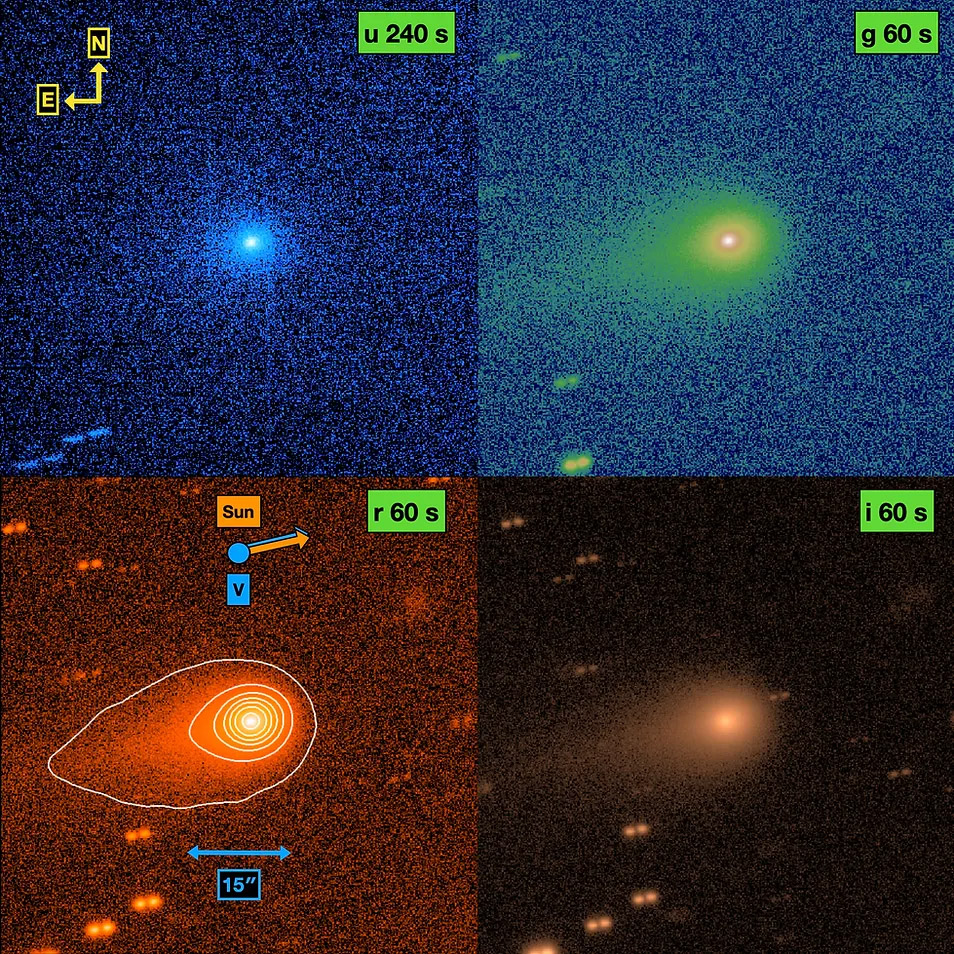
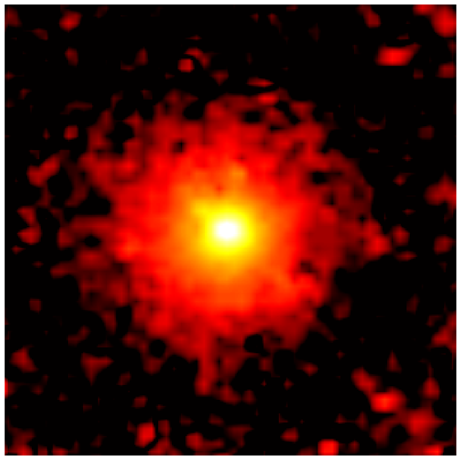
Gemini South in Chile recorded exactly that feature for 3I/ATLAS. Astronomers reported a narrow anti-solar dust tail about 30 arcseconds long. At the comet’s distance, that spans roughly 56,000 kilometers. The coma measured about 10 arcseconds across, or nearly 19,000 kilometers. The report also noted the tail’s position angle aligned with the anti-solar direction. That alignment is the hallmark of an anti-solar tail.
Chemistry from space telescopes
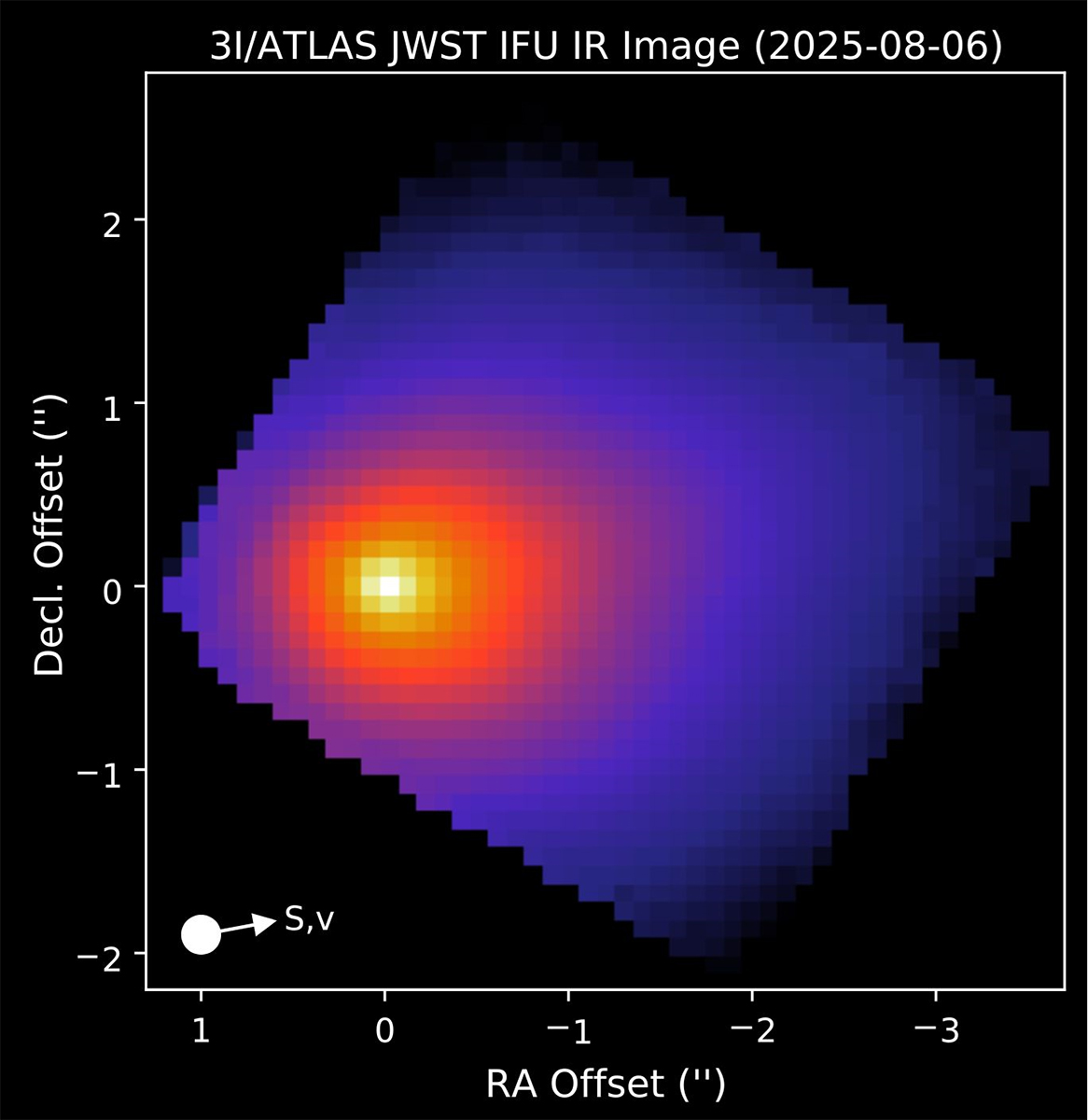
Composition is the other half of the story. Space telescopes can split the light and reveal the gases driving activity. Early in August, the James Webb Space Telescope made its first observations. The spectrum showed a gas coma dominated by carbon dioxide. It also included water vapor, carbon monoxide, and other species. That mix is unusual for a comet this far from the Sun. It suggests abundant CO2 ices are near the surface or suspended in grains.
The observing team reported a CO2 to H₂O mixing ratio of around eight to one. That ratio ranks among the highest seen in any comet. The authors proposed two broad explanations. The comet might be intrinsically CO2-rich from birth. Or sunlight may not yet be penetrating deeply enough to release much water. Either way, the chemistry looks different from many solar-system comets at similar distances.
What the tail tells us about the nucleus
A dust tail needs both gas and loose grains. Gas rushes off the sunlit side and lifts dust into the coma. Solar radiation pressure then pushes smaller grains away. The Gemini South measurement of a narrow, anti-solar tail fits that picture. A straight, sun-pointing tail often indicates a significant ion component as well. Continued spectroscopy will sort dust from ions in the coming weeks.
The tail length also ties to dust size. Longer, sharper features often favor smaller grains. Short, stubby fans can indicate larger particles that feel less push. As 3I/ATLAS nears perihelion, the tail may lengthen and brighten. It could also split into multiple structures as activity ramps up. Comparing Hubble’s July dust plume with Gemini South’s late-August tail will chart that transition. That sequence helps model the nucleus surface and jet locations.
3I/ATLAS is only the third interstellar visitor we have caught in time. That rarity makes every measurement count. We now have a documented anti-solar tail from Gemini South and Hubble’s size constraints, and a dust plume. We also have JWST’s CO2-dominated gas signature and Swift’s water detection. Together, these results show a complex, active body. It behaves like a comet, but with chemistry that stands out. Gemini and its partners will likely continue rapid-response imaging. Those snapshots track dust production and morphology. Hubble can look for fine structure and measure how the coma changes with time. JWST can revisit the spectrum after perihelion to test the chemistry again
Clear skies!
See more from DIYPhotography.net on Google
Add DIYPhotography.net as a trusted source. This makes
our stories more likely to appear in your Google Search results.
 Add as a preferred source on Google

Soumyadeep Mukherjee
Soumyadeep Mukherjee is an award-winning astrophotographer from India. He has a doctorate degree in Linguistics. His work extends to the sub-genres of nightscape, deep sky, solar, lunar and optical phenomenon photography. He is also a photography educator and has conducted numerous workshops. His works have appeared in over 40 books & magazines including Astronomy, BBC Sky at Night, Sky & Telescope among others, and in various websites including National Geographic, NASA, Forbes. He was the first Indian to win “Astronomy Photographer of the Year” award in a major category.




Join the Discussion
DIYP Comment Policy
Be nice, be on-topic, no personal information or flames.