





















Sun’s South Pole Photographed for the First Time by Solar Orbiter
Jun 12, 2025
Soumyadeep Mukherjee
Soumyadeep Mukherjee is an award-winning astrophotographer from India. He has a doctorate degree in Linguistics. His work extends to the sub-genres of nightscape, deep sky, solar, lunar and optical phenomenon photography. He is also a photography educator and has conducted numerous workshops. His works have appeared in over 40 books & magazines including Astronomy, BBC Sky at Night, Sky & Telescope among others, and in various websites including National Geographic, NASA, Forbes. He was the first Indian to win “Astronomy Photographer of the Year” award in a major category.
Share:
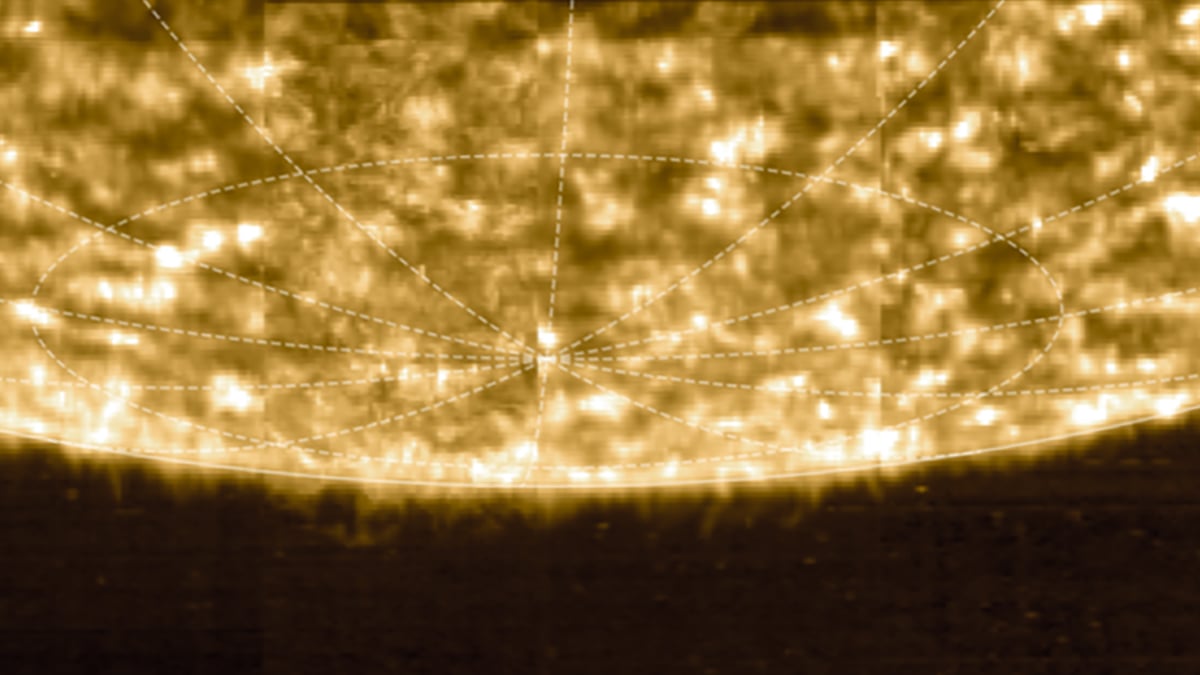
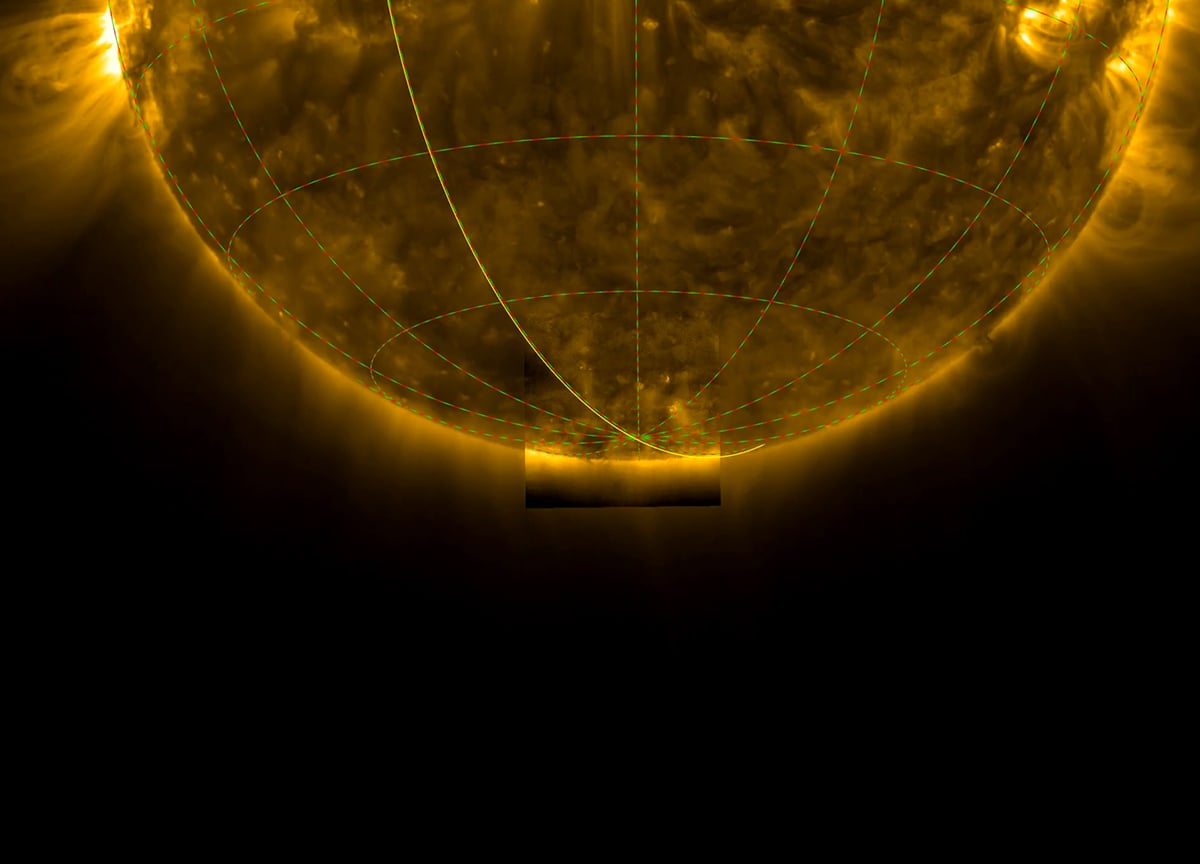
For the first time in human history, we have seen what no one ever has: the poles of the Sun. Thanks to the European Space Agency’s (ESA) Solar Orbiter, we now have detailed images and data of the Sun’s mysterious polar regions. This breakthrough is more than just a first. It marks a major milestone in understanding our star.
The mission: Solar Orbiter
The Solar Orbiter is a joint mission by the European Space Agency (ESA) and NASA. It launched on 10 February 2020 from Cape Canaveral, Florida. Its goal is simple but ambitious: to study the Sun up close. More specifically, it aims to understand how solar activity is generated and how it affects the solar system. One of its top science goals is to observe the Sun’s poles. Why the poles? Because they play a key role in the Sun’s magnetic field and its 11-year activity cycle. Until now, we’ve never had a direct look at these regions.
How the images were taken
The Solar Orbiter uses a clever strategy to get a better view of the Sun. It performs gravity-assist flybys around Venus. Each flyby changes the spacecraft’s orbit just a little bit. This helps it “tilt” its view over time. In March 2025, the spacecraft achieved a 17-degree inclination. That might not sound like much, but it’s enough to see the Sun’s south pole. Over the coming years, more Venus flybys will help it reach inclinations of up to 33 degrees by 2029.
This technique gives us our first-ever over-the-top view of the Sun. Earlier spacecraft, like NASA’s Ulysses, studied the poles indirectly. Solar Orbiter has finally made direct observations.
The instruments behind the views
Solar Orbiter carries ten scientific instruments. Six of these look at the Sun directly. Four others study the space environment around the spacecraft. Together, they provide a complete picture. For the polar observations, three instruments played a key role:
1. PHI (Polarimetric and Helioseismic Imager)
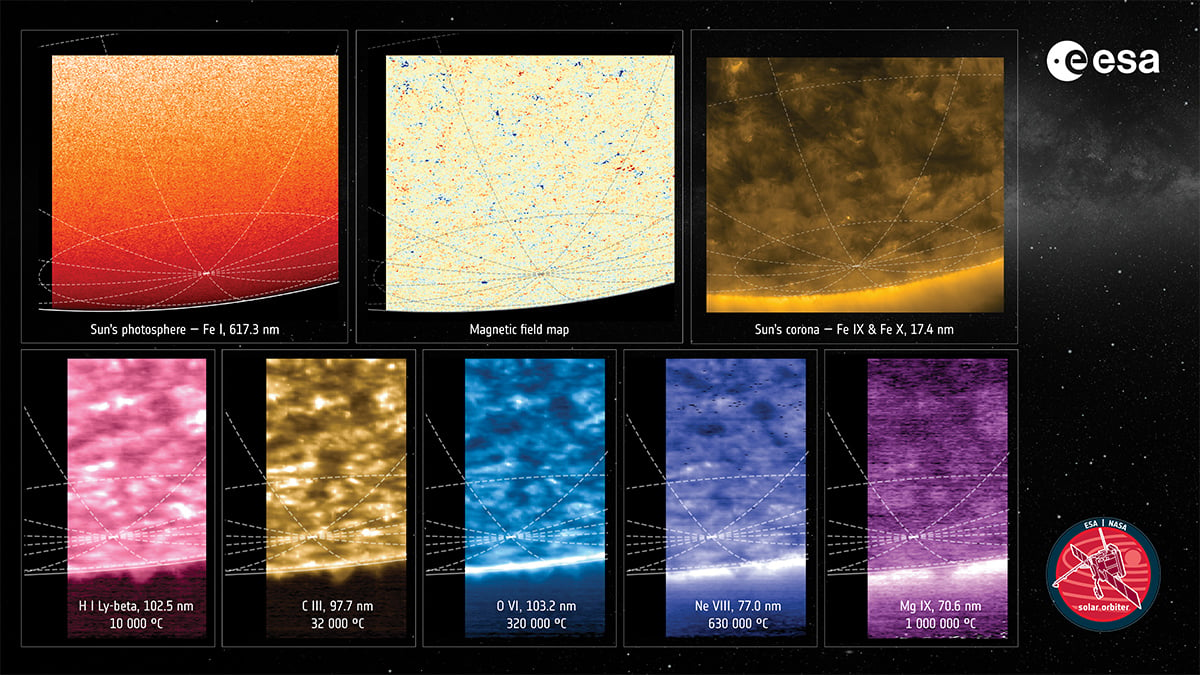
PHI takes high-resolution images of the Sun’s magnetic field. It helps us see how the Sun’s surface moves and how its magnetic field behaves. PHI gave us a detailed magnetogram of the south pole. It showed complex magnetic patterns, including patches with opposite polarity.
2. EUI (Extreme Ultraviolet Imager)
EUI captures images in the ultraviolet spectrum. These images show us the hot outer atmosphere of the Sun—the corona. EUI revealed fine loops, bright spots, and swirling plasma near the pole. These features are linked to solar wind and space weather.
3. SPICE (Spectral Imaging of the Coronal Environment)
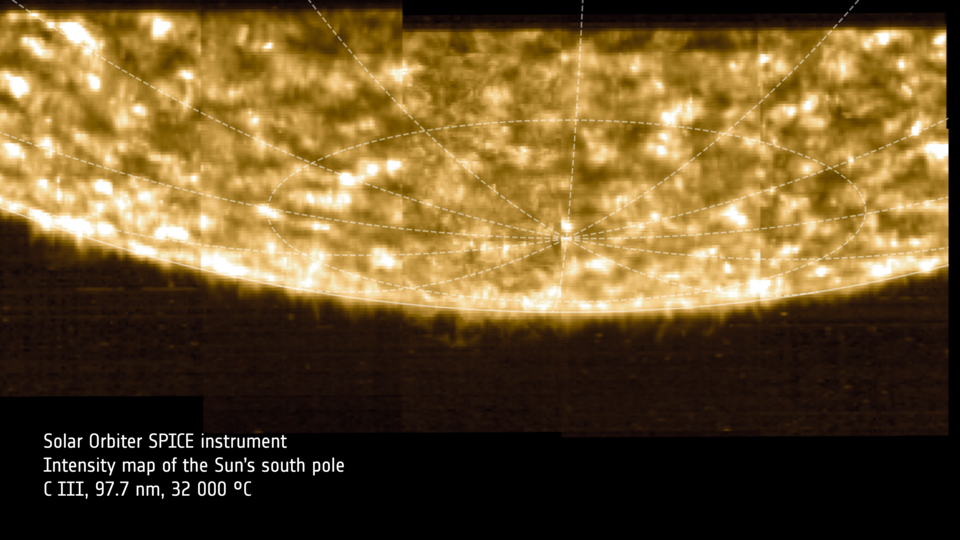
SPICE is a spectrometer. It measures the Sun’s ultraviolet light at various wavelengths and detects elements like carbon, oxygen, and hydrogen. It also measures their temperature and movement. This tells us how plasma flows in the polar regions.
What the South Pole shows
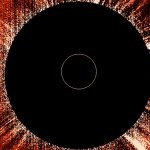
The Sun’s South Pole looks chaotic. The PHI magnetogram shows magnetic patches with both north and south polarities. This matches what scientists expect during the solar maximum. During solar maximum, the Sun’s magnetic field flips. The north becomes south, and vice versa. This process begins at the poles. So these images give us a front-row seat to magnetic reversal in progress. The EUI images show tiny magnetic loops and bright features. These are likely connected to small solar eruptions. Such events release energy into space and contribute to the solar wind. SPICE data reveals hot plasma moving at high speeds. Some areas show upward motion. Others show downward flows. This suggests complex dynamics at the poles. It also hints at how material escapes into the solar wind.
Solar Orbiter has taken us to a new frontier. For centuries, we’ve watched the Sun rise and set. We’ve seen sunspots and eclipses. But we never saw its poles until now. These first polar images are only the beginning. They are a doorway to better understanding our star, they show us where solar storms are born, they teach us how the Sun changes and evolves. The Solar Orbiter mission proves that with patience, planning, and international cooperation, we can unlock the deepest mysteries of the cosmos. The Sun has always been our source of life. Now, it’s also our newest source of discovery.
Clear skies!
See more from DIYPhotography.net on Google
Add DIYPhotography.net as a trusted source. This makes
our stories more likely to appear in your Google Search results.
 Add as a preferred source on Google

Soumyadeep Mukherjee
Soumyadeep Mukherjee is an award-winning astrophotographer from India. He has a doctorate degree in Linguistics. His work extends to the sub-genres of nightscape, deep sky, solar, lunar and optical phenomenon photography. He is also a photography educator and has conducted numerous workshops. His works have appeared in over 40 books & magazines including Astronomy, BBC Sky at Night, Sky & Telescope among others, and in various websites including National Geographic, NASA, Forbes. He was the first Indian to win “Astronomy Photographer of the Year” award in a major category.


Join the Discussion
DIYP Comment Policy
Be nice, be on-topic, no personal information or flames.