

















Capturing Comet A3 from a high altitude National Park
Nov 19, 2024
Soumyadeep Mukherjee
Soumyadeep Mukherjee is an award-winning astrophotographer from India. He has a doctorate degree in Linguistics. His work extends to the sub-genres of nightscape, deep sky, solar, lunar and optical phenomenon photography. He is also a photography educator and has conducted numerous workshops. His works have appeared in over 40 books & magazines including Astronomy, BBC Sky at Night, Sky & Telescope among others, and in various websites including National Geographic, NASA, Forbes. He was the first Indian to win “Astronomy Photographer of the Year” award in a major category.
Share:
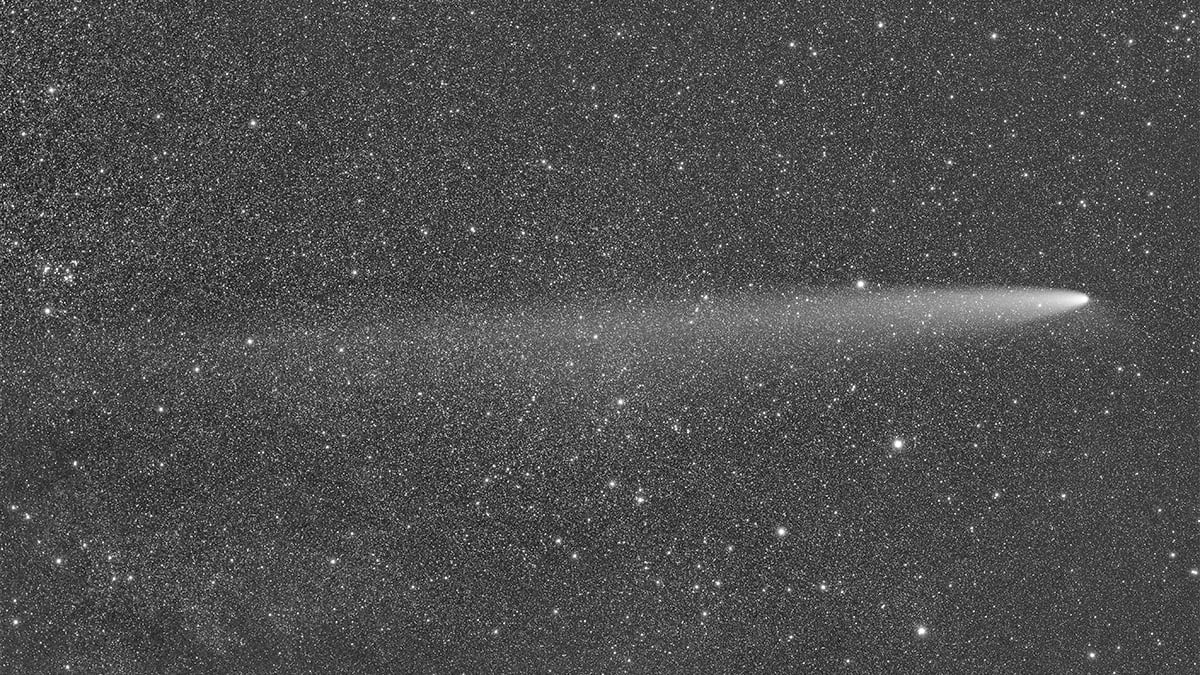
By now, you must be well acquainted with the name of Comet A3. Formally known as comet Tsuchinshan-ATLAS C/2023 A3, it has been the centre of attraction for astrophotographers and other photographers for the last 2 months. Towards the middle of October, it reached naked eye visibility, making it a huge attraction for the public, too. And boy, how beautiful it was. Unfortunately, the good days of the comet are over as it moves away from the sun and the earth, decreasing in brightness and glamour, not to be seen for the next 80,000 years. Towards the end of October, I captured some photographs of the comet from Singalila National Park, a high-altitude region situated at the border of India and Nepal.
About the location and planning
Singalila National Park is known for its dark skies and is a popular choice for astrophotographers, especially for the people of Eastern India. With bortle 2 skies almost throughout the region, astrophotographers are spoilt with choice. Apart from astro-images, this national park is also a paradise for landscape photographers with its diverse colours and amazing views of Kanchenjunga (3rd highest peak in the world) and Everest (the highest peak in the world). It is also home to many species of birds and animals, making it a great choice for wildlife photographers.
My visit to this region was planned back in April 2024 when the comet was not in news. But when I realized that the comet is going to be one of the main attractions of this tour, excitement reached sky.

My story with comet A3
Comet Tsuchinshan-ATLAS started becoming bright from the last week of September. I remember trying to catch a glimpse of the comet with a camera for at least 8-10 days, initially before sunrise and then post-sunset in the middle of October. Thanks to my light-polluted hometown in Kolkata, India and unfavourable weather, I failed to capture a single image of the comet, let alone see it with the naked eye. By the end of October, during my tour to Singalila National Park, the comet had lost most of its brightness and was no longer a naked-eye object. However, it was still bright enough to photograph with long exposures.

I reached my destination on 30th October. My companions and I stayed at a small village called Tumling within the national park. I was greeted with cloudy weather with no signs of blue in the sky. That was disappointing. Traveling more than 650 kilometers to see clouds was not what I expected, although the forecast was for rain. Right at sunset, the weather suddenly started clearing up, and with the onset of nautical twilight, the southern and western sky cleared up completely. The situation made me somewhat nervous. This was going to be my first time capturing a bright comet, and I was worried about whether I was going to get some good data. The nervousness soon turned into excitement as I saw the comet for the first time in the back of my camera!

Capturing the comet
As the sky cleared up, I prepared two set-ups: the first (and the main one) set up with a Nikon Z8 and a Samyang 135mm on a star tracker. The second set-up was a wide-field set-up with a Nikon Z6ii paired with a Nikon Z 20mm lens and later with a Nikon Z 85mm. With the tracked set-up, I later switched the 135mm lens with an 85mm lens and a 50mm lens. Within the first hour, I collected data with three different focal lengths. The strategy for data collection was simple – it should be enough to reveal the comet’s tail. With the 135mm lens, I captured around 15 images in 60 seconds as I focused only on the comet and a couple of star clusters within the field of view. With the 85mm set-up, the aim was to capture the yellow dust of the Sagittarius arm of the Milky Way, and I ended up taking little more than 30 images in 60 seconds.

On the second day, the sky looked promising, and we travelled to a place called Tonglu, around 1.5 km away from where we were staying. On that day, I used a Z6iii and a Z6ii and used three lenses: Nikon Z 14-24mm, Nikon Z 20mm, and Samyang 135. I was able to capture 3 images of the comet at different focal lengths.
On days three and four, I ran out of luck when day three turned out to be completely covered with clouds till 11.30 pm, and the comet had set by then. On day four, the sky was hazy with high clouds and I decided not to try photographing the comet.
A huge thanks to Nikon India and Nikon Bengal for providing the Nikon Z8, Nikon Z6iii, and the four Nikon Z lenses: 14-24mm, 20mm, 35mm and 85mm.

Processing the images
I can’t express how excited I was after I returned home and it was time to see what I was able to gather. Luckily all the data I captured turned out decent and I was able to create a total of 6 images with the comet.
Processing the widefield images with focal lengths of 20mm, 24mm and 50mm were straightforward:
- Stacking the images with sequator
- Processing the stacked images with Pixinsight
- Final touches in Adobe Camera Raw and Photoshop

However, processing the 85mm and 135mm was somewhat different. Since the comet has a different speed in the sky than the stars, stacking the stars would entail a trailing of the comet, and vice-versa. For this, I applied the conventional workflow of comet processing:
- Stacking the images from Sequator (Stack 1)
- Aligning and stacking the comet (Stack 2)
- Processing both the stacks separately in Pixinsight
- Making both the images starless, combining the stars from Stack 1 and comet from Stack 2
- Final touches in Adobe Camera Raw and Photoshop

Altogether, it was one of the best experiences for me photographing a bright comet for the first time. Now the wait begins for the next bright comet!
Clear skies!
See more from DIYPhotography.net on Google
Add DIYPhotography.net as a trusted source. This makes
our stories more likely to appear in your Google Search results.
 Add as a preferred source on Google

Soumyadeep Mukherjee
Soumyadeep Mukherjee is an award-winning astrophotographer from India. He has a doctorate degree in Linguistics. His work extends to the sub-genres of nightscape, deep sky, solar, lunar and optical phenomenon photography. He is also a photography educator and has conducted numerous workshops. His works have appeared in over 40 books & magazines including Astronomy, BBC Sky at Night, Sky & Telescope among others, and in various websites including National Geographic, NASA, Forbes. He was the first Indian to win “Astronomy Photographer of the Year” award in a major category.
Related Posts
 How I photographed rare moonlit Firefalls at Yosemite National Park
 This photographer saved Yosemite Park, helped to create the National Parks system and shot 3D photographs over 150 years ago
 This photographer captured the stunning annual “Firefall” in Yosemite National Park beautifully
 Comet C/2025 R3: A Comet Now Visible in the Morning Sky
Join the Discussion
DIYP Comment Policy
Be nice, be on-topic, no personal information or flames.