






















Hubble Photographs NGC 7456: A Spiral Galaxy Full of Surprises
Sep 1, 2025
Soumyadeep Mukherjee
Soumyadeep Mukherjee is an award-winning astrophotographer from India. He has a doctorate degree in Linguistics. His work extends to the sub-genres of nightscape, deep sky, solar, lunar and optical phenomenon photography. He is also a photography educator and has conducted numerous workshops. His works have appeared in over 40 books & magazines including Astronomy, BBC Sky at Night, Sky & Telescope among others, and in various websites including National Geographic, NASA, Forbes. He was the first Indian to win “Astronomy Photographer of the Year” award in a major category.
Share:

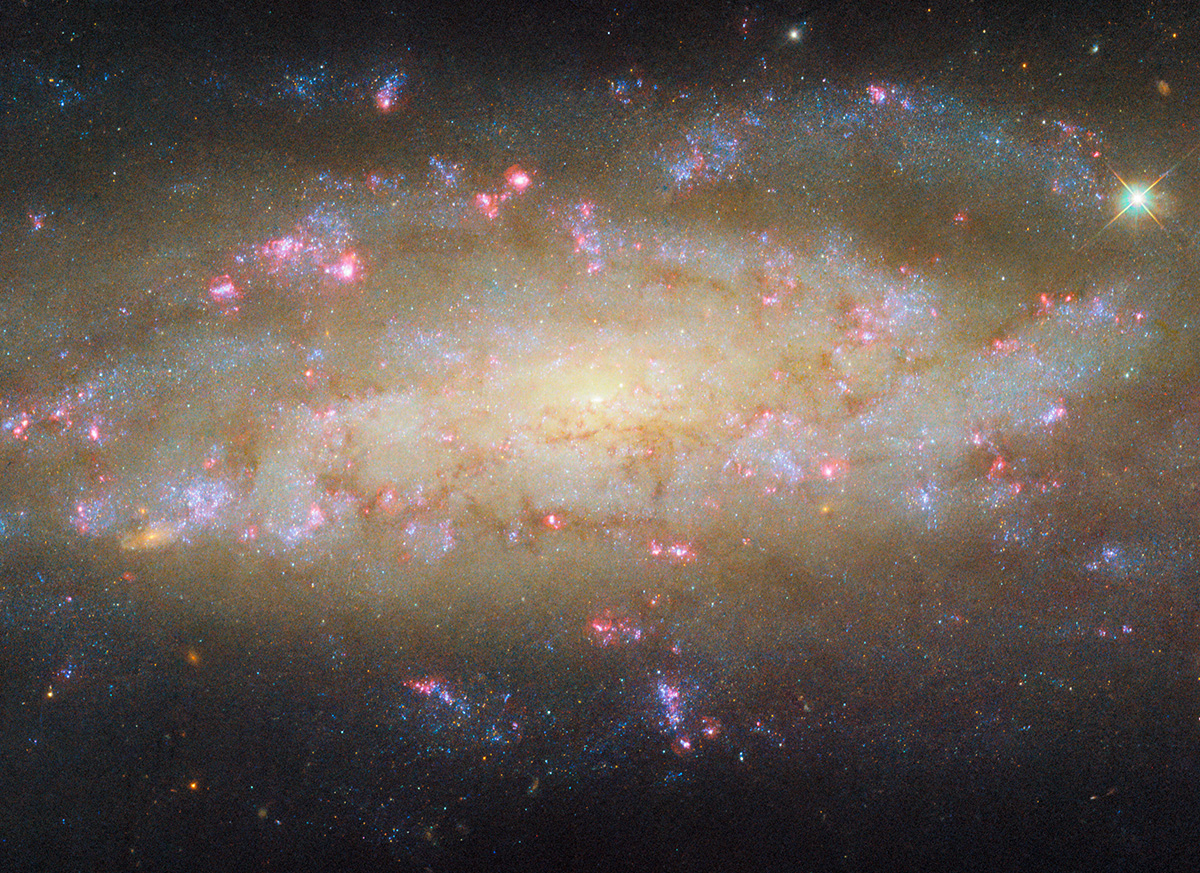
In its latest release, Hubble presents the spiral galaxy NGC 7456 in remarkable detail. The galaxy lies around 51 million light-years away in the constellation Grus, also known as the Crane. Hubble’s sharp vision captures the galaxy in visible, ultraviolet, and near-infrared light, revealing structures and processes that are otherwise hidden from the human eye. The galaxy initially appears to be a classic spiral, with a glowing central bulge and arms winding around it. But closer inspection shows that this is a far more complex system. Its arms appear patchy, broken in places, and mixed with dark dust lanes. Bright knots of pink stand out along these arms. These are H II regions, clouds of ionized hydrogen gas where young stars are forming.
The structure of a spiral galaxy
Spiral galaxies like NGC 7456 are among the most familiar structures in the universe. They contain a disk of stars, gas, and dust, organized into spiral arms that wind around a dense central region. These arms are not solid features but are shaped by waves of density moving through the galaxy. As gas clouds encounter these density waves, they collapse and form new stars. This explains why spiral arms are rich in bright, young stars and star-forming regions.
In the case of NGC 7456, the arms appear irregular and broken rather than clearly defined. This irregularity hints at the galaxy’s dynamic history. Interactions with nearby galaxies, bursts of star formation, or internal instabilities can distort the symmetry of spiral arms. Hubble’s image highlights the contrast between the smooth background of older stars and the uneven chains of younger stars and gas clouds. This contrast allows astronomers to study the cycle of star birth and death in galaxies like this one.
Star formation and H II regions
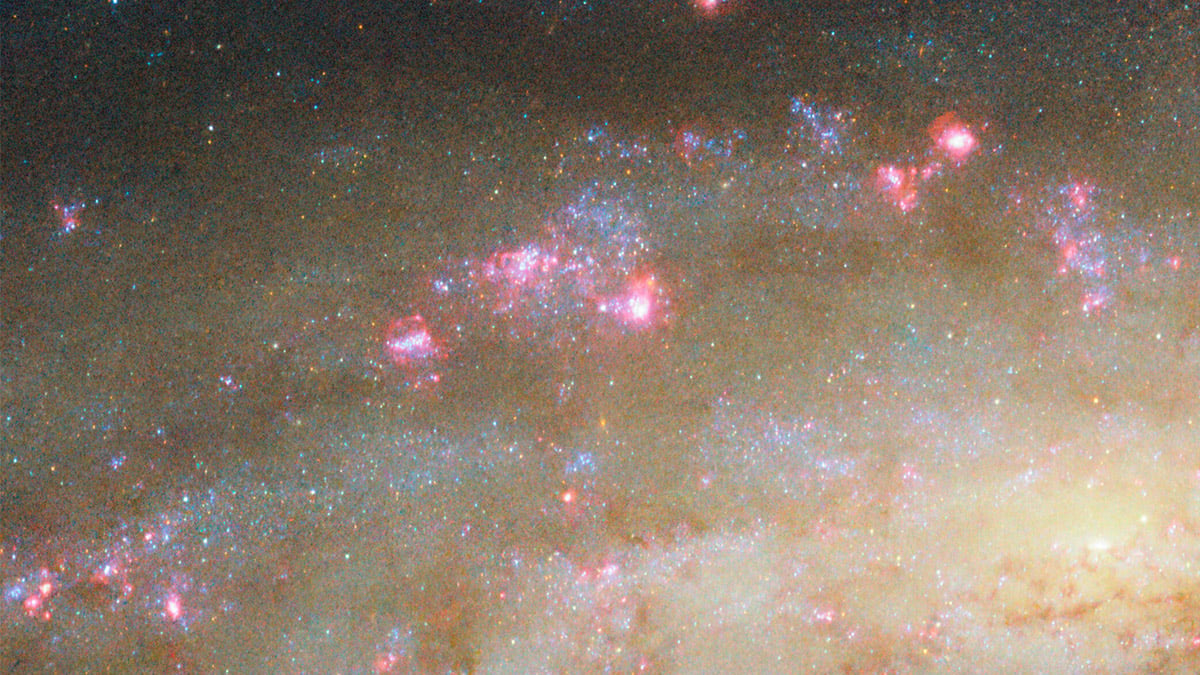
The bright pink blossoms in the image are among its most striking features. These are H II regions, where intense ultraviolet light from young, massive stars ionizes surrounding hydrogen gas. The process makes the gas glow in visible light, creating patches of color across the spiral arms. Such regions mark the sites of recent and ongoing star formation.
In NGC 7456, these regions are widespread and numerous, suggesting that the galaxy is an active stellar nursery. Studying the distribution and brightness of H II regions gives astronomers direct information about the galaxy’s star-forming rate. It also helps them understand how gas is converted into stars and how feedback from young stars influences the interstellar medium.
High-energy mysteries in X-ray light
While Hubble provides the visible and ultraviolet portrait of NGC 7456, other observatories add new layers of information. ESA’s XMM-Newton X-ray telescope has observed the galaxy and found ultraluminous X-ray sources within it. These are compact objects, usually neutron stars or black holes, that emit more X-rays than typical stellar systems of their size should.
Ultraluminous X-ray sources are rare and puzzling. Their brightness suggests that material is falling onto them at unusually high rates. This can happen if a black hole pulls in gas from a companion star, creating an accretion disk that shines brightly in X-rays. The presence of such sources in NGC 7456 indicates that the galaxy hosts remnants of massive stars, along with the violent processes that accompany them.
The core and its black hole
At the heart of most large galaxies lies a supermassive black hole, and NGC 7456 is no exception. Its bright and energetic core suggests that the black hole is active. When gas and dust fall toward a supermassive black hole, they heat up and release radiation across the electromagnetic spectrum. This process powers what astronomers call an active galactic nucleus.
In NGC 7456, the central brightness is consistent with such activity. The black hole acts as both a consumer and an engine, pulling in material while also influencing the surrounding galaxy through energetic outflows. Studying active galactic nuclei provides insight into how galaxies and their central black holes grow together over cosmic time. The fact that NGC 7456 shows evidence of such activity makes it a valuable target for future observations.
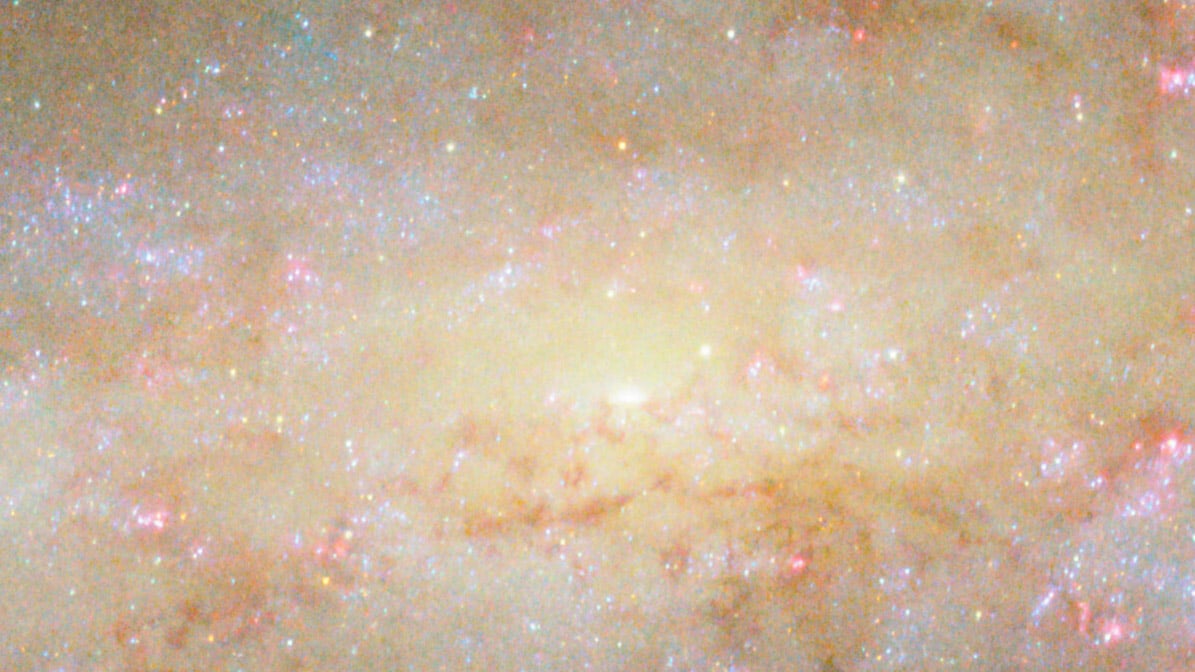
NGC 7456 is not one of the brightest or most famous galaxies in the sky, yet it offers a laboratory for many branches of astrophysics. Its patchy spiral arms record the history of density waves and star formation, H II regions demonstrate how young stars shape their environment, and ultraluminous X-ray sources show the afterlives of massive stars in extreme conditions. Its active core highlights the influence of a supermassive black hole on galactic evolution. The combined data from Hubble and XMM-Newton allow astronomers to connect these pieces into a broader picture.
Clear skies!
See more from DIYPhotography.net on Google
Add DIYPhotography.net as a trusted source. This makes
our stories more likely to appear in your Google Search results.
 Add as a preferred source on Google

Soumyadeep Mukherjee
Soumyadeep Mukherjee is an award-winning astrophotographer from India. He has a doctorate degree in Linguistics. His work extends to the sub-genres of nightscape, deep sky, solar, lunar and optical phenomenon photography. He is also a photography educator and has conducted numerous workshops. His works have appeared in over 40 books & magazines including Astronomy, BBC Sky at Night, Sky & Telescope among others, and in various websites including National Geographic, NASA, Forbes. He was the first Indian to win “Astronomy Photographer of the Year” award in a major category.


Join the Discussion
DIYP Comment Policy
Be nice, be on-topic, no personal information or flames.