
























Hubble’s Sharpest Portrait of a Visitor from the Stars: Comet 3I/ATLAS
Aug 8, 2025
Soumyadeep Mukherjee
Soumyadeep Mukherjee is an award-winning astrophotographer from India. He has a doctorate degree in Linguistics. His work extends to the sub-genres of nightscape, deep sky, solar, lunar and optical phenomenon photography. He is also a photography educator and has conducted numerous workshops. His works have appeared in over 40 books & magazines including Astronomy, BBC Sky at Night, Sky & Telescope among others, and in various websites including National Geographic, NASA, Forbes. He was the first Indian to win “Astronomy Photographer of the Year” award in a major category.
Share:

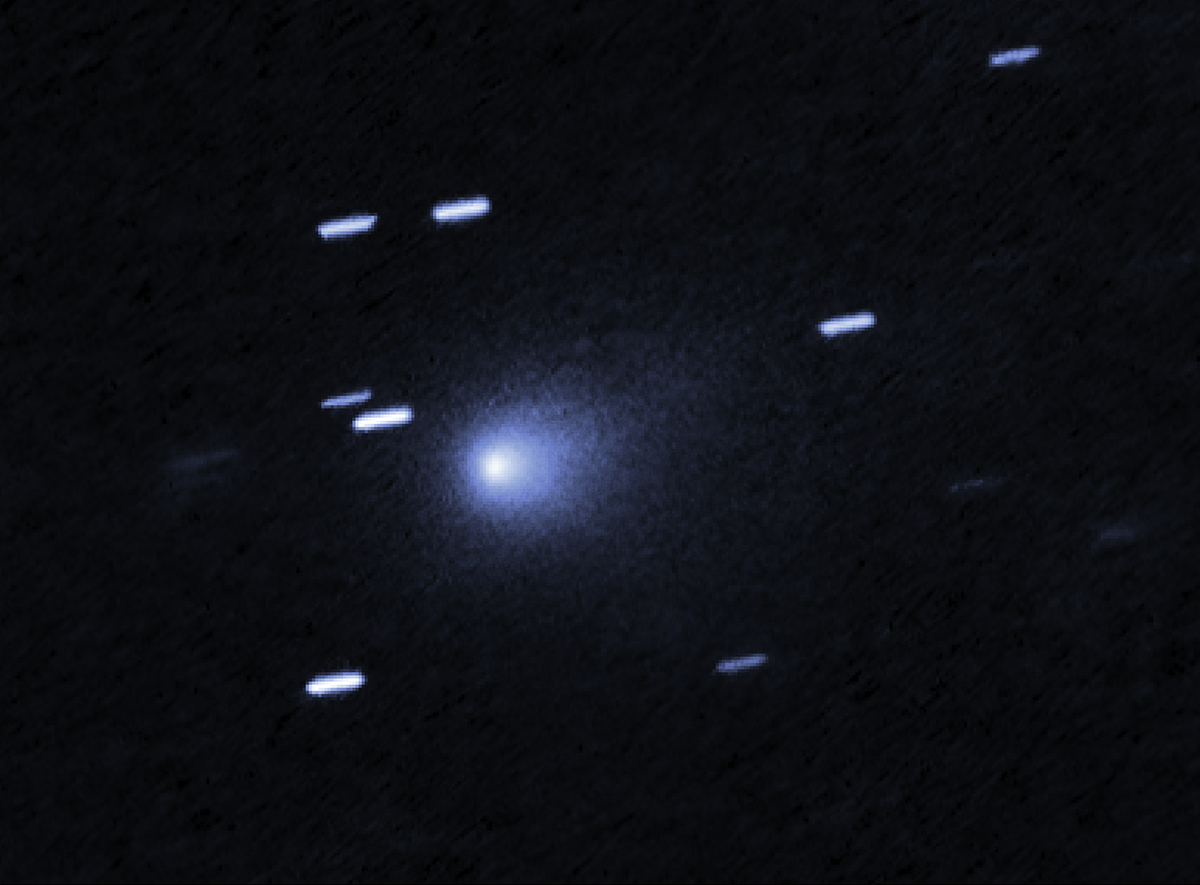
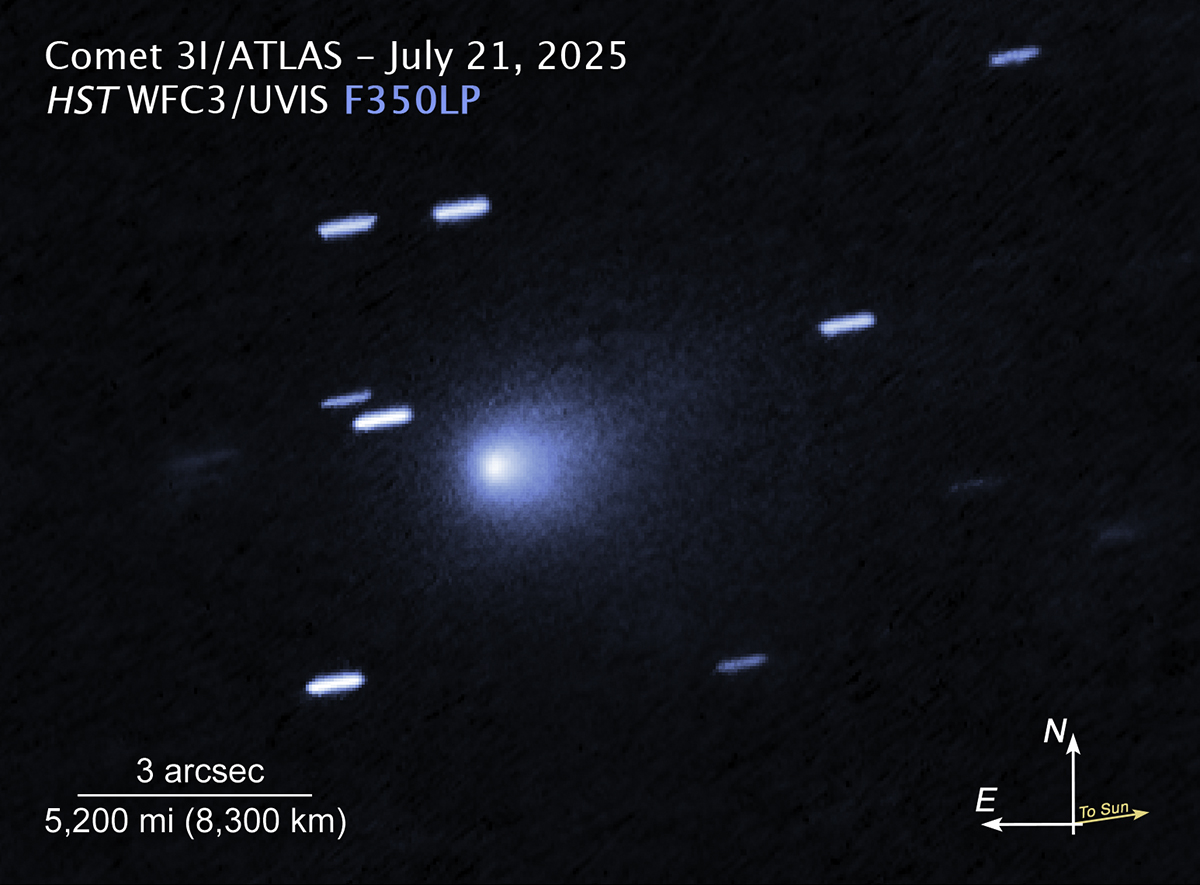
On 21 July 2025, the Hubble Space Telescope captured a remarkable sight. It took the clearest image yet of 3I/ATLAS, a comet from another star system. This cosmic visitor is only the third confirmed interstellar object ever seen in our Solar System. The Hubble image provides astronomers with a rare opportunity to study a piece of another world. The stunning photo shows a bright, hazy coma surrounding a small icy core. A faint dust tail trails behind. It looks just like any comet we’ve seen before, but it comes from beyond our Sun.
A rare interstellar guest
3I/ATLAS is the third object ever confirmed to enter our Solar System from interstellar space. The “I” in its name stands for “interstellar.” The first was the strange, cigar-shaped ‘Oumuamua in 2017. The second was the active comet 2I/Borisov in 2019. Unlike the other two, 3I/ATLAS was discovered very early. The ATLAS survey telescope in Chile spotted it on 1 July 2025. It was already showing a coma and dust activity, even while it was still far from the Sun. Because of its early discovery, scientists had time to prepare, and Hubble was quickly scheduled to observe it.
Hubble took the image when the comet was about 446 million kilometers from Earth. That’s roughly the distance of Jupiter’s orbit. Even from that far, the telescope’s sharp vision revealed surprising details. To get the photo, Hubble had to track the comet’s motion across the sky. As it followed the fast-moving object, background stars became streaks in the image. Meanwhile, the comet appears sharp and centered. This technique highlights the speed at which the comet moves, yet still reveals the delicate features of its dusty envelope.
A teardrop of dust and ice
In the Hubble image, the comet’s coma appears as a soft teardrop shape. This coma is a cloud of dust and gas released from the icy nucleus as sunlight warms it. The coma extends thousands of kilometers but becomes thinner with distance. On one side, we see a dust plume, likely coming from a sunlit patch on the nucleus. On the other hand, a faint dust tail points away from the Sun, pushed by solar radiation. This shape is typical of comets, yet it’s coming from something alien to our system. Despite its foreign origin, 3I/ATLAS behaves like a regular comet.

Size of the comet
The Hubble image gave scientists their best estimate yet of the comet’s solid nucleus. Ground-based telescopes saw the comet as bright, but much of that light came from the surrounding coma. It was difficult to determine the exact size of the core. With Hubble’s clarity, astronomers could subtract the coma’s glow and isolate the light from the nucleus itself. They estimated the nucleus to be no larger than 5.6 kilometers across. It could even be as small as 320 meters. This wide size range shows how difficult the measurement is. But even the upper limit places it within the size range of typical Solar System comets.
Fastest interstellar object ever
One of the most exciting facts about 3I/ATLAS is its speed. It’s moving at about 210,000 kilometers per hour relative to the Sun. That’s around 60 kilometers per second, faster than any previous interstellar object. That speed tells us it isn’t bound to the Sun. It came from outside and will eventually leave again. Its path is hyperbolic, meaning it will pass through once and never return. Its speed also hints at a long, lonely journey through the galaxy. It may have drifted through space for billions of years before arriving here.
Despite its speed and interstellar origin, 3I/ATLAS poses no danger to our planet. It will never come closer than 1.8 astronomical units from Earth. That’s about 270 million kilometers. It will pass closest to the Sun on 30 October 2025, at around 1.4 AU. That’s still farther than the orbit of Mars.
Astronomers will keep observing 3I/ATLAS for as long as possible. Ground-based telescopes will monitor changes in its brightness and dust activity. The comet will be visible until mid-September 2025, after which it will pass behind the Sun. In December 2025, it may reappear for a short time before vanishing for good. Other telescopes may attempt to capture more data, perhaps even detecting gases in the coma or studying the dust’s composition.
Clear skies!
See more from DIYPhotography.net on Google
Add DIYPhotography.net as a trusted source. This makes
our stories more likely to appear in your Google Search results.
 Add as a preferred source on Google

Soumyadeep Mukherjee
Soumyadeep Mukherjee is an award-winning astrophotographer from India. He has a doctorate degree in Linguistics. His work extends to the sub-genres of nightscape, deep sky, solar, lunar and optical phenomenon photography. He is also a photography educator and has conducted numerous workshops. His works have appeared in over 40 books & magazines including Astronomy, BBC Sky at Night, Sky & Telescope among others, and in various websites including National Geographic, NASA, Forbes. He was the first Indian to win “Astronomy Photographer of the Year” award in a major category.


Join the Discussion
DIYP Comment Policy
Be nice, be on-topic, no personal information or flames.