





















Tianwen-1’s Surprise Close-Up: China’s Mars Orbiter Images Interstellar Comet 3I/ATLAS
Nov 7, 2025
Soumyadeep Mukherjee
Soumyadeep Mukherjee is an award-winning astrophotographer from India. He has a doctorate degree in Linguistics. His work extends to the sub-genres of nightscape, deep sky, solar, lunar and optical phenomenon photography. He is also a photography educator and has conducted numerous workshops. His works have appeared in over 40 books & magazines including Astronomy, BBC Sky at Night, Sky & Telescope among others, and in various websites including National Geographic, NASA, Forbes. He was the first Indian to win “Astronomy Photographer of the Year” award in a major category.
Share:

China’s Tianwen-1 mission has pulled off something extraordinary: photographing an interstellar comet from Mars orbit. In early October 2025, the orbiter captured detailed images of comet 3I/ATLAS, a rare visitor that came from beyond our Solar System. The pictures, released by the China National Space Administration (CNSA), mark the second time a spacecraft orbiting another planet has imaged an interstellar object.
A new visitor from the stars
Comet 3I/ATLAS is only the third confirmed interstellar object ever discovered. It follows ‘Oumuamua (2017) and 2I/Borisov (2019), two earlier wanderers that also passed through our Solar System. Astronomers discovered 3I/ATLAS in July 2025 using the Asteroid Terrestrial-impact Last Alert System (ATLAS) survey in Hawaii. Its strange trajectory immediately stood out.
Instead of following an elliptical orbit around the Sun, 3I/ATLAS travels on a hyperbolic path. That means it came from outside the Solar System and will leave it forever after this brief visit. When its orbit was traced back, scientists realized it was passing close to Mars’s orbit in October 2025, a perfect opportunity for a spacecraft already circling the Red Planet.
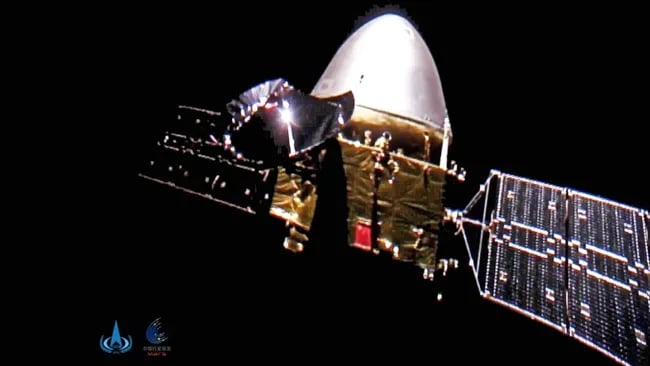
That spacecraft was Tianwen-1, launched in 2020 as China’s first mission to Mars. It has been orbiting the planet since February 2021, studying its surface, atmosphere, and geology. But this time, the mission team turned its camera outward, toward the deep, dark sky.
Photographing a comet from 29 million kilometers away
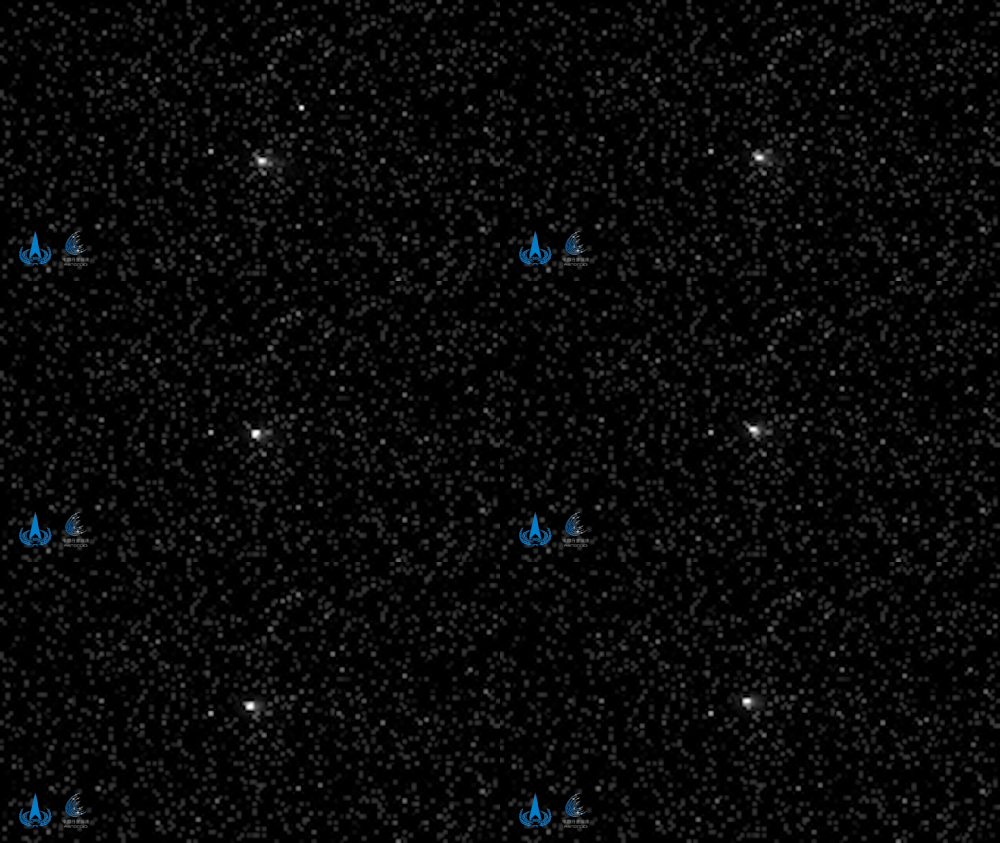
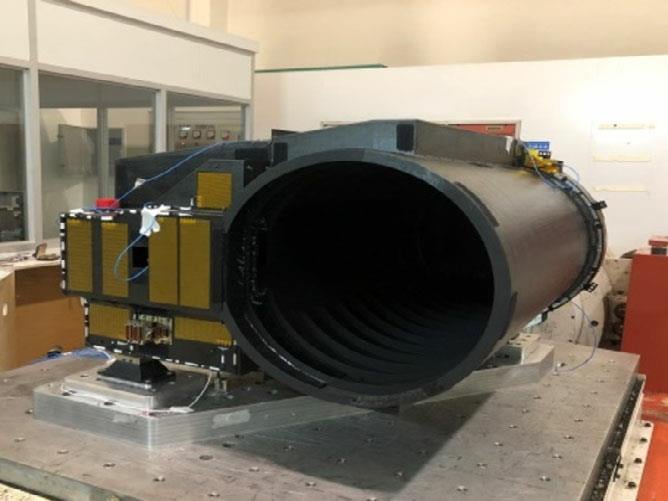
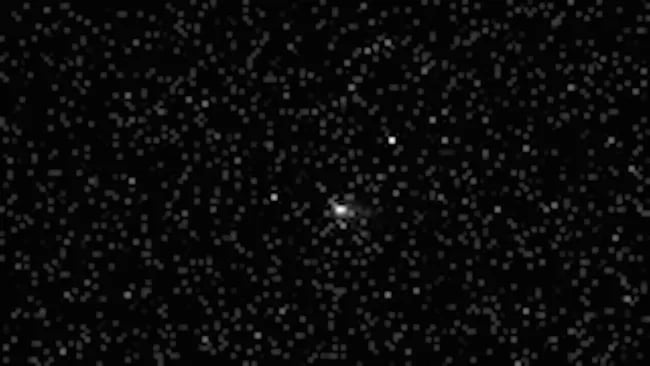
Between October 1 and 4, 2025, Tianwen-1’s High-Resolution Imaging Camera (HiRIC) focused on comet 3I/ATLAS. The comet was about 18 million miles (29 million kilometers) away, a faint speck even for a powerful space camera. Yet, the team managed to capture multiple images showing the comet’s bright nucleus surrounded by a soft, glowing coma.
The images are impressive for several reasons. First, HiRIC was designed to map Mars’s surface in sharp detail, not to photograph faint moving objects in deep space. Second, the comet was moving fast relative to Mars. The team had to calculate its position with extreme precision to ensure the camera stayed locked on target.
According to CNSA, these images are part of a technical demonstration to test long-range tracking and imaging of faint celestial bodies. They also serve as a practice exercise for China’s next major deep-space project, the Tianwen-2 mission, which will visit a near-Earth asteroid and return samples to Earth later this decade.
What the images reveal
The released photos show 3I/ATLAS as a bright spot surrounded by a faint, cloudy halo, the coma formed when sunlight heats the comet’s icy surface. In several frames, a short tail is visible extending away from the Sun. The images confirm that the comet was actively releasing gas and dust as it approached perihelion (its closest point to the Sun).
While the resolution isn’t high enough to see surface details, the images still provide valuable data. They allow scientists to estimate the size of the nucleus, measure brightness changes, and study how the comet’s activity evolves. Seeing it from a different angle, from Mars orbit instead of Earth, also helps build three-dimensional models of its coma and tail structure.
The Tianwen-1 images complement observations from Earth-based telescopes, including Hubble and other large observatories. Combining these datasets allows researchers to refine measurements of the comet’s shape, spin, and dust production. Every additional viewpoint improves the overall picture.
A technical feat by the Tianwen-1 team
HiRIC, Tianwen-1’s high-resolution camera, was the key to this observation. Normally, it captures Mars at resolutions of about half a meter per pixel from low orbit. To image 3I/ATLAS, the camera had to be reprogrammed for long exposures while maintaining stable pointing accuracy.
Engineers simulated the comet’s predicted motion across the sky, fine-tuned exposure times, and synchronized the spacecraft’s orientation. Because the target was faint, the team had to balance sensitivity with noise reduction. They then processed multiple frames to produce a clear, composite image.
The fact that this was done from millions of kilometers away from both Mars and the comet is remarkable. The mission team described the operation as a “valuable rehearsal” for Tianwen-2 and future deep-space missions. CNSA said the exercise demonstrates China’s growing ability to conduct complex astronomical observations using existing planetary assets.

A glimpse of the future
Tianwen-1’s imaging of 3I/ATLAS highlights a broader shift in how space agencies operate. Modern missions are becoming more versatile. Spacecraft designed for one planet or object can now take on opportunistic targets when the conditions are right. The observation also suggests that multi-planet coordination could become a standard feature of future comet research. If orbiters around Mars, Venus, and Earth observe the same object from different angles, scientists can build far more complete models of its activity and structure.
For China, this success feeds directly into its long-term exploration roadmap. The country’s next steps include Tianwen-2, which will collect samples from the near-Earth asteroid 469219 Kamoʻoalewa, and Tianwen-3, a planned Mars sample-return mission. The skills demonstrated in tracking and imaging a faint, fast-moving comet are directly applicable to both missions.
Further readings
Right from the discovery of the interstellar comet 3I/ATLAS, DIYP has published several articles on its photographs and features. Here is the list of articles:
- A New Visitor from the Stars: Comet 3I/ATLAS
- Gemini North Photographs the Interstellar Comet 3I/ATLAS
- Hubble’s Sharpest Portrait of a Visitor from the Stars: Comet 3I/ATLAS
- JWST Reveals the Secrets of Interstellar Comet 3I/ATLAS in New Images
- SPHEREx Maps the Carbon Dioxide Breath of Interstellar Comet 3I/ATLAS
- Gemini South Photographs Anti-Solar Tail of 3I/ATLAS
- Interstellar Comet 3I/ATLAS: Gemini South Images Reveal a Growing Tail
- Interstellar Comet 3I/ATLAS through Many Eyes: All Images so Far
- A Faint Smudge from Mars: Did Perseverance Really Capture Interstellar Comet 3I/ATLAS?
- ESA’s Mars Orbiter Capture “Closest Yet” View of Interstellar Comet 3I/ATLAS
- Comet 3I/ATLAS Returns: Astronomer Photographs it after Perihelion
Clear skies!
See more from DIYPhotography.net on Google
Add DIYPhotography.net as a trusted source. This makes
our stories more likely to appear in your Google Search results.
 Add as a preferred source on Google

Soumyadeep Mukherjee
Soumyadeep Mukherjee is an award-winning astrophotographer from India. He has a doctorate degree in Linguistics. His work extends to the sub-genres of nightscape, deep sky, solar, lunar and optical phenomenon photography. He is also a photography educator and has conducted numerous workshops. His works have appeared in over 40 books & magazines including Astronomy, BBC Sky at Night, Sky & Telescope among others, and in various websites including National Geographic, NASA, Forbes. He was the first Indian to win “Astronomy Photographer of the Year” award in a major category.
Related Posts
 ESA’s Mars Orbiter Capture “Closest Yet” View of Interstellar Comet 3I/ATLAS
 A Faint Smudge from Mars: Did Perseverance Really Capture Interstellar Comet 3I/ATLAS?
 JWST Reveals the Secrets of Interstellar Comet 3I/ATLAS in New Images
 X-Ray Images of 3I/ATLAS: XRISM and XMM-Newton Captures Interstellar Comet
Join the Discussion
DIYP Comment Policy
Be nice, be on-topic, no personal information or flames.