























NASA’s New Year: Chandra Captures Champagne Cluster Frozen in X-Ray
Jan 4, 2026
Soumyadeep Mukherjee
Soumyadeep Mukherjee is an award-winning astrophotographer from India. He has a doctorate degree in Linguistics. His work extends to the sub-genres of nightscape, deep sky, solar, lunar and optical phenomenon photography. He is also a photography educator and has conducted numerous workshops. His works have appeared in over 40 books & magazines including Astronomy, BBC Sky at Night, Sky & Telescope among others, and in various websites including National Geographic, NASA, Forbes. He was the first Indian to win “Astronomy Photographer of the Year” award in a major category.
Share:
Galaxy clusters represent the final stage of structure formation in the universe. They assemble slowly through gravity, accretion, and repeated mergers. These events release enormous energy and reshape matter on scales of millions of light-years. X-ray astronomy plays a central role in studying this process because it reveals the hot intracluster medium, which dominates the visible baryonic mass of clusters.
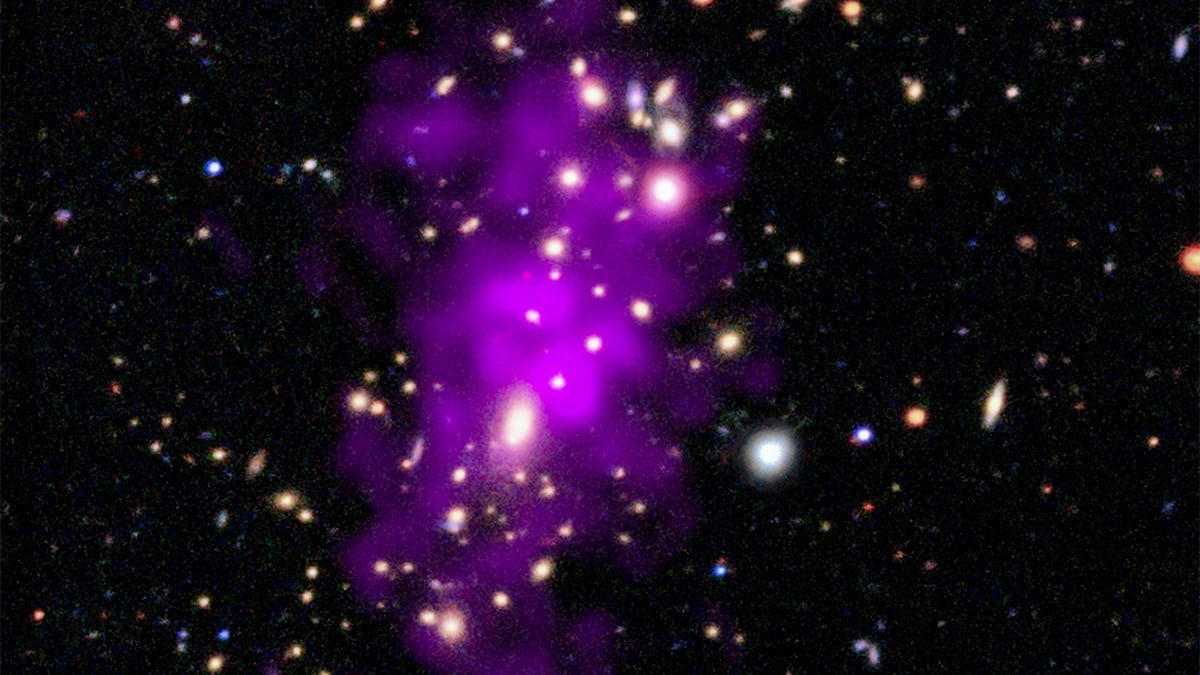
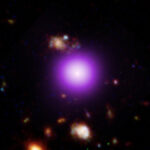
NASA’s Chandra X-ray Observatory has now captured a detailed view of one such system. The target is a distant merging galaxy cluster known as the Champagne Cluster. The image combines X-ray data from Chandra with optical observations from ground-based surveys. Together, these datasets show two galaxy clusters in the middle of a collision. The interaction heats the gas to extreme temperatures and distorts the cluster’s structure.
Discovery and location of the Champagne Cluster
Astronomers first identified the Champagne Cluster on December 31, 2020. The discovery date inspired the informal name. The cluster’s appearance also played a role. Diffuse structures in early data resembled bubbles rising through liquid. The nickname captured both timing and form. The system’s formal designation is RM J130558.9+263048.4. It lies about 3.5 billion light-years from Earth in the constellation Coma Berenices. At this distance, astronomers observe the cluster as it existed billions of years ago, long before the present structure of the nearby universe took shape.
Early observations showed that the cluster did not appear relaxed. Instead, its gas distribution looked stretched and irregular. Such features often signal recent or ongoing mergers. Chandra’s deeper X-ray observations later confirmed this interpretation.
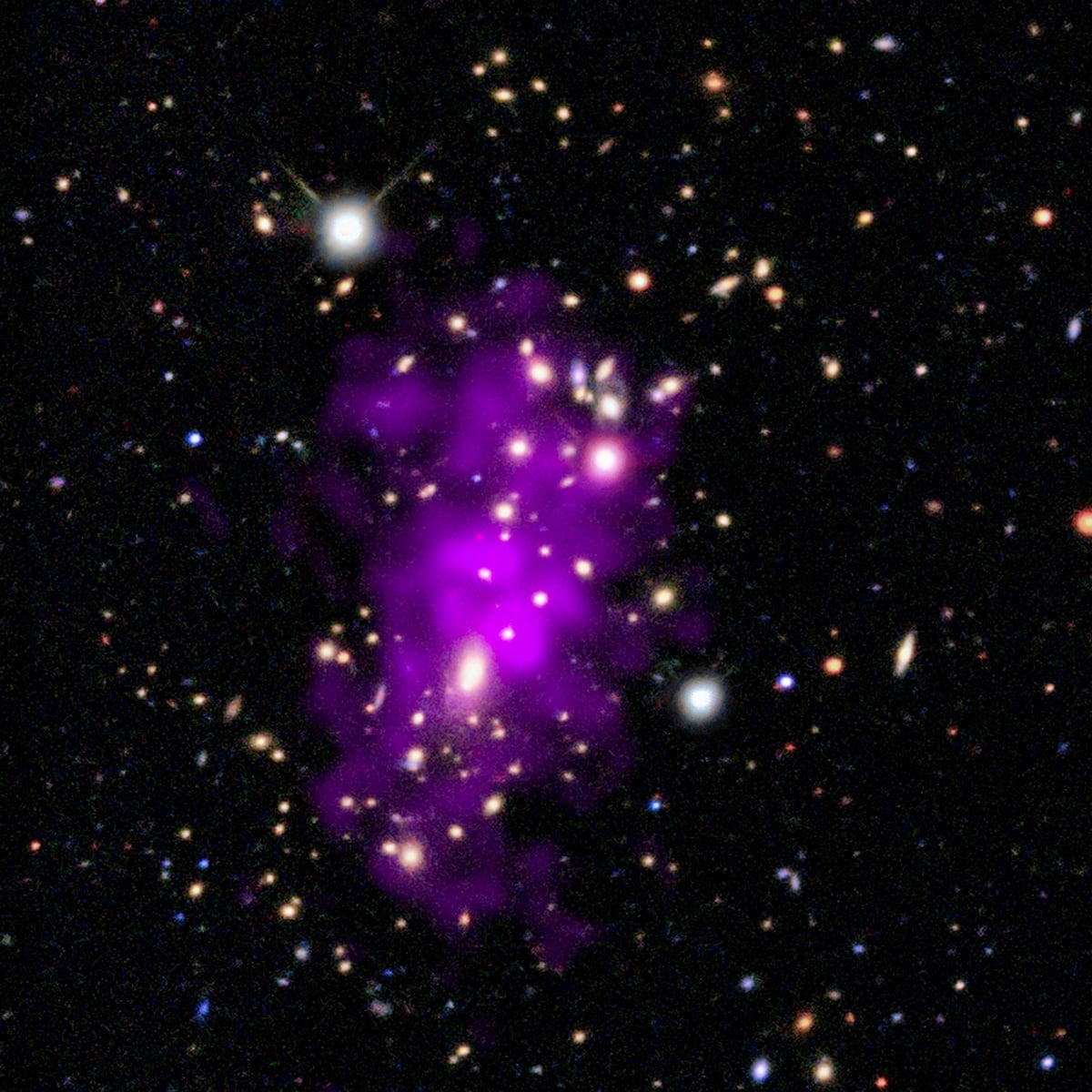
Most of a galaxy cluster does not emit visible light. Individual galaxies account for only a small fraction of the total mass. The dominant visible component is hot gas that fills the space between galaxies. This gas reaches temperatures of tens of millions of degrees and emits strongly in X-rays. Chandra detects this emission with high angular resolution. In the Champagne Cluster image, X-rays appear as purple regions. These regions trace the density and temperature of the intracluster gas. Because gas responds strongly to collisions, it preserves a record of past interactions.
A merger between two massive systems
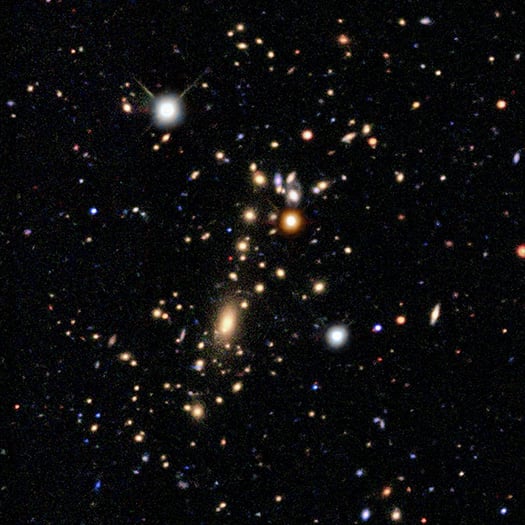
The combined image reveals two distinct concentrations of galaxies. One concentration is located in the upper region of the image. The other sits below. Each marks the core of a separate galaxy cluster. Between these cores, the hot gas appears elongated and distorted. This shape indicates a past collision. During the encounter, gas clouds from both clusters interacted directly. They slowed down, compressed, and heated rapidly. Shock fronts likely formed, further raising temperatures.
Astronomers have explored multiple collision scenarios using simulations. In one model, the clusters collided more than two billion years ago and are now falling back together under gravity. In another, the collision occurred roughly 400 million years ago, and the clusters are moving apart. Both scenarios reproduce key features seen in the X-ray data. Further analysis will help constrain the exact timeline. Regardless of the details, the Champagne Cluster represents a rare stage in cluster evolution.
Such mergers rank among the most energetic events in the universe. They release more energy than supernova explosions on galactic scales. Yet they unfold slowly, spanning hundreds of millions to billions of years.
Hot gas, dark matter, and hidden mass
Galaxy clusters contain three primary components. Galaxies form the most visible part. Hot gas contributes a much larger fraction of the baryonic mass. Dark matter dominates the total mass budget. In the Champagne Cluster, Chandra observations show that the hot gas alone outweighs the combined mass of all visible galaxies. This result matches measurements from other massive clusters. It also underscores the importance of X-ray astronomy for accurate mass estimates.
Dark matter does not emit light. Astronomers detect it indirectly through its gravitational influence. During cluster mergers, dark matter behaves differently from gas. It does not collide or slow significantly. Instead, it passes through the interaction largely unaffected. This contrast makes merging clusters a powerful tool for studying dark matter. By comparing gas positions with galaxy distributions, researchers infer where dark matter must reside. Systems like the Bullet Cluster provided some of the strongest observational evidence for dark matter’s existence.
The Champagne Cluster adds another valuable example. Its geometry differs from simpler mergers, offering new conditions under which to test theoretical models. These observations help refine constraints on dark matter properties and alternative gravity theories.

Galaxy evolution and cosmic growth
Galaxy clusters sit at the intersections of the cosmic web. Filaments of matter feed them over time. Mergers drive much of their growth. The Champagne Cluster captures this process mid-stream. It shows that large-scale structure formation remains active even billions of years after the Big Bang. The universe continues to reorganize itself under gravity.
Cluster mergers affect more than large-scale structure. They influence the evolution of individual galaxies. Shock waves and turbulence can strip gas from galaxies or suppress star formation. Over time, these effects shape galaxy populations within clusters. The data also improve numerical simulations. Cosmological models depend on assumptions about gas physics, gravity, and dark matter. Real systems like the Champagne Cluster test these assumptions. Agreement strengthens confidence. Discrepancies drive revision and progress.
Chandra’s measurements of gas temperature and density play a key role here. They translate directly into physical quantities used in simulations. Since its launch in 1999, the Chandra X-ray Observatory has transformed high-energy astronomy. It has revealed black holes, supernova remnants, and galaxy clusters with unmatched clarity. Its sharp vision allows astronomers to study faint X-ray structures even at great distances.
Clear skies!
See more from DIYPhotography.net on Google
Add DIYPhotography.net as a trusted source. This makes
our stories more likely to appear in your Google Search results.
 Add as a preferred source on Google

Soumyadeep Mukherjee
Soumyadeep Mukherjee is an award-winning astrophotographer from India. He has a doctorate degree in Linguistics. His work extends to the sub-genres of nightscape, deep sky, solar, lunar and optical phenomenon photography. He is also a photography educator and has conducted numerous workshops. His works have appeared in over 40 books & magazines including Astronomy, BBC Sky at Night, Sky & Telescope among others, and in various websites including National Geographic, NASA, Forbes. He was the first Indian to win “Astronomy Photographer of the Year” award in a major category.

Join the Discussion
DIYP Comment Policy
Be nice, be on-topic, no personal information or flames.